

When good product practice tells you to stop: What we learned trying to externalise our Effective Digital Content course
Riding on the success of our internal Effective Digital Content course, we set out to expand by building an external version for the short courses platform, taking a product thinking approach. Three months on, experimenting with a proof-of-concept course has convinced to pause this work – to avoid falling into a build trap.
The success of our relaunched Effective Digital Content (EDC) course, to date completed by more than 400 University staff, prompted ambitions to reposition the course for external audiences by including it in the University’s Short Online Courses platform. With the help of colleagues from the Short Online Courses team and the Learning Technology team, we did some market research, identified target audiences, defined a product vision and goals and began using the Canvas platform to develop a proof-of-concept.
Read more about our plans to reposition EDC as an external course in my blog post from March 2026:
Repositioning Effective Digital Content as a short online course: A product approach
At the end of sprint three (of a total of seven planned sprints) we faced unknowns and unanswered questions preventing us from achieving some of the fundamentals we’d defined in the product vision and goals. Resisting a sunk-cost fallacy-motivated urge to continue building, we made a sensible decision to stop and to pause until we’re in a better-informed place to have the confidence to continue.
In this post, I reflect on the benefits of adopting product thinking, the discomfort with facing difficult questions upfront and the practicalities of learning about audiences for expansion opportunities.
Revisiting the Product Kata helped clarify feelings of uncertainty
Melissa Perri’s book ‘The Build Trap’ contains a helpful framework to guide product development which I have become familiar with through my involvement with Drupal product teams. On the strategic level, this framework helped me set out a vision for an external version of the Effective Digital Content course, establish the problem the course was aiming to solve and its audiences, and work out the learning outcomes associated with each course module.
Entering the execution phase, however, taking each course module at a time and building each one out to meet the needs of the established audiences, things took longer than planned, and felt more difficult than we’d anticipated.
Pausing for reflection, we unpicked where things were going wrong. Going back to our vision, we had wanted to repeat the success of the internal EDC course, giving learners practical experience of writing digital content for their audiences. We had been able to instill this experience in the internal course because we had been able to regularly engage with University web publishers, to fully understand their content design challenges and design practical experiences for them that specifically addressed their friction points. Without such detailed insight into external audiences, we were effectively basing our course design decisions on guesswork and assumptions, which explained why our initial efforts seemed to be missing the mark. The strategic vision was sound, but our capacity to fully explore the problems and optimise associated solutions was limited, therefore execution was flawed.
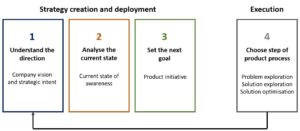
Adaptation of the Product Kata from Melissa Perri’s book ‘The Build Trap’ showing the split between strategy creation and deployment and execution
The practical workbook is EDC’s best asset – but is hard to replicate for broader audiences
A lightbulb moment in our reflections came when considering what worked well about our internal EDC course. When staff complete this course, they are required to complete exercises in a workbook which they submit to the UX team for feedback. This tests learners’ ability to do fundamental content design tasks like structure headings, write hyperlinks and turn lengthy text into chunks to be scan-read. Reviewing more than 400 submitted workbooks, we affirmed the importance of this element of the course both for learners and for our team as owners of the course as a product. Through these workbooks, learners are able to practice content design in the specific context of the University sites they are responsible for, and as the product team, we are able to see impact the course has had in improving content design knowledge.
Replicating the workbook concept for external audiences would require knowing about the contexts and content they were working with, in order to design exercises that required them to test those skills. Without knowledge of our audiences’ circumstances, the best we could do would be to design a generic set of exercises, devoid of the nuances needed to really engage learners in practising content design techniques.
Testing what we had built so far taught us what we didn’t know
In UX and product design there’s a saying: the best time to test is yesterday, failing that, test now. Resisting the urge to keep building EDC modules, we made the decision to take the three modules that had been built and to test them with University publishers. Feedback from the tests was positive, which was nice to hear, but didn’t really help us assess if the modules we had made were a good fit for external audiences. University staff wouldn’t take an external Effective Digital Content course as they had already taken the internal version. To assess if we’d made a good product we needed to know answers to questions such as:
- What needs should we prioritise for our target audiences?
- How do our audiences currently meet these needs?
- Would univerisities with a distributed content model find an external course useful?
- What would motivate our target audiences to take this type of course?
- How well do existing courses meet user needs and expectations?
- Will our proposed course be valuable to target audiences?
In another of Melissa Perri’s books ‘Product Operations: How successful companies build better products at scale’ by Melissa Perri and Denise Tilles, the authors use a case study at a financial services organisation, Fidelity, to show the relationship between user research and the product design lifecycle. Applying this relationship by positioning EDC external as the product, it was clear that our outstanding questions fell into the ‘Core UXR question’ category at the ‘Discover’ ‘Define’ and ‘Design’ stages and therefore needed to be addressed before proceeding to the ‘Develop’ and ‘Deploy’ stages.
Having worked with other teams both within and outside the University, we knew all too well the potential risks and consequences of building without adequate research – and resolved that it was better to stop building to avoid wasting effort.
Successful expansion will rely on targeting audiences and researching their needs more fully
Taking a pause in the build will allow us to take time to assess the gaps in our knowledge of our target audiences, and work out ways of learning what we don’t know. Understanding the nuanced needs of our target audiences will help us familiarise with the market for content design training in the public sector to assess the value of the expansion opportunity. Referring again to ‘Product Operations’, learning the differences between the markets associated with our expansion opportunity (the total addressable market, the serviceable addressable market and the serviceable obtainable market) will help us decide whether the proposition is viable, deliverable and desirable or not.
In the meantime, we’re using what we’ve learned to improve internal EDC and training
As a team, we really value what we learn from time spent in research, and we always endeavour to act on what we have learned and make sure research does not go to waste. In this case, going through the process of reworking three course modules to aim them at external audiences has pinpointed ways to improve the internal version of our course – in particular to make the introductory module clearer and more impactful and to be clearer on some accessibility concepts. Submitted workbooks and feedback from our regular Content Improvement Clubs also provide a constant source of learning, to identify areas publishers still struggle with that we can continue to address with subsequent tweaked versions of EDC and topics for additional publisher training sessions.

