

Discovery insights on cost of study in higher education
We’re in the middle of a project to make it easier for prospective students to understand the likely cost of studying and living in Edinburgh. Over February, we did a variety of discovery activities to learn more about prospective student needs, how other institutions approach content on this topic and what the law requires us to say.
Project background
This project kicks off the first of our 2026 enhancement projects, prioritised by the Prospective Student Web Steering Group.
Enhancement projects in 2026 (read Neil’s blog post)
The cost of study work was on our backlog to primarily address two things:
- issues in prior user research where students found it hard to understand what the total cost of study (including living costs) would be for both undergraduate and postgraduate programmes
- requirements of the Digital Markets, Competition and Consumers Act 2024 (DMCC) to provide a total cost to consumers
To start off this project, we conducted a variety of research activities to get more insight into this topic.
Discovery activities
Review of prior research
We had two prior research activities that gave us insight into cost of study:
- 2021 usability testing of a design sprint prototype we made to calculate total tuition fees
- 2025 summative testing of our newly launched degree finders
Our 2021 prototype tests showed that students:
- wanted to see an explanation of what their tuition fees did and did not cover
- were okay with seeing an estimate of fees for future years but questioned why there were increases
- were interested in seeing a total cost of study, not just tuition fees
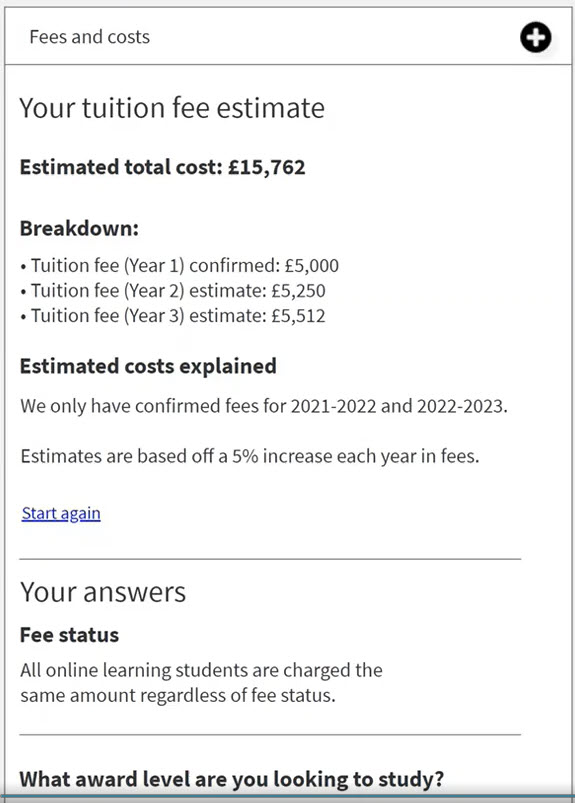
Our 2021 prototype showed an estimated total tuition fee cost, broken down by what the fee would be for each year.
Walkthrough of our 2021 design sprint tuition fees prototype
Our 2025 summative testing showed that students:
- could not calculate the cost of living in Edinburgh because they did not understand they were presented with monthly and not yearly figures
- found it difficult to calculate a total cost of study as living costs were presented as a range that was too wide
Recap of our 2025 postgraduate degree finder summative testing
Recap of our 2025 undergraduate degree finder summative testing
Review of legislation
To learn more about the DMCC Act, we reviewed our department’s internal guidance which distilled the bits of the legislation that were relevant to us. We also read a few Wonkhe articles that delved into this topic.
Programme costs guidance from the University (login needed)
Universities now need to be much clearer about the total cost of a course (Wonkhe article)
Universities should face the consequences for misleading students over the cost of living (Wonkhe)
From these sources, we learned the following about the DMCC Act:
- We must provide a total cost of study across all years of study, plus additional programme fees that are mandatory (like if a field trip is a compulsory part of a programme).
- If we cannot provide an exact fee, we can provide an ‘indicative’ or ‘from’ price with information on how to understand the likely price. This information needs to be as prominent as the part of the price you can calculate.
- Our content needs to be evidence-based, so we should be clear about sources for any cost figures.
- We need to be clear what tuition fees apply in the event of someone deferring or resitting a year.
The Wonkhe articles also raised some important points to consider in our project:
- For international students, the Home Office has a financial requirement to show you have enough money to cover living costs while on a student visa. This figure can be misleading, though, as it’s much less than what you actually need to live.
- For UK students, maintenance loans are often not enough to meet living costs.
- There’s a danger in referring students to third-party tools to calculate living costs as these often get deleted or are not updated.
- If we advertise the social activities you can do as part of university life, we should be listing how much these cost in our figures.
Audit of other university sites
Beyond reviewing our research and the DMCC Act, we also wanted to know what other universities were doing. We did a competitor audit of UK and international universities (35 total) to see:
- if anyone was already presenting a total cost of study
- how universities were presenting cost figures
- if we could get any design ideas or inspiration from others’ approaches
In short, we found most universities were in the same position as us, just providing a single tuition fee for one academic year, and no university in the UK we audited had joined up tuition fees with additional study and living costs to present a total cost figure.
The university that was closest to showing a total cost of study was the University of Iowa as it included tuition, housing and additional studying and living costs. But this was only for a single year. There were also footnotes to their figures that showed certain programmes had different fees, so this was a total cost per year for only some students.
University of Iowa tuition and estimated costs
In the UK, the closest we found to listing a total cost was University of Bristol, which listed an estimated total tuition fee for UK students across three years of study.
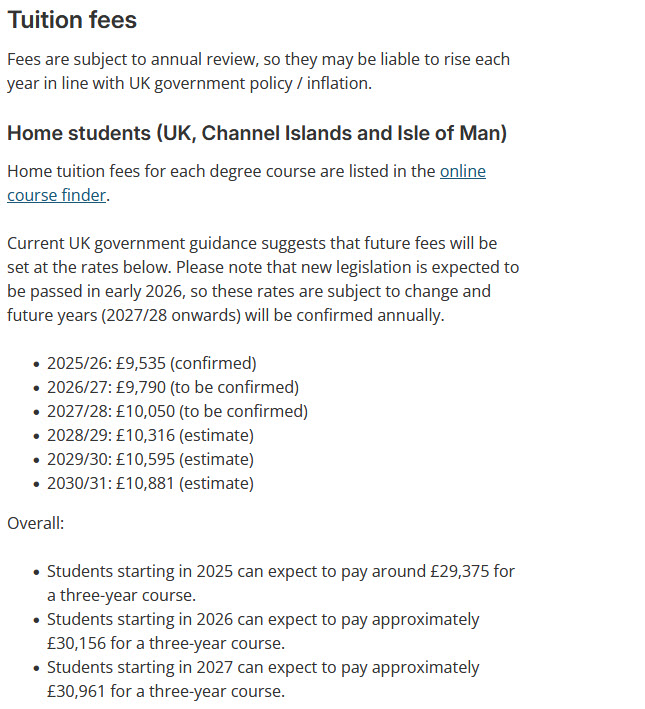
Bristol list the total cost of tuition fees for 3-year degrees for UK students.
University of Bristol fees and funding
Regarding how universities present cost figures, we found a similar mix of presentations, whether by showing a range, average, estimate, or exact figure. So while our summative testing showed our range of living costs to be confusing, this was no different to what others were doing.
As for ideas, there were a few stand-out universities doing interesting things in this space, like:
- Cardiff University’s living costs calculator that could be toggled for different attributes like level of study, nationality and accommodation
- Leeds Beckett’s fees and living costs info, including links out to student blogs on the topic and a comprehensive living costs calculator
- University of Toronto’s comprehensive rental costs page that showed different costs by area, rental size and costs from different sources
In short, we did not find a UK university completely complying with legislation yet, but there were pockets of good ideas across some of the institutions we looked at about how to present costs information.
Pop-up research with Edinburgh students
We did not have capacity to conduct extensive user research in this project, but we wanted to get a sense of how current students looked for cost of study and living information as a prospective student. Content designer Nicole went on campus with our UX specialist Pete to do short interviews with students about this.
They asked 15 students, 8 of whom said they looked for cost of living information while applying (7 undergrads, 1 postgrad). 7 of those 8 had only looked at cost of living info after getting an offer, while only 1 looked before the offer stage.
We learned that:
- All students were mainly looking for information about accommodation costs and said it was the most important factor for planning their budget for living in Edinburgh.
- When asked if there was anything they wished they knew earlier about living costs, 5 said they already knew Edinburgh was an expensive city, while the other 3 mentioned issues like food and alcohol being more expensive than anticipated and it being difficult to find work while studying.
- In terms of how the cost of living has impacted their social life, 6 mentioned there are things they’d like to do that they cannot afford, 2 mentioned it impacted their ability to travel between years, while 1 mentioned they had to live further out from campus than they would have expected.
While only short interviews, this bit of research highlighted to us the importance of providing comprehensive accommodation cost information (which was corroborated by other sources we looked at).
Analytics
Performance analyst Carla gave us some analytics on our existing cost of living content across the University web estate (not just our Study site pages). From this we learned:
- Most traffic is coming from the UK.
- Our undergraduate living costs content has four times the traffic of postgraduate.
- The top three search terms that land users on any of our cost of living-related information all have the term ‘accommodation’ in it.
Review of 2025 Entrants and Decliners Survey
Every year our Market Insight team runs a survey with those who started at Edinburgh or declined our offer, asking various questions about their applicant journey.
From this, we could see a trend in a higher percentage of decliners citing cost of living and study as an issue compared to entrants.
For example, 45% of decliners said the cost of living at Edinburgh was either extremely or very influential in their university search, compared with 37% entrants.
When asked about the main reason that contributed to them rejecting Edinburgh, 4% of decliners chose living costs in Edinburgh (9th in a list of 23). But when asked about all factors that contributed, cost of living jumped to 24% and was top of the list.
Audit of University of Edinburgh cost content
In addition to looking at competitors, we needed to get a better understanding of both our own and other departments’ information on cost of study.
We audited the:
- University financial support section on the Scholarships and student funding site
- Cost of living help section on the Students site
- Money section on the Advice Place site
- Fees and funding section on the Undergraduate study site
- Fees and funding section on the Postgraduate study site
- Plan your budget pages on the New students site
We learned that:
- Some financial support and most cost of living help pages looked to have been last updated in 2023-2024, referencing some out-of-date figures and services.
- Both the Advice Place and Students site have useful information for students on how to budget for expenses while studying we should be pointing prospective students to.
- Lots of the pages on sites we do not manage had accessibility and readability issues that need fixed before we can link them on our pages.
Going from discovery to development
What content we need to develop versus what we can
We came out of discovery realising our content is not currently fit to give a total numerical cost of study for each degree programme. Our additional study costs and living cost information are not structured content that can be repurposed to build a total calculation for each degree programme.
This is something we’ll need to address in future, but in the context of this project, we can:
- redevelop our living costs content to address the known usability issues
- create new content on how to calculate the total cost of study
Synthesising and refining our discovery findings
To get ready for content development, we sythesised our discovery findings. In the notes from each of our discovery activities, we starred the notes we felt were the most important takeaways or best ideas we came across.
We then affinity mapped these to various categories like:
- how we should present cost figures
- what bits of advice and explanation of figures we should give
- sources we can get living costs from
- University content our pages should link to
- accommodation information we should consider including
Similarly, we affinity mapped all the living cost category names we came across in our competitor audit (for example, do we say ‘wifi’ or ‘internet’ as a cost).
For both these activities, we dot voted on the ideas we thought would work best (based on what we knew from the research) and on the category names that were clearest.
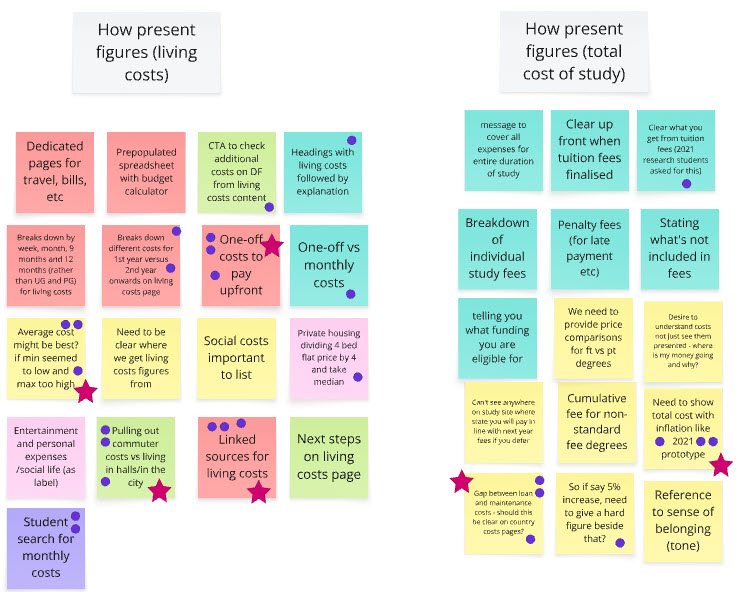
Part of our affinity map showing our post-it of ideas on how to present figures and where we dot-voted on them.
This gave us a refined list of ideas and labels to take forward to development. That’s not to say we’ll definitely use the ones that got the most votes in our final designs. Rather, it was a way to consolidate our findings and align us as a team to help get started with development.
Creating user stories
A final refinement activity we did was take the bits of user research we have from the testing findings and pop-up research to create a few user stories. These are short statements that capture what a user wants to know or is looking to do related to a piece of content.
While we did not do an extensive user research piece as part of this project, we had enough insight to create user stories to help us focus what our new content needs to answer for prospective students.
What’s next
Over March, we’ve been focused on developing the new content I mentioned. We’ve started by redesigning the existing living costs pages, followed by creating the brand-new content on calculating the total cost of study.
We’ll share more about that once the development phase is complete.
How are you tackling cost of study information?
If you work at a UK university and are also looking into how you need to comply with the DMCC Act, I’d love to hear what ideas or discussions you’re having at your institution.
Feel free to email me if you’re up for a chat on this.