

User journey map for prospective taught postgraduates
Our prospective postgraduate taught student journey map is shaped by three high-level phases we identified in the user research we did in the process of designing and delivering the new University degree finders. It’s an at-a-glance summary for student recruitment and marketing colleagues.
In 2024, we undertook research to inform the design of a postgraduate degree profile and supporting website content. We’ve already played back our findings to the University’s marketing and student recruitment community, but we wanted to create a journey map to present what we know at a glance. The event write up contains a link to the slides and video for University of Edinburgh staff.
I’ve also written about why we created user journey maps and how best to use them.
Why it’s useful to have user journey maps and how best to use them
The range of resources available to prospective taught postgraduate students
Many information sources and resources are available to help prospective taught postgraduates, and they are all available from the start of their process of thinking about study. Because most students have been through the process of applying for an undergraduate degree, they are more aware of each information source and which is most useful for a specific purpose.
The information sources and resources available to support prospective taught postgraduate students
The information sources can broadly be categorised as:
- People in proximity to the prospective student
- Peers
- Family
- Friends
- Lecturers
- International Agents
- Web-based information – self-service oriented
- 3rd party websites, for example, Findamasters.com and ranking sites
- University websites
- Social media
- People associated with a university
- Current students
- Alumni
- University staff
- Officially organised events
- Career fairs
- Open days
- Campus tours
Although people can begin anywhere in this list of resources, there was a clear trend towards a particular pathway, and this has formed the visualisation in the user journey map.
How the majority proceeded through the journey steps
There were 2 distinct starting points depending on the need to find funding. Many participants in our research began with a search for programmes and then looked for potential funding in case they found something.
However, several international participants required funding to study, so their first step was a funding search. Many funders require applicants to have a place on a degree programme before they can apply for the funding. Some scholarship schemes only fund places at particular universities. After finding a funding source for which they were eligible to apply, prospective international taught postgraduates then looked for a postgraduate programme following similar journey steps to those of their domestic peers.
To find a postgraduate programme, all students began with online research:
- Those not limited in which universities they could apply to started with a general web search for the subject area they wish to study.
- The next step was to visit 3rd party sites, for example:
- Ranking websites
- Aggregator sites like Findamasters.com, Postgraduate.co.uk
- The 3rd party websites linked them to university websites
- If someone was applying to a funder who only covered places at particular universities, they went directly to those university websites.
After using the university websites, they progressed to speaking to people:
- Advisors and influencers at 3rd party organisations and universities
- Staff, current and past students at information fairs and visit campuses
- International agents
Features of the prospective taught postgraduate user journey
Before describing the specific pathway on the map, it’s helpful to provide some context about the user journey, followed by a brief description of the map content.
Prospective taught postgraduates are more familiar with the general process than prospective undergraduate students
As mentioned in the blog on the prospective undergraduate user journey, when undergraduates start their journey, they don’t know what to do to find and apply for a degree.
Read my blog about the prospective undergraduate experience
This is not the case for most taught postgraduates. They have already been through the experience of applying to and studying for an undergraduate degree and learned what information, guidance, and support are available and from which sources. This means they can progress through the journey more quickly. It also means they can be unaware that postgraduate application processes can differ between universities.
The prospective taught postgraduate user journey can vary in duration
The duration of the user journey depends on the starting point. People applying to study at postgraduate level can start the journey to find a degree programme at multiple points:
- While they are still studying for an undergraduate degree
- After recently graduating from an undergraduate degree
- Returning to academic study after a significant break for career or family reasons
- After completing an access course
Funding applications affect the duration of the journey and its outcome. Because many funders require applicants to secure a place on a degree programme to be eligible to apply for funding, participants often match their application schedule to that of the funding bodies.
Some of the participants in the research deliberately chose to allow themselves the freedom to take as long as necessary to find the right programme. One even happened to see a programme they were attracted to after the deadline had passed, got in touch just in case and was allowed to apply.
International student differences
For international students, the journey steps are the same; what differs is how they carry them out:
- International agents can offer support at no cost to the prospective students
- International events run in their country by university staff can be instrumental in their choice of institution
- Visiting the campus is a more significant consideration because of the travel arrangements, cost and time off work. Most international participants were not even in a position to consider it. Those who did often combined it with a leisure trip or relied on a past holiday visit for their ‘feel of the place’.
Masters by research – differences with the majority of PGT applicants
Masters by research participants were underrepresented in our participant pool, so it is not possible to make generalisations. However, we did learn something about the process they followed.
The process for finding a masters by research degree was similar to that for a research programme for some and others, like looking for a taught programme.
The applicants were focused on the desire to conduct research, and some expected to find these programmes within the research degrees category of our postgraduate degree finder. (The design of this has since changed significantly with the launch of the new service).
Career change or progression was the main reason for pursuing postgraduate study
Students had a clear subject area in mind and did online research to identify places which offered it. They were also concerned with the location and the reputation of the university.
The journey can be non-linear but has a clear thread
In contrast with the prospective undergraduate journey, the prospective taught postgraduate user journey is primarily linear. However, participants repeated steps or had to backtrack or completely restart if they didn’t find a suitable programme or secure funding.
Researching options involved extensive cross-referencing between different information sources and could be quite demanding when done alongside work and family commitments.
Participants described feelings of intensity and determination mixed with excitement and optimism.
Few people interviewed applied for more than one programme at a time
At this level of study, there is more specialisation, which means typically, there are fewer programmes which include the topics people want to study and lead in their desired career direction.
There is also an extra workload in making multiple applications because they need to tailor their application to each university and programme, which means writing a fresh personal statement for each one. They are doing this alongside their life commitments and seeking a balance to avoid or limit stress.
However, this would benefit from further exploration, as our analysis of application data showed notable numbers applying for multiple taught programmes at the University of Edinburgh.
Prospective taught postgraduates are more equipped to use self-service information but still need to speak to people
Prospective taught postgraduates are typically more able to self-serve because they are at a different life stage to prospective undergraduates. Most have been through a university application process for their undergraduate study and expect a similar process.
They want to ask questions and speak to people, but at this study level, the questions are less about guidance on the process and more about answers to specific questions. The questions focus more on the course content, teaching format, and timetabling. In short, is this the right programme for me? Can I fit it in? Can I afford it?
High-level stages in the user journey
Stage 1: ‘Awareness’
- Research what to study and where
- For some: find funding providers
Actions and information in Stage 1: ‘Awareness’
Stage 1 starts in multiple places:
- Finishing an undergraduate degree
- Returning to study
- Changing career
Prospective taught postgraduates are typically in a more mature life stage than when applying for an undergraduate degree. They spoke about deliberately pacing their activities and expected to know how to find and apply.
They were more adept at using online resources and so more able to self-serve.
Some begin with a funding search followed by a programme search. Most start with an online search for where to study their subject, and some include the location. Some of our participants were recommended a particular degree by an influencer, but they still began online by searching for or visiting the degree programme page.
They compile a list of potential programmes at the end of the web search. Many spoke of using a spreadsheet to keep track of the list. At this stage, the list can be very long. For example, one participant looking for an intercalated year who used a 3rd party website which lists possible intercalation programmes copied all of the programmes in his subject into a spreadsheet.
A few participants started by looking at particular universities, either because they were limited by their funder, wanted to attend that institution or be in a specific region.
Emotional journey in Stage 1: ‘Awareness’
Participants’ emotional journey started level and calm. The prospect of future study uplifted them and then dropped a bit once they were digesting information from multiple sources and could see the workload ahead of them.
Thoughts in Stage 1: ‘Awareness’
At the start of the journey, they considered where they could study their subject and ruled out undesirable places. They considered the general feasibility of studying based on cost and schedule. Institution reputations and ranking were also on their minds.
Opportunities in Stage 1: ‘Awareness’
The main opportunity here is to provide priority information at the point of need.
Ideally, international entry requirements should be presented in their overseas equivalent format.
At this point in the journey, attraction and engagement material can be most helpful. One participant recalled a description from choosing a programme:
“The internationally recognised researchers and clinicians from our human cognitive and neuroscience research group, I would love to be a part of a group like that. And I think it would just be amazing.”
Stage 2: ‘Narrow choices and apply’
During this stage, prospective taught postgraduates:
- Choose a programme(s) they want to apply for
- Apply for programme(s)
- Apply for funding
During this stage, participants compared detailed content between degree programmes at the same and different universities. They wanted to know specific module details to ensure the programme would take them in the desired direction. Seeing expected career destinations and what previous students had done helped to determine whether the programme was relevant to them.
Actions and information in Stage 2: Narrow choices & apply’
The starting point for this stage is the long list of potential programmes.
Participants who had made a spreadsheet methodically reviewed their options and reduced the list to a small number of options, which they then compared in detail.
The subject they want to study is the main focus of the prospective taught postgraduates’ attention
Participants described doing a comprehensive and detailed review of the programme’s content. They wanted to know what the courses would cover.
It was helpful to see career destinations to reassure them the programme would lead in their desired direction.
Many participants reported speaking to people to get a sense of the nature of the teaching and the experience of studying at a given university from a first-hand perspective. One participant was particularly interested in learning about the programme content and its teaching format to check that it was high quality and that the university wasn’t trying to ‘ride on its reputation’.
Younger applicants also looked for first-hand perspectives on social media. Almost all participants said they looked up the location online to try and get a sense of the place. Many participants, including domestic applicants, could not visit before applying for a programme.
We observed in the content reviews and user research that finding and understanding the international entry requirements was often unclear. When the requirements were presented in the overseas equivalent, participants rated them positively. When listed in the British system, for example, an Upper Second or 2:1 undergraduate degree, participants did a web search to learn what that was and their country equivalent.
Several participants mentioned watching the video “How to make an effective application”. One mentioned the personal statement for the University of Edinburgh being more thorough and requiring more work but saw that as a positive because it enabled more personal growth. However, that’s an exceptionally positive view; some might find it intimidating.
Emotional journey in Stage 2: Narrow choices & apply’
Participants’ mood at the start of this stage was slightly less upbeat, mainly because they could now see the high workload ahead of them.
This part of the journey is where they will likely become frustrated if a university website presentation is confusing because they are looking for detailed content.
Their mood lifted once they had narrowed their choices to a few programmes. Although the workload was still high, they were motivated, excited at the prospect of study and determined to present themselves in the best possible light.
Thoughts in Stage 2: Narrow choices & apply’
Thoughts reflect their focus on programme selection:
- What do the courses (‘modules’) cover? Is it what I want to study?
- These things sound exciting, but what is it ‘really like’ to study this programme? They appreciated student videos but expected the university to show itself only in a positive light.
- I’d like to be sure I can follow the lecturers’ teaching style, even if it’s new to me. Talking to the programme director would be helpful.
And on making the best application:
- How do I apply?
- What do they want in a personal statement and how do I write the best one?
Opportunities in Stage 2: Narrow choices & apply’
There are many opportunities in this stage regarding online information provision
- Matching the presentation of programme pages to the priority information prospective taught postgraduate students are looking for.
- Make the programme or School website easy to locate from the programme page
- Clearly distinguish between the programme page and the School website, and don’t repeat the same content on both
- Prominent information on ways to engage with staff and current and past students through events and chat facilities
There are also opportunities for online events:
- Feature content in events in addition to what is already published online.
- Participants read all the information they could find and wanted events to go into more depth on what they would study, how and where it would lead them.
- Highlight the subject by featuring talks by lecturers and School staff
- Highlight the benefits of the community they would be part of in joining the school or centre.
- Make ample space and time for ‘Question and Answer’ sessions and explore hybrid formats, whether online or in-person
Stage 3: ‘Decide and accept’
Actions and information in Stage 3: ‘Decide and accept’
This stage represents the Offer Holder stage. There are not many actions the prospective student needs to take; they are mainly waiting for a response.
At this stage in the journey, it helps to indicate what the application process involves, how long to expect it to take and when and how to get in touch.
Once they have received an offer, those whose study relies on securing funding can submit their final funding application. They will need to wait for the outcome before accepting their place, and there are no guarantees they will succeed. If unsuccessful, they might withdraw their application or put it on hold until the next round of funding applications.
Those who receive more than one offer will review the programmes in detail again to decide which to accept. They consider finer differences in course content, location, costs and career direction.
Subject-related content is the most attractive material for offer holders to receive
The most engaging content that participants mentioned receiving at the Offer Holder stage was about the subject area, school or centre.
The subject they are going to study is what engaged and excited participants the most.
International students welcome visa advice
After receiving an offer, international students look at the visa application process. This can be stressful when it isn’t clear what they need to do.
Emotional journey in Stage 3: ‘Decide and accept’
Participants expressed mixed emotions at the start of this stage in the journey. They can’t do any more work to affect the outcome of their application, and they might feel nervous and optimistic about the outcome.
This changes to eagerness to begin once an offer has been made and accepted. For example, one participant was 2 months away from the beginning of their programme and had already downloaded the reading list, checked out all the books and begun methodically working through the course material.
Thoughts in Stage 3: ‘Decide and accept’
Most of the thoughts at this stage were about how long to wait for an offer or rejection and what to do if they had not heard anything.
Opportunities in Stage 3: ‘Decide and accept’
There are opportunities before the offer holder stage for positively engaging with people and reassuring them by clarifying the application process and how long to expect to wait for a decision. If they will not be contacted until a decision is made, state this explicitly so they don’t worry that there is a problem if they don’t receive any contact.
Explain when to get in touch with the University during this part of the process and how to do it.
Once an offer has been made, opportunities exist to engage with offer holders. The most valuable and attractive information is about the subject area, the programme and the department.
There are opportunities for offer holder events to allow more dedicated time for questions. Questions are more individualised at this point and can be more time-sensitive and critical, particularly for people with questions about visas and accommodation.
There are also opportunities after an offer has been accepted; participants become nervous when they don’t hear from their School or programme. This is particularly relevant to international students coming to study on campus. For example, one participant about to move from the US had not received any timetabling information or teaching material, and their programme started in 1 month. They were concerned that they would miss essential communications during their international move.
Areas for future research to expand the map
During our research, we observed several sub-groups that would be useful to map the user journey for; however, we didn’t have the necessary representation for them in our pool of user research participants. These groups were:
- Prospective online learners
- Prospective international students
- Widening Participation students
The overall user journey map
We’ve summarised the user research insight covered in this post as a user journey map.
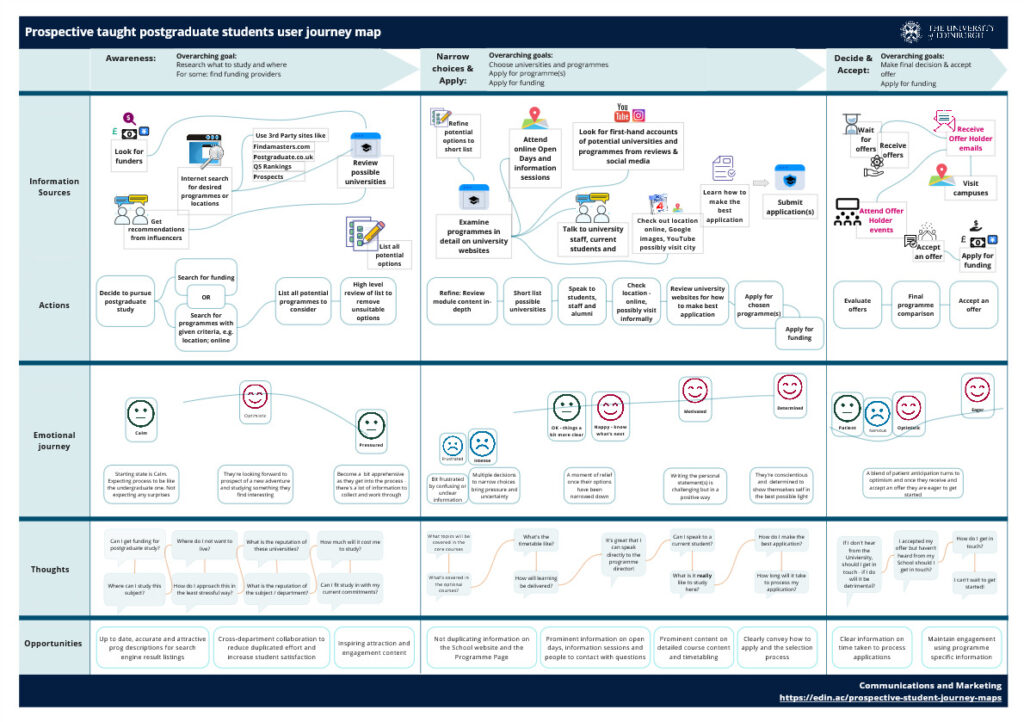
The prospective postgraduate journey is more sturctured than that of undergraduates. However, there were 2 distinct starting points depending on the need to find funding. Our user journey map is the distillation of insight gathered through interviews and usability tests with tens of prospective postgraduates interested in study at the University of Edinburgh.
Download all prospective student user journey map (PDF – University of Edinburgh staff login needed)
More about our prospective student user journey maps
This post is part of a series:
- Overview: Why it’s useful to have user journey maps and how best to use them
- Prospective undergraduate user journey map
- Prospective taught postgraduate user journey map
- Prospective postgraduate researcher user journey map