

Applying for a self-directed PhD: a user journey map for prospective postgraduate research students
The user journey for students applying for a self-directed PhD is distinct from those looking for a project-based PhD, so we’ve mapped each separately with an accompanying commentary on what we learned from our user research.
In 2023, we undertook research to inform the design of a research degree profile and supporting website content. We’ve already played back our findings to the University’s marketing and student recruitment community, but we wanted to create a journey map to present what we know at a glance.
There are 2 user journey maps for prospective postgraduate research students
The user journey for applying to do a PhD splits according to which type of PhD the applicant is applying for: project-based or self-directed.
To familiarise yourself with this split in the user journey, I recommend you first read my introductory blog post about mapping the prospective research student user journey.
Blog: Our evolving understanding of the prospective postgraduate research applicant user journey
Blog sharing the user journey map for applying to do a project-based PhD
The self-directed PhD applicant journey
The journey for applicants who don’t know how to find and apply for a PhD begins with prospective research students doing a web search for PhDs. They organically work out the process as they explore the search results.
In the journey to apply for a self-directed PhD there are 2 high-level stages:
- ‘Awareness’
- ‘Assessment and Application’
Stage 1: ‘Awareness’
The main goals in stage 1 are to find suitable PhD opportunities and to find out about how to apply for a PhD.
Actions and information in Stage 1: ‘Awareness’
Stage 1 can start with either a search for funding or a keyword search for a PhD. Several overseas participants who wanted to study in the UK knew they would need to find funding, so they sometimes began with a funding search.
Many participants started with an internet search for a PhD in their desired location or area of research. Some began by looking at highly ranked universities.
Results include a mixture of locations providing information on doing a PhD and advertised PhD projects and research opportunities:
- Ranking websites
- University websites
- Research Centres, Institutes, Departments, Consortia, Funders
- Aggregators like findaphd.com
Participants explored the research opportunities and performed the exact search on aggregator sites.
At this point, they face the multiple ways of advertising PhD projects and opportunities. They gradually learn what options apply to them by exploring the results.
They also sign up to receive regular emails about upcoming opportunities, which again might contain a mixture of different types of PhD.
Emotional journey in Stage 1: ‘Awareness’
Emotions are mixed throughout the process. There is a mix at the start of ambivalence from not knowing what to expect to curiosity and optimism.
In the middle of this stage, the primary state is confused. And towards the end, a bit calmer as they find a way to proceed.
Thoughts in Stage 1: ‘Awareness’
Thoughts during this stage reflect a voyage of discovery: learning about PhDs and trying to find a suitable opportunity.
The initial thoughts are about whether to do a PhD and how to make sense of the options in the search results.
Opportunities in Stage 1: ‘Awareness’
The foremost opportunity at this stage is to provide clear online information and guidance on the process. This is when people are moving between sections of the website. A clear purpose for what information is published where can help people remember what they read and support them in making decisions.
It is also a time when people are moving between university websites, and clarity of information stands out.
This is also a prime time to feature attraction and engagement content. One participant was so inspired by the video introduction to the research centre that they had joined that they insisted on playing it during the research session.
Stage 2: ‘Assessment and application’
The second journey stage is a combination of assessing opportunities and candidate selection. The final online application is often a formal step at the end of this process.
Actions and information in Stage 2: ‘Assessment and application’
This stage of the journey can be very long and involved. There can be many iterations of this stage as applicants persevere until they find the right opportunity.
A challenging and intensive part of the process can be securing an academic supervisor. Before they can do that, they must locate the appropriate subject area to explore for opportunities.
It might not always be straightforward to find the right subject area for PhDs; for example, some universities might explore ‘the curation and display of Egyptian artefacts in Egypt’ in their Archaeology department, others in Art History or Anthropology. The landscape of academic research does not sit in neat categories but straddles subject areas in unique and interesting ways.
Once applicants have located the relevant area of the institution, they need to find the right person to approach for supervision. This can be done differently between universities and within the same university.
Some departments stipulate that a named contact or an office should be emailed. Others expect prospective students to browse the staff directory and email the staff member a direct request.
Once the applicant has found an appropriate potential supervisor, they can discuss their research proposal. Even now, they might have to start the process over again if the academic cannot supervise or gives feedback that their proposal needs to be reworked or even wholly rethought.
Applicants can begin the process by writing their proposal first or by trying to find a supervisor first, and potential supervisors often give feedback on their proposal, even if they can’t offer supervision.
Some prospective research students begin with a funding search but need to secure a place on a programme before they can apply for funding. The deadline for funding applications can drive the schedule for this journey stage.
Even after writing a proposal, agreeing supervision with an appropriate academic and securing a place on a PhD programme, applicants can be unsuccessful in their funding application. If so, they might have to repeat this stage of the journey.
Emotional journey in Stage 2: ‘Assessment and application’
The emotional journey in this stage mirrors the challenging nature of the process. It can be daunting and intense. It can also take a long time.
Thoughts in Stage 2: ‘Assessment and application’
Thoughts during this stage are about understanding the nature of the process and their concerns about approaching the right people in the right way.
Opportunities in Stage 2: ‘Assessment and application’
Opportunities in Stage 2 are around making the process clear.
In a process which inherently involves a lot of cross-referencing and re-visiting content, having a clear purpose for and navigation between parts of the website can help prospective research students find out what they need more quickly and help them remember where they found information.
Guidance on when and how to contact an academic to enquire about supervision is a significant benefit during this stage.
Variations on the user journey
The steps mapped are a common thread through the journey for an applicant to a project-based PhD who does not know about the process when they begin. There were notable examples of people taking a shorter route, even though they did not know the whole process.
Finding an opportunity very early on
Applicants who find a suitable opportunity very early can progress very quickly. When the second stage doesn’t need any iteration, it can take much less time.
Having guidance from an academic
Participants who were advised to do a PhD by an academic often had guidance on what steps to take when, how to prepare a proposal and how to find funding. This shortened and simplified their journey.
Going straight to particular university websites from the start
Overseas applicants who want to study in the UK who know they will need funding might only be able to consider specific universities stipulated by the funding provider. They might start by exploring the university websites directly.
The self-directed PhD user journey map
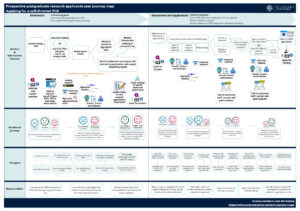
There are 2 high-level stages in the self-directed PhD prospective student user journey. Our user journey maps are based on interviews with 20 applicants to the University of Edinburgh.
Download all prospective student user journey map (PDF – University of Edinburgh staff login needed)
More about our prospective student user journey maps
This post is part of a series: