

Usability testing the display of multiple entry years in the undergraduate degree finder
The 2027 undergraduate entry went live last week, and it was the first time that two editions were published in the new degree finder at the same time. The team went on campus to conduct some usability testing with it. In this blog I’ll show how testing it has given us the confidence that displaying multiple entry years doesn’t prevent prospective students selecting the correct year of entry for a programme.
Why we tested
This is the first time that we have published two undergraduate editions in the new degree finder. Previously, the ‘old’ or ‘current’ edition was uploaded to a subsite of our study website or housed on a separate subdomain.
This is no longer the case with the new degree finder where both editions (2026/2027 and 2027/2028) will be displayed side-by-side. This means for a period, between Febuary and September, prospective students will see entries for both academic years in their search results listings.
We know from website analytics that when both editions were displayed in the old degree finder prospective students found it difficult to find the correct year of entry for when they wanted to apply.
We wanted to ensure that this was not a problem that prospective students would face using the new degree finder and when presented with multiple entry years they could easily identify the correct one based on their circumstances.
To learn this, we used a research approach frequently used by our team called pop-up usability testing. This approach allows us to learn quickly if something we have designed is meeting the needs of our users by going on campus and testing with students.
Louis’ blog post on what pop-up testing is and why we use it
What we tested
We presented 17 undergraduate students with a search results listing page in our live undergraduate degree finder which displayed a list of programmes for law for programmes with entry to both 2026/2027 and 2027/2028.
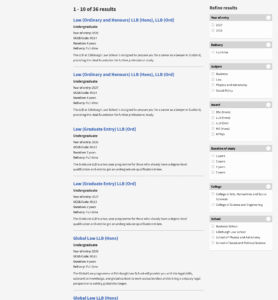
The search results listing page for law programmes presented to each student
We asked each student to find information for the Global Law programme and provided each of them with one of two scenarios:
Scenario 1: find information for a programme for entry in the current academic year (2026/2027)
Scenario 2: find information for a programme for entry in the next academic year (2027/2028)
The goal of the testing was to learn if each student would look for information in the programme for the correct year of entry based on what scenario they were given.
What we learned
Of the 17 undergraduate students we tested with, 9 were given scenario 1 and 8 were given scenario 2.
We learned that all 9 students given scenario 1 looked for information in the programme for the correct year of entry which was 2026/2027.
We learned that 6 out of 8 students given scenario 2 looked for information in the programme for the correct year of entry which was 2027/2028.
Next steps
It would be great if all 17 students looked for information in the programme with the correct year of entry.
However, this is a positive result and a significant improvement considering the issues prospective students faced selecting the correct year of entry in the old degree finder.
As we did in the old degree finder, we will continue to use website analytics to track certain user behaviours to give us continued confidence that prospective students are not facing any issues selecting the correct year of entry for the year they want to apply in.
We’ll be particularly interested in tracking behaviours through the summer when the clearing process opens for the 2026/2027 academic year and UCAS applications open for the 2027/2028 academic year.