

User journey map for prospective undergraduates
Our prospective undergraduate student journey map is shaped by three high-level phases we identified in the user research we did in the process of designing and delivering the new University degree finders. It’s an at-a-glance summary for student recruitment and marketing colleagues.
In 2023, we undertook research to inform the design of a research degree profile and supporting website content. We’ve already played back our findings to the University’s marketing and student recruitment community, but we wanted to create journey maps to present what we know at a glance.
If you haven’t already, you should also read the blog post about why we created user journey maps and how best to use them.
Why it’s useful to have user journey maps and how best to use them
In this blog post
This post is quite long and detailed, so here’s a summary of what I cover:
- The main insight from user research: prospective undergraduates are doing 2 tasks in parallel
- The information sources and resources available to support prospective undergraduate students
- Context on the prospective undergraduate user journey
- The journey starts in high school and takes approximately 2 years
- For international students, the journey steps are the same; what differs is how they carry them out
- The journey is organic and non-linear – it’s hard work but worthwhile
- The 3 high-level stages in the user journey:
- Stage 1: Awareness – learn the process to apply and make initial programme selection
- Stage 2: Narrow choices & apply – review earlier selection and make final application decision
- Stage 3: Decide and accept – receive offers and accept an offer
The main insight from our user research
Prospective undergraduates are doing 2 tasks in parallel
Prospective undergraduates don’t know where to start. They must learn how to find and apply for a degree and about the information and resources available to help them. This is an unacknowledged activity they carry out in parallel with looking for what to study and where.
Many information sources and resources are available to help prospective undergraduates, all available from the start. They can begin with any of them because they don’t know what they are and which is most useful for a specific purpose.
Information sources and resources available to support prospective undergraduate students
People in proximity to the prospective student:
- Peers
- Family
- Friends
- School teachers
- International Agents
Web-based information – self-service oriented:
- 3rd party websites, for example, Prospects, UCAS and ranking sites
- University websites
- Social media
People associated with a university:
- Current students
- Alumni
- University staff
Officially organised events:
- Career fairs
- Open days
- Campus tours
Although people can and do begin anywhere in this list of resources, there is a general trend towards a particular pathway, which is the basis of the visualisation in the user journey map we’ve produced.
How the majority proceeded through the journey steps
The students we interviewed typically began by speaking to people they’re in closest contact with:
- Teachers
- Peers
- Family
Then they moved into online research:
- General web search, which takes them to 3rd party sites
- UCAS
- Ranking websites
- 3rd party websites linking to university websites
Finally, they progressed to speaking to people connected to universities and agencies:
- Advisors and influencers at 3rd party organisations and universities
- Attend information fairs and visit campuses
Context on the prospective undergraduate user journey
Before describing the specific pathway on the map, it’s helpful to provide some context about the target audience to accompany it.
The journey starts in high school and takes approximately 2 years
During the last 2 years of mandatory high school education, students study subjects that will prepare them to study at a more advanced or higher level. The subjects they then choose for the following year or years, usually Highers in Scotland, or A levels in the rest of the UK, lead to particular subject areas to study at degree level. (There are alternatives. For example some Scottish students study A levels, and some students across the UK study for the International Baccalaureate).
For students in most of the UK, the journey continues to the end of 6th form, which some attend at their high school, while some attend a dedicated 6th form college. Scottish students follow broadly the same process, but their final two years of study are not labelled as ‘6th form’ and Higher-level followed by Advanced Higher-level study is more flexible. It is feasible for Scottish students to enter university a year earlier than others in the UK, skipping the final (6th) year of study for Advanced Highers.
The students are still young at the start of the user journey
The journey starts for people aged 15 to 16, who are entering a major life transition. We encountered people even younger than this attending extended open days with older siblings and parents.
By the end of the user journey, the prospective students have matured and often make quite different final choices of subjects to study at university than the ones they started with.
Parents are often involved
The age and life stage of prospective students at the beginning of their journey often means there is significant parental involvement in the process, particularly for the younger Scottish students.
Colleagues in Student Recruitment and Admissions were very familiar with prospective undergraduates’ initial youth and inexperience and the nature and range of parental involvement.
For instance, speaking to a couple of Scottish prospective students accompanied by a parent at an extended open day, we asked, ‘Can you tell us what you’ve done so far to decide where to study?’ only to be told, ‘We asked mum!’ Their initial process was being conducted entirely by their parent. That parent dearly wanted a Scotland-wide table of universities offering their child’s subject of interest, with the associated entry requirements.
Other parents took a more supportive and ‘in-the-background’ stance while continuing to guide and support.
For international students, the journey steps are the same;
what differs is how they carry them out
- International agents can offer support at no cost to the prospective students
- International events run in their country by university staff can be instrumental in their choice of institution
- Visiting the campus is a more significant consideration because of the travel arrangements and cost. This doesn’t mean they don’t visit; for example, we encountered visitors from Singapore, France and South Africa on one campus tour. However, several international participants were not able to even consider it.
The journey is organic and non-linear; it’s hard work but worthwhile
Participants didn’t simply follow the mapped journey steps once; they repeated it multiple times. Sometimes, they learned information that prompted them to backtrack and completely restart. They might change their minds about a subject area based on the advice of influencers or discover a new subject area to pursue instead. Researching options involved extensive cross-referencing between different information sources.
Participants described feelings of being overwhelmed and intimidated mixed with determination and optimism. They said it was intense, tedious and exciting, requiring patience and endurance. Some said they matured throughout the journey.
The 3 high-level stages in the user journey
- Awareness
- Narrow choices and apply
- Decide and accept
Stage 1: Awareness
During the awareness stage, prospective undergraduates must:
- Learn the process and the available information and resources
- Research what to study and where
- Make provisional decisions on where and what to study
Actions and information in Stage 1: ‘Awareness’
Stage 1 starts in high school for the majority of prospective students. They are entering a major life transition and are mainly between the ages of 15 and 18 when they carry out the journey.
Whilst learning how to choose and apply for a programme, prospective undergraduates face the initial decision of whether to attend university or not, and if so, what to study. They often start by exploring their favourite subject or the one they do best in.
They research universities by location, reputation and available programmes to find out what subjects and degrees are available and the career paths they lead to. Locations which are undesirable and too far away are ruled out first.
Once prospective students in our research had chosen a subject area they would like to study, they looked at the programme content in detail. Even at this early awareness stage, they examine programme details on university websites in depth, looking at specific course content. They gradually compiled a long list of possible universities.
An area to learn about in future research is whether students initially rule out institutions which ask for grades they don’t expect to be able to attain at this point or whether they aren’t thinking about it yet. This was difficult to learn in research with prospective University of Edinburgh students who had, or hoped to achieve, high exam grades and had a history of high academic achievement. Prospective students planning to attend elsewhere were included in our research, but their numbers were low.
Emotional journey in Stage 1: ‘Awareness’
A particular feature of the emotional journey is that people had a mix of emotions as they progressed through the steps, rather than starting in one state and ending in another.
For example, at the beginning, they felt simultaneously ambivalent, curious and optimistic; in the middle, simultaneously overwhelmed and determined; and at the end, both optimistic and neutral.
Thoughts in stage 1
Prospective students’ thinking reflected their emotional journey and increasing knowledge of the process, information and resources.
For example:
- Do I want to go to university, and how do I find out what to do?
- I don’t even know what questions I should be asking
- What universities offer my favourite subjects with my predicted grades, and where do I want to study?
- What’s a good degree if I’m interested in this subject area, and what career would this lead to?
- Do I need to visit campus?
Some students choose not to visit the campus
Several of the students who took part in the user research chose not to visit the campus before receiving an offer in case they fell in love with a place and didn’t get in.
Opportunities in Stage 1: ‘Awareness’
A major opportunity at this stage of the journey is to help people understand what they need to do to find and apply for a degree and what they can use to help them choose.
There is a gap in the available information indicating how each touchpoint or resource in the journey can help them.
Providing information like this will reduce the chances of people asking questions at events that are answered online and help them get the most out of the events they attend.
Collaborate across service areas to reduce duplication of effort and enhance the student experience
Prospective students experience the services that universities offer as an integrated whole. They are unaware that different departments specialise in a given area. Collaborating with staff from different departments can reduce duplication and help people make the best use of what the university provides. For example, using the website to supplement and support attendance at an open day online or on campus.
Stage 2: Narrow choices & apply
During this stage, prospective undergraduates:
- Revisited earlier decisions
- Chose universities and programmes
- Applied by completing the UCAS application
Actions and information in Stage 2: Narrow choices & apply’
This stage is approximately 1 year from the start of the journey. Some participants had changed their minds about what they wanted to study by this stage.
Stage 2 begins with a review of the list of provisional programmes and universities made at the end of the previous stage.
Participants were now more aware of what information they needed or wanted, and the resources available to help them get it.
They began by looking at subject choices and specific universities in detail, considering the topics they wanted to pursue in detail. For example, one participant was considering Maths and Spanish at one university and ruled it out because the Spanish course focused on literature rather than linguistic tuition.
They wanted to know what it’s ‘really’ like to attend a given institution.
Many reported watching videos on YouTube by current students or those who lived in the city. They were somewhat sceptical about the videos on the University website, assuming they would present a polished and positive image. They wanted to know the cons of a place as well as the pros.
This part of the journey is also non-linear; for example, they might discover that a programme they like doesn’t cover the aspects of the topic they want to study, so they will reconsider their list of potential programmes.
When making the final selection to apply for, the process becomes more methodical and systematic. Several participants reported creating a spreadsheet assessing each entry against the same criteria as Stage 1. They were comparing aspects including location, reputation and detailed subjects on offer.
The final choice was based on the details of the courses, both required and optional.
Emotional journey in Stage 2: Narrow choices & apply’
This journey stage was described as particularly intense because it occurs when they are studying for Scottish Highers, A levels or equivalent. They have to carry out a demanding process precisely when their studies are most demanding.
Notable comments from the participants were about managing their time, feeling overwhelmed and stressed, and focusing on remaining positive.
Thoughts in Stage 2: Narrow choices & apply’
Their thoughts in Stage 2 were about specifics on detailed programme selection and completing the UCAS application
- Details of the programme content
- The teaching format
- The facilities
- The accommodation – where is it, what is it like, and how much does it cost
- What it’s ‘really’ like to study somewhere
- Completing their personal statement
Opportunities in Stage 2: Narrow choices & apply’
A significant opportunity here is to help people make an informed choice by giving them detailed information on what the degree programme covers, including information about optional courses. Several participants said they received this detailed course information as an offer holder and would have valued receiving it earlier.
Other opportunities are to highlight timetabling information and show where accommodation locations are in the campus context – how far are they from where the teaching happens?
Stage 3: Decide and accept
This stage represents the Offer Holder stage. The period is somewhat calmer for the prospective student because they’ve applied and taken exams or submitted coursework. The main task is to wait for exam results and offers. However, they must revisit the comparison exercise if they receive multiple offers.
Actions and information in Stage 3: ‘Decide and accept’
The overarching goal for this stage is to make a final decision & accept an offer.
Emotional journey in Stage 3: ‘Decide and accept’
Their emotional journey is also mixed at this stage and depends on whether they get their expected grades or an offer from their first choice of university.
Thoughts in Stage 3: ‘Decide and accept’
The main focus is choosing which offer to take if they receive more than one.
Opportunities in Stage 3: ‘Decide and accept’
The main opportunities here are helping students to understand the benefits of accepting their offer.
Participants welcomed relevant communication from the universities they had applied to, and, as before, their primary interest was the subject material they would be studying. Details from their relevant School were welcomed.
The prospective undergraduate user journey map
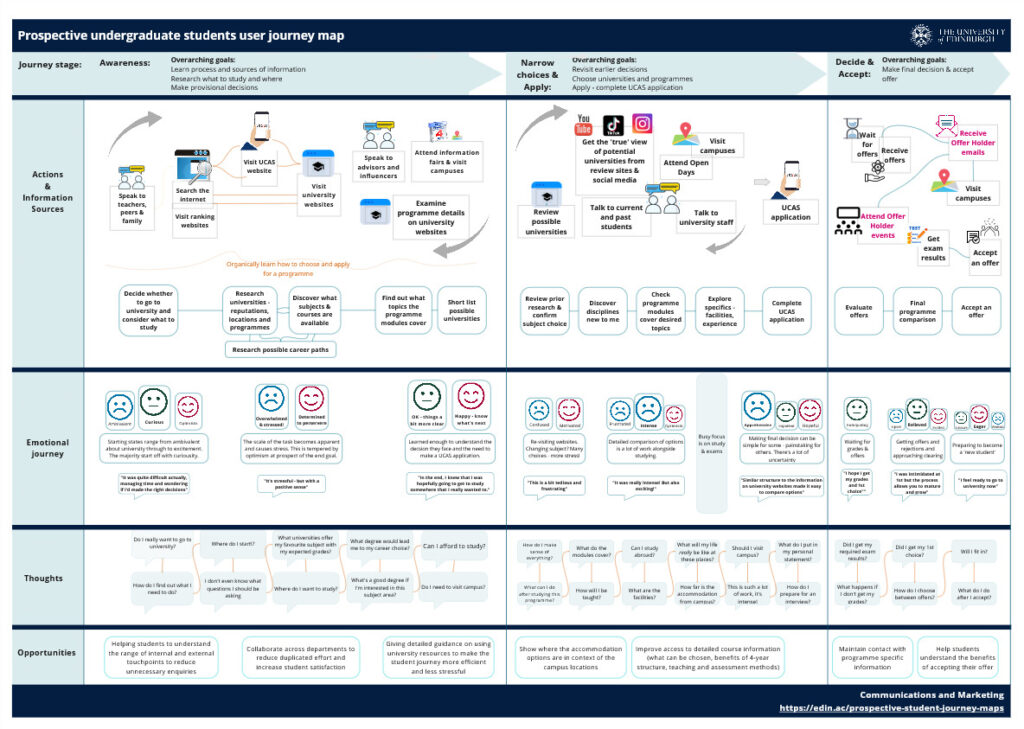
The prospective undergraduate journey is organic and non-linear. Our user journey map is the distillation of insight gathered through interviews and usability tests with tens of prospective undergraduates interested in study at the University of Edinburgh.
Download all prospective student user journey map (PDF – University of Edinburgh staff login needed)
More about our prospective student user journey maps
This post is part of a series: