

From recommendations to reality: Applying UX design thinking for a technical solution for staff profiles
The Role of Profiles project produced 10 recommendations for an improved University profile provision. To start actioning these, I assembled a working group of specialists and drew on UX design principles – implementing practical prioritisation while seeking innovative solutions that addressed the research findings.
Recognising the widespread value and strategic importance of communicating the work, accomplishments and status of University staff, the UX Service undertook a research project to investigate the needs and requirements for an improved provision to publish profile content within the University web estate. The project uncovered many insights, brought together in a series of technical and non-technical recommendations. Since the research project closed, I have been looking for ways to act upon the recommendations, in a bid to make them happen and crystallise a new profile provision for the University.
Read about the profile research project in our series of blog posts
To start bringing the recommendations to life, I needed a UX design process to follow
In the absence of a formal follow-up project to implement the recommendations, and recognising the unwavering importance of profile content being available on University websites, I was keen to retain momentum and to keep profiles on the agenda. Having worked as a UX Lead in different realms, I have learned about various UX design processes to effect technical builds. I was keen to experiment with an approach based on the Agile Squad method, which brings together individuals from multidisciplinary teams to focus on specific feature areas of a technological solution. This seemed like a good fit for profiles, firstly as a way to break down the recommendations into smaller tasks, and secondly as a way to harness the University-wide knowledge and expertise about profiles my team had uncovered as part of the research.
Read more about the Agile Squad Model in project management in an article on daily.dev
I set up a specialist squad to continue making progress on profiles
In the latter stages of the profiles research project, I had ran two successful co-creation workshops, bringing together colleagues from different teams, Schools and Groups, all with different perspectives yet a shared interest in profiles. These workshops had demonstrated that, across the University, there were colleagues already developing profile solutions, and that there was a bank of innovative ideas to tap into – to help achieve an improved profile solution.
In the interests of starting small and keeping things simple, I formed a Teams channel which included staff from the Business School, the School of Engineering, the PURE team, IS Apps and EDINA. I initiated a round of discussions, brainstorms and show-and-tells to harness expertise and gather perspectives from each team in turn.
Reviewing the recommendations, I ranked them by what to tackle first
With the help of squad colleagues, I revisited the 10 recommendations from the research project to better understand the dependencies and complexities and accordingly, sort them into a prioritised order. The recommendations that required EdWeb2 expertise needed to be accommodated within the existing EdWeb2 roadmap and therefore were placed in a queue behind other priorities. Recommendations relating to profile creation and maintenance had dependencies on the updated provision being in place, and similarly, it was logical to schedule training sessions to help colleagues write effective profiles to occur once the new provision was available to use.
See the full list of project recommendations in my blog post: The Role of Profiles is to represent our staff: Recommendations and reflections from our project
It made practical sense to start by investigating data exchange solutions
One of the more sizeable recommendations from the profiles project was as follows:
Profiles should support the display of content from other repositories using technical solutions where feasible
This recommendation recognised the tendency of profile owners to publish content about themselves and their work in multiple sources, and their wish to be able to bring those content sources together, to display in a University of Edinburgh profile. To address this recommendation, I began some investigation work – primarily to find out about existing solutions for data exchange (both for profiles and more broadly) that would provide food for thought about how to break the recommendation down into small tasks.
A simple diagram served as a boundary object to align thinking and prompt collaboration
In technology design and innovation, reference is often made to the value of prototypes and wireframes as a way to crystallise thinking and to spark ideas. In this piece of work, a diagram depicting the expected interactions to achieve data sharing between different systems served as a useful artefact to bring a shared way of thinking across the teams and to prompt ideas for achieving the different aspects of the proposed idea.
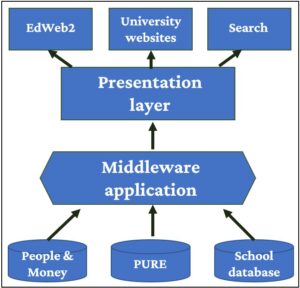
Diagram of the boundary object used to describe the proposed model to achieve presentation of profile data on EdWeb2, other University websites and search via a middleware app, pulling from sources such as People and Money and PURE.
A workshop with Business School colleagues helped formulate a proof of concept
UEBS operates a non-EdWeb site, and to meet the need to display profile content of UEBS colleagues, the technical team had devised a solution that parsed data from fields within PURE (the University’s primary research repository, operated by Elsevier) and displayed it in UEBS staff profiles. As part of the profiles squad, the UEBS team shared details of their solution to enable critique and assessment of its suitability for wider, scaled-up production.
Having learned about what worked, what didn’t and the associated requirements and dependencies, and keeping in mind the user requirements from the research project, it felt appropriate to propose developing a minimal viable product (MVP) for the University-wide profile solution. Defining the MVP was helpful to give us something to aim for in the short-term, and we recognised that in the process of working towards delivering the MVP, we would learn along the way and ultimately get closer to a solution that was feasible to deliver for the whole University.
The MVP contained three parts:
- Profile data coming from PURE or from another identity source, such as People and Money or the Active Directory
- A Drupal 11 site within EdWeb2 with a profile entity to handle the data
- A School site to ingest the data
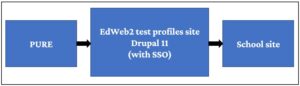
Diagram to show the MVP where data from PURE enters a Drupal 11 site ready to be ingested by a School site
Breaking this down further, we agreed that the first step would be to make some PURE profile data available to be consumed by the Drupal 11 site – envisioned to be achieved with a single PURE ID of a person. A subsequent step would be to expose the data as a JSON feed from the Drupal 11 site, ready to be consumed by the School site.
Meeting the PURE team helped tease out typical repository dependencies
Given a key part of the MVP was data-sharing from PURE, the next logical step was to learn from the PURE team about the possibilities for data extraction from this system. On the technical side, the team shared PURE API documentation with details of data endpoints and new data formats to help with modelling the data consumption planned for the MVP. They also shared information about PURE’s upgrade path and ongoing maintenance needs which was important to consider within the context of the planned profile solution. Reflecting on requirements of PURE end-users, the team revealed trends for PURE profile data – for example, the need for academics to not only capture detail of their publications but also of their research activities within PURE. This was interesting to hear as it mirrored a finding from the profiles research project relating to profile content.
Furthermore, the team provided insight into broader requirements for the use of PURE data, including integrations with other systems, for the purpose of support and publicising research activities in alignment with high-level University strategic objectives (such as REF 2029). Understanding the wider landscape was helpful to reinforce the potential of the improved profiles provision we are aiming to achieve and the key role of PURE within that.
Learning about integrations from IS Apps colleagues offered an innovative way to look at data sharing
The team from IS Apps recently presented about their use of Choreo – a cloud-native platform which powers their newly-launched integration service. Choreo has the capacity to manage APIs and integrate services and systems, affirming its potential usefulness as part of our improved profile provision. Meeting the IS Apps team to explain our goals for a profiles MVP, we began to consider options for being able to make use of identity data APIs to receive baseline data to populate profiles for part 1 of the MVP.
Read more about the Choreo technology on the WSO2 website
Wider interest from the Higher Education Drupal community suggested opportunities for contribution
Having contributed to open-source Drupal for several years, I have built up a network of useful contacts for shared learning about Drupal solutions. Raising awareness of our profiles project in the Drupal community provoked a response from people in other institutions trying to achieve similar goals, leading to knowledge-sharing with institutions such as the University of Cambridge, Stanford University and the University of Bergen. As our squad progresses with its work, I hope that the University of Edinburgh can contribute an open-source technical solution that may benefit organisations like ours, and that may be taken and adapted for more and more use cases.
With EDINA and Drupal we ideated for potential use of AI: balancing opportunities with risks
Reflecting on ways of achieving data exchange between systems, it was natural to consider how AI could assist. Consulting colleagues from the ELM team within EDINA we explained our plans for the MVP as a provocation to understand the potential for AI. Between us, we identified the potential for MCP servers for contextual data transformation, to potentially deliver repository data dynamically in AI-ready formats. We also identified an idea for ELM to potentially deliver profile data from defined sources conversationally, in response to queries. Both ideas were subject to dependencies and further investigation.
Drawing on earlier learnings about use of AI to formulate profile content, we recognised the need for profile owners to be able to sense-check the content before it was displayed, to ensure it did not misrepresent them. For this reason, we resolved that if either of our suggested AI ideas proved technically viable, user research with profile holders should occur to inform actions and progress, to ensure full agency for personal data remained with those the data belonged to.
Read about a project experimenting with AI to generate profile content in the blog post: An AI tool for generating academic staff profiles using a pre-trained LLM – findings from a study
Considering tried-and-tested use cases for ELM, we identified that profile owners may like to make individual use of ELM to assist with the wording of their profile content, in particular to undertake tasks like writing the content in particular styles conference abstracts, providing ELM with the necessary contextual sources to be used to shape profile content in particular ways. I identified a potential test use case for a new Drupal AI module I have been contributing to, the AI Context Control Center (CCC), currently under rapid development within the Drupal community.
Read more about the development of the AI Context Control Center on Drupal.org
We have a way to go to implement the recommendations, but we’ve made a good start
All things considered, we’re getting incrementally closer to an improved profile provision, but we’re not there yet. Taking a UX design lead on developing a profile solution is helping to ensure we keep sight of the recommendations formed from the research project. Working in a squad that brings together people from multiple disciplines from the wider University provides a welcome way to learn about different colleagues’ ways of working, ideas and approaches. It is heartening and motivating to see the appetite and interest in profiles from colleagues around the University and from the wider content management community, and I feel confident that, with continued support, we will, in time, arrive at a better profiles provision to serve staff at the University.

