

Repositioning Effective Digital Content as a short online course: A product approach
Following a successful launch of Effective Digital Content, our internal course that staff complete to learn and practice fundamental content design skills, the UX Service saw an opportunity to make the course more widely available, on the University’s Short Courses platform.
In May 2025, after months of user research-informed development work, my UX Service team delivered a new Effective Digital Content course to University staff. To date, hundreds of staff have successfully completed the course with some staff openly celebrating their achievement by sharing their digital badge.
Read more about how the team adopted a staff-centred approach to developing the Effective Digital Content course:
Series of blog posts about the Effective Digital Content course
Demand for the course from other universities prompted us to think bigger
After the launch of the Effective Digital Content (EDC) course, the UX team presented their work to various forums and groups. Following a showcase of the course at the UCISA UX Community Day in September 2025, we received interest in the course from the wider Higher Education sector, with colleagues from other UK universities requesting access to the course content, so that they could apply the concepts to content publishing in their respective institutions. There were various options to make the course public, and following conversations with University colleagues in Open Education and the Short Courses platform, we decided to pursue adding Effective Digital Content to the short online courses portfolio, to make it part of the University’s continuing professional development offering.
University of Edinburgh short courses website
Market research confirmed EDC a good fit for the short online courses portfolio
As the team behind the course, we acknowledged our bias in deeming it suitable for inclusion in the Short Courses platform. In order to make a more objective assessment of its suitability, we needed to do some research into the external target market and also, to identify related courses and programmes. Google Trends data revealed a growth for the content design sector in recent years, and further market analysis showed that although competitor content design courses were available, none were offered by universities or were targeted specifically at the Higher Education sector, suggesting our EDC could fill a market niche.
Content professionals from the public sector were defined as a target audience
Taking into account competitor courses and their respective offerings and critiquing the content in each of the EDC modules we defined the kind of person we felt would be interested in and would benefit from taking the EDC course. These included:
- Staff working in communications, marketing, academic or administrative roles in the public sector, working with text-heavy content to ensure compliance with standards
- People with responsibility for creating or managing digital content on websites, social media or other platforms
- Those new to content design with broader writing or content creation experience
- Professionals interested in growing skills and confidence working with content as part of continuing professional development.
Our proposal to reposition EDC as a short online course was approved
Supplying the market research findings together with an appraisal of the course against University-wide criteria such as alignment with strategic objectives and sustainability goals meant the proposal for EDC to be included in the Short Courses portfolio was approved by senior management, giving us the green light to proceed with making it happen.
Design and technical constraints prevented us lifting and shifting the existing course
Excited by the prospect of seeing EDC in a new platform, the UX team dived in, familiarising with Canvas and Eduframe – the dual technologies underpinning the Short Courses platform. After some initial experimentation, however, it quickly became clear that a straight migration of the course content wouldn’t work for several reasons:
- The section headings of the existing EDC course didn’t map directly into the structure of Canvas
- Some of the existing EDC video module content was directly Edinburgh-centric (referring to systems like EdWeb for example)
- The workbook element of the course (where learners receive feedback on worked example) wasn’t feasible to scale beyond an internal audience
Considering these problems one-by-one made them difficult to solve, as there were dependencies between them, as well as additional unknowns still to be worked out.
Read more about Learning Management System software Canvas and Eduframe on the Instructure website
I brought in a product development framework to keep things on track
Having worked as a UX Lead on various projects, I recognised that when decisions become difficult, it is worth taking a step back to consider the bigger picture, to avoid getting lost in the details and potentially making decisions based on short-term logic that may have adverse consequences in the longer-term. Drawing on my most recent experience, working as part of the Drupal CMS product team, I referred to a useful product design framework, the Product Kata, from ‘The Build Trap’ book by Melissa Perri.
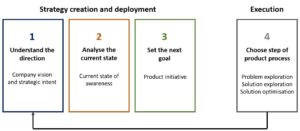
Adaptation of the Product Kata diagram from Melissa Perri’s book ‘The Build Trap’ showing the 4 stages: Understand the direction, Analyse the current state, Set the next goal, and Choose step of product process.
This framework follows a classic UX design process whereby the product strategy and vision provide the direction, and an analysis of the current state indicates the work to be done to achieve the vision. With the gulf between the current state and the vision defined, it is possible to set milestone goals and establish the relevant product process step to achieve these: problem exploration, solution exploration or solution optimisation.
I used details from our approved proposal document to define a product vision
Using examples from ‘The Build Trap’ as inspiration, and drawing on the information supplied in the proposal, I pulled together a product vision for EDC as a short online course, outlined as follows:
Product vision
To become the first-choice digital content training course for professionals in Higher Education – equipping them with the practical knowledge and confidence they need to create content that is clear, accessible, transparent and sustainable.
The problem our product is solving
As public sector institutions, universities have strict accessibility, legal and transparency obligations. Thousands of people working for universities are responsible for creating and maintaining digital content – but many have not received support or dedicated training. The result is content that’s difficult to read, costly to maintain and runs the risk of being inaccessible to many users.
The gap our product is addressing
There are lots of content design courses available, but few address the practical realities of writing digital content in the Higher Education sector, where accessibility compliance, inclusivity and transparency are non-negotiable.
Who our product is serving
The main audience for our product are staff in professional roles who publish digital content a part of their broader roles and need practical guidance they can absorb at their own pace and can immediately apply to their own contexts. A secondary audience is those wishing to move into content design roles, perhaps from related fields such as copywriting or social media communications.
What makes our product stand out from the competition
Our course was built by content professionals working inside a prestigious Russell Group university, responding to real needs identified by years of research with staff with content publishing responsibilities. It has been refined over years and has been completed by over one thousand staff. Unlike competitor course which are marketing led or are UX-oriented, our course specifically addresses:
- Hands-on guidance on making content accessible
- Ways to improve the efficiency of finding information, reducing cognitive load and friction
- Responsible practices to reduce unnecessary digital waste and promote sustainability
- Real-world context – with examples and exercises grounded in the Higher Education environment
- Practical application of theory, designed to be adaptable and applicable in learners’ own contexts.
The strategic value associated with our product
Our course stands to bring value to the University of Edinburgh by:
- Extending the reach and impact of our in-house content design expertise to a wider audience
- Positioning the University as a leader in digital content practice
- Demonstrating commitment to knowledge-sharing and sector collaboration
It also promises to deliver value to learners and their respective organisations by:
- Building a common language and baseline standard for content design across the sector
- Addressing growing regulatory and accessibility obligations
- Supporting staff professional development
- Helping to reduce costly content errors and accessibility failures.
At a more granular level, I teased out learning outcomes for each course module
Regarding the collection of modules in the internal version of the EDC to represent the ‘current state’, I wrote learning outcomes for each module, to epitomise the purpose of each one.
To form the learning outcomes, I firstly thought about the practical skills learners would gain on completion, but that felt limited. Perhaps more important for the learners to take away was an appreciation of what these skills could achieve with them and therefore why they were important. Added to this, I felt that each module should also leave learners with an impetus to take the skills and apply them to content in own contexts.
Recalling how we developed EDC for internal staff, I remembered how we worked hard to avoid a static learning experience – and instead provide an experience where the learner is actively guided to apply what they have learned, both to supplied examples in the course but also to their own real-life circumstances.
In the book ‘Learning Experience Design: How to Create Effective Learning that Works’, author Donald Clark refers to this set of emotions as ‘Reflective feeling’:
One important facet of reflective feeling comes through the follow-up, actually doing something. This can be triggered by nudge learning so that the learner gets their kicks through going back to their job and actually implementing a challenge” – Donald Clark, Learning Experience Design: How to Create Effective Learning that Works, 2022
With this in mind I grouped the learning outcomes under ‘practical skills’, ‘knowledge and understanding’ and ‘attitude and awareness’. Examples of each for the module ‘Get link text right’ were as follows:
Practical skill
- Write link text that is clear, meaningful and make sense on its own out of context
Knowledge and understanding
- Understand why certain phrases like ‘click here’, ‘more’ and ‘further information’ should never be used as link text
Attitude and awareness
- Appreciate that good link text improves the experience for all users, not just those with accessibility needs.
The learning outcomes serve as principles to guide content trade-offs and define a proof-of-concept
Having learning outcomes for each module has helped us critique the existing EDC content, to establish what is needed to meet the learning outcomes, what is a nice-to-have and what might be missing. This is, in turn helping to set a blueprint for the minimal content of each module for EDC within the short courses platform.
Referring back to the Product Kata, these outcomes serve as a way to progress from the stage 2 current state to stage 3 where we set our next goals. In real terms this means that as we continue to make decisions about course content – for example, whether to include videos, or how to provide learner feedback, how to replace the workbook element of the course, we can use the outcomes as guardrails to refer to, to drive our decision-making in an auditable way. Collectively these decisions or milestone goals will inform a proof-of-concept ready for testing with representative audiences – the results of which will guide stage 4 and our path of execution – problem exploration, solution exploration or solution optimisation as appropriate.
We’re working with colleagues to deliver the proof-of-concept by summer 2026
Repositioning our EDC course for a new platform has been a learning curve so far, and we’re continuing to draw on the expertise of University colleagues in the teaching and learning realm to ensure we make best use of the technology to deliver a course which meets the need of our target audiences and is an attractive proposition for them to engage with to learn content design.
We’ve set a target to achieve a proof-of-concept course by summer 2026, and are working towards this through a series of three-week long sprints, each focused on one of the course modules – including review of content against learning outcomes, ideation around activities and exercises and testing with at least one user. When we reach the end of these planned sprints, we have a view to testing the entire course with participants representative of the target audience, to iterate on research learnings and deliver a version one of our EDC product by the start of the next academic year 2026/2027.
Exciting times ahead! We’re grateful to the support of the Short Courses team, the Learning Technology team and others to help us bring our content design expertise to life in a new EDC short online course.

