

Creating a new style guide page on University terminology
This year the User Experience Service have been working on improving the University’s editorial style guide. Nick Daniels, Hannah Watson and I have blogged about previous aspects of this work:
- Why we’re refreshing the editorial style guide
- An analysis of responses to our editorial style guide survey
- Reviewing and rewriting the formatting section of the editorial style guide
In this post, I will focus on the work we’ve done to create a new page on University terminology for the style guide.
Our research findings led to the creation of a new University terminology page
An intrinsic part of the style guide refresh project has been looking at the way we write content across the University’s vast array of web pages to evaluate how we use, spell and punctuate certain words – identifying opportunities to reduce inconsistencies. In doing so, we recognised that there were a variety of University-specific words being written in varying ways, using different types of punctuation, capitalisation and abbreviation.
We also heard anecdotally through our research with style guide users about some areas of confusion around how to use certain University-specific terminology and the need for some clearer examples.
Colleagues questioned how they should be referring to the University in different contexts.
When am I allowed to say UoE rather than the University of Edinburgh?
We also heard about the confusion around how to write masters.
How do you refer to masters degrees? Does it have an apostrophe or not?
Bringing together the findings of both our desk-based research and user insights, we decided to create a page in the style guide dedicated to guidance on how to use specific terminology within the University of Edinburgh context.
We’ve expanded the previous ‘Referring to the University’ page, consolidating guidance from other style guide pages
We started our review process by looking at the ‘Referring to the University’ page, which previously sat within the ‘Language and tone’ section of the style guide. The page covered how to refer to the University of Edinburgh and when to capitalise the words ‘school’ and ‘college’. Whilst we felt that this guidance was still needed, the existing explanations needed clarification and more illustrative examples.
During our review of the guide as whole, we also noticed that other pages such as spelling, abbreviations and the PDF version of the guide included guidance on University-specific words/terms. Therefore, we decided to consolidate these, where relevant, so they all appeared together on the University terminology page for ease of reference.
The new page therefore covers guidance on:
- referring to the University
- writing the names of schools and colleges, including when to capitalise the words ‘school’ and ‘college’
- writing degree programme titles and awards, including honours and degree classes
- when to capitalise the word ‘masters’ and whether an apostrophe is needed
- words to avoid
University terminology style guide page
We’ve included more illustrative examples to aid understanding
Throughout our user research and also usability testing, the power of a good example has shone through. We’ve seen first-hand how it can often allow a user to cut through technical or grammatical explanations to understand how the rule or convention will apply in a practical sense.
Examples are therefore a key feature of the new style guide pages. We’ve used feature boxes to highlight examples throughout the pages of the guide, so they are easy to scan and locate. On the University terminology page, given the nuances in how you use certain words or phrases, depending on the context, we’ve often provided two or three different examples to hopefully make it clear how the term would apply in each case.
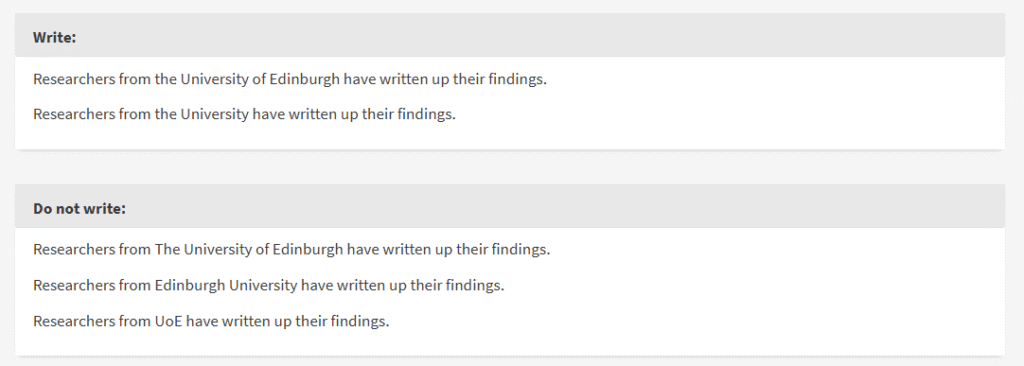
A screenshot of the University terminology style guide page, showing illustrative examples of how to apply the style guide conventions, displayed in feature boxes.
The University terminology page aims to enhance consistency
The importance of consistency, particularly when thinking about University terminology cannot be underestimated. It has a direct impact on the perception of the University’s brand and reputation.
A key example and perhaps the most important is how we reference the University itself. During our research we’ve seen many variations: Edinburgh University, UoE, ‘Edinburgh’, the University, The University of Edinburgh to name but a few.
If we aren’t consistent in the way we refer to the University and how we write more generally, we increase the likelihood that audiences (both internally, but particularly externally) will become confused or uncertain when consuming our content.
We hope that the new University terminology page helps to answer some of the questions you might have and provide you with confidence in how to use University-specific words/phrases in different contexts.
How to access the new University terminology page
You can access the new University terminology page in the ‘Language and tone’ section of the style guide
University terminology style guide page
We’ve also updated the abbreviations page of the style guide
Alongside the work we’ve been doing on University terminology, we’ve also reviewed and refreshed the abbreviations page, which is now called ‘Acronyms and abbreviations’. On this page you will find helpful guidance and practical examples on how to use shortened forms of words and phrases within your web content.
Acronyms and abbreviations style guide page
Next steps
Our work continues to keep updating the remaining pages of the style guide. Punctuation is next on the list, along with dates and numbers.
How you can get involved in shaping the new style guide
We are always on the look out for willing volunteers to test out new versions of style guide pages. If you would like to get involved, please get in touch with the User Experience Service: user-experience@ed.ac.uk.

