

The next industrial revolution? Reflections from Jisc Digifest 2026
From the birthplace of the original Industrial Revolution, a group of around 2000 intrepid EdTech practitioners and enthusiasts sought to examine and understand what has been dubbed the ‘Fourth Industrial Revolution.’ I was fortunate to be among them for Jisc Digifest 2026 in Birmingham this week.
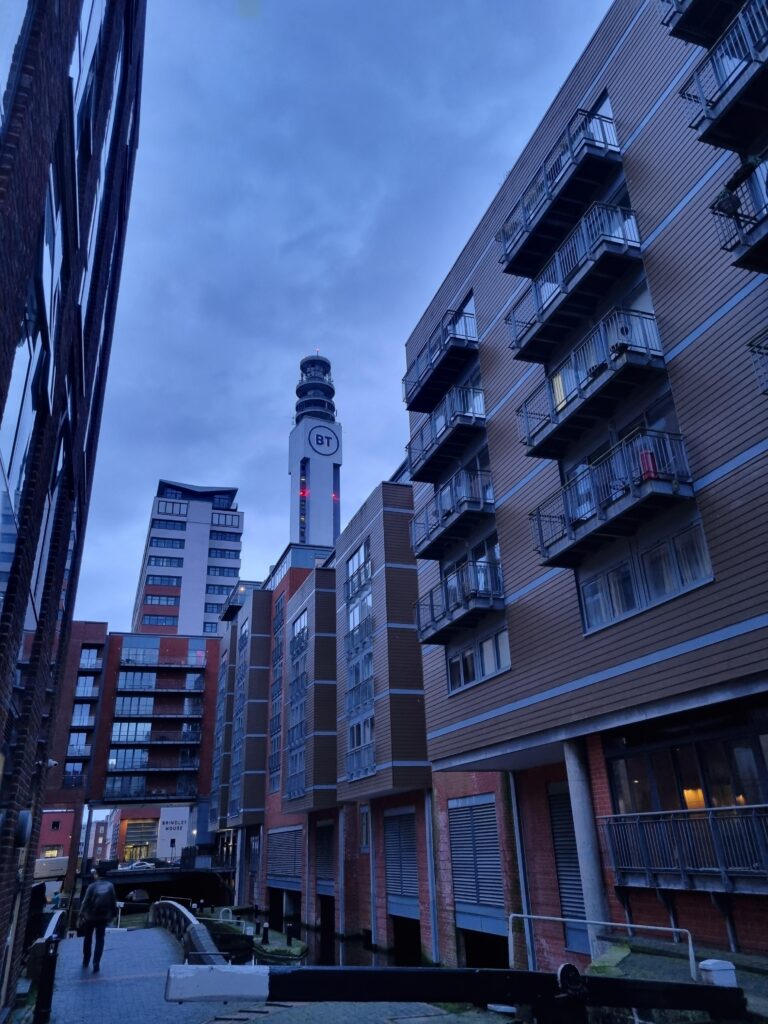
Birmingham: An 18th century canal sits under a 1960s communication tower nestled among 21st century mid-density residences
There were many opportunities to contribute and get creative
This was my first live Jisc event, and I was delighted to find that the organisers had thoughtfully arranged numerous opportunities for creative thinking and initiating engaging discussions with fellow attendees.
Perhaps my favourite element, the Jisc Hub at the centre of the main exhibition hall. It contained an interactive diorama of what appeared to be a student’s desk circa-2005, complete with an iMac G3, Rubik’s cube, and a fully-playable Nintendo 64. A form on the computer offered delegates to think about the changes in technology since that time and, by extension, what changes we might see on a similar timescale in the future.
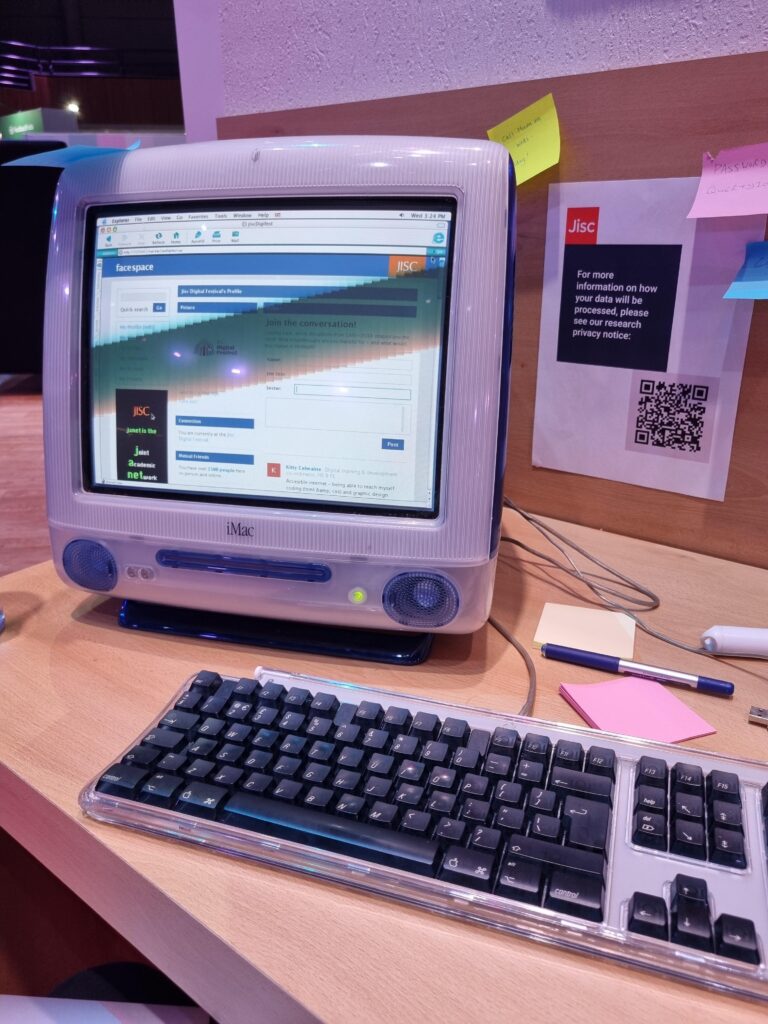
I am grateful for the development of non-CRT computer displays
Adobe offered delegates a chance to design their own chocolate bar wrapper using the AI tools embedded in Adobe Express. Origami, jigsaw puzzles, and colouring in were available in the Community Hub area.
Far from being frivolous activities, these were opportunities to be creative, and to spark conversations with other delegates.
We have the power to affect change
The conference kicked off with an inspiring keynote speech by climate activist Melati Wijsen. Since the age of 12, Melati has been a passionate advocate for environmental issues, having addressed audiences at the UN and Davos. Her compelling argument underscored the crucial need to include young people in our decision-making processes.
Daniel Liu from the University of Sydney provided a compelling case in allowing students to direct their own learning with AI tools. His case study showed examples of students generating their own self-directed learning tools using an LLM trained on their course materials. In seconds, they were able to generate pop-quizzes, simulations, and interactive graphics to supplement their learning experience.
Liu and many other speakers emphasised that we would do our students a disservice by denying access to these tools, and that it is the duty of educators to ensure that they are taught to use them effectively.
Access to technology is essential to living in the modern world: We must work to ensure that nobody is left behind
I was particularly interested to hear about the positive steps being made in digital inclusion spaces.
Elizabeth Newall presented a set of guidelines that Jisc has developed to assist transnational education (TNE) students and staff. This session was an excellent reminder of the considerations we must make when building our digital estates: for example, we might not think twice when uploading a large image file on one of our webpages over fibre-optic, but such an image might be a severe pain point for a consumer on a cellular-based internet connection.
Such considerations are of particular interest to me: as the Service Manager for the portal service, MyEd, I need to ensure that our services are as lightweight and responsive as possible in order to remain accessible to all of our users.
In a similar vein, I was interested to learn about the UK Government’s Digital Inclusion Action Plan. For many of us, completing tasks like paying for parking or filling in a tax form is made more convenient when done online. However, this is a source of enormous risk for the 8 million people identified by this plan – especially when the action can only be completed online.
Enthusiasm for AI is high among professionals, but questions remain
It is my perception that AI in education technology is beginning to mature and that there is an increasing sense of surety around its potential. This was perhaps best illustrated by the collaborative art piece that was drawn in real-time over the course of the two days. Seeded with the simple question ‘What kind of future do you want to help create?’, a clear picture began to emerge of the exciting potential that these disruptive technologies could provide.
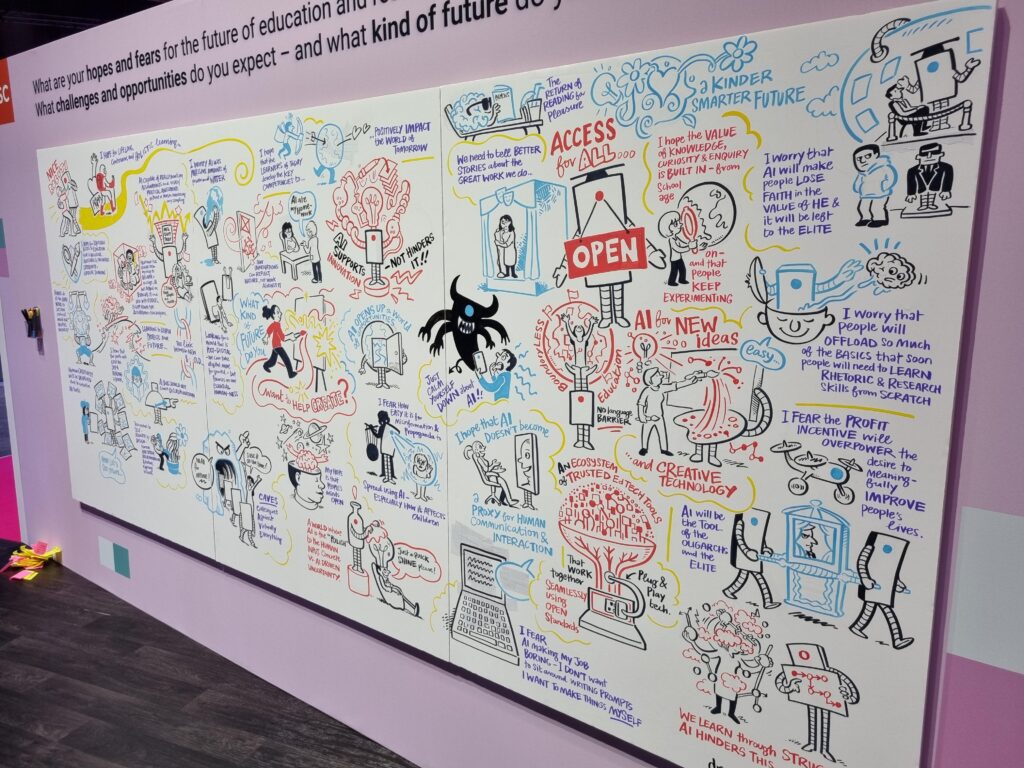
‘What kind of future do you want to help create?’
On the other hand, there are still fundamental questions about AI that are still outstanding, such as: ownership and sustainability of the hardware that AI relies on, the reliance many AI models have on consuming the intellectual property of others, and even the potential for AI to erode the very skills and qualities that make us human.
In perhaps my favourite session of all, ‘Inside the student experience: change, challenges and future hopes’, such concerns were echoed by a panel of student digital champions. They emphasised the importance of listening to student voices and involving them in the decision-making process at all levels. Their perspectives reinforced the notion that the technology of tomorrow must be developed not just with intelligence, but with wisdom and a deep respect for what it means to be human.

