

Diag====| Initiating an AUTOMATIC CHECK FOR UPDATES ON PAGE LOAD wp_loaded due to FeedWordPress option = string(4) "init"
Diag====| FeedWordPress is set up to hold pings, fwp_held_ping=0
Diag| Polling feed [https://blogs.ed.ac.uk/isintern/category/digital-learning-applications-media/feed/]
Diag====| HTTP [https://blogs.ed.ac.uk/isintern/category/digital-learning-applications-media/feed/] ⌈ array(7) {
  ["timeout"]=>
  int(20)
  ["redirection"]=>
  int(5)
  ["headers"]=>
  array(1) {
    ["Accept"]=>
    string(185) "application/atom+xml, application/rss+xml, application/rdf+xml;q=0.9, application/xml;q=0.8, text/xml;q=0.8, text/html;q=0.7, unknown/unknown;q=0.1, application/unknown;q=0.1, */*;q=0.1"
  }
  ["user-agent"]=>
  string(162) "FeedWordPress/2024.1119 (aggregator:feedwordpress; WordPress/6.8.5 + SimplePie/1.8.0; Allow like Gecko; +http://feedwordpress.radgeek.com/) at blogs.ed.ac.uk/dlam"
  ["authentication"]=>
  NULL
  ["username"]=>
  string(0) ""
  ["password"]=>
  string(0) ""
}
Diag====| HTTP [https://blogs.ed.ac.uk/isintern/category/digital-learning-applications-media/feed/] ⌉ array(6) {
  ["headers"]=>
  object(WpOrg\Requests\Utility\CaseInsensitiveDictionary)#2405 (1) {
    ["data":protected]=>
    array(12) {
      ["content-type"]=>
      string(34) "application/rss+xml; charset=UTF-8"
      ["date"]=>
      string(29) "Wed, 29 Apr 2026 10:02:44 GMT"
      ["server"]=>
      string(6) "Apache"
      ["x-powered-by"]=>
      string(10) "PHP/8.3.30"
      ["expires"]=>
      string(29) "Thu, 19 Nov 1981 08:52:00 GMT"
      ["cache-control"]=>
      string(35) "no-store, no-cache, must-revalidate"
      ["pragma"]=>
      string(8) "no-cache"
      ["link"]=>
      string(68) "<https://blogs.ed.ac.uk/isintern/wp-json/>; rel="https://api.w.org/""
      ["set-cookie"]=>
      array(3) {
        [0]=>
        string(62) "PHPSESSID=9g499q0t92m32f22oi3dunmh0r; path=/; secure; HttpOnly"
        [1]=>
        string(131) "spo_197_fa=e201a5a0d5ffd7b4165d9cec6bc47af3; expires=Wed, 29 Apr 2026 10:32:44 GMT; Max-Age=1800; path=/isintern/; Secure; HttpOnly"
        [2]=>
        string(125) "RCKBMHKB=027ff8be59-56fd-48GN_49W0-BNtcv-SNDtRAeVHj-Ca-aGKIJRnPra0GzMjkiqrvi3ZafZge3H0plT2Lj00; path=/; SameSite=None; Secure"
      }
      ["last-modified"]=>
      string(29) "Mon, 09 Mar 2026 12:40:28 GMT"
      ["etag"]=>
      string(34) ""73485174a70690c650b20cc06b0e5732""
      ["vary"]=>
      string(15) "Accept-Encoding"
    }
  }
  ["body"]=>
  string(1475) "<?xml version="1.0" encoding="UTF-8"?><rss version="2.0"
	xmlns:content="http://purl.org/rss/1.0/modules/content/"
	xmlns:wfw="http://wellformedweb.org/CommentAPI/"
	xmlns:dc="http://purl.org/dc/elements/1.1/"
	xmlns:atom="http://www.w3.org/2005/Atom"
	xmlns:sy="http://purl.org/rss/1.0/modules/syndication/"
	xmlns:slash="http://purl.org/rss/1.0/modules/slash/"
	xmlns:cc="http://creativecommons.org/ns#" >

<channel>
	<title>Information Services Group: Student Employee Blog</title>
	<atom:link href="https://blogs.ed.ac.uk/isintern/category/digital-learning-applications-media/feed/" rel="self" type="application/rss+xml" />
	<link>https://blogs.ed.ac.uk/isintern</link>
	<description>Hear from students about their experience working in the University's Information Services Group</description>
	<lastBuildDate>Mon, 09 Mar 2026 12:40:28 +0000</lastBuildDate>
	<language>en-GB</language>
	<sy:updatePeriod>
	hourly	</sy:updatePeriod>
	<sy:updateFrequency>
	1	</sy:updateFrequency>
	<generator>https://wordpress.org/?v=6.8.5</generator>

<image>
	<url>https://blogs.ed.ac.uk/isintern/wp-content/uploads/sites/197/2019/06/cropped-UOE-roundel-png-32x32.png</url>
	<title>Information Services Group: Student Employee Blog</title>
	<link>https://blogs.ed.ac.uk/isintern</link>
	<width>32</width>
	<height>32</height>
</image> 
<cc:license >Creative Commons Attribution CC BY 3.0</cc:license><dc:rights  >Creative Commons Attribution CC BY 3.0</dc:rights></channel>
</rss>
"
  ["response"]=>
  array(2) {
    ["code"]=>
    int(200)
    ["message"]=>
    string(2) "OK"
  }
  ["cookies"]=>
  array(3) {
    [0]=>
    object(WP_Http_Cookie)#2417 (7) {
      ["name"]=>
      string(9) "PHPSESSID"
      ["value"]=>
      string(26) "9g499q0t92m32f22oi3dunmh0r"
      ["expires"]=>
      NULL
      ["path"]=>
      string(1) "/"
      ["domain"]=>
      string(14) "blogs.ed.ac.uk"
      ["port"]=>
      NULL
      ["host_only"]=>
      bool(true)
    }
    [1]=>
    object(WP_Http_Cookie)#2416 (7) {
      ["name"]=>
      string(10) "spo_197_fa"
      ["value"]=>
      string(32) "e201a5a0d5ffd7b4165d9cec6bc47af3"
      ["expires"]=>
      int(1777458764)
      ["path"]=>
      string(10) "/isintern/"
      ["domain"]=>
      string(14) "blogs.ed.ac.uk"
      ["port"]=>
      NULL
      ["host_only"]=>
      bool(true)
    }
    [2]=>
    object(WP_Http_Cookie)#2418 (7) {
      ["name"]=>
      string(8) "RCKBMHKB"
      ["value"]=>
      string(85) "027ff8be59-56fd-48GN_49W0-BNtcv-SNDtRAeVHj-Ca-aGKIJRnPra0GzMjkiqrvi3ZafZge3H0plT2Lj00"
      ["expires"]=>
      NULL
      ["path"]=>
      string(1) "/"
      ["domain"]=>
      string(14) "blogs.ed.ac.uk"
      ["port"]=>
      NULL
      ["host_only"]=>
      bool(true)
    }
  }
  ["filename"]=>
  NULL
  ["http_response"]=>
  object(WP_HTTP_Requests_Response)#2404 (5) {
    ["data"]=>
    NULL
    ["headers"]=>
    NULL
    ["status"]=>
    NULL
    ["response":protected]=>
    object(WpOrg\Requests\Response)#2406 (10) {
      ["body"]=>
      string(1475) "<?xml version="1.0" encoding="UTF-8"?><rss version="2.0"
	xmlns:content="http://purl.org/rss/1.0/modules/content/"
	xmlns:wfw="http://wellformedweb.org/CommentAPI/"
	xmlns:dc="http://purl.org/dc/elements/1.1/"
	xmlns:atom="http://www.w3.org/2005/Atom"
	xmlns:sy="http://purl.org/rss/1.0/modules/syndication/"
	xmlns:slash="http://purl.org/rss/1.0/modules/slash/"
	xmlns:cc="http://creativecommons.org/ns#" >

<channel>
	<title>Information Services Group: Student Employee Blog</title>
	<atom:link href="https://blogs.ed.ac.uk/isintern/category/digital-learning-applications-media/feed/" rel="self" type="application/rss+xml" />
	<link>https://blogs.ed.ac.uk/isintern</link>
	<description>Hear from students about their experience working in the University's Information Services Group</description>
	<lastBuildDate>Mon, 09 Mar 2026 12:40:28 +0000</lastBuildDate>
	<language>en-GB</language>
	<sy:updatePeriod>
	hourly	</sy:updatePeriod>
	<sy:updateFrequency>
	1	</sy:updateFrequency>
	<generator>https://wordpress.org/?v=6.8.5</generator>

<image>
	<url>https://blogs.ed.ac.uk/isintern/wp-content/uploads/sites/197/2019/06/cropped-UOE-roundel-png-32x32.png</url>
	<title>Information Services Group: Student Employee Blog</title>
	<link>https://blogs.ed.ac.uk/isintern</link>
	<width>32</width>
	<height>32</height>
</image> 
<cc:license >Creative Commons Attribution CC BY 3.0</cc:license><dc:rights  >Creative Commons Attribution CC BY 3.0</dc:rights></channel>
</rss>
"
      ["raw"]=>
      string(2327) "HTTP/1.1 200 OK
Content-Type: application/rss+xml; charset=UTF-8
Transfer-Encoding: chunked
Connection: close
Date: Wed, 29 Apr 2026 10:02:44 GMT
Server: Apache
X-Powered-By: PHP/8.3.30
Expires: Thu, 19 Nov 1981 08:52:00 GMT
Cache-Control: no-store, no-cache, must-revalidate
Pragma: no-cache
Link: <https://blogs.ed.ac.uk/isintern/wp-json/>; rel="https://api.w.org/"
Set-Cookie: PHPSESSID=9g499q0t92m32f22oi3dunmh0r; path=/; secure; HttpOnly
Set-Cookie: spo_197_fa=e201a5a0d5ffd7b4165d9cec6bc47af3; expires=Wed, 29 Apr 2026 10:32:44 GMT; Max-Age=1800; path=/isintern/; Secure; HttpOnly
Last-Modified: Mon, 09 Mar 2026 12:40:28 GMT
ETag: "73485174a70690c650b20cc06b0e5732"
Vary: Accept-Encoding
Set-Cookie: RCKBMHKB=027ff8be59-56fd-48GN_49W0-BNtcv-SNDtRAeVHj-Ca-aGKIJRnPra0GzMjkiqrvi3ZafZge3H0plT2Lj00; path=/; SameSite=None; Secure

<?xml version="1.0" encoding="UTF-8"?><rss version="2.0"
	xmlns:content="http://purl.org/rss/1.0/modules/content/"
	xmlns:wfw="http://wellformedweb.org/CommentAPI/"
	xmlns:dc="http://purl.org/dc/elements/1.1/"
	xmlns:atom="http://www.w3.org/2005/Atom"
	xmlns:sy="http://purl.org/rss/1.0/modules/syndication/"
	xmlns:slash="http://purl.org/rss/1.0/modules/slash/"
	xmlns:cc="http://creativecommons.org/ns#" >

<channel>
	<title>Information Services Group: Student Employee Blog</title>
	<atom:link href="https://blogs.ed.ac.uk/isintern/category/digital-learning-applications-media/feed/" rel="self" type="application/rss+xml" />
	<link>https://blogs.ed.ac.uk/isintern</link>
	<description>Hear from students about their experience working in the University's Information Services Group</description>
	<lastBuildDate>Mon, 09 Mar 2026 12:40:28 +0000</lastBuildDate>
	<language>en-GB</language>
	<sy:updatePeriod>
	hourly	</sy:updatePeriod>
	<sy:updateFrequency>
	1	</sy:updateFrequency>
	<generator>https://wordpress.org/?v=6.8.5</generator>

<image>
	<url>https://blogs.ed.ac.uk/isintern/wp-content/uploads/sites/197/2019/06/cropped-UOE-roundel-png-32x32.png</url>
	<title>Information Services Group: Student Employee Blog</title>
	<link>https://blogs.ed.ac.uk/isintern</link>
	<width>32</width>
	<height>32</height>
</image> 
<cc:license >Creative Commons Attribution CC BY 3.0</cc:license><dc:rights  >Creative Commons Attribution CC BY 3.0</dc:rights></channel>
</rss>
"
      ["headers"]=>
      object(WpOrg\Requests\Response\Headers)#2407 (1) {
        ["data":protected]=>
        array(12) {
          ["content-type"]=>
          array(1) {
            [0]=>
            string(34) "application/rss+xml; charset=UTF-8"
          }
          ["date"]=>
          array(1) {
            [0]=>
            string(29) "Wed, 29 Apr 2026 10:02:44 GMT"
          }
          ["server"]=>
          array(1) {
            [0]=>
            string(6) "Apache"
          }
          ["x-powered-by"]=>
          array(1) {
            [0]=>
            string(10) "PHP/8.3.30"
          }
          ["expires"]=>
          array(1) {
            [0]=>
            string(29) "Thu, 19 Nov 1981 08:52:00 GMT"
          }
          ["cache-control"]=>
          array(1) {
            [0]=>
            string(35) "no-store, no-cache, must-revalidate"
          }
          ["pragma"]=>
          array(1) {
            [0]=>
            string(8) "no-cache"
          }
          ["link"]=>
          array(1) {
            [0]=>
            string(68) "<https://blogs.ed.ac.uk/isintern/wp-json/>; rel="https://api.w.org/""
          }
          ["set-cookie"]=>
          array(3) {
            [0]=>
            string(62) "PHPSESSID=9g499q0t92m32f22oi3dunmh0r; path=/; secure; HttpOnly"
            [1]=>
            string(131) "spo_197_fa=e201a5a0d5ffd7b4165d9cec6bc47af3; expires=Wed, 29 Apr 2026 10:32:44 GMT; Max-Age=1800; path=/isintern/; Secure; HttpOnly"
            [2]=>
            string(125) "RCKBMHKB=027ff8be59-56fd-48GN_49W0-BNtcv-SNDtRAeVHj-Ca-aGKIJRnPra0GzMjkiqrvi3ZafZge3H0plT2Lj00; path=/; SameSite=None; Secure"
          }
          ["last-modified"]=>
          array(1) {
            [0]=>
            string(29) "Mon, 09 Mar 2026 12:40:28 GMT"
          }
          ["etag"]=>
          array(1) {
            [0]=>
            string(34) ""73485174a70690c650b20cc06b0e5732""
          }
          ["vary"]=>
          array(1) {
            [0]=>
            string(15) "Accept-Encoding"
          }
        }
      }
      ["status_code"]=>
      int(200)
      ["protocol_version"]=>
      float(1.1)
      ["success"]=>
      bool(true)
      ["redirects"]=>
      int(0)
      ["url"]=>
      string(82) "https://blogs.ed.ac.uk/isintern/category/digital-learning-applications-media/feed/"
      ["history"]=>
      array(0) {
      }
      ["cookies"]=>
      object(WpOrg\Requests\Cookie\Jar)#2403 (1) {
        ["cookies":protected]=>
        array(3) {
          ["PHPSESSID"]=>
          object(WpOrg\Requests\Cookie)#2411 (5) {
            ["name"]=>
            string(9) "PHPSESSID"
            ["value"]=>
            string(26) "9g499q0t92m32f22oi3dunmh0r"
            ["attributes"]=>
            object(WpOrg\Requests\Utility\CaseInsensitiveDictionary)#2410 (1) {
              ["data":protected]=>
              array(4) {
                ["path"]=>
                string(1) "/"
                ["secure"]=>
                bool(true)
                ["httponly"]=>
                bool(true)
                ["domain"]=>
                string(14) "blogs.ed.ac.uk"
              }
            }
            ["flags"]=>
            array(4) {
              ["creation"]=>
              int(1777456965)
              ["last-access"]=>
              int(1777456965)
              ["persistent"]=>
              bool(false)
              ["host-only"]=>
              bool(true)
            }
            ["reference_time"]=>
            int(1777456965)
          }
          ["spo_197_fa"]=>
          object(WpOrg\Requests\Cookie)#2412 (5) {
            ["name"]=>
            string(10) "spo_197_fa"
            ["value"]=>
            string(32) "e201a5a0d5ffd7b4165d9cec6bc47af3"
            ["attributes"]=>
            object(WpOrg\Requests\Utility\CaseInsensitiveDictionary)#2413 (1) {
              ["data":protected]=>
              array(6) {
                ["expires"]=>
                int(1777458764)
                ["max-age"]=>
                int(1777458765)
                ["path"]=>
                string(10) "/isintern/"
                ["secure"]=>
                bool(true)
                ["httponly"]=>
                bool(true)
                ["domain"]=>
                string(14) "blogs.ed.ac.uk"
              }
            }
            ["flags"]=>
            array(4) {
              ["creation"]=>
              int(1777456965)
              ["last-access"]=>
              int(1777456965)
              ["persistent"]=>
              bool(false)
              ["host-only"]=>
              bool(true)
            }
            ["reference_time"]=>
            int(1777456965)
          }
          ["RCKBMHKB"]=>
          object(WpOrg\Requests\Cookie)#2414 (5) {
            ["name"]=>
            string(8) "RCKBMHKB"
            ["value"]=>
            string(85) "027ff8be59-56fd-48GN_49W0-BNtcv-SNDtRAeVHj-Ca-aGKIJRnPra0GzMjkiqrvi3ZafZge3H0plT2Lj00"
            ["attributes"]=>
            object(WpOrg\Requests\Utility\CaseInsensitiveDictionary)#2415 (1) {
              ["data":protected]=>
              array(4) {
                ["path"]=>
                string(1) "/"
                ["samesite"]=>
                string(4) "None"
                ["secure"]=>
                bool(true)
                ["domain"]=>
                string(14) "blogs.ed.ac.uk"
              }
            }
            ["flags"]=>
            array(4) {
              ["creation"]=>
              int(1777456965)
              ["last-access"]=>
              int(1777456965)
              ["persistent"]=>
              bool(false)
              ["host-only"]=>
              bool(true)
            }
            ["reference_time"]=>
            int(1777456965)
          }
        }
      }
    }
    ["filename":protected]=>
    NULL
  }
}
Diag| Polling feed [https://blogs.ed.ac.uk/deliageorgescu/feed/]
Diag====| HTTP [https://blogs.ed.ac.uk/deliageorgescu/feed/] ⌈ array(7) {
  ["timeout"]=>
  int(20)
  ["redirection"]=>
  int(5)
  ["headers"]=>
  array(1) {
    ["Accept"]=>
    string(185) "application/atom+xml, application/rss+xml, application/rdf+xml;q=0.9, application/xml;q=0.8, text/xml;q=0.8, text/html;q=0.7, unknown/unknown;q=0.1, application/unknown;q=0.1, */*;q=0.1"
  }
  ["user-agent"]=>
  string(162) "FeedWordPress/2024.1119 (aggregator:feedwordpress; WordPress/6.8.5 + SimplePie/1.8.0; Allow like Gecko; +http://feedwordpress.radgeek.com/) at blogs.ed.ac.uk/dlam"
  ["authentication"]=>
  NULL
  ["username"]=>
  string(0) ""
  ["password"]=>
  string(0) ""
}
Diag====| HTTP [https://blogs.ed.ac.uk/deliageorgescu/feed/] ⌉ array(6) {
  ["headers"]=>
  object(WpOrg\Requests\Utility\CaseInsensitiveDictionary)#2411 (1) {
    ["data":protected]=>
    array(12) {
      ["content-type"]=>
      string(34) "application/rss+xml; charset=UTF-8"
      ["date"]=>
      string(29) "Wed, 29 Apr 2026 10:02:45 GMT"
      ["server"]=>
      string(6) "Apache"
      ["x-powered-by"]=>
      string(10) "PHP/8.3.30"
      ["expires"]=>
      string(29) "Thu, 19 Nov 1981 08:52:00 GMT"
      ["cache-control"]=>
      string(35) "no-store, no-cache, must-revalidate"
      ["pragma"]=>
      string(8) "no-cache"
      ["link"]=>
      string(74) "<https://blogs.ed.ac.uk/deliageorgescu/wp-json/>; rel="https://api.w.org/""
      ["set-cookie"]=>
      array(3) {
        [0]=>
        string(62) "PHPSESSID=2qtlr27th3m0lg22uug2chh9c3; path=/; secure; HttpOnly"
        [1]=>
        string(138) "spo_7365_fa=81d1f6808915cd52fa07e96bf7b18f33; expires=Wed, 29 Apr 2026 10:32:45 GMT; Max-Age=1800; path=/deliageorgescu/; Secure; HttpOnly"
        [2]=>
        string(125) "RCKBMHKB=027ff8be59-56fd-48FSTqcL7kSsmVxVtVOnu40wwKLo8gYYIlf04kpfcWLFKXoBFYJ1fDbEZCZRtHSJOoNIE; path=/; SameSite=None; Secure"
      }
      ["last-modified"]=>
      string(29) "Wed, 18 Mar 2026 14:55:04 GMT"
      ["etag"]=>
      string(34) ""a92b1921fccd13b266bcc35eca7a5c90""
      ["vary"]=>
      string(15) "Accept-Encoding"
    }
  }
  ["body"]=>
  string(25107) "<?xml version="1.0" encoding="UTF-8"?><rss version="2.0"
	xmlns:content="http://purl.org/rss/1.0/modules/content/"
	xmlns:wfw="http://wellformedweb.org/CommentAPI/"
	xmlns:dc="http://purl.org/dc/elements/1.1/"
	xmlns:atom="http://www.w3.org/2005/Atom"
	xmlns:sy="http://purl.org/rss/1.0/modules/syndication/"
	xmlns:slash="http://purl.org/rss/1.0/modules/slash/"
	xmlns:cc="http://creativecommons.org/ns#" >

<channel>
	<title>A foray into Delia's world</title>
	<atom:link href="https://blogs.ed.ac.uk/deliageorgescu/feed/" rel="self" type="application/rss+xml" />
	<link>https://blogs.ed.ac.uk/deliageorgescu</link>
	<description>The ramblings of a bilingual foodie lost in the Learning Technology world</description>
	<lastBuildDate>Wed, 18 Mar 2026 14:55:04 +0000</lastBuildDate>
	<language>en-GB</language>
	<sy:updatePeriod>
	hourly	</sy:updatePeriod>
	<sy:updateFrequency>
	1	</sy:updateFrequency>
	<generator>https://wordpress.org/?v=6.8.5</generator>
<cc:license >Creative Commons Attribution CC BY 3.0</cc:license><dc:rights  >Creative Commons Attribution CC BY 3.0</dc:rights>	<item>
		<title>Badges with Backbone @ Canvas UK Spring meeting</title>
		<link>https://blogs.ed.ac.uk/deliageorgescu/2026/03/03/badges-with-backbone-canvas-uk-spring-meeting/</link>
					<comments>https://blogs.ed.ac.uk/deliageorgescu/2026/03/03/badges-with-backbone-canvas-uk-spring-meeting/#comments</comments>
		
		<dc:creator><![CDATA[dgeorge2]]></dc:creator>
		<pubDate>Tue, 03 Mar 2026 18:42:04 +0000</pubDate>
				<category><![CDATA[Uncategorised]]></category>
		<category><![CDATA[badges]]></category>
		<category><![CDATA[dlam]]></category>
		<category><![CDATA[dlam-feed]]></category>
		<guid isPermaLink="false">https://blogs.ed.ac.uk/deliageorgescu/?p=150</guid>

					<description><![CDATA[<span class="span-reading-time rt-reading-time" style="display: block;"><span class="rt-label rt-prefix">Reading Time: </span> <span class="rt-time"> 2</span> <span class="rt-label rt-postfix">minutes</span></span>The Spring Canvas UK User Group was hosted at ARU Peterborough — a brand‑new institution, opened in 2022, set up to boost local skills and employability through career‑focused education. The university was created to tackle a long‑standing skills shortage in the area, with Peterborough sitting in the bottom 10% nationally for degree‑level qualifications. Their aim […]]]></description>
										<content:encoded><![CDATA[<span class="span-reading-time rt-reading-time" style="display: block;"><span class="rt-label rt-prefix">Reading Time: </span> <span class="rt-time"> 2</span> <span class="rt-label rt-postfix">minutes</span></span><p>The Spring Canvas UK User Group was hosted at ARU Peterborough — a brand‑new institution, opened in 2022, set up to boost local skills and employability through career‑focused education. The university was created to tackle a long‑standing skills shortage in the area, with Peterborough sitting in the bottom 10% nationally for degree‑level qualifications. Their aim is to widen participation, attract students from non‑traditional backgrounds, and build a curriculum tied directly to local economic needs. In short: a practical response to a higher‑education “cold spot.”</p>
<p>It couldn’t be more different from the University of Edinburgh — we’re very much the classic, historic university, and incredibly privileged in what we already have. And it seems like contradiction was the theme of this conference at least from my perspective.</p>
<h2>Badges with Backbone</h2>
<p>I was first up: Building a scalable badging model & ecosystem — which, let’s be honest, is not the most memorable title. Thanks to last week’s Practical Strategic Storytelling workshop, I renamed it “Badges with Backbone.” Much better. The audience asked lots of questions at the end. That’s a good thing… right? After what felt like a light interrogation (I was genuinely sweating), what became clear to me was this: we do have the infrastructure in place for a scalable model — check. But now we need to reconnect that infrastructure to our earners and their employers. We need to understand:</p>
<ul>
<li>How they perceive badges</li>
<li>Whether they understand their value</li>
<li>How badges evidence skills in ways that genuinely enhance employability.</li>
</ul>
<p>For our last survey, we relied on champions to share the questionnaire with the earners, and the response rate was… modest. I’m not claiming direct causation — but it does make me try going straight to the source next time: EUSA, open days, employer events — anywhere we can actually talk to the people involved.</p>
<h2><strong>Different Models, Same Purpose</strong></h2>
<p>Boston College presented after me, and I’m glad they did. Their approach to badging is bright, colourful, gamified, aimed at under‑18s. It is programme‑based and tied directly to marketable skills. At polar opposites from ours.</p>
<p>But it was a good reminder that one size doesn’t fit all. Different audiences, different needs, different solutions. They even use badges for staff accessibility training — honestly, not a bad idea.</p>
<p>I’ll admit I felt a pang of jealousy when they mentioned their rapid rollout (March to September in the same year). Then I remembered the sheer amount of groundwork we’ve put into our framework. Ours is built to scale, built to last, and ready for wider use with the SCP.</p>
<h2>APIs, AI, and Unexpected Practicality</h2>
<p>Manchester University’s session on APIs and AI was surprisingly one of the most practical AI‑in‑education talks I’ve been to. Surprising because I don’t code. I make a point to avoid coding. Usually anything with “API” in the title makes me want to sneak out of the room.</p>
<p>But the way they framed it — using AI to speed up tasks I’d otherwise spend months trying to learn — actually made sense. It felt more relevant to my day‑to‑day work than the usual high‑level ethical debates about AI literacy.</p>
<h2>Wrapping Up</h2>
<p>Overall, it was a valuable conference. Good conversations with colleagues and with the vendor, and a reminder that while we work with technology, frameworks, and strategy, we’re still human beings trying to build things that help other human beings.</p>
<p>And after presenting, surviving a Q&A, and facilitating one of the afternoon’s discussion tables… yes, I absolutely needed that pint at the end.</p>

			<span class="uoe-published-time uoe-seo-hidden-area">
				<time datetime="2026-03-03" itemprop="dateModified">Mar 3, 2026</time>
			</span>
		]]></content:encoded>
					
					<wfw:commentRss>https://blogs.ed.ac.uk/deliageorgescu/2026/03/03/badges-with-backbone-canvas-uk-spring-meeting/feed/</wfw:commentRss>
			<slash:comments>1</slash:comments>
		
		
			</item>
		<item>
		<title>Back to the Beginning: Black Sabbath and Birmingham</title>
		<link>https://blogs.ed.ac.uk/deliageorgescu/2025/07/24/back-to-the-beginning-black-sabbath-and-birmingham/</link>
					<comments>https://blogs.ed.ac.uk/deliageorgescu/2025/07/24/back-to-the-beginning-black-sabbath-and-birmingham/#respond</comments>
		
		<dc:creator><![CDATA[dgeorge2]]></dc:creator>
		<pubDate>Thu, 24 Jul 2025 13:29:34 +0000</pubDate>
				<category><![CDATA[Uncategorised]]></category>
		<guid isPermaLink="false">https://blogs.ed.ac.uk/deliageorgescu/?p=139</guid>

					<description><![CDATA[<span class="span-reading-time rt-reading-time" style="display: block;"><span class="rt-label rt-prefix">Reading Time: </span> <span class="rt-time"> 3</span> <span class="rt-label rt-postfix">minutes</span></span>The last time I found myself in Birmingham, it was for a Canvas conference. Like many of my colleagues, I looked forward to the event — but not the destination. Birmingham, for all its history, carries a certain reputation these days: gritty, grey, post-industrial. It’s a city people often pass through, not go to. This […]]]></description>
										<content:encoded><![CDATA[<span class="span-reading-time rt-reading-time" style="display: block;"><span class="rt-label rt-prefix">Reading Time: </span> <span class="rt-time"> 3</span> <span class="rt-label rt-postfix">minutes</span></span><p data-start="504" data-end="814">The last time I found myself in Birmingham, it was for a Canvas conference. Like many of my colleagues, I looked forward to the event — but not the destination. Birmingham, for all its history, carries a certain reputation these days: gritty, grey, post-industrial. It’s a city people often pass through, not go to.</p>
<p data-start="816" data-end="849">This time, though, was different.</p>
<p style="text-align: left" data-start="851" data-end="1155">Birmingham named this summer the <em data-start="113" data-end="132">Summer of Sabbath</em>, commemorating the band’s career throughout the city — from Ozzy the metal bull greeting us at the train station, to The Crown Pub and a dedicated exhibition at the Birmingham Museum. And at the heart of it all, the crown jewel: a farewell concert, the most anticipated event in metal music — and not only metal. It was a cultural moment, a homecoming unlike any other.</p>
<p data-start="851" data-end="1155"><img decoding="async" class="alignnone size-medium wp-image-141 alignright" src="https://blogs.ed.ac.uk/deliageorgescu/wp-content/uploads/sites/7365/2025/07/Ozzy-the-bull-300x228.png" alt="Ozzy the bull metal structure" width="300" height="228" srcset="https://blogs.ed.ac.uk/deliageorgescu/wp-content/uploads/sites/7365/2025/07/Ozzy-the-bull-300x228.png 300w, https://blogs.ed.ac.uk/deliageorgescu/wp-content/uploads/sites/7365/2025/07/Ozzy-the-bull-768x583.png 768w, https://blogs.ed.ac.uk/deliageorgescu/wp-content/uploads/sites/7365/2025/07/Ozzy-the-bull.png 878w" sizes="(max-width: 300px) 100vw, 300px" /></p>
<p>The concert’s title couldn’t be more appropriate. As the train left the station heading toward Villa Park, it felt like a trip into the past — back to where it all began. We passed many a traditional red-brick building, graffitied, worn and crumbling — echoes of a more prosperous time. Once the beating heart of British industry, Birmingham led the charge in manufacturing, engineering, and automotive innovation. That proud past still lingers, like soot in the air, even as the city shifts and strains under modern pressures.</p>
<p data-start="1688" data-end="1994">For most visitors, this backdrop might feel unwelcoming — austere, even. But for this journey, it felt exactly right. I wasn’t here to experience the modern city. I was here for a pilgrimage: to witness the final homecoming of the godfathers of heavy metal. Black Sabbath, returning to where it all began.</p>
<p data-start="1996" data-end="2333">There are already hundreds of reviews out there dissecting the gig itself —the epic setlist, the legends on stage (who could fill Villa Park on their own, let alone as a collective force. But for me, the most striking element wasn’t just the music. It was how perfectly the surroundings fit.</p>
<p data-start="2335" data-end="2730">On stage, the massive screens displayed black-and-white footage of Birmingham in the 1960s. Steelworks, smokestacks, workers. As the haunting riff of “Black Sabbath” rang out, those old images reminded us that this band — and this sound — weren’t born in spite of the city’s hardship, but because of it.</p>
<p data-start="3037" data-end="3371">From our spot in the Holte End, I looked to the right, out through a break in the stands. There, through the opening, you could see rooftops stretching into the distance, the occasional train rumbling past — a living, breathing reminder of where we were. In that moment, it all made sense. The music. The place. The people. Birmingham may not be glamorous, but it has soul. And for a band like Black Sabbath — it was always the only place to begin, and the only place to end.</p>
<p><img loading="lazy" decoding="async" class=" wp-image-146 aligncenter" src="https://blogs.ed.ac.uk/deliageorgescu/wp-content/uploads/sites/7365/2025/07/Untitled-300x169.png" alt="Stadium concert setting with stage and crowd" width="350" height="197" srcset="https://blogs.ed.ac.uk/deliageorgescu/wp-content/uploads/sites/7365/2025/07/Untitled-300x169.png 300w, https://blogs.ed.ac.uk/deliageorgescu/wp-content/uploads/sites/7365/2025/07/Untitled-1024x577.png 1024w, https://blogs.ed.ac.uk/deliageorgescu/wp-content/uploads/sites/7365/2025/07/Untitled-768x433.png 768w, https://blogs.ed.ac.uk/deliageorgescu/wp-content/uploads/sites/7365/2025/07/Untitled-1536x865.png 1536w, https://blogs.ed.ac.uk/deliageorgescu/wp-content/uploads/sites/7365/2025/07/Untitled-1440x811.png 1440w, https://blogs.ed.ac.uk/deliageorgescu/wp-content/uploads/sites/7365/2025/07/Untitled.png 1919w" sizes="auto, (max-width: 350px) 100vw, 350px" /></p>
<p>PS: Writing this after hearing about Ozzy’s passing yesterday gives this experience a new depth, which is why I decided to share it. I wasn’t sure whether it belonged here, but after chatting with a few colleagues about the concert, I realised it might resonate more than I thought.</p>

			<span class="uoe-published-time uoe-seo-hidden-area">
				<time datetime="2025-07-24" itemprop="dateModified">Jul 24, 2025</time>
			</span>
		]]></content:encoded>
					
					<wfw:commentRss>https://blogs.ed.ac.uk/deliageorgescu/2025/07/24/back-to-the-beginning-black-sabbath-and-birmingham/feed/</wfw:commentRss>
			<slash:comments>0</slash:comments>
		
		
			</item>
		<item>
		<title>Masticate on this!</title>
		<link>https://blogs.ed.ac.uk/deliageorgescu/2022/10/05/masticate-on-this/</link>
					<comments>https://blogs.ed.ac.uk/deliageorgescu/2022/10/05/masticate-on-this/#respond</comments>
		
		<dc:creator><![CDATA[dgeorge2]]></dc:creator>
		<pubDate>Wed, 05 Oct 2022 13:20:34 +0000</pubDate>
				<category><![CDATA[Uncategorised]]></category>
		<category><![CDATA[dlam-feed]]></category>
		<guid isPermaLink="false">https://blogs.ed.ac.uk/deliageorgescu/?p=30</guid>

					<description><![CDATA[<span class="span-reading-time rt-reading-time" style="display: block;"><span class="rt-label rt-prefix">Reading Time: </span> <span class="rt-time"> 4</span> <span class="rt-label rt-postfix">minutes</span></span>My first blog was due to happen soon, so I might as well start with something I love My friends ask me why I don’t start documenting my food experiments and restaurant visits in a food blog (they are probably tired of me steering all conversations towards food and consider it would be more worthwhile […]]]></description>
										<content:encoded><![CDATA[<span class="span-reading-time rt-reading-time" style="display: block;"><span class="rt-label rt-prefix">Reading Time: </span> <span class="rt-time"> 4</span> <span class="rt-label rt-postfix">minutes</span></span><h4 style="text-align: center">My first blog was due to happen soon, so I might as well start with something I love</h4>
<p>My friends ask me why I don’t start documenting my food experiments and restaurant visits in a food blog (they are probably tired of me steering all conversations towards food and consider it would be more worthwhile to focus my energy into a constructive avenue). My work colleagues suggest I blog as a tool of reflecting on my work experience and potentially providing a start for my CMALT portfolio (hopefully more on that in another post). So I’m going to try to combine these topics, into a ‘food I had at work’ blog. Well, sort of…</p>
<p><img loading="lazy" decoding="async" class="wp-image-62 alignright" src="https://blogs.ed.ac.uk/deliageorgescu/wp-content/uploads/sites/7365/2022/10/a-169x300.jpg" alt="a display table with cake trays" width="241" height="428" srcset="https://blogs.ed.ac.uk/deliageorgescu/wp-content/uploads/sites/7365/2022/10/a-169x300.jpg 169w, https://blogs.ed.ac.uk/deliageorgescu/wp-content/uploads/sites/7365/2022/10/a-577x1024.jpg 577w, https://blogs.ed.ac.uk/deliageorgescu/wp-content/uploads/sites/7365/2022/10/a-768x1364.jpg 768w, https://blogs.ed.ac.uk/deliageorgescu/wp-content/uploads/sites/7365/2022/10/a-865x1536.jpg 865w, https://blogs.ed.ac.uk/deliageorgescu/wp-content/uploads/sites/7365/2022/10/a-1153x2048.jpg 1153w, https://blogs.ed.ac.uk/deliageorgescu/wp-content/uploads/sites/7365/2022/10/a-541x960.jpg 541w, https://blogs.ed.ac.uk/deliageorgescu/wp-content/uploads/sites/7365/2022/10/a-scaled.jpg 1442w" sizes="auto, (max-width: 241px) 100vw, 241px" />Every time I come into the Argyle House office I feel tempted by the myriad of lovely shops around the Grassmarket area: ice-cream from <a href="https://www.instagram.com/marysmilkbar/">Mary’s Milk Bar</a>, cake from <a href="https://www.instagram.com/tastybunsbakery/">Tasty Buns</a>, coffee from the <a href="https://www.thesourcecoffee.co.uk/">Source</a>, spanakopita from the <a href="https://www.facebook.com/GreekArtisanPastries/">Greek Artisan Pastries</a> are just a handful of my favourites that come to mind. Yesterday I added a new discovery to that list: the relatively recently opened <a href="https://www.instagram.com/slice_of_greece_/">Slice of Greece</a>, on Morrison Street. As I waltzed into the shop, my eyes were instantly drawn to the mastic desserts in the display. The one I chose was a Galaktompoureko, a mastic flavoured custard filled phyllo pastry pie. Why, you are asking, among all the chocolate covered croissants, baklavas and mousse pots?</p>
<p>Mastic, or mastiha, happens to be one of my favourite flavours in the world! Sadly, I don’t come across it as often as I’d like to, especially in the UK, it is an underdog. In all the GBBO seasons I’ve watched (admittedly, not all, so somebody PLEASE correct me if I’m wrong) I’ve only seen it used once in season 12 when George made brandy snaps filled with an orange blossom and mastic creme pat, and mentioned once on their recipe page (<a href="https://thegreatbritishbakeoff.co.uk/recipes/all/paul-hollywood-flaounas/">https://thegreatbritishbakeoff.co.uk/recipes/all/paul-hollywood-flaounas/</a>).</p>
<h4 style="text-align: center">But what exactly is mastic?</h4>
<h4><img loading="lazy" decoding="async" class="wp-image-33 alignright" src="https://blogs.ed.ac.uk/deliageorgescu/wp-content/uploads/sites/7365/2022/10/20220818_121423-169x300.jpg" alt="Close-up of resin dripping out of a mastic tree bark" width="234" height="415" srcset="https://blogs.ed.ac.uk/deliageorgescu/wp-content/uploads/sites/7365/2022/10/20220818_121423-169x300.jpg 169w, https://blogs.ed.ac.uk/deliageorgescu/wp-content/uploads/sites/7365/2022/10/20220818_121423-576x1024.jpg 576w, https://blogs.ed.ac.uk/deliageorgescu/wp-content/uploads/sites/7365/2022/10/20220818_121423.jpg 613w" sizes="auto, (max-width: 234px) 100vw, 234px" /></h4>
<p>Mastic is the resin extracted from the <em>Pistacia lentiscus </em>aka the Chios mastic tree, a little shrub like tree. The resin is ‘revealed’ by cutting into the tree bark, which releases the ‘tears’ of resin. These harden and are then collected and cleaned.  It is used as a flavouring in lots of deserts (list) as well as in mastica, an alcoholic sweet liqueur similar to ouzo, and in cosmetic products due to its nice smell and supposed medicinal benefits. It is also the earliest known form of chewing gum: the Ancient Greeks aptly named the resin after the word <em>mastikhan, </em>“to gnash the teeth”, which through a long linguistic journey via Latin and Old French also reached English: “to masticate, to chew”.</p>
<p>Mastichochoria, the mastic villages in the south of the island, are the main (and only constant) producers of mastic in the world. There are small groves in the Çeşme peninsula in Turkey, and the Japanese tried importing and growing the trees but the unique soil and climate of Chios made planting the trees elsewhere an impossible task.</p>
<p>The taste is very unique and hard to describe. It always takes me a while to come up with an answer when someone asks me to describe it, and I always wish I had a piece of gum to hand them, as it would make the process a lot easier. I’d say it tastes ‘resin-y’ (what a surprise!) herbally and pine-y. It is definitely an aquired taste. So far I’ve only used it in a <a href="https://www.tasteatlas.com/maras-dondurmas/recipe">Maraş style ice-cream</a> and flavoured custard.</p>
<h4 style="text-align: center">A bit of a (his)story*</h4>
<p><img loading="lazy" decoding="async" class="wp-image-57 alignright" src="https://blogs.ed.ac.uk/deliageorgescu/wp-content/uploads/sites/7365/2022/10/Eugene_Delacroix_-_Le_Massacre_de_Scio-254x300.jpg" alt="Massacre of Choios painting by Eugene Delacroix" width="327" height="387" srcset="https://blogs.ed.ac.uk/deliageorgescu/wp-content/uploads/sites/7365/2022/10/Eugene_Delacroix_-_Le_Massacre_de_Scio-254x300.jpg 254w, https://blogs.ed.ac.uk/deliageorgescu/wp-content/uploads/sites/7365/2022/10/Eugene_Delacroix_-_Le_Massacre_de_Scio-867x1024.jpg 867w, https://blogs.ed.ac.uk/deliageorgescu/wp-content/uploads/sites/7365/2022/10/Eugene_Delacroix_-_Le_Massacre_de_Scio-768x907.jpg 768w, https://blogs.ed.ac.uk/deliageorgescu/wp-content/uploads/sites/7365/2022/10/Eugene_Delacroix_-_Le_Massacre_de_Scio-813x960.jpg 813w, https://blogs.ed.ac.uk/deliageorgescu/wp-content/uploads/sites/7365/2022/10/Eugene_Delacroix_-_Le_Massacre_de_Scio.jpg 1024w" sizes="auto, (max-width: 327px) 100vw, 327px" />To me, mastic is a taste of summer holidays in Turkey (I know, Greek people please be patient). My dad would always have a packet of mastic chewing gum in his car, and it would the first thing I tasted upon my arrival in Turkey. However, it was not until this summer that I visited the ‘home’ of mastic- the island of Chios. The 5<sup>th</sup> biggest Greek island, it is located only 3.5 miles (5.5 km) from the Turkish coast. And as the location suggests, it has a very turbulent history.</p>
<p>Archaeological research on Chios has found evidence of habitation as early as the Neolithic era, and the island has gone through the hands of multiple occupiers: Persians, Greeks, Romans, Byzantine, Genoese, Ottoman and eventually back to the Greek, after the First Balkan War in 1912. All of which left an imprint on the island. There is still quite a bit of animosity between the Greek and the Turkish people of the island, one of the most interesting examples being the removal and re-addition of the replica of Eugene Delacroix’s “The Massacre of Chios” from the Byzantine museum on Chios (incidentally, the museum is located in the old mosque). In 2009, a copy of the painting was displayed in the museum, swiftly withdrawn a few months later in a “good faith initiative” for the improvement of Greek-Turkish relations. However, the Greeks protested its removal, leading to the copy being brought back on display.</p>
<p>So here it is, a blog about the food I had at work, turned travel blog, turned love declaration to mastic.</p>
<p>Oh, and please give Slice of Greece a try. I did lie a bit at the start, I also got a couple of mousse pots because I couldn’t resist them – the black forest and the caramel ones. Also, the next day I returned for a (huge) slice of baklava, it had to be tested! I can now also confirm they do one of the best baklavas I’ve had in Edinburgh- laden with syrup, walnuts and cinnamon, and not overly sweet, which was a nice surprise. <img loading="lazy" decoding="async" class="size-medium wp-image-69 aligncenter" src="https://blogs.ed.ac.uk/deliageorgescu/wp-content/uploads/sites/7365/2022/10/cake-298x300.jpg" alt="2 plastic pots with mouse in the foreground, and a pastry in a box in the background" width="298" height="300" srcset="https://blogs.ed.ac.uk/deliageorgescu/wp-content/uploads/sites/7365/2022/10/cake-298x300.jpg 298w, https://blogs.ed.ac.uk/deliageorgescu/wp-content/uploads/sites/7365/2022/10/cake-1019x1024.jpg 1019w, https://blogs.ed.ac.uk/deliageorgescu/wp-content/uploads/sites/7365/2022/10/cake-150x150.jpg 150w, https://blogs.ed.ac.uk/deliageorgescu/wp-content/uploads/sites/7365/2022/10/cake-768x772.jpg 768w, https://blogs.ed.ac.uk/deliageorgescu/wp-content/uploads/sites/7365/2022/10/cake-1528x1536.jpg 1528w, https://blogs.ed.ac.uk/deliageorgescu/wp-content/uploads/sites/7365/2022/10/cake-955x960.jpg 955w, https://blogs.ed.ac.uk/deliageorgescu/wp-content/uploads/sites/7365/2022/10/cake.jpg 1717w" sizes="auto, (max-width: 298px) 100vw, 298px" /></p>
<p>*historic facts borrowed from <a href="https://en.wikipedia.org/wiki/Chios">https://en.wikipedia.org/wiki/Chios</a></p>

			<span class="uoe-published-time uoe-seo-hidden-area">
				<time datetime="2022-10-05" itemprop="dateModified">Oct 5, 2022</time>
			</span>
		]]></content:encoded>
					
					<wfw:commentRss>https://blogs.ed.ac.uk/deliageorgescu/2022/10/05/masticate-on-this/feed/</wfw:commentRss>
			<slash:comments>0</slash:comments>
		
		
			</item>
	</channel>
</rss>
"
  ["response"]=>
  array(2) {
    ["code"]=>
    int(200)
    ["message"]=>
    string(2) "OK"
  }
  ["cookies"]=>
  array(3) {
    [0]=>
    object(WP_Http_Cookie)#988 (7) {
      ["name"]=>
      string(9) "PHPSESSID"
      ["value"]=>
      string(26) "2qtlr27th3m0lg22uug2chh9c3"
      ["expires"]=>
      NULL
      ["path"]=>
      string(1) "/"
      ["domain"]=>
      string(14) "blogs.ed.ac.uk"
      ["port"]=>
      NULL
      ["host_only"]=>
      bool(true)
    }
    [1]=>
    object(WP_Http_Cookie)#989 (7) {
      ["name"]=>
      string(11) "spo_7365_fa"
      ["value"]=>
      string(32) "81d1f6808915cd52fa07e96bf7b18f33"
      ["expires"]=>
      int(1777458765)
      ["path"]=>
      string(16) "/deliageorgescu/"
      ["domain"]=>
      string(14) "blogs.ed.ac.uk"
      ["port"]=>
      NULL
      ["host_only"]=>
      bool(true)
    }
    [2]=>
    object(WP_Http_Cookie)#987 (7) {
      ["name"]=>
      string(8) "RCKBMHKB"
      ["value"]=>
      string(85) "027ff8be59-56fd-48FSTqcL7kSsmVxVtVOnu40wwKLo8gYYIlf04kpfcWLFKXoBFYJ1fDbEZCZRtHSJOoNIE"
      ["expires"]=>
      NULL
      ["path"]=>
      string(1) "/"
      ["domain"]=>
      string(14) "blogs.ed.ac.uk"
      ["port"]=>
      NULL
      ["host_only"]=>
      bool(true)
    }
  }
  ["filename"]=>
  NULL
  ["http_response"]=>
  object(WP_HTTP_Requests_Response)#2413 (5) {
    ["data"]=>
    NULL
    ["headers"]=>
    NULL
    ["status"]=>
    NULL
    ["response":protected]=>
    object(WpOrg\Requests\Response)#2410 (10) {
      ["body"]=>
      string(25107) "<?xml version="1.0" encoding="UTF-8"?><rss version="2.0"
	xmlns:content="http://purl.org/rss/1.0/modules/content/"
	xmlns:wfw="http://wellformedweb.org/CommentAPI/"
	xmlns:dc="http://purl.org/dc/elements/1.1/"
	xmlns:atom="http://www.w3.org/2005/Atom"
	xmlns:sy="http://purl.org/rss/1.0/modules/syndication/"
	xmlns:slash="http://purl.org/rss/1.0/modules/slash/"
	xmlns:cc="http://creativecommons.org/ns#" >

<channel>
	<title>A foray into Delia's world</title>
	<atom:link href="https://blogs.ed.ac.uk/deliageorgescu/feed/" rel="self" type="application/rss+xml" />
	<link>https://blogs.ed.ac.uk/deliageorgescu</link>
	<description>The ramblings of a bilingual foodie lost in the Learning Technology world</description>
	<lastBuildDate>Wed, 18 Mar 2026 14:55:04 +0000</lastBuildDate>
	<language>en-GB</language>
	<sy:updatePeriod>
	hourly	</sy:updatePeriod>
	<sy:updateFrequency>
	1	</sy:updateFrequency>
	<generator>https://wordpress.org/?v=6.8.5</generator>
<cc:license >Creative Commons Attribution CC BY 3.0</cc:license><dc:rights  >Creative Commons Attribution CC BY 3.0</dc:rights>	<item>
		<title>Badges with Backbone @ Canvas UK Spring meeting</title>
		<link>https://blogs.ed.ac.uk/deliageorgescu/2026/03/03/badges-with-backbone-canvas-uk-spring-meeting/</link>
					<comments>https://blogs.ed.ac.uk/deliageorgescu/2026/03/03/badges-with-backbone-canvas-uk-spring-meeting/#comments</comments>
		
		<dc:creator><![CDATA[dgeorge2]]></dc:creator>
		<pubDate>Tue, 03 Mar 2026 18:42:04 +0000</pubDate>
				<category><![CDATA[Uncategorised]]></category>
		<category><![CDATA[badges]]></category>
		<category><![CDATA[dlam]]></category>
		<category><![CDATA[dlam-feed]]></category>
		<guid isPermaLink="false">https://blogs.ed.ac.uk/deliageorgescu/?p=150</guid>

					<description><![CDATA[<span class="span-reading-time rt-reading-time" style="display: block;"><span class="rt-label rt-prefix">Reading Time: </span> <span class="rt-time"> 2</span> <span class="rt-label rt-postfix">minutes</span></span>The Spring Canvas UK User Group was hosted at ARU Peterborough — a brand‑new institution, opened in 2022, set up to boost local skills and employability through career‑focused education. The university was created to tackle a long‑standing skills shortage in the area, with Peterborough sitting in the bottom 10% nationally for degree‑level qualifications. Their aim […]]]></description>
										<content:encoded><![CDATA[<span class="span-reading-time rt-reading-time" style="display: block;"><span class="rt-label rt-prefix">Reading Time: </span> <span class="rt-time"> 2</span> <span class="rt-label rt-postfix">minutes</span></span><p>The Spring Canvas UK User Group was hosted at ARU Peterborough — a brand‑new institution, opened in 2022, set up to boost local skills and employability through career‑focused education. The university was created to tackle a long‑standing skills shortage in the area, with Peterborough sitting in the bottom 10% nationally for degree‑level qualifications. Their aim is to widen participation, attract students from non‑traditional backgrounds, and build a curriculum tied directly to local economic needs. In short: a practical response to a higher‑education “cold spot.”</p>
<p>It couldn’t be more different from the University of Edinburgh — we’re very much the classic, historic university, and incredibly privileged in what we already have. And it seems like contradiction was the theme of this conference at least from my perspective.</p>
<h2>Badges with Backbone</h2>
<p>I was first up: Building a scalable badging model & ecosystem — which, let’s be honest, is not the most memorable title. Thanks to last week’s Practical Strategic Storytelling workshop, I renamed it “Badges with Backbone.” Much better. The audience asked lots of questions at the end. That’s a good thing… right? After what felt like a light interrogation (I was genuinely sweating), what became clear to me was this: we do have the infrastructure in place for a scalable model — check. But now we need to reconnect that infrastructure to our earners and their employers. We need to understand:</p>
<ul>
<li>How they perceive badges</li>
<li>Whether they understand their value</li>
<li>How badges evidence skills in ways that genuinely enhance employability.</li>
</ul>
<p>For our last survey, we relied on champions to share the questionnaire with the earners, and the response rate was… modest. I’m not claiming direct causation — but it does make me try going straight to the source next time: EUSA, open days, employer events — anywhere we can actually talk to the people involved.</p>
<h2><strong>Different Models, Same Purpose</strong></h2>
<p>Boston College presented after me, and I’m glad they did. Their approach to badging is bright, colourful, gamified, aimed at under‑18s. It is programme‑based and tied directly to marketable skills. At polar opposites from ours.</p>
<p>But it was a good reminder that one size doesn’t fit all. Different audiences, different needs, different solutions. They even use badges for staff accessibility training — honestly, not a bad idea.</p>
<p>I’ll admit I felt a pang of jealousy when they mentioned their rapid rollout (March to September in the same year). Then I remembered the sheer amount of groundwork we’ve put into our framework. Ours is built to scale, built to last, and ready for wider use with the SCP.</p>
<h2>APIs, AI, and Unexpected Practicality</h2>
<p>Manchester University’s session on APIs and AI was surprisingly one of the most practical AI‑in‑education talks I’ve been to. Surprising because I don’t code. I make a point to avoid coding. Usually anything with “API” in the title makes me want to sneak out of the room.</p>
<p>But the way they framed it — using AI to speed up tasks I’d otherwise spend months trying to learn — actually made sense. It felt more relevant to my day‑to‑day work than the usual high‑level ethical debates about AI literacy.</p>
<h2>Wrapping Up</h2>
<p>Overall, it was a valuable conference. Good conversations with colleagues and with the vendor, and a reminder that while we work with technology, frameworks, and strategy, we’re still human beings trying to build things that help other human beings.</p>
<p>And after presenting, surviving a Q&A, and facilitating one of the afternoon’s discussion tables… yes, I absolutely needed that pint at the end.</p>

			<span class="uoe-published-time uoe-seo-hidden-area">
				<time datetime="2026-03-03" itemprop="dateModified">Mar 3, 2026</time>
			</span>
		]]></content:encoded>
					
					<wfw:commentRss>https://blogs.ed.ac.uk/deliageorgescu/2026/03/03/badges-with-backbone-canvas-uk-spring-meeting/feed/</wfw:commentRss>
			<slash:comments>1</slash:comments>
		
		
			</item>
		<item>
		<title>Back to the Beginning: Black Sabbath and Birmingham</title>
		<link>https://blogs.ed.ac.uk/deliageorgescu/2025/07/24/back-to-the-beginning-black-sabbath-and-birmingham/</link>
					<comments>https://blogs.ed.ac.uk/deliageorgescu/2025/07/24/back-to-the-beginning-black-sabbath-and-birmingham/#respond</comments>
		
		<dc:creator><![CDATA[dgeorge2]]></dc:creator>
		<pubDate>Thu, 24 Jul 2025 13:29:34 +0000</pubDate>
				<category><![CDATA[Uncategorised]]></category>
		<guid isPermaLink="false">https://blogs.ed.ac.uk/deliageorgescu/?p=139</guid>

					<description><![CDATA[<span class="span-reading-time rt-reading-time" style="display: block;"><span class="rt-label rt-prefix">Reading Time: </span> <span class="rt-time"> 3</span> <span class="rt-label rt-postfix">minutes</span></span>The last time I found myself in Birmingham, it was for a Canvas conference. Like many of my colleagues, I looked forward to the event — but not the destination. Birmingham, for all its history, carries a certain reputation these days: gritty, grey, post-industrial. It’s a city people often pass through, not go to. This […]]]></description>
										<content:encoded><![CDATA[<span class="span-reading-time rt-reading-time" style="display: block;"><span class="rt-label rt-prefix">Reading Time: </span> <span class="rt-time"> 3</span> <span class="rt-label rt-postfix">minutes</span></span><p data-start="504" data-end="814">The last time I found myself in Birmingham, it was for a Canvas conference. Like many of my colleagues, I looked forward to the event — but not the destination. Birmingham, for all its history, carries a certain reputation these days: gritty, grey, post-industrial. It’s a city people often pass through, not go to.</p>
<p data-start="816" data-end="849">This time, though, was different.</p>
<p style="text-align: left" data-start="851" data-end="1155">Birmingham named this summer the <em data-start="113" data-end="132">Summer of Sabbath</em>, commemorating the band’s career throughout the city — from Ozzy the metal bull greeting us at the train station, to The Crown Pub and a dedicated exhibition at the Birmingham Museum. And at the heart of it all, the crown jewel: a farewell concert, the most anticipated event in metal music — and not only metal. It was a cultural moment, a homecoming unlike any other.</p>
<p data-start="851" data-end="1155"><img decoding="async" class="alignnone size-medium wp-image-141 alignright" src="https://blogs.ed.ac.uk/deliageorgescu/wp-content/uploads/sites/7365/2025/07/Ozzy-the-bull-300x228.png" alt="Ozzy the bull metal structure" width="300" height="228" srcset="https://blogs.ed.ac.uk/deliageorgescu/wp-content/uploads/sites/7365/2025/07/Ozzy-the-bull-300x228.png 300w, https://blogs.ed.ac.uk/deliageorgescu/wp-content/uploads/sites/7365/2025/07/Ozzy-the-bull-768x583.png 768w, https://blogs.ed.ac.uk/deliageorgescu/wp-content/uploads/sites/7365/2025/07/Ozzy-the-bull.png 878w" sizes="(max-width: 300px) 100vw, 300px" /></p>
<p>The concert’s title couldn’t be more appropriate. As the train left the station heading toward Villa Park, it felt like a trip into the past — back to where it all began. We passed many a traditional red-brick building, graffitied, worn and crumbling — echoes of a more prosperous time. Once the beating heart of British industry, Birmingham led the charge in manufacturing, engineering, and automotive innovation. That proud past still lingers, like soot in the air, even as the city shifts and strains under modern pressures.</p>
<p data-start="1688" data-end="1994">For most visitors, this backdrop might feel unwelcoming — austere, even. But for this journey, it felt exactly right. I wasn’t here to experience the modern city. I was here for a pilgrimage: to witness the final homecoming of the godfathers of heavy metal. Black Sabbath, returning to where it all began.</p>
<p data-start="1996" data-end="2333">There are already hundreds of reviews out there dissecting the gig itself —the epic setlist, the legends on stage (who could fill Villa Park on their own, let alone as a collective force. But for me, the most striking element wasn’t just the music. It was how perfectly the surroundings fit.</p>
<p data-start="2335" data-end="2730">On stage, the massive screens displayed black-and-white footage of Birmingham in the 1960s. Steelworks, smokestacks, workers. As the haunting riff of “Black Sabbath” rang out, those old images reminded us that this band — and this sound — weren’t born in spite of the city’s hardship, but because of it.</p>
<p data-start="3037" data-end="3371">From our spot in the Holte End, I looked to the right, out through a break in the stands. There, through the opening, you could see rooftops stretching into the distance, the occasional train rumbling past — a living, breathing reminder of where we were. In that moment, it all made sense. The music. The place. The people. Birmingham may not be glamorous, but it has soul. And for a band like Black Sabbath — it was always the only place to begin, and the only place to end.</p>
<p><img loading="lazy" decoding="async" class=" wp-image-146 aligncenter" src="https://blogs.ed.ac.uk/deliageorgescu/wp-content/uploads/sites/7365/2025/07/Untitled-300x169.png" alt="Stadium concert setting with stage and crowd" width="350" height="197" srcset="https://blogs.ed.ac.uk/deliageorgescu/wp-content/uploads/sites/7365/2025/07/Untitled-300x169.png 300w, https://blogs.ed.ac.uk/deliageorgescu/wp-content/uploads/sites/7365/2025/07/Untitled-1024x577.png 1024w, https://blogs.ed.ac.uk/deliageorgescu/wp-content/uploads/sites/7365/2025/07/Untitled-768x433.png 768w, https://blogs.ed.ac.uk/deliageorgescu/wp-content/uploads/sites/7365/2025/07/Untitled-1536x865.png 1536w, https://blogs.ed.ac.uk/deliageorgescu/wp-content/uploads/sites/7365/2025/07/Untitled-1440x811.png 1440w, https://blogs.ed.ac.uk/deliageorgescu/wp-content/uploads/sites/7365/2025/07/Untitled.png 1919w" sizes="auto, (max-width: 350px) 100vw, 350px" /></p>
<p>PS: Writing this after hearing about Ozzy’s passing yesterday gives this experience a new depth, which is why I decided to share it. I wasn’t sure whether it belonged here, but after chatting with a few colleagues about the concert, I realised it might resonate more than I thought.</p>

			<span class="uoe-published-time uoe-seo-hidden-area">
				<time datetime="2025-07-24" itemprop="dateModified">Jul 24, 2025</time>
			</span>
		]]></content:encoded>
					
					<wfw:commentRss>https://blogs.ed.ac.uk/deliageorgescu/2025/07/24/back-to-the-beginning-black-sabbath-and-birmingham/feed/</wfw:commentRss>
			<slash:comments>0</slash:comments>
		
		
			</item>
		<item>
		<title>Masticate on this!</title>
		<link>https://blogs.ed.ac.uk/deliageorgescu/2022/10/05/masticate-on-this/</link>
					<comments>https://blogs.ed.ac.uk/deliageorgescu/2022/10/05/masticate-on-this/#respond</comments>
		
		<dc:creator><![CDATA[dgeorge2]]></dc:creator>
		<pubDate>Wed, 05 Oct 2022 13:20:34 +0000</pubDate>
				<category><![CDATA[Uncategorised]]></category>
		<category><![CDATA[dlam-feed]]></category>
		<guid isPermaLink="false">https://blogs.ed.ac.uk/deliageorgescu/?p=30</guid>

					<description><![CDATA[<span class="span-reading-time rt-reading-time" style="display: block;"><span class="rt-label rt-prefix">Reading Time: </span> <span class="rt-time"> 4</span> <span class="rt-label rt-postfix">minutes</span></span>My first blog was due to happen soon, so I might as well start with something I love My friends ask me why I don’t start documenting my food experiments and restaurant visits in a food blog (they are probably tired of me steering all conversations towards food and consider it would be more worthwhile […]]]></description>
										<content:encoded><![CDATA[<span class="span-reading-time rt-reading-time" style="display: block;"><span class="rt-label rt-prefix">Reading Time: </span> <span class="rt-time"> 4</span> <span class="rt-label rt-postfix">minutes</span></span><h4 style="text-align: center">My first blog was due to happen soon, so I might as well start with something I love</h4>
<p>My friends ask me why I don’t start documenting my food experiments and restaurant visits in a food blog (they are probably tired of me steering all conversations towards food and consider it would be more worthwhile to focus my energy into a constructive avenue). My work colleagues suggest I blog as a tool of reflecting on my work experience and potentially providing a start for my CMALT portfolio (hopefully more on that in another post). So I’m going to try to combine these topics, into a ‘food I had at work’ blog. Well, sort of…</p>
<p><img loading="lazy" decoding="async" class="wp-image-62 alignright" src="https://blogs.ed.ac.uk/deliageorgescu/wp-content/uploads/sites/7365/2022/10/a-169x300.jpg" alt="a display table with cake trays" width="241" height="428" srcset="https://blogs.ed.ac.uk/deliageorgescu/wp-content/uploads/sites/7365/2022/10/a-169x300.jpg 169w, https://blogs.ed.ac.uk/deliageorgescu/wp-content/uploads/sites/7365/2022/10/a-577x1024.jpg 577w, https://blogs.ed.ac.uk/deliageorgescu/wp-content/uploads/sites/7365/2022/10/a-768x1364.jpg 768w, https://blogs.ed.ac.uk/deliageorgescu/wp-content/uploads/sites/7365/2022/10/a-865x1536.jpg 865w, https://blogs.ed.ac.uk/deliageorgescu/wp-content/uploads/sites/7365/2022/10/a-1153x2048.jpg 1153w, https://blogs.ed.ac.uk/deliageorgescu/wp-content/uploads/sites/7365/2022/10/a-541x960.jpg 541w, https://blogs.ed.ac.uk/deliageorgescu/wp-content/uploads/sites/7365/2022/10/a-scaled.jpg 1442w" sizes="auto, (max-width: 241px) 100vw, 241px" />Every time I come into the Argyle House office I feel tempted by the myriad of lovely shops around the Grassmarket area: ice-cream from <a href="https://www.instagram.com/marysmilkbar/">Mary’s Milk Bar</a>, cake from <a href="https://www.instagram.com/tastybunsbakery/">Tasty Buns</a>, coffee from the <a href="https://www.thesourcecoffee.co.uk/">Source</a>, spanakopita from the <a href="https://www.facebook.com/GreekArtisanPastries/">Greek Artisan Pastries</a> are just a handful of my favourites that come to mind. Yesterday I added a new discovery to that list: the relatively recently opened <a href="https://www.instagram.com/slice_of_greece_/">Slice of Greece</a>, on Morrison Street. As I waltzed into the shop, my eyes were instantly drawn to the mastic desserts in the display. The one I chose was a Galaktompoureko, a mastic flavoured custard filled phyllo pastry pie. Why, you are asking, among all the chocolate covered croissants, baklavas and mousse pots?</p>
<p>Mastic, or mastiha, happens to be one of my favourite flavours in the world! Sadly, I don’t come across it as often as I’d like to, especially in the UK, it is an underdog. In all the GBBO seasons I’ve watched (admittedly, not all, so somebody PLEASE correct me if I’m wrong) I’ve only seen it used once in season 12 when George made brandy snaps filled with an orange blossom and mastic creme pat, and mentioned once on their recipe page (<a href="https://thegreatbritishbakeoff.co.uk/recipes/all/paul-hollywood-flaounas/">https://thegreatbritishbakeoff.co.uk/recipes/all/paul-hollywood-flaounas/</a>).</p>
<h4 style="text-align: center">But what exactly is mastic?</h4>
<h4><img loading="lazy" decoding="async" class="wp-image-33 alignright" src="https://blogs.ed.ac.uk/deliageorgescu/wp-content/uploads/sites/7365/2022/10/20220818_121423-169x300.jpg" alt="Close-up of resin dripping out of a mastic tree bark" width="234" height="415" srcset="https://blogs.ed.ac.uk/deliageorgescu/wp-content/uploads/sites/7365/2022/10/20220818_121423-169x300.jpg 169w, https://blogs.ed.ac.uk/deliageorgescu/wp-content/uploads/sites/7365/2022/10/20220818_121423-576x1024.jpg 576w, https://blogs.ed.ac.uk/deliageorgescu/wp-content/uploads/sites/7365/2022/10/20220818_121423.jpg 613w" sizes="auto, (max-width: 234px) 100vw, 234px" /></h4>
<p>Mastic is the resin extracted from the <em>Pistacia lentiscus </em>aka the Chios mastic tree, a little shrub like tree. The resin is ‘revealed’ by cutting into the tree bark, which releases the ‘tears’ of resin. These harden and are then collected and cleaned.  It is used as a flavouring in lots of deserts (list) as well as in mastica, an alcoholic sweet liqueur similar to ouzo, and in cosmetic products due to its nice smell and supposed medicinal benefits. It is also the earliest known form of chewing gum: the Ancient Greeks aptly named the resin after the word <em>mastikhan, </em>“to gnash the teeth”, which through a long linguistic journey via Latin and Old French also reached English: “to masticate, to chew”.</p>
<p>Mastichochoria, the mastic villages in the south of the island, are the main (and only constant) producers of mastic in the world. There are small groves in the Çeşme peninsula in Turkey, and the Japanese tried importing and growing the trees but the unique soil and climate of Chios made planting the trees elsewhere an impossible task.</p>
<p>The taste is very unique and hard to describe. It always takes me a while to come up with an answer when someone asks me to describe it, and I always wish I had a piece of gum to hand them, as it would make the process a lot easier. I’d say it tastes ‘resin-y’ (what a surprise!) herbally and pine-y. It is definitely an aquired taste. So far I’ve only used it in a <a href="https://www.tasteatlas.com/maras-dondurmas/recipe">Maraş style ice-cream</a> and flavoured custard.</p>
<h4 style="text-align: center">A bit of a (his)story*</h4>
<p><img loading="lazy" decoding="async" class="wp-image-57 alignright" src="https://blogs.ed.ac.uk/deliageorgescu/wp-content/uploads/sites/7365/2022/10/Eugene_Delacroix_-_Le_Massacre_de_Scio-254x300.jpg" alt="Massacre of Choios painting by Eugene Delacroix" width="327" height="387" srcset="https://blogs.ed.ac.uk/deliageorgescu/wp-content/uploads/sites/7365/2022/10/Eugene_Delacroix_-_Le_Massacre_de_Scio-254x300.jpg 254w, https://blogs.ed.ac.uk/deliageorgescu/wp-content/uploads/sites/7365/2022/10/Eugene_Delacroix_-_Le_Massacre_de_Scio-867x1024.jpg 867w, https://blogs.ed.ac.uk/deliageorgescu/wp-content/uploads/sites/7365/2022/10/Eugene_Delacroix_-_Le_Massacre_de_Scio-768x907.jpg 768w, https://blogs.ed.ac.uk/deliageorgescu/wp-content/uploads/sites/7365/2022/10/Eugene_Delacroix_-_Le_Massacre_de_Scio-813x960.jpg 813w, https://blogs.ed.ac.uk/deliageorgescu/wp-content/uploads/sites/7365/2022/10/Eugene_Delacroix_-_Le_Massacre_de_Scio.jpg 1024w" sizes="auto, (max-width: 327px) 100vw, 327px" />To me, mastic is a taste of summer holidays in Turkey (I know, Greek people please be patient). My dad would always have a packet of mastic chewing gum in his car, and it would the first thing I tasted upon my arrival in Turkey. However, it was not until this summer that I visited the ‘home’ of mastic- the island of Chios. The 5<sup>th</sup> biggest Greek island, it is located only 3.5 miles (5.5 km) from the Turkish coast. And as the location suggests, it has a very turbulent history.</p>
<p>Archaeological research on Chios has found evidence of habitation as early as the Neolithic era, and the island has gone through the hands of multiple occupiers: Persians, Greeks, Romans, Byzantine, Genoese, Ottoman and eventually back to the Greek, after the First Balkan War in 1912. All of which left an imprint on the island. There is still quite a bit of animosity between the Greek and the Turkish people of the island, one of the most interesting examples being the removal and re-addition of the replica of Eugene Delacroix’s “The Massacre of Chios” from the Byzantine museum on Chios (incidentally, the museum is located in the old mosque). In 2009, a copy of the painting was displayed in the museum, swiftly withdrawn a few months later in a “good faith initiative” for the improvement of Greek-Turkish relations. However, the Greeks protested its removal, leading to the copy being brought back on display.</p>
<p>So here it is, a blog about the food I had at work, turned travel blog, turned love declaration to mastic.</p>
<p>Oh, and please give Slice of Greece a try. I did lie a bit at the start, I also got a couple of mousse pots because I couldn’t resist them – the black forest and the caramel ones. Also, the next day I returned for a (huge) slice of baklava, it had to be tested! I can now also confirm they do one of the best baklavas I’ve had in Edinburgh- laden with syrup, walnuts and cinnamon, and not overly sweet, which was a nice surprise. <img loading="lazy" decoding="async" class="size-medium wp-image-69 aligncenter" src="https://blogs.ed.ac.uk/deliageorgescu/wp-content/uploads/sites/7365/2022/10/cake-298x300.jpg" alt="2 plastic pots with mouse in the foreground, and a pastry in a box in the background" width="298" height="300" srcset="https://blogs.ed.ac.uk/deliageorgescu/wp-content/uploads/sites/7365/2022/10/cake-298x300.jpg 298w, https://blogs.ed.ac.uk/deliageorgescu/wp-content/uploads/sites/7365/2022/10/cake-1019x1024.jpg 1019w, https://blogs.ed.ac.uk/deliageorgescu/wp-content/uploads/sites/7365/2022/10/cake-150x150.jpg 150w, https://blogs.ed.ac.uk/deliageorgescu/wp-content/uploads/sites/7365/2022/10/cake-768x772.jpg 768w, https://blogs.ed.ac.uk/deliageorgescu/wp-content/uploads/sites/7365/2022/10/cake-1528x1536.jpg 1528w, https://blogs.ed.ac.uk/deliageorgescu/wp-content/uploads/sites/7365/2022/10/cake-955x960.jpg 955w, https://blogs.ed.ac.uk/deliageorgescu/wp-content/uploads/sites/7365/2022/10/cake.jpg 1717w" sizes="auto, (max-width: 298px) 100vw, 298px" /></p>
<p>*historic facts borrowed from <a href="https://en.wikipedia.org/wiki/Chios">https://en.wikipedia.org/wiki/Chios</a></p>

			<span class="uoe-published-time uoe-seo-hidden-area">
				<time datetime="2022-10-05" itemprop="dateModified">Oct 5, 2022</time>
			</span>
		]]></content:encoded>
					
					<wfw:commentRss>https://blogs.ed.ac.uk/deliageorgescu/2022/10/05/masticate-on-this/feed/</wfw:commentRss>
			<slash:comments>0</slash:comments>
		
		
			</item>
	</channel>
</rss>
"
      ["raw"]=>
      string(25972) "HTTP/1.1 200 OK
Content-Type: application/rss+xml; charset=UTF-8
Transfer-Encoding: chunked
Connection: close
Date: Wed, 29 Apr 2026 10:02:45 GMT
Server: Apache
X-Powered-By: PHP/8.3.30
Expires: Thu, 19 Nov 1981 08:52:00 GMT
Cache-Control: no-store, no-cache, must-revalidate
Pragma: no-cache
Link: <https://blogs.ed.ac.uk/deliageorgescu/wp-json/>; rel="https://api.w.org/"
Set-Cookie: PHPSESSID=2qtlr27th3m0lg22uug2chh9c3; path=/; secure; HttpOnly
Set-Cookie: spo_7365_fa=81d1f6808915cd52fa07e96bf7b18f33; expires=Wed, 29 Apr 2026 10:32:45 GMT; Max-Age=1800; path=/deliageorgescu/; Secure; HttpOnly
Last-Modified: Wed, 18 Mar 2026 14:55:04 GMT
ETag: "a92b1921fccd13b266bcc35eca7a5c90"
Vary: Accept-Encoding
Set-Cookie: RCKBMHKB=027ff8be59-56fd-48FSTqcL7kSsmVxVtVOnu40wwKLo8gYYIlf04kpfcWLFKXoBFYJ1fDbEZCZRtHSJOoNIE; path=/; SameSite=None; Secure

<?xml version="1.0" encoding="UTF-8"?><rss version="2.0"
	xmlns:content="http://purl.org/rss/1.0/modules/content/"
	xmlns:wfw="http://wellformedweb.org/CommentAPI/"
	xmlns:dc="http://purl.org/dc/elements/1.1/"
	xmlns:atom="http://www.w3.org/2005/Atom"
	xmlns:sy="http://purl.org/rss/1.0/modules/syndication/"
	xmlns:slash="http://purl.org/rss/1.0/modules/slash/"
	xmlns:cc="http://creativecommons.org/ns#" >

<channel>
	<title>A foray into Delia's world</title>
	<atom:link href="https://blogs.ed.ac.uk/deliageorgescu/feed/" rel="self" type="application/rss+xml" />
	<link>https://blogs.ed.ac.uk/deliageorgescu</link>
	<description>The ramblings of a bilingual foodie lost in the Learning Technology world</description>
	<lastBuildDate>Wed, 18 Mar 2026 14:55:04 +0000</lastBuildDate>
	<language>en-GB</language>
	<sy:updatePeriod>
	hourly	</sy:updatePeriod>
	<sy:updateFrequency>
	1	</sy:updateFrequency>
	<generator>https://wordpress.org/?v=6.8.5</generator>
<cc:license >Creative Commons Attribution CC BY 3.0</cc:license><dc:rights  >Creative Commons Attribution CC BY 3.0</dc:rights>	<item>
		<title>Badges with Backbone @ Canvas UK Spring meeting</title>
		<link>https://blogs.ed.ac.uk/deliageorgescu/2026/03/03/badges-with-backbone-canvas-uk-spring-meeting/</link>
					<comments>https://blogs.ed.ac.uk/deliageorgescu/2026/03/03/badges-with-backbone-canvas-uk-spring-meeting/#comments</comments>
		
		<dc:creator><![CDATA[dgeorge2]]></dc:creator>
		<pubDate>Tue, 03 Mar 2026 18:42:04 +0000</pubDate>
				<category><![CDATA[Uncategorised]]></category>
		<category><![CDATA[badges]]></category>
		<category><![CDATA[dlam]]></category>
		<category><![CDATA[dlam-feed]]></category>
		<guid isPermaLink="false">https://blogs.ed.ac.uk/deliageorgescu/?p=150</guid>

					<description><![CDATA[<span class="span-reading-time rt-reading-time" style="display: block;"><span class="rt-label rt-prefix">Reading Time: </span> <span class="rt-time"> 2</span> <span class="rt-label rt-postfix">minutes</span></span>The Spring Canvas UK User Group was hosted at ARU Peterborough — a brand‑new institution, opened in 2022, set up to boost local skills and employability through career‑focused education. The university was created to tackle a long‑standing skills shortage in the area, with Peterborough sitting in the bottom 10% nationally for degree‑level qualifications. Their aim […]]]></description>
										<content:encoded><![CDATA[<span class="span-reading-time rt-reading-time" style="display: block;"><span class="rt-label rt-prefix">Reading Time: </span> <span class="rt-time"> 2</span> <span class="rt-label rt-postfix">minutes</span></span><p>The Spring Canvas UK User Group was hosted at ARU Peterborough — a brand‑new institution, opened in 2022, set up to boost local skills and employability through career‑focused education. The university was created to tackle a long‑standing skills shortage in the area, with Peterborough sitting in the bottom 10% nationally for degree‑level qualifications. Their aim is to widen participation, attract students from non‑traditional backgrounds, and build a curriculum tied directly to local economic needs. In short: a practical response to a higher‑education “cold spot.”</p>
<p>It couldn’t be more different from the University of Edinburgh — we’re very much the classic, historic university, and incredibly privileged in what we already have. And it seems like contradiction was the theme of this conference at least from my perspective.</p>
<h2>Badges with Backbone</h2>
<p>I was first up: Building a scalable badging model & ecosystem — which, let’s be honest, is not the most memorable title. Thanks to last week’s Practical Strategic Storytelling workshop, I renamed it “Badges with Backbone.” Much better. The audience asked lots of questions at the end. That’s a good thing… right? After what felt like a light interrogation (I was genuinely sweating), what became clear to me was this: we do have the infrastructure in place for a scalable model — check. But now we need to reconnect that infrastructure to our earners and their employers. We need to understand:</p>
<ul>
<li>How they perceive badges</li>
<li>Whether they understand their value</li>
<li>How badges evidence skills in ways that genuinely enhance employability.</li>
</ul>
<p>For our last survey, we relied on champions to share the questionnaire with the earners, and the response rate was… modest. I’m not claiming direct causation — but it does make me try going straight to the source next time: EUSA, open days, employer events — anywhere we can actually talk to the people involved.</p>
<h2><strong>Different Models, Same Purpose</strong></h2>
<p>Boston College presented after me, and I’m glad they did. Their approach to badging is bright, colourful, gamified, aimed at under‑18s. It is programme‑based and tied directly to marketable skills. At polar opposites from ours.</p>
<p>But it was a good reminder that one size doesn’t fit all. Different audiences, different needs, different solutions. They even use badges for staff accessibility training — honestly, not a bad idea.</p>
<p>I’ll admit I felt a pang of jealousy when they mentioned their rapid rollout (March to September in the same year). Then I remembered the sheer amount of groundwork we’ve put into our framework. Ours is built to scale, built to last, and ready for wider use with the SCP.</p>
<h2>APIs, AI, and Unexpected Practicality</h2>
<p>Manchester University’s session on APIs and AI was surprisingly one of the most practical AI‑in‑education talks I’ve been to. Surprising because I don’t code. I make a point to avoid coding. Usually anything with “API” in the title makes me want to sneak out of the room.</p>
<p>But the way they framed it — using AI to speed up tasks I’d otherwise spend months trying to learn — actually made sense. It felt more relevant to my day‑to‑day work than the usual high‑level ethical debates about AI literacy.</p>
<h2>Wrapping Up</h2>
<p>Overall, it was a valuable conference. Good conversations with colleagues and with the vendor, and a reminder that while we work with technology, frameworks, and strategy, we’re still human beings trying to build things that help other human beings.</p>
<p>And after presenting, surviving a Q&A, and facilitating one of the afternoon’s discussion tables… yes, I absolutely needed that pint at the end.</p>

			<span class="uoe-published-time uoe-seo-hidden-area">
				<time datetime="2026-03-03" itemprop="dateModified">Mar 3, 2026</time>
			</span>
		]]></content:encoded>
					
					<wfw:commentRss>https://blogs.ed.ac.uk/deliageorgescu/2026/03/03/badges-with-backbone-canvas-uk-spring-meeting/feed/</wfw:commentRss>
			<slash:comments>1</slash:comments>
		
		
			</item>
		<item>
		<title>Back to the Beginning: Black Sabbath and Birmingham</title>
		<link>https://blogs.ed.ac.uk/deliageorgescu/2025/07/24/back-to-the-beginning-black-sabbath-and-birmingham/</link>
					<comments>https://blogs.ed.ac.uk/deliageorgescu/2025/07/24/back-to-the-beginning-black-sabbath-and-birmingham/#respond</comments>
		
		<dc:creator><![CDATA[dgeorge2]]></dc:creator>
		<pubDate>Thu, 24 Jul 2025 13:29:34 +0000</pubDate>
				<category><![CDATA[Uncategorised]]></category>
		<guid isPermaLink="false">https://blogs.ed.ac.uk/deliageorgescu/?p=139</guid>

					<description><![CDATA[<span class="span-reading-time rt-reading-time" style="display: block;"><span class="rt-label rt-prefix">Reading Time: </span> <span class="rt-time"> 3</span> <span class="rt-label rt-postfix">minutes</span></span>The last time I found myself in Birmingham, it was for a Canvas conference. Like many of my colleagues, I looked forward to the event — but not the destination. Birmingham, for all its history, carries a certain reputation these days: gritty, grey, post-industrial. It’s a city people often pass through, not go to. This […]]]></description>
										<content:encoded><![CDATA[<span class="span-reading-time rt-reading-time" style="display: block;"><span class="rt-label rt-prefix">Reading Time: </span> <span class="rt-time"> 3</span> <span class="rt-label rt-postfix">minutes</span></span><p data-start="504" data-end="814">The last time I found myself in Birmingham, it was for a Canvas conference. Like many of my colleagues, I looked forward to the event — but not the destination. Birmingham, for all its history, carries a certain reputation these days: gritty, grey, post-industrial. It’s a city people often pass through, not go to.</p>
<p data-start="816" data-end="849">This time, though, was different.</p>
<p style="text-align: left" data-start="851" data-end="1155">Birmingham named this summer the <em data-start="113" data-end="132">Summer of Sabbath</em>, commemorating the band’s career throughout the city — from Ozzy the metal bull greeting us at the train station, to The Crown Pub and a dedicated exhibition at the Birmingham Museum. And at the heart of it all, the crown jewel: a farewell concert, the most anticipated event in metal music — and not only metal. It was a cultural moment, a homecoming unlike any other.</p>
<p data-start="851" data-end="1155"><img decoding="async" class="alignnone size-medium wp-image-141 alignright" src="https://blogs.ed.ac.uk/deliageorgescu/wp-content/uploads/sites/7365/2025/07/Ozzy-the-bull-300x228.png" alt="Ozzy the bull metal structure" width="300" height="228" srcset="https://blogs.ed.ac.uk/deliageorgescu/wp-content/uploads/sites/7365/2025/07/Ozzy-the-bull-300x228.png 300w, https://blogs.ed.ac.uk/deliageorgescu/wp-content/uploads/sites/7365/2025/07/Ozzy-the-bull-768x583.png 768w, https://blogs.ed.ac.uk/deliageorgescu/wp-content/uploads/sites/7365/2025/07/Ozzy-the-bull.png 878w" sizes="(max-width: 300px) 100vw, 300px" /></p>
<p>The concert’s title couldn’t be more appropriate. As the train left the station heading toward Villa Park, it felt like a trip into the past — back to where it all began. We passed many a traditional red-brick building, graffitied, worn and crumbling — echoes of a more prosperous time. Once the beating heart of British industry, Birmingham led the charge in manufacturing, engineering, and automotive innovation. That proud past still lingers, like soot in the air, even as the city shifts and strains under modern pressures.</p>
<p data-start="1688" data-end="1994">For most visitors, this backdrop might feel unwelcoming — austere, even. But for this journey, it felt exactly right. I wasn’t here to experience the modern city. I was here for a pilgrimage: to witness the final homecoming of the godfathers of heavy metal. Black Sabbath, returning to where it all began.</p>
<p data-start="1996" data-end="2333">There are already hundreds of reviews out there dissecting the gig itself —the epic setlist, the legends on stage (who could fill Villa Park on their own, let alone as a collective force. But for me, the most striking element wasn’t just the music. It was how perfectly the surroundings fit.</p>
<p data-start="2335" data-end="2730">On stage, the massive screens displayed black-and-white footage of Birmingham in the 1960s. Steelworks, smokestacks, workers. As the haunting riff of “Black Sabbath” rang out, those old images reminded us that this band — and this sound — weren’t born in spite of the city’s hardship, but because of it.</p>
<p data-start="3037" data-end="3371">From our spot in the Holte End, I looked to the right, out through a break in the stands. There, through the opening, you could see rooftops stretching into the distance, the occasional train rumbling past — a living, breathing reminder of where we were. In that moment, it all made sense. The music. The place. The people. Birmingham may not be glamorous, but it has soul. And for a band like Black Sabbath — it was always the only place to begin, and the only place to end.</p>
<p><img loading="lazy" decoding="async" class=" wp-image-146 aligncenter" src="https://blogs.ed.ac.uk/deliageorgescu/wp-content/uploads/sites/7365/2025/07/Untitled-300x169.png" alt="Stadium concert setting with stage and crowd" width="350" height="197" srcset="https://blogs.ed.ac.uk/deliageorgescu/wp-content/uploads/sites/7365/2025/07/Untitled-300x169.png 300w, https://blogs.ed.ac.uk/deliageorgescu/wp-content/uploads/sites/7365/2025/07/Untitled-1024x577.png 1024w, https://blogs.ed.ac.uk/deliageorgescu/wp-content/uploads/sites/7365/2025/07/Untitled-768x433.png 768w, https://blogs.ed.ac.uk/deliageorgescu/wp-content/uploads/sites/7365/2025/07/Untitled-1536x865.png 1536w, https://blogs.ed.ac.uk/deliageorgescu/wp-content/uploads/sites/7365/2025/07/Untitled-1440x811.png 1440w, https://blogs.ed.ac.uk/deliageorgescu/wp-content/uploads/sites/7365/2025/07/Untitled.png 1919w" sizes="auto, (max-width: 350px) 100vw, 350px" /></p>
<p>PS: Writing this after hearing about Ozzy’s passing yesterday gives this experience a new depth, which is why I decided to share it. I wasn’t sure whether it belonged here, but after chatting with a few colleagues about the concert, I realised it might resonate more than I thought.</p>

			<span class="uoe-published-time uoe-seo-hidden-area">
				<time datetime="2025-07-24" itemprop="dateModified">Jul 24, 2025</time>
			</span>
		]]></content:encoded>
					
					<wfw:commentRss>https://blogs.ed.ac.uk/deliageorgescu/2025/07/24/back-to-the-beginning-black-sabbath-and-birmingham/feed/</wfw:commentRss>
			<slash:comments>0</slash:comments>
		
		
			</item>
		<item>
		<title>Masticate on this!</title>
		<link>https://blogs.ed.ac.uk/deliageorgescu/2022/10/05/masticate-on-this/</link>
					<comments>https://blogs.ed.ac.uk/deliageorgescu/2022/10/05/masticate-on-this/#respond</comments>
		
		<dc:creator><![CDATA[dgeorge2]]></dc:creator>
		<pubDate>Wed, 05 Oct 2022 13:20:34 +0000</pubDate>
				<category><![CDATA[Uncategorised]]></category>
		<category><![CDATA[dlam-feed]]></category>
		<guid isPermaLink="false">https://blogs.ed.ac.uk/deliageorgescu/?p=30</guid>

					<description><![CDATA[<span class="span-reading-time rt-reading-time" style="display: block;"><span class="rt-label rt-prefix">Reading Time: </span> <span class="rt-time"> 4</span> <span class="rt-label rt-postfix">minutes</span></span>My first blog was due to happen soon, so I might as well start with something I love My friends ask me why I don’t start documenting my food experiments and restaurant visits in a food blog (they are probably tired of me steering all conversations towards food and consider it would be more worthwhile […]]]></description>
										<content:encoded><![CDATA[<span class="span-reading-time rt-reading-time" style="display: block;"><span class="rt-label rt-prefix">Reading Time: </span> <span class="rt-time"> 4</span> <span class="rt-label rt-postfix">minutes</span></span><h4 style="text-align: center">My first blog was due to happen soon, so I might as well start with something I love</h4>
<p>My friends ask me why I don’t start documenting my food experiments and restaurant visits in a food blog (they are probably tired of me steering all conversations towards food and consider it would be more worthwhile to focus my energy into a constructive avenue). My work colleagues suggest I blog as a tool of reflecting on my work experience and potentially providing a start for my CMALT portfolio (hopefully more on that in another post). So I’m going to try to combine these topics, into a ‘food I had at work’ blog. Well, sort of…</p>
<p><img loading="lazy" decoding="async" class="wp-image-62 alignright" src="https://blogs.ed.ac.uk/deliageorgescu/wp-content/uploads/sites/7365/2022/10/a-169x300.jpg" alt="a display table with cake trays" width="241" height="428" srcset="https://blogs.ed.ac.uk/deliageorgescu/wp-content/uploads/sites/7365/2022/10/a-169x300.jpg 169w, https://blogs.ed.ac.uk/deliageorgescu/wp-content/uploads/sites/7365/2022/10/a-577x1024.jpg 577w, https://blogs.ed.ac.uk/deliageorgescu/wp-content/uploads/sites/7365/2022/10/a-768x1364.jpg 768w, https://blogs.ed.ac.uk/deliageorgescu/wp-content/uploads/sites/7365/2022/10/a-865x1536.jpg 865w, https://blogs.ed.ac.uk/deliageorgescu/wp-content/uploads/sites/7365/2022/10/a-1153x2048.jpg 1153w, https://blogs.ed.ac.uk/deliageorgescu/wp-content/uploads/sites/7365/2022/10/a-541x960.jpg 541w, https://blogs.ed.ac.uk/deliageorgescu/wp-content/uploads/sites/7365/2022/10/a-scaled.jpg 1442w" sizes="auto, (max-width: 241px) 100vw, 241px" />Every time I come into the Argyle House office I feel tempted by the myriad of lovely shops around the Grassmarket area: ice-cream from <a href="https://www.instagram.com/marysmilkbar/">Mary’s Milk Bar</a>, cake from <a href="https://www.instagram.com/tastybunsbakery/">Tasty Buns</a>, coffee from the <a href="https://www.thesourcecoffee.co.uk/">Source</a>, spanakopita from the <a href="https://www.facebook.com/GreekArtisanPastries/">Greek Artisan Pastries</a> are just a handful of my favourites that come to mind. Yesterday I added a new discovery to that list: the relatively recently opened <a href="https://www.instagram.com/slice_of_greece_/">Slice of Greece</a>, on Morrison Street. As I waltzed into the shop, my eyes were instantly drawn to the mastic desserts in the display. The one I chose was a Galaktompoureko, a mastic flavoured custard filled phyllo pastry pie. Why, you are asking, among all the chocolate covered croissants, baklavas and mousse pots?</p>
<p>Mastic, or mastiha, happens to be one of my favourite flavours in the world! Sadly, I don’t come across it as often as I’d like to, especially in the UK, it is an underdog. In all the GBBO seasons I’ve watched (admittedly, not all, so somebody PLEASE correct me if I’m wrong) I’ve only seen it used once in season 12 when George made brandy snaps filled with an orange blossom and mastic creme pat, and mentioned once on their recipe page (<a href="https://thegreatbritishbakeoff.co.uk/recipes/all/paul-hollywood-flaounas/">https://thegreatbritishbakeoff.co.uk/recipes/all/paul-hollywood-flaounas/</a>).</p>
<h4 style="text-align: center">But what exactly is mastic?</h4>
<h4><img loading="lazy" decoding="async" class="wp-image-33 alignright" src="https://blogs.ed.ac.uk/deliageorgescu/wp-content/uploads/sites/7365/2022/10/20220818_121423-169x300.jpg" alt="Close-up of resin dripping out of a mastic tree bark" width="234" height="415" srcset="https://blogs.ed.ac.uk/deliageorgescu/wp-content/uploads/sites/7365/2022/10/20220818_121423-169x300.jpg 169w, https://blogs.ed.ac.uk/deliageorgescu/wp-content/uploads/sites/7365/2022/10/20220818_121423-576x1024.jpg 576w, https://blogs.ed.ac.uk/deliageorgescu/wp-content/uploads/sites/7365/2022/10/20220818_121423.jpg 613w" sizes="auto, (max-width: 234px) 100vw, 234px" /></h4>
<p>Mastic is the resin extracted from the <em>Pistacia lentiscus </em>aka the Chios mastic tree, a little shrub like tree. The resin is ‘revealed’ by cutting into the tree bark, which releases the ‘tears’ of resin. These harden and are then collected and cleaned.  It is used as a flavouring in lots of deserts (list) as well as in mastica, an alcoholic sweet liqueur similar to ouzo, and in cosmetic products due to its nice smell and supposed medicinal benefits. It is also the earliest known form of chewing gum: the Ancient Greeks aptly named the resin after the word <em>mastikhan, </em>“to gnash the teeth”, which through a long linguistic journey via Latin and Old French also reached English: “to masticate, to chew”.</p>
<p>Mastichochoria, the mastic villages in the south of the island, are the main (and only constant) producers of mastic in the world. There are small groves in the Çeşme peninsula in Turkey, and the Japanese tried importing and growing the trees but the unique soil and climate of Chios made planting the trees elsewhere an impossible task.</p>
<p>The taste is very unique and hard to describe. It always takes me a while to come up with an answer when someone asks me to describe it, and I always wish I had a piece of gum to hand them, as it would make the process a lot easier. I’d say it tastes ‘resin-y’ (what a surprise!) herbally and pine-y. It is definitely an aquired taste. So far I’ve only used it in a <a href="https://www.tasteatlas.com/maras-dondurmas/recipe">Maraş style ice-cream</a> and flavoured custard.</p>
<h4 style="text-align: center">A bit of a (his)story*</h4>
<p><img loading="lazy" decoding="async" class="wp-image-57 alignright" src="https://blogs.ed.ac.uk/deliageorgescu/wp-content/uploads/sites/7365/2022/10/Eugene_Delacroix_-_Le_Massacre_de_Scio-254x300.jpg" alt="Massacre of Choios painting by Eugene Delacroix" width="327" height="387" srcset="https://blogs.ed.ac.uk/deliageorgescu/wp-content/uploads/sites/7365/2022/10/Eugene_Delacroix_-_Le_Massacre_de_Scio-254x300.jpg 254w, https://blogs.ed.ac.uk/deliageorgescu/wp-content/uploads/sites/7365/2022/10/Eugene_Delacroix_-_Le_Massacre_de_Scio-867x1024.jpg 867w, https://blogs.ed.ac.uk/deliageorgescu/wp-content/uploads/sites/7365/2022/10/Eugene_Delacroix_-_Le_Massacre_de_Scio-768x907.jpg 768w, https://blogs.ed.ac.uk/deliageorgescu/wp-content/uploads/sites/7365/2022/10/Eugene_Delacroix_-_Le_Massacre_de_Scio-813x960.jpg 813w, https://blogs.ed.ac.uk/deliageorgescu/wp-content/uploads/sites/7365/2022/10/Eugene_Delacroix_-_Le_Massacre_de_Scio.jpg 1024w" sizes="auto, (max-width: 327px) 100vw, 327px" />To me, mastic is a taste of summer holidays in Turkey (I know, Greek people please be patient). My dad would always have a packet of mastic chewing gum in his car, and it would the first thing I tasted upon my arrival in Turkey. However, it was not until this summer that I visited the ‘home’ of mastic- the island of Chios. The 5<sup>th</sup> biggest Greek island, it is located only 3.5 miles (5.5 km) from the Turkish coast. And as the location suggests, it has a very turbulent history.</p>
<p>Archaeological research on Chios has found evidence of habitation as early as the Neolithic era, and the island has gone through the hands of multiple occupiers: Persians, Greeks, Romans, Byzantine, Genoese, Ottoman and eventually back to the Greek, after the First Balkan War in 1912. All of which left an imprint on the island. There is still quite a bit of animosity between the Greek and the Turkish people of the island, one of the most interesting examples being the removal and re-addition of the replica of Eugene Delacroix’s “The Massacre of Chios” from the Byzantine museum on Chios (incidentally, the museum is located in the old mosque). In 2009, a copy of the painting was displayed in the museum, swiftly withdrawn a few months later in a “good faith initiative” for the improvement of Greek-Turkish relations. However, the Greeks protested its removal, leading to the copy being brought back on display.</p>
<p>So here it is, a blog about the food I had at work, turned travel blog, turned love declaration to mastic.</p>
<p>Oh, and please give Slice of Greece a try. I did lie a bit at the start, I also got a couple of mousse pots because I couldn’t resist them – the black forest and the caramel ones. Also, the next day I returned for a (huge) slice of baklava, it had to be tested! I can now also confirm they do one of the best baklavas I’ve had in Edinburgh- laden with syrup, walnuts and cinnamon, and not overly sweet, which was a nice surprise. <img loading="lazy" decoding="async" class="size-medium wp-image-69 aligncenter" src="https://blogs.ed.ac.uk/deliageorgescu/wp-content/uploads/sites/7365/2022/10/cake-298x300.jpg" alt="2 plastic pots with mouse in the foreground, and a pastry in a box in the background" width="298" height="300" srcset="https://blogs.ed.ac.uk/deliageorgescu/wp-content/uploads/sites/7365/2022/10/cake-298x300.jpg 298w, https://blogs.ed.ac.uk/deliageorgescu/wp-content/uploads/sites/7365/2022/10/cake-1019x1024.jpg 1019w, https://blogs.ed.ac.uk/deliageorgescu/wp-content/uploads/sites/7365/2022/10/cake-150x150.jpg 150w, https://blogs.ed.ac.uk/deliageorgescu/wp-content/uploads/sites/7365/2022/10/cake-768x772.jpg 768w, https://blogs.ed.ac.uk/deliageorgescu/wp-content/uploads/sites/7365/2022/10/cake-1528x1536.jpg 1528w, https://blogs.ed.ac.uk/deliageorgescu/wp-content/uploads/sites/7365/2022/10/cake-955x960.jpg 955w, https://blogs.ed.ac.uk/deliageorgescu/wp-content/uploads/sites/7365/2022/10/cake.jpg 1717w" sizes="auto, (max-width: 298px) 100vw, 298px" /></p>
<p>*historic facts borrowed from <a href="https://en.wikipedia.org/wiki/Chios">https://en.wikipedia.org/wiki/Chios</a></p>

			<span class="uoe-published-time uoe-seo-hidden-area">
				<time datetime="2022-10-05" itemprop="dateModified">Oct 5, 2022</time>
			</span>
		]]></content:encoded>
					
					<wfw:commentRss>https://blogs.ed.ac.uk/deliageorgescu/2022/10/05/masticate-on-this/feed/</wfw:commentRss>
			<slash:comments>0</slash:comments>
		
		
			</item>
	</channel>
</rss>
"
      ["headers"]=>
      object(WpOrg\Requests\Response\Headers)#2407 (1) {
        ["data":protected]=>
        array(12) {
          ["content-type"]=>
          array(1) {
            [0]=>
            string(34) "application/rss+xml; charset=UTF-8"
          }
          ["date"]=>
          array(1) {
            [0]=>
            string(29) "Wed, 29 Apr 2026 10:02:45 GMT"
          }
          ["server"]=>
          array(1) {
            [0]=>
            string(6) "Apache"
          }
          ["x-powered-by"]=>
          array(1) {
            [0]=>
            string(10) "PHP/8.3.30"
          }
          ["expires"]=>
          array(1) {
            [0]=>
            string(29) "Thu, 19 Nov 1981 08:52:00 GMT"
          }
          ["cache-control"]=>
          array(1) {
            [0]=>
            string(35) "no-store, no-cache, must-revalidate"
          }
          ["pragma"]=>
          array(1) {
            [0]=>
            string(8) "no-cache"
          }
          ["link"]=>
          array(1) {
            [0]=>
            string(74) "<https://blogs.ed.ac.uk/deliageorgescu/wp-json/>; rel="https://api.w.org/""
          }
          ["set-cookie"]=>
          array(3) {
            [0]=>
            string(62) "PHPSESSID=2qtlr27th3m0lg22uug2chh9c3; path=/; secure; HttpOnly"
            [1]=>
            string(138) "spo_7365_fa=81d1f6808915cd52fa07e96bf7b18f33; expires=Wed, 29 Apr 2026 10:32:45 GMT; Max-Age=1800; path=/deliageorgescu/; Secure; HttpOnly"
            [2]=>
            string(125) "RCKBMHKB=027ff8be59-56fd-48FSTqcL7kSsmVxVtVOnu40wwKLo8gYYIlf04kpfcWLFKXoBFYJ1fDbEZCZRtHSJOoNIE; path=/; SameSite=None; Secure"
          }
          ["last-modified"]=>
          array(1) {
            [0]=>
            string(29) "Wed, 18 Mar 2026 14:55:04 GMT"
          }
          ["etag"]=>
          array(1) {
            [0]=>
            string(34) ""a92b1921fccd13b266bcc35eca7a5c90""
          }
          ["vary"]=>
          array(1) {
            [0]=>
            string(15) "Accept-Encoding"
          }
        }
      }
      ["status_code"]=>
      int(200)
      ["protocol_version"]=>
      float(1.1)
      ["success"]=>
      bool(true)
      ["redirects"]=>
      int(0)
      ["url"]=>
      string(43) "https://blogs.ed.ac.uk/deliageorgescu/feed/"
      ["history"]=>
      array(0) {
      }
      ["cookies"]=>
      object(WpOrg\Requests\Cookie\Jar)#2412 (1) {
        ["cookies":protected]=>
        array(3) {
          ["PHPSESSID"]=>
          object(WpOrg\Requests\Cookie)#994 (5) {
            ["name"]=>
            string(9) "PHPSESSID"
            ["value"]=>
            string(26) "2qtlr27th3m0lg22uug2chh9c3"
            ["attributes"]=>
            object(WpOrg\Requests\Utility\CaseInsensitiveDictionary)#2417 (1) {
              ["data":protected]=>
              array(4) {
                ["path"]=>
                string(1) "/"
                ["secure"]=>
                bool(true)
                ["httponly"]=>
                bool(true)
                ["domain"]=>
                string(14) "blogs.ed.ac.uk"
              }
            }
            ["flags"]=>
            array(4) {
              ["creation"]=>
              int(1777456965)
              ["last-access"]=>
              int(1777456965)
              ["persistent"]=>
              bool(false)
              ["host-only"]=>
              bool(true)
            }
            ["reference_time"]=>
            int(1777456965)
          }
          ["spo_7365_fa"]=>
          object(WpOrg\Requests\Cookie)#993 (5) {
            ["name"]=>
            string(11) "spo_7365_fa"
            ["value"]=>
            string(32) "81d1f6808915cd52fa07e96bf7b18f33"
            ["attributes"]=>
            object(WpOrg\Requests\Utility\CaseInsensitiveDictionary)#992 (1) {
              ["data":protected]=>
              array(6) {
                ["expires"]=>
                int(1777458765)
                ["max-age"]=>
                int(1777458765)
                ["path"]=>
                string(16) "/deliageorgescu/"
                ["secure"]=>
                bool(true)
                ["httponly"]=>
                bool(true)
                ["domain"]=>
                string(14) "blogs.ed.ac.uk"
              }
            }
            ["flags"]=>
            array(4) {
              ["creation"]=>
              int(1777456965)
              ["last-access"]=>
              int(1777456965)
              ["persistent"]=>
              bool(false)
              ["host-only"]=>
              bool(true)
            }
            ["reference_time"]=>
            int(1777456965)
          }
          ["RCKBMHKB"]=>
          object(WpOrg\Requests\Cookie)#991 (5) {
            ["name"]=>
            string(8) "RCKBMHKB"
            ["value"]=>
            string(85) "027ff8be59-56fd-48FSTqcL7kSsmVxVtVOnu40wwKLo8gYYIlf04kpfcWLFKXoBFYJ1fDbEZCZRtHSJOoNIE"
            ["attributes"]=>
            object(WpOrg\Requests\Utility\CaseInsensitiveDictionary)#990 (1) {
              ["data":protected]=>
              array(4) {
                ["path"]=>
                string(1) "/"
                ["samesite"]=>
                string(4) "None"
                ["secure"]=>
                bool(true)
                ["domain"]=>
                string(14) "blogs.ed.ac.uk"
              }
            }
            ["flags"]=>
            array(4) {
              ["creation"]=>
              int(1777456965)
              ["last-access"]=>
              int(1777456965)
              ["persistent"]=>
              bool(false)
              ["host-only"]=>
              bool(true)
            }
            ["reference_time"]=>
            int(1777456965)
          }
        }
      }
    }
    ["filename":protected]=>
    NULL
  }
}
Diag| Considering item [https://blogs.ed.ac.uk/deliageorgescu/?p=150] "Badges with Backbone @ Canvas UK Spring meeting"
Diag========| SQL: SELECT   wp_30_posts.ID, wp_30_posts.guid, wp_30_posts.post_modified_gmt, wp_30_posts.post_name
					 FROM wp_30_posts  LEFT JOIN wp_30_postmeta EO_META ON EO_META.meta_key = 'ease_only' AND EO_META.post_id = wp_30_posts.ID 
					 WHERE 1=1  AND ((guid = 'https://blogs.ed.ac.uk/deliageorgescu/?p=150'))
					 
					 ORDER BY wp_30_posts.post_date DESC
					 
Diag====| Item [https://blogs.ed.ac.uk/deliageorgescu/?p=150] "Badges with Backbone @ Canvas UK Spring meeting" is a duplicate of an existing post.
Diag| Considering item [https://blogs.ed.ac.uk/deliageorgescu/?p=139] "Back to the Beginning: Black Sabbath and Birmingham"
Diag========| SQL: SELECT   wp_30_posts.ID, wp_30_posts.guid, wp_30_posts.post_modified_gmt, wp_30_posts.post_name
					 FROM wp_30_posts  LEFT JOIN wp_30_postmeta EO_META ON EO_META.meta_key = 'ease_only' AND EO_META.post_id = wp_30_posts.ID 
					 WHERE 1=1  AND ((guid = 'https://blogs.ed.ac.uk/deliageorgescu/?p=139'))
					 
					 ORDER BY wp_30_posts.post_date DESC
					 
Diag====| Item [https://blogs.ed.ac.uk/deliageorgescu/?p=139] "Back to the Beginning: Black Sabbath and Birmingham" is a NEW POST.
Diag========| CHECK existence of category: "Uncategorised" with result: null
Diag========| CHECK existence of post_tag: "Uncategorised" with result: null
Diag========| CHECKED familiarity of term "Uncategorised" across {"1":"category","2":"post_tag"} with result: false
Diag====| Assigned category "Uncategorised" by feed; checking {"1":"category","2":"post_tag"} with result: null
Diag====| Category: MAPPED term names ["Uncategorised"] to IDs: null
Diag====| Category: MAPPED term names [] to IDs: null
Diag| Considering item [https://blogs.ed.ac.uk/deliageorgescu/?p=30] "Masticate on this!"
Diag========| SQL: SELECT   wp_30_posts.ID, wp_30_posts.guid, wp_30_posts.post_modified_gmt, wp_30_posts.post_name
					 FROM wp_30_posts  LEFT JOIN wp_30_postmeta EO_META ON EO_META.meta_key = 'ease_only' AND EO_META.post_id = wp_30_posts.ID 
					 WHERE 1=1  AND ((guid = 'https://blogs.ed.ac.uk/deliageorgescu/?p=30'))
					 
					 ORDER BY wp_30_posts.post_date DESC
					 
Diag====| Item [https://blogs.ed.ac.uk/deliageorgescu/?p=30] "Masticate on this!" is a duplicate of an existing post.
Diag| Polling feed [https://blogs.ed.ac.uk/sliceoflearning/feed/?tag=dlam-feed]
Diag====| HTTP [https://blogs.ed.ac.uk/sliceoflearning/feed/?tag=dlam-feed] ⌈ array(7) {
  ["timeout"]=>
  int(20)
  ["redirection"]=>
  int(5)
  ["headers"]=>
  array(1) {
    ["Accept"]=>
    string(185) "application/atom+xml, application/rss+xml, application/rdf+xml;q=0.9, application/xml;q=0.8, text/xml;q=0.8, text/html;q=0.7, unknown/unknown;q=0.1, application/unknown;q=0.1, */*;q=0.1"
  }
  ["user-agent"]=>
  string(162) "FeedWordPress/2024.1119 (aggregator:feedwordpress; WordPress/6.8.5 + SimplePie/1.8.0; Allow like Gecko; +http://feedwordpress.radgeek.com/) at blogs.ed.ac.uk/dlam"
  ["authentication"]=>
  NULL
  ["username"]=>
  string(0) ""
  ["password"]=>
  string(0) ""
}
Diag====| HTTP [https://blogs.ed.ac.uk/sliceoflearning/feed/?tag=dlam-feed] ⌉ array(6) {
  ["headers"]=>
  object(WpOrg\Requests\Utility\CaseInsensitiveDictionary)#2436 (1) {
    ["data":protected]=>
    array(12) {
      ["content-type"]=>
      string(34) "application/rss+xml; charset=UTF-8"
      ["date"]=>
      string(29) "Wed, 29 Apr 2026 10:02:45 GMT"
      ["server"]=>
      string(6) "Apache"
      ["x-powered-by"]=>
      string(10) "PHP/8.3.30"
      ["expires"]=>
      string(29) "Thu, 19 Nov 1981 08:52:00 GMT"
      ["cache-control"]=>
      string(35) "no-store, no-cache, must-revalidate"
      ["pragma"]=>
      string(8) "no-cache"
      ["link"]=>
      string(194) "<https://blogs.ed.ac.uk/sliceoflearning/wp-json/>; rel="https://api.w.org/", <https://blogs.ed.ac.uk/sliceoflearning/wp-json/wp/v2/tags/8>; rel="alternate"; title="JSON"; type="application/json""
      ["set-cookie"]=>
      array(3) {
        [0]=>
        string(62) "PHPSESSID=ccsaokv588e2gaepo9ouovke5c; path=/; secure; HttpOnly"
        [1]=>
        string(139) "spo_2048_fa=1f6a19a4a61ea1542b1e6b34a077e786; expires=Wed, 29 Apr 2026 10:32:46 GMT; Max-Age=1800; path=/sliceoflearning/; Secure; HttpOnly"
        [2]=>
        string(125) "RCKBMHKB=027ff8be59-56fd-48kmqKFCxkbpRqrKJ3eLQy7z_jWVmnVfSD40gDCfEP5ziqsDVOVzKQFa6s10NCxnAUzw0; path=/; SameSite=None; Secure"
      }
      ["last-modified"]=>
      string(29) "Mon, 05 Sep 2022 13:49:32 GMT"
      ["etag"]=>
      string(34) ""3f92756d9ecbe74d271c36001f3864b1""
      ["vary"]=>
      string(15) "Accept-Encoding"
    }
  }
  ["body"]=>
  string(31884) "<?xml version="1.0" encoding="UTF-8"?><rss version="2.0"
	xmlns:content="http://purl.org/rss/1.0/modules/content/"
	xmlns:wfw="http://wellformedweb.org/CommentAPI/"
	xmlns:dc="http://purl.org/dc/elements/1.1/"
	xmlns:atom="http://www.w3.org/2005/Atom"
	xmlns:sy="http://purl.org/rss/1.0/modules/syndication/"
	xmlns:slash="http://purl.org/rss/1.0/modules/slash/"
	xmlns:cc="http://creativecommons.org/ns#" >

<channel>
	<title>dlam-feed – A Slice of Learning</title>
	<atom:link href="https://blogs.ed.ac.uk/sliceoflearning/feed/?tag=dlam-feed" rel="self" type="application/rss+xml" />
	<link>https://blogs.ed.ac.uk/sliceoflearning</link>
	<description></description>
	<lastBuildDate>Thu, 24 Sep 2020 15:04:52 +0000</lastBuildDate>
	<language>en-GB</language>
	<sy:updatePeriod>
	hourly	</sy:updatePeriod>
	<sy:updateFrequency>
	1	</sy:updateFrequency>
	<generator>https://wordpress.org/?v=6.8.5</generator>
<cc:license >Creative Commons Attribution CC BY 3.0</cc:license><dc:rights  >Creative Commons Attribution CC BY 3.0</dc:rights>	<item>
		<title>More about Blogs.ed and Plugins</title>
		<link>https://blogs.ed.ac.uk/sliceoflearning/2020/09/23/more-about-blogs-ed-and-plugins/</link>
					<comments>https://blogs.ed.ac.uk/sliceoflearning/2020/09/23/more-about-blogs-ed-and-plugins/#respond</comments>
		
		<dc:creator><![CDATA[James Slack]]></dc:creator>
		<pubDate>Wed, 23 Sep 2020 15:22:18 +0000</pubDate>
				<category><![CDATA[Uncategorised]]></category>
		<category><![CDATA[dlam-feed]]></category>
		<guid isPermaLink="false">https://blogs.ed.ac.uk/sliceoflearning/?p=176</guid>

					<description><![CDATA[<span class="span-reading-time rt-reading-time" style="display: block;"><span class="rt-label rt-prefix">Reading Time: </span> <span class="rt-time"> 6</span> <span class="rt-label rt-postfix">minutes</span></span>Processes and Plugins   I admit, I may be cheating a little here. As part of HeyPresstoConf20 I really wanted to be able to talk about our Plugins and Processes but couldn’t fit into the Tweet limit so I’m putting it all here. This should be helpful if you are planning on building your own […]]]></description>
										<content:encoded><![CDATA[<span class="span-reading-time rt-reading-time" style="display: block;"><span class="rt-label rt-prefix">Reading Time: </span> <span class="rt-time"> 6</span> <span class="rt-label rt-postfix">minutes</span></span><h1>Processes and Plugins</h1>
<p> </p>
<p>I admit, I may be cheating a little here. As part of HeyPresstoConf20 I really wanted to be able to talk about our Plugins and Processes but couldn’t fit into the Tweet limit so I’m putting it all here. This should be helpful if you are planning on building your own WordPress Multisite at your institution, as ever, if you want to discuss this feel free to get in touch.</p>
<p> </p>
<p>Firstly let’s talk about how we go about selecting Plugins. We start to look when multiple users all ask for the same of similar plugin/function or if we encounter and issue that needs a plugin to be resolved. Thankfully we have an inhouse development team that can be called on if we cannot find something which is a blessing but they support multiple platforms so we do need to have good reason. If we do find a plugin or multiple plugins then we start to investigate whether they actually resolve our issue and if they add any issues or have unexpected behaviour, so far this seems to make basic sense. We have, however, developed a process to audit plugins to ascertain whether they are well supported, well reviewed and also if they contain privacy invasive cookies using the following criteria:</p>
<table width="99%">
<tbody>
<tr>
<td><strong>Plugin / theme name:</strong></td>
<td><strong>Yes / no</strong></td>
<td><strong>Comments</strong></td>
<td><strong>Date requested</strong></td>
<td><strong>Date installed</strong></td>
</tr>
<tr>
<td><strong>What does it do?</strong></td>
<td></td>
<td></td>
<td></td>
<td></td>
</tr>
<tr>
<td><strong>How much does it cost?</strong></p>
<ul>
<li>Cost of adoption</li>
<li>Cost of training</li>
<li>Cost of usage</li>
</ul>
</td>
<td></td>
<td></td>
<td></td>
<td></td>
</tr>
<tr>
<td><strong>Author background</strong></td>
<td></td>
<td></td>
<td></td>
<td></td>
</tr>
<tr>
<td><strong>Is the documentation good?</strong></td>
<td></td>
<td></td>
<td></td>
<td></td>
</tr>
<tr>
<td><strong>Who will use the add-on?</strong></p>
<ul>
<li>admins / authors</li>
</ul>
</td>
<td></td>
<td></td>
<td></td>
<td></td>
</tr>
<tr>
<td><strong>Feedback / reviews</strong></p>
<ul>
<li>Is it used by many, reviews / comments</li>
</ul>
</td>
<td></td>
<td></td>
<td></td>
<td></td>
</tr>
<tr>
<td><strong>Technical status:</strong></p>
<ul>
<li>Is it up to date, compatible with our version of wordpress?</li>
<li>Is it well written?</li>
<li>Does it backup/restore?</li>
<li>Is it secure?</li>
<li>Is data shared outside of wordpress?</li>
<li>Type of cookies set</li>
</ul>
</td>
<td></td>
<td></td>
<td></td>
<td></td>
</tr>
<tr>
<td><strong>Accessibility:</strong></p>
<ul>
<li>Check any spellcheck functionality on free data entry boxes/forms that is either automatically run by the system or that requires users interaction</li>
<li>Describe any data validation that is automatically run by the system to ensure users enter data in the correct formats.  Check error messages are in sufficient colour contrast, accessible font, clear location, not pop ups.</li>
<li>Check whether the template scales correctly using different resolutions and whether there are any resolutions that are not recommended, tested using ctrl + and Windows Magnifier</li>
<li>Check the colours and colour contrasts and font types and styles used i.e. are italics and continuous capitals avoided?</li>
<li>Check functionality that would allow users to customise their views (i.e. font size, colours, contrast ratios).  This is by altering browser settings.</li>
<li>Check whether all content is accessible through a keyboard interface and whether it requires specific timings for keystrokes. I.e. is it possible to navigate around the template and complete any forms etc without ever using a mouse.</li>
<li>Check there is an indication or warning of links which will open a new tab or window and check that these warnings are accessible</li>
<li>Check that the template conveys no information in only colour or sound.</li>
<li>Check there is no flashing or scrolling text? If so does the text flash 3 or more times per second and can it be paused? If there is flashing or scrolling text please provide more details.</li>
<li>Check that Zoomtext is compatible with the template without plug ins</li>
<li>Check that JAWS is compatible with the template without plug ins</li>
<li>Check that TextHelp Read and Write Gold is compatible with the template in terms of spellcheck, hover highlight and highlight and read without plug ins.</li>
<li>Check that tooltips are clear and enabled by default on the template.</li>
</ul>
<p>·       Check that there are text alternatives for any non-text content.</p>
<ul>
<li>Check that for any audio/visual items are there captions available and theses have been checked for accuracy.</li>
<li>Check there are no time limits prescribed for the viewing/inputting of content to the template</li>
<li>Check what specialist help is linked to on the template and that this includes a method of contacting someone for assistance?</li>
<li>Check that if the template is accessed via a mobile or tablet device the user system does not require to use any requires any specific timings/specific keystrokes to complete tasks</li>
<li>Check the template works with mobiles/tablets to offer any text to speech functionality of the results for those with visual impairments?</li>
</ul>
</td>
<td></td>
<td></td>
<td></td>
<td></td>
</tr>
</tbody>
</table>
<p> </p>
<p>You can also read more about this process in this blog post by Callum, one of the original service managers who has since moved to greener pastures (about 5 metres away when we were in the office) – <a href="https://blogs.ed.ac.uk/dlam/2019/04/08/cookie-audit-findings/">Cookie Audit Process Blog</a></p>
<p>Lastly, here is a comprehensive list of all of the plugins that we currently use, all of these have been vetted through our process so should provide a good starting point.</p>
<h3>Plugins</h3>
<table width="1132">
<tbody>
<tr>
<td width="270"><strong>Plugin</strong></td>
<td width="225">Developer</td>
<td width="511">Description</td>
<td width="126">Network Activated?</td>
</tr>
<tr>
<td>Add Existing Users</td>
<td>WPMUDEV</td>
<td width="511">Allows you to bulk add existing users to a site, including the facility to set their role.</td>
<td>N</td>
</tr>
<tr>
<td><a href="http://addmultipleusers.happynuclear.com/">Add Multiple Users</a></td>
<td>HappyNuclear</td>
<td width="511">This plugin allows you to add multiple user accounts to your WordPress blog using a range of tools.</td>
<td>Y</td>
</tr>
<tr>
<td><a href="https://akismet.com/">Akismet Anti-Spam</a></td>
<td>Automattic</td>
<td width="511">Used by millions, Akismet is quite possibly the best way in the world to protect your blog from spam. Your site is fully configured and being protected, even while you sleep.</td>
<td>Y</td>
</tr>
<tr>
<td>Batch Create</td>
<td>WPMUDEV</td>
<td width="511">Create hundred or thousands of blogs and users automatically by simply uploading a csv text file – subdomain and user creation automation has never been so easy.</td>
<td>Y</td>
</tr>
<tr>
<td>BeeHive Pro</td>
<td>WPMUDEV</td>
<td width="511">Basicall Google Analytics, users can use their own ID or apply for access to the University managed one</td>
<td>N</td>
</tr>
<tr>
<td>Broken Link Checker</td>
<td>ManageWP</td>
<td width="511">Checks your blog for broken links and missing images and notifies you on the dashboard if any are found.</td>
<td>N</td>
</tr>
<tr>
<td>Classic Editor</td>
<td>WordPress Contributers</td>
<td width="511">Enabled at network level to remove block editor default</td>
<td>N</td>
</tr>
<tr>
<td>CommentPress Core</td>
<td><a href="http://www.futureofthebook.org/"> Institute for the Future of the Book</a></td>
<td width="511">CommentPress allows readers to comment in the margins of a text. You can use it to annotate, gloss, workshop, debate and more!</td>
<td>N</td>
</tr>
<tr>
<td>Cookies for Comment</td>
<td><a href="http://ocaoimh.ie/"> Donncha O Caoimh</a></td>
<td width="511">Sets a cookie that must exist for a comment to be allowed through</td>
<td>Y</td>
</tr>
<tr>
<td>Cryout Series Slider</td>
<td><a href="http://www.cryoutcreations.eu/">Cryout Creations</a></td>
<td width="511">accessibility ready free image slider for WordPress.</td>
<td>N</td>
</tr>
<tr>
<td>Disable Comments</td>
<td><a href="http://www.rayofsolaris.net/">Samir Shah</a></td>
<td width="511">Allows administrators to globally disable comments on their site. Comments can be disabled according to post type.</td>
<td>N</td>
</tr>
<tr>
<td><a href="https://gitlab.is.ed.ac.uk/is-dlam/academic-blogging-project/ed-solr">EdSolr</a></td>
<td>UoE</td>
<td width="511">Integrates Apache Solr with a WordPress Multisite Installation.</td>
<td>Y</td>
</tr>
<tr>
<td>Email Subscribers & Newsletters</td>
<td><a href="https://www.icegram.com/"> Icegram</a></td>
<td width="511">Add subscription forms on website, send HTML newsletters, and automatically notify subscribers about new blog posts once they are published.</td>
<td>N</td>
</tr>
<tr>
<td>Enlighter – Customizable Syntax Highlighter</td>
<td><a href="https://andidittrich.com/">Andi Dittrich</a></td>
<td width="511">Syntax Highlighter</td>
<td>N</td>
</tr>
<tr>
<td>FeedWordPress</td>
<td><a href="https://feedwordpress.radgeek.com/contact/"> C. Johnson</a></td>
<td width="511">simple and flexible Atom/RSS syndication for WordPress</td>
<td>N</td>
</tr>
<tr>
<td>Flickr Album Gallery</td>
<td>FARAZFRANK</td>
<td>Flickr Album Gallery is on JS API plugin to display all public Flickr albums on your WordPress website.</td>
<td>N</td>
</tr>
<tr>
<td>Force Regenerate Thumbnails</td>
<td><a href="http://www.pedroelsner.com/">Pedro Elsner</a></td>
<td width="511">Delete and REALLY force the regenerate thumbnail.</td>
<td>N</td>
</tr>
<tr>
<td><a href="http://www.arnebrachhold.de/redir/sitemap-home/">Google XML Sitemaps</a></td>
<td><a href="http://www.arnebrachhold.de/"> Arne Brachhold</a></td>
<td width="511">This plugin improves SEO using sitemaps for best indexation by search engines like Google, Bing, Yahoo and others.</td>
<td>Y</td>
</tr>
<tr>
<td>Image Attribution Tagger</td>
<td><a href="http://red8interactive.com/">Red8 Interactive</a></td>
<td width="511">A plugin that adds image credits to licensed images</td>
<td>Y</td>
</tr>
<tr>
<td>MimeTypes Link Icons</td>
<td><a href="https://github.com/eagerterrier/MimeTypes-Link-Icons"> Toby Cox, Juliette Reinders Folmer</a></td>
<td width="511">This will add file type icons next to links automatically.</td>
<td>Y</td>
</tr>
<tr>
<td>Multisite Plugin Manager</td>
<td><a href="http://uglyrobot.com/"> Aaron Edwards</a></td>
<td width="511">The essential plugin for every multisite install! Manage plugin access permissions across your entire multisite network.</td>
<td>Y</td>
</tr>
<tr>
<td>Multisite Privacy</td>
<td>WPMUDEV</td>
<td width="511">Adds more levels of privacy and allows you to control them across all sites – or allow users to override them.</td>
<td>Y</td>
</tr>
<tr>
<td>NS Cloner – Site Copier</td>
<td><a href="https://neversettle.it/">Never Settle</a></td>
<td width="511">Allows us to create sites from a template</td>
<td>Y</td>
</tr>
<tr>
<td>NS Cloner Pro</td>
<td><a href="https://neversettle.it/">Never Settle</a></td>
<td width="511">add-ons to the NS Cloner Core</td>
<td>Y</td>
</tr>
<tr>
<td>Open Attribute</td>
<td><a href="http://openattribute.com/">OpenAttribute</a></td>
<td width="511"></td>
<td>Y</td>
</tr>
<tr>
<td>PDF & Print</td>
<td><a href="https://bestwebsoft.com/">BestWebSoft</a></td>
<td width="511">Generate PDF files and print WordPress posts/pages. Customize document header/footer styles and appearance.</td>
<td>N</td>
</tr>
<tr>
<td>Reading Time WP</td>
<td><a href="https://jasonyingling.me/">Jason Yingling</a></td>
<td width="511">Add an estimated reading time to your posts.</td>
<td>N</td>
</tr>
<tr>
<td>Remove Email Verification</td>
<td>WPMUDEV</td>
<td width="511">Removes need to send a verification email when adding users to site or blogs</td>
<td>Y</td>
</tr>
<tr>
<td>TinyMCE Comment Field – WPSIWYG</td>
<td><a href="http://www.eracer.de/">Stefan Helmer</a></td>
<td width="511">This plugin turns the comment field from a primitive into a WYSIWYG editor, using the internal TinyMCE library bundled with WordPress.</td>
<td>N</td>
</tr>
<tr>
<td>Titan Framework</td>
<td><a href="http://gambit.ph/"> Benjamin Intal, Gambit</a></td>
<td width="511">Titan Framework allows theme and plugin developers to create a admin pages, options, meta boxes, and theme customizer options with just a few simple lines of code.</td>
<td>N</td>
</tr>
<tr>
<td>True Multisite Indexer</td>
<td><a href="https://rudrastyh.com/">Misha Rudrastyh</a></td>
<td width="511">Indexes all posts across your network and brings them into one spot – a very powerful tool that you use as a base to display posts in different ways or to manage your network.</td>
<td>Y</td>
</tr>
<tr>
<td>Ultimate Category Excluder</td>
<td><a href="http://infolific.com/technology/"> Marios Alexandrou</a></td>
<td width="511">Easily exclude categories from your front page, feeds, archives, and search results.</td>
<td>N</td>
</tr>
<tr>
<td>WordPress Importer</td>
<td><a href="https://wordpress.org/"> wordpressdotorg</a></td>
<td width="511">Import posts, pages, comments, custom fields, categories, tags and more from a WordPress export file.</td>
<td>Y</td>
</tr>
<tr>
<td>WordPress.com Theme Updates</td>
<td><a href="http://automattic.com/"> Automattic</a></td>
<td width="511">Update themes downloaded from WordPress.com seamlessly with the rest of your WordPress updates.</td>
<td>Y</td>
</tr>
<tr>
<td>WP Accessibility</td>
<td><a href="http://www.joedolson.com/"> Joe Dolson</a></td>
<td width="511">Helps improve accessibility in your WordPress site, like removing title attributes.</td>
<td>N</td>
</tr>
<tr>
<td>WP Crontrol</td>
<td><a href="https://github.com/johnbillion/wp-crontrol/graphs/contributors"> John Blackbourn & contributors</a></td>
<td width="511">WP Crontrol lets you view and control what’s happening in the WP-Cron system.</td>
<td>N</td>
</tr>
<tr>
<td>WP QuickLaTeX</td>
<td><a href="http://www.holoborodko.com/pavel/">Pavel Holoborodko</a></td>
<td width="511">Access to complete LaTeX distribution. Publish formulae & graphics using native LaTeX syntax directly in the text. Inline formulas, displayed equations auto-numbering, labeling and referencing, AMS-LaTeX, TikZ, custom LaTeX preamble. No LaTeX installation required. Easily customizable using UI dialog. Actively developed and maintained. Visit QuickLaTeX homepage for more info.</td>
<td>N</td>
</tr>
<tr>
<td>WP to Twitter</td>
<td><a href="http://www.joedolson.com/">Joseph C Dolson</a></td>
<td width="511">Posts a Tweet when you update your WordPress blog or post a link, using your URL shortener. Rich options to customise and promote your Tweets.</td>
<td>N</td>
</tr>
<tr>
<td>WPMUDEV Dashboard</td>
<td>WPMUDEV</td>
<td width="511">Brings the powers of WPMU DEV directly to you. It will revolutionize how you use WordPress. Activate now!</td>
<td>N</td>
</tr>
</tbody>
</table>
<p> </p>
<h3>Themes</h3>
<div>
<table style="border-collapse: collapse; width: 48pt;" border="0" width="64" cellspacing="0" cellpadding="0">
<colgroup>
<col style="width: 48pt;" width="64" /> </colgroup>
<tbody>
<tr style="height: 14.5pt;">
<td style="height: 14.5pt; width: 48pt;" width="64" height="19"><strong>Theme Name</strong></td>
</tr>
<tr style="height: 14.5pt;">
<td style="height: 14.5pt;" height="19">Apostrophe 2</td>
</tr>
<tr style="height: 14.5pt;">
<td style="height: 14.5pt;" height="19">AwesomePress</td>
</tr>
<tr style="height: 14.5pt;">
<td style="height: 14.5pt;" height="19">Baskerville</td>
</tr>
<tr style="height: 14.5pt;">
<td style="height: 14.5pt;" height="19">Bhari</td>
</tr>
<tr style="height: 14.5pt;">
<td style="height: 14.5pt;" height="19">Blask</td>
</tr>
<tr style="height: 14.5pt;">
<td style="height: 14.5pt;" height="19">Cover</td>
</tr>
<tr style="height: 14.5pt;">
<td style="height: 14.5pt;" height="19">Cover2</td>
</tr>
<tr style="height: 14.5pt;">
<td style="height: 14.5pt;" height="19">Cyanotype</td>
</tr>
<tr style="height: 14.5pt;">
<td style="height: 14.5pt;" height="19">Davis</td>
</tr>
<tr style="height: 14.5pt;">
<td style="height: 14.5pt;" height="19">Fluida</td>
</tr>
<tr style="height: 14.5pt;">
<td style="height: 14.5pt;" height="19">Fukasawa</td>
</tr>
<tr style="height: 14.5pt;">
<td style="height: 14.5pt;" height="19">Garfunkel</td>
</tr>
<tr style="height: 14.5pt;">
<td style="height: 14.5pt;" height="19">Hitchcock</td>
</tr>
<tr style="height: 14.5pt;">
<td style="height: 14.5pt;" height="19">Intergalactic</td>
</tr>
<tr style="height: 14.5pt;">
<td style="height: 14.5pt;" height="19">Intergalactic 2</td>
</tr>
<tr style="height: 14.5pt;">
<td style="height: 14.5pt;" height="19">Isola</td>
</tr>
<tr style="height: 14.5pt;">
<td style="height: 14.5pt;" height="19">Lovecraft</td>
</tr>
<tr style="height: 14.5pt;">
<td style="height: 14.5pt;" height="19">Make</td>
</tr>
<tr style="height: 14.5pt;">
<td style="height: 14.5pt;" height="19">Period</td>
</tr>
<tr style="height: 14.5pt;">
<td style="height: 14.5pt;" height="19">Radcliffe</td>
</tr>
<tr style="height: 14.5pt;">
<td style="height: 14.5pt;" height="19">Sorbet</td>
</tr>
<tr style="height: 14.5pt;">
<td style="height: 14.5pt;" height="19">SPLOTpoint</td>
</tr>
<tr style="height: 14.5pt;">
<td style="height: 14.5pt;" height="19">Tiny Framework</td>
</tr>
<tr style="height: 14.5pt;">
<td style="height: 14.5pt;" height="19">Twenty Fifteen</td>
</tr>
<tr style="height: 14.5pt;">
<td style="height: 14.5pt;" height="19">Twenty Nineteen</td>
</tr>
<tr style="height: 14.5pt;">
<td style="height: 14.5pt;" height="19">Twenty Seventeen</td>
</tr>
<tr style="height: 14.5pt;">
<td style="height: 14.5pt;" height="19">Twenty Sixteen</td>
</tr>
<tr style="height: 14.5pt;">
<td style="height: 14.5pt;" height="19">Twenty Twenty</td>
</tr>
<tr style="height: 14.5pt;">
<td style="height: 14.5pt;" height="19">Writee</td>
</tr>
</tbody>
</table>
</div>
]]></content:encoded>
					
					<wfw:commentRss>https://blogs.ed.ac.uk/sliceoflearning/2020/09/23/more-about-blogs-ed-and-plugins/feed/</wfw:commentRss>
			<slash:comments>0</slash:comments>
		
		
			</item>
		<item>
		<title>Service Inheritance</title>
		<link>https://blogs.ed.ac.uk/sliceoflearning/2020/08/14/service-inheritance/</link>
					<comments>https://blogs.ed.ac.uk/sliceoflearning/2020/08/14/service-inheritance/#comments</comments>
		
		<dc:creator><![CDATA[James Slack]]></dc:creator>
		<pubDate>Fri, 14 Aug 2020 16:06:04 +0000</pubDate>
				<category><![CDATA[Uncategorised]]></category>
		<category><![CDATA[dlam-feed]]></category>
		<guid isPermaLink="false">https://blogs.ed.ac.uk/sliceoflearning/?p=165</guid>

					<description><![CDATA[<span class="span-reading-time rt-reading-time" style="display: block;"><span class="rt-label rt-prefix">Reading Time: </span> <span class="rt-time"> 6</span> <span class="rt-label rt-postfix">minutes</span></span>How to Inherit a Service A while back, before quarantine and therefore a lifetime ago, I ‘inherited’ a service. Anyone familiar with how these things go will also be somewhat familiar with how the conversation went: “We think you’ve done quiet well and we’d like you to take over this service” “Does that mean I […]]]></description>
										<content:encoded><![CDATA[<span class="span-reading-time rt-reading-time" style="display: block;"><span class="rt-label rt-prefix">Reading Time: </span> <span class="rt-time"> 6</span> <span class="rt-label rt-postfix">minutes</span></span><h1>How to Inherit a Service</h1>
<p>A while back, before quarantine and therefore a lifetime ago, I ‘inherited’ a service. Anyone familiar with how these things go will also be somewhat familiar with how the conversation went:</p>
<p>“We think you’ve done quiet well and we’d like you to take over this service”</p>
<p>“Does that mean I can drop my old service”</p>
<p>“No”.</p>
<p>Thankfully I have loved taking over this service, by this service I do actually mean *this* service. I now manage the Academic Blogging service, blogs.ed.ac.uk which is what you are reading this post on. I have blogged in the past but sporadically at best. Managing the service is completely different, managing any service is difficult but managing a service which is designed to be open and allow people to do what they want (to an extent) comes with it’s own interesting challenges, more of that in another post.</p>
<p>Today however I wanted to talk more specifically about inheriting a service. It’s something that I hadn’t really thought about before but it struck me that this is the first ‘living’ service that I have taken over. I have a relatively short period of experience of managing learning technology services, roughly 6 years at this point. In that time I have managed two large services but both of these were in their infancy when I got hold. I was able to largely decide what these service should look like, what they would look like and what the policies around them would be. Obviously there is an amount of team work and involvement of other teams in this process but as a service manager the impetus usually came from me.</p>
<p>Taking on a new service that has existed before, however, is something completely different. I often enjoy using bad analogies that I tend to stretch to far, so allow me to do this yet again: Inheriting services is like getting an armchair that belonged to someone else (ish). It’s arranged in a different way, it faces the door, it doesn’t go back far enough, it feels a bit to firm and there are Revels tucked into the side of the cushion. Who would put Revels down there, why would they choose Revels of all the things available?</p>
<h2>Service Personality</h2>
<p>The problem/issue/opportunity is, someone or a group of somebodies have decided how this should work and put it all in place. Now you come in and you’re not sure if you always agree. Most of the time you will but you just need to understand the ‘why’ after seeing the ‘what’ and ‘how’. Most services have a ‘vision’ of sorts attached, usually within the original Project Brief or the Service Level Description (SLD) that sets out the ‘shape’ of the service. This works great in isolation but what often happens is that this clearly defined ‘shape’ then gets released and it tends to need to alter shape to fits its environment in some way. (I DID say I enjoy bad analogies).</p>
<h2>Opportunities for Change</h2>
<p>I’ve always very strongly believed that getting a ‘fresh pair of eyes’ is possibly one of the most useful things to do when you have a great idea or process. Having someone outside of the ‘organisation’ take a look is often the best way to pick up on things, firstly it forces you to explain why you made a decision and also allows you to be questioned. If you can’t convince someone as to why something works that way then you might want to re-evaluate or compromise with the other view point. I love the following quote, which I believe is attributed to Grace Hopper  – “The most dangerous phrase in the language is, ‘We’ve always done it this way’ ”</p>
<p>(If you don’t know who Grace Hopper is, please pause and look her up. I will wait)</p>
<h2>Inheritance runs both ways</h2>
<p>This is the part that surprised me the most when I realised that this was the first service that was secondhand/pre-loved/pre-existing/had a life before me. I started this long monologue talking about how I had inherited something but it seems obvious that the service had also imbibed something from it’s creators and previous owners. There were certain priorities or choices that were made by previous people upon the service, impressions in the surface that had left their mark. I agree with the vast majority of these but some I want to change, based on my priorities or choices that I think make it fit it’s environment in a better way, or a way that appears better to me. Obviously all of this is measured alongside the needs of the current community, I wouldn’t make big changes that negatively impacted people using the service but I may make decisions that change the ‘flavour’ in some ways.</p>
<h2>Making it yours or making you part of it</h2>
<p>After you have been looking after the service for a short while you will likely find a list of things that don’t really feel right to you. It’s likely that these decisions were made some time ago and might not reflect the needs of the user community anymore. I would say it is important to mention here that we aren’t criticising the previous owners, just using this change as an opportunity to review and also add you own input to the service. Once you have found these areas then try to seek the justification if possible, there could be a very good reason as to why something works like this and not like *this*. If there isn’t a good justification or if that doesn’t really hold anymore then start building your case for making a change and what that change will be. Next you get to take these changes to the service team, working group or user community. If these don’t exist then this is a good chance to make them as having some external input, if only at certain times will greatly improve the service as a whole. Also be sure to check that these changes are actually wanted/needed/will have a positive impact, change for the sake of change is a winding road. Always remember RACI (Responsible, Accountable,<strong> Consulted, Informed</strong>)</p>
<p>This is the part that I enjoy the most about managing services, there is a human part even if what *it* is an application running on virtual machines somewhere (I imagine in a basement, because, it has to be). I get to take all of the work that went before and add my layer on top and alter it ever so slightly, like a funky new flavour in your Rainbow Cake – I REALLY DID say that I like bad analogies.</p>
<p> </p>
<div id="attachment_166" style="width: 696px" class="wp-caption alignnone"><img fetchpriority="high" decoding="async" aria-describedby="caption-attachment-166" class="size-full wp-image-166" src="https://blogs.ed.ac.uk/sliceoflearning/wp-content/uploads/sites/2048/2020/08/7478835056_c91640ed8c_b.jpg" alt=""Layers from top - Rainbow Birthday Cake" by avlxyz is licensed under CC BY-NC-SA 2.0" width="686" height="1024" /><p id="caption-attachment-166" class="wp-caption-text">“Layers from top – Rainbow Birthday Cake” by avlxyz is licensed under CC BY-NC-SA 2.0</p></div>
<p> </p>
<p>Takeaways from service inheritance</p>
<p>If you are a current service owner</p>
<ul>
<li>For you managing a service, try to document what decisions were taken and why they were taken, this makes it a lot quicker for someone to get a feel for how the service exists now. Adding the justification really makes a big difference when someone new steps in</li>
<li>Even if the service isn’t being taken over by someone else it can be very helpful to get fresh eyes on a service, or to include more people when making the decisions. Working groups or user involvement are very good for this.</li>
<li>Try to update original documentation as the service shifts over time, most institutions seem to push for this at intervals but it helps to remember how services can change over time.</li>
<li>Include retrospective look backs at the service at regular intervals, perhaps each year. Having a look at the changes that were added, how they were received and whether they helped add something useful to the service is a very rewarding process</li>
</ul>
<p>If you are taking over an existing service</p>
<ul>
<li>Getting an overview or introduction to the service is incredibly useful but do bear in mind that it is unlikely that you will be able to understand the entire service after one meeting</li>
<li>If possible try to take the previous service owner hostage so that you can refer to them if they didn’t document things</li>
<li>Once you have a good understanding of the service highlight the areas that you have issues with. Areas that you don’t understand why something was done in a particular way or why a certain policy exists. Try to find to root cause for these, if they make sense and fit the service you can leave them for now. If that doesn’t fit the service or the user’s need then earmark those areas for change.</li>
<li>Add your personal touch, come up with suggestions in these specific areas that you have highlighted and taken them to existing working groups or service team. If they don’t exist then consider creating them.</li>
</ul>
]]></content:encoded>
					
					<wfw:commentRss>https://blogs.ed.ac.uk/sliceoflearning/2020/08/14/service-inheritance/feed/</wfw:commentRss>
			<slash:comments>1</slash:comments>
		
		
			</item>
	</channel>
</rss>
"
  ["response"]=>
  array(2) {
    ["code"]=>
    int(200)
    ["message"]=>
    string(2) "OK"
  }
  ["cookies"]=>
  array(3) {
    [0]=>
    object(WP_Http_Cookie)#2448 (7) {
      ["name"]=>
      string(9) "PHPSESSID"
      ["value"]=>
      string(26) "ccsaokv588e2gaepo9ouovke5c"
      ["expires"]=>
      NULL
      ["path"]=>
      string(1) "/"
      ["domain"]=>
      string(14) "blogs.ed.ac.uk"
      ["port"]=>
      NULL
      ["host_only"]=>
      bool(true)
    }
    [1]=>
    object(WP_Http_Cookie)#2447 (7) {
      ["name"]=>
      string(11) "spo_2048_fa"
      ["value"]=>
      string(32) "1f6a19a4a61ea1542b1e6b34a077e786"
      ["expires"]=>
      int(1777458766)
      ["path"]=>
      string(17) "/sliceoflearning/"
      ["domain"]=>
      string(14) "blogs.ed.ac.uk"
      ["port"]=>
      NULL
      ["host_only"]=>
      bool(true)
    }
    [2]=>
    object(WP_Http_Cookie)#2449 (7) {
      ["name"]=>
      string(8) "RCKBMHKB"
      ["value"]=>
      string(85) "027ff8be59-56fd-48kmqKFCxkbpRqrKJ3eLQy7z_jWVmnVfSD40gDCfEP5ziqsDVOVzKQFa6s10NCxnAUzw0"
      ["expires"]=>
      NULL
      ["path"]=>
      string(1) "/"
      ["domain"]=>
      string(14) "blogs.ed.ac.uk"
      ["port"]=>
      NULL
      ["host_only"]=>
      bool(true)
    }
  }
  ["filename"]=>
  NULL
  ["http_response"]=>
  object(WP_HTTP_Requests_Response)#2435 (5) {
    ["data"]=>
    NULL
    ["headers"]=>
    NULL
    ["status"]=>
    NULL
    ["response":protected]=>
    object(WpOrg\Requests\Response)#2437 (10) {
      ["body"]=>
      string(31884) "<?xml version="1.0" encoding="UTF-8"?><rss version="2.0"
	xmlns:content="http://purl.org/rss/1.0/modules/content/"
	xmlns:wfw="http://wellformedweb.org/CommentAPI/"
	xmlns:dc="http://purl.org/dc/elements/1.1/"
	xmlns:atom="http://www.w3.org/2005/Atom"
	xmlns:sy="http://purl.org/rss/1.0/modules/syndication/"
	xmlns:slash="http://purl.org/rss/1.0/modules/slash/"
	xmlns:cc="http://creativecommons.org/ns#" >

<channel>
	<title>dlam-feed – A Slice of Learning</title>
	<atom:link href="https://blogs.ed.ac.uk/sliceoflearning/feed/?tag=dlam-feed" rel="self" type="application/rss+xml" />
	<link>https://blogs.ed.ac.uk/sliceoflearning</link>
	<description></description>
	<lastBuildDate>Thu, 24 Sep 2020 15:04:52 +0000</lastBuildDate>
	<language>en-GB</language>
	<sy:updatePeriod>
	hourly	</sy:updatePeriod>
	<sy:updateFrequency>
	1	</sy:updateFrequency>
	<generator>https://wordpress.org/?v=6.8.5</generator>
<cc:license >Creative Commons Attribution CC BY 3.0</cc:license><dc:rights  >Creative Commons Attribution CC BY 3.0</dc:rights>	<item>
		<title>More about Blogs.ed and Plugins</title>
		<link>https://blogs.ed.ac.uk/sliceoflearning/2020/09/23/more-about-blogs-ed-and-plugins/</link>
					<comments>https://blogs.ed.ac.uk/sliceoflearning/2020/09/23/more-about-blogs-ed-and-plugins/#respond</comments>
		
		<dc:creator><![CDATA[James Slack]]></dc:creator>
		<pubDate>Wed, 23 Sep 2020 15:22:18 +0000</pubDate>
				<category><![CDATA[Uncategorised]]></category>
		<category><![CDATA[dlam-feed]]></category>
		<guid isPermaLink="false">https://blogs.ed.ac.uk/sliceoflearning/?p=176</guid>

					<description><![CDATA[<span class="span-reading-time rt-reading-time" style="display: block;"><span class="rt-label rt-prefix">Reading Time: </span> <span class="rt-time"> 6</span> <span class="rt-label rt-postfix">minutes</span></span>Processes and Plugins   I admit, I may be cheating a little here. As part of HeyPresstoConf20 I really wanted to be able to talk about our Plugins and Processes but couldn’t fit into the Tweet limit so I’m putting it all here. This should be helpful if you are planning on building your own […]]]></description>
										<content:encoded><![CDATA[<span class="span-reading-time rt-reading-time" style="display: block;"><span class="rt-label rt-prefix">Reading Time: </span> <span class="rt-time"> 6</span> <span class="rt-label rt-postfix">minutes</span></span><h1>Processes and Plugins</h1>
<p> </p>
<p>I admit, I may be cheating a little here. As part of HeyPresstoConf20 I really wanted to be able to talk about our Plugins and Processes but couldn’t fit into the Tweet limit so I’m putting it all here. This should be helpful if you are planning on building your own WordPress Multisite at your institution, as ever, if you want to discuss this feel free to get in touch.</p>
<p> </p>
<p>Firstly let’s talk about how we go about selecting Plugins. We start to look when multiple users all ask for the same of similar plugin/function or if we encounter and issue that needs a plugin to be resolved. Thankfully we have an inhouse development team that can be called on if we cannot find something which is a blessing but they support multiple platforms so we do need to have good reason. If we do find a plugin or multiple plugins then we start to investigate whether they actually resolve our issue and if they add any issues or have unexpected behaviour, so far this seems to make basic sense. We have, however, developed a process to audit plugins to ascertain whether they are well supported, well reviewed and also if they contain privacy invasive cookies using the following criteria:</p>
<table width="99%">
<tbody>
<tr>
<td><strong>Plugin / theme name:</strong></td>
<td><strong>Yes / no</strong></td>
<td><strong>Comments</strong></td>
<td><strong>Date requested</strong></td>
<td><strong>Date installed</strong></td>
</tr>
<tr>
<td><strong>What does it do?</strong></td>
<td></td>
<td></td>
<td></td>
<td></td>
</tr>
<tr>
<td><strong>How much does it cost?</strong></p>
<ul>
<li>Cost of adoption</li>
<li>Cost of training</li>
<li>Cost of usage</li>
</ul>
</td>
<td></td>
<td></td>
<td></td>
<td></td>
</tr>
<tr>
<td><strong>Author background</strong></td>
<td></td>
<td></td>
<td></td>
<td></td>
</tr>
<tr>
<td><strong>Is the documentation good?</strong></td>
<td></td>
<td></td>
<td></td>
<td></td>
</tr>
<tr>
<td><strong>Who will use the add-on?</strong></p>
<ul>
<li>admins / authors</li>
</ul>
</td>
<td></td>
<td></td>
<td></td>
<td></td>
</tr>
<tr>
<td><strong>Feedback / reviews</strong></p>
<ul>
<li>Is it used by many, reviews / comments</li>
</ul>
</td>
<td></td>
<td></td>
<td></td>
<td></td>
</tr>
<tr>
<td><strong>Technical status:</strong></p>
<ul>
<li>Is it up to date, compatible with our version of wordpress?</li>
<li>Is it well written?</li>
<li>Does it backup/restore?</li>
<li>Is it secure?</li>
<li>Is data shared outside of wordpress?</li>
<li>Type of cookies set</li>
</ul>
</td>
<td></td>
<td></td>
<td></td>
<td></td>
</tr>
<tr>
<td><strong>Accessibility:</strong></p>
<ul>
<li>Check any spellcheck functionality on free data entry boxes/forms that is either automatically run by the system or that requires users interaction</li>
<li>Describe any data validation that is automatically run by the system to ensure users enter data in the correct formats.  Check error messages are in sufficient colour contrast, accessible font, clear location, not pop ups.</li>
<li>Check whether the template scales correctly using different resolutions and whether there are any resolutions that are not recommended, tested using ctrl + and Windows Magnifier</li>
<li>Check the colours and colour contrasts and font types and styles used i.e. are italics and continuous capitals avoided?</li>
<li>Check functionality that would allow users to customise their views (i.e. font size, colours, contrast ratios).  This is by altering browser settings.</li>
<li>Check whether all content is accessible through a keyboard interface and whether it requires specific timings for keystrokes. I.e. is it possible to navigate around the template and complete any forms etc without ever using a mouse.</li>
<li>Check there is an indication or warning of links which will open a new tab or window and check that these warnings are accessible</li>
<li>Check that the template conveys no information in only colour or sound.</li>
<li>Check there is no flashing or scrolling text? If so does the text flash 3 or more times per second and can it be paused? If there is flashing or scrolling text please provide more details.</li>
<li>Check that Zoomtext is compatible with the template without plug ins</li>
<li>Check that JAWS is compatible with the template without plug ins</li>
<li>Check that TextHelp Read and Write Gold is compatible with the template in terms of spellcheck, hover highlight and highlight and read without plug ins.</li>
<li>Check that tooltips are clear and enabled by default on the template.</li>
</ul>
<p>·       Check that there are text alternatives for any non-text content.</p>
<ul>
<li>Check that for any audio/visual items are there captions available and theses have been checked for accuracy.</li>
<li>Check there are no time limits prescribed for the viewing/inputting of content to the template</li>
<li>Check what specialist help is linked to on the template and that this includes a method of contacting someone for assistance?</li>
<li>Check that if the template is accessed via a mobile or tablet device the user system does not require to use any requires any specific timings/specific keystrokes to complete tasks</li>
<li>Check the template works with mobiles/tablets to offer any text to speech functionality of the results for those with visual impairments?</li>
</ul>
</td>
<td></td>
<td></td>
<td></td>
<td></td>
</tr>
</tbody>
</table>
<p> </p>
<p>You can also read more about this process in this blog post by Callum, one of the original service managers who has since moved to greener pastures (about 5 metres away when we were in the office) – <a href="https://blogs.ed.ac.uk/dlam/2019/04/08/cookie-audit-findings/">Cookie Audit Process Blog</a></p>
<p>Lastly, here is a comprehensive list of all of the plugins that we currently use, all of these have been vetted through our process so should provide a good starting point.</p>
<h3>Plugins</h3>
<table width="1132">
<tbody>
<tr>
<td width="270"><strong>Plugin</strong></td>
<td width="225">Developer</td>
<td width="511">Description</td>
<td width="126">Network Activated?</td>
</tr>
<tr>
<td>Add Existing Users</td>
<td>WPMUDEV</td>
<td width="511">Allows you to bulk add existing users to a site, including the facility to set their role.</td>
<td>N</td>
</tr>
<tr>
<td><a href="http://addmultipleusers.happynuclear.com/">Add Multiple Users</a></td>
<td>HappyNuclear</td>
<td width="511">This plugin allows you to add multiple user accounts to your WordPress blog using a range of tools.</td>
<td>Y</td>
</tr>
<tr>
<td><a href="https://akismet.com/">Akismet Anti-Spam</a></td>
<td>Automattic</td>
<td width="511">Used by millions, Akismet is quite possibly the best way in the world to protect your blog from spam. Your site is fully configured and being protected, even while you sleep.</td>
<td>Y</td>
</tr>
<tr>
<td>Batch Create</td>
<td>WPMUDEV</td>
<td width="511">Create hundred or thousands of blogs and users automatically by simply uploading a csv text file – subdomain and user creation automation has never been so easy.</td>
<td>Y</td>
</tr>
<tr>
<td>BeeHive Pro</td>
<td>WPMUDEV</td>
<td width="511">Basicall Google Analytics, users can use their own ID or apply for access to the University managed one</td>
<td>N</td>
</tr>
<tr>
<td>Broken Link Checker</td>
<td>ManageWP</td>
<td width="511">Checks your blog for broken links and missing images and notifies you on the dashboard if any are found.</td>
<td>N</td>
</tr>
<tr>
<td>Classic Editor</td>
<td>WordPress Contributers</td>
<td width="511">Enabled at network level to remove block editor default</td>
<td>N</td>
</tr>
<tr>
<td>CommentPress Core</td>
<td><a href="http://www.futureofthebook.org/"> Institute for the Future of the Book</a></td>
<td width="511">CommentPress allows readers to comment in the margins of a text. You can use it to annotate, gloss, workshop, debate and more!</td>
<td>N</td>
</tr>
<tr>
<td>Cookies for Comment</td>
<td><a href="http://ocaoimh.ie/"> Donncha O Caoimh</a></td>
<td width="511">Sets a cookie that must exist for a comment to be allowed through</td>
<td>Y</td>
</tr>
<tr>
<td>Cryout Series Slider</td>
<td><a href="http://www.cryoutcreations.eu/">Cryout Creations</a></td>
<td width="511">accessibility ready free image slider for WordPress.</td>
<td>N</td>
</tr>
<tr>
<td>Disable Comments</td>
<td><a href="http://www.rayofsolaris.net/">Samir Shah</a></td>
<td width="511">Allows administrators to globally disable comments on their site. Comments can be disabled according to post type.</td>
<td>N</td>
</tr>
<tr>
<td><a href="https://gitlab.is.ed.ac.uk/is-dlam/academic-blogging-project/ed-solr">EdSolr</a></td>
<td>UoE</td>
<td width="511">Integrates Apache Solr with a WordPress Multisite Installation.</td>
<td>Y</td>
</tr>
<tr>
<td>Email Subscribers & Newsletters</td>
<td><a href="https://www.icegram.com/"> Icegram</a></td>
<td width="511">Add subscription forms on website, send HTML newsletters, and automatically notify subscribers about new blog posts once they are published.</td>
<td>N</td>
</tr>
<tr>
<td>Enlighter – Customizable Syntax Highlighter</td>
<td><a href="https://andidittrich.com/">Andi Dittrich</a></td>
<td width="511">Syntax Highlighter</td>
<td>N</td>
</tr>
<tr>
<td>FeedWordPress</td>
<td><a href="https://feedwordpress.radgeek.com/contact/"> C. Johnson</a></td>
<td width="511">simple and flexible Atom/RSS syndication for WordPress</td>
<td>N</td>
</tr>
<tr>
<td>Flickr Album Gallery</td>
<td>FARAZFRANK</td>
<td>Flickr Album Gallery is on JS API plugin to display all public Flickr albums on your WordPress website.</td>
<td>N</td>
</tr>
<tr>
<td>Force Regenerate Thumbnails</td>
<td><a href="http://www.pedroelsner.com/">Pedro Elsner</a></td>
<td width="511">Delete and REALLY force the regenerate thumbnail.</td>
<td>N</td>
</tr>
<tr>
<td><a href="http://www.arnebrachhold.de/redir/sitemap-home/">Google XML Sitemaps</a></td>
<td><a href="http://www.arnebrachhold.de/"> Arne Brachhold</a></td>
<td width="511">This plugin improves SEO using sitemaps for best indexation by search engines like Google, Bing, Yahoo and others.</td>
<td>Y</td>
</tr>
<tr>
<td>Image Attribution Tagger</td>
<td><a href="http://red8interactive.com/">Red8 Interactive</a></td>
<td width="511">A plugin that adds image credits to licensed images</td>
<td>Y</td>
</tr>
<tr>
<td>MimeTypes Link Icons</td>
<td><a href="https://github.com/eagerterrier/MimeTypes-Link-Icons"> Toby Cox, Juliette Reinders Folmer</a></td>
<td width="511">This will add file type icons next to links automatically.</td>
<td>Y</td>
</tr>
<tr>
<td>Multisite Plugin Manager</td>
<td><a href="http://uglyrobot.com/"> Aaron Edwards</a></td>
<td width="511">The essential plugin for every multisite install! Manage plugin access permissions across your entire multisite network.</td>
<td>Y</td>
</tr>
<tr>
<td>Multisite Privacy</td>
<td>WPMUDEV</td>
<td width="511">Adds more levels of privacy and allows you to control them across all sites – or allow users to override them.</td>
<td>Y</td>
</tr>
<tr>
<td>NS Cloner – Site Copier</td>
<td><a href="https://neversettle.it/">Never Settle</a></td>
<td width="511">Allows us to create sites from a template</td>
<td>Y</td>
</tr>
<tr>
<td>NS Cloner Pro</td>
<td><a href="https://neversettle.it/">Never Settle</a></td>
<td width="511">add-ons to the NS Cloner Core</td>
<td>Y</td>
</tr>
<tr>
<td>Open Attribute</td>
<td><a href="http://openattribute.com/">OpenAttribute</a></td>
<td width="511"></td>
<td>Y</td>
</tr>
<tr>
<td>PDF & Print</td>
<td><a href="https://bestwebsoft.com/">BestWebSoft</a></td>
<td width="511">Generate PDF files and print WordPress posts/pages. Customize document header/footer styles and appearance.</td>
<td>N</td>
</tr>
<tr>
<td>Reading Time WP</td>
<td><a href="https://jasonyingling.me/">Jason Yingling</a></td>
<td width="511">Add an estimated reading time to your posts.</td>
<td>N</td>
</tr>
<tr>
<td>Remove Email Verification</td>
<td>WPMUDEV</td>
<td width="511">Removes need to send a verification email when adding users to site or blogs</td>
<td>Y</td>
</tr>
<tr>
<td>TinyMCE Comment Field – WPSIWYG</td>
<td><a href="http://www.eracer.de/">Stefan Helmer</a></td>
<td width="511">This plugin turns the comment field from a primitive into a WYSIWYG editor, using the internal TinyMCE library bundled with WordPress.</td>
<td>N</td>
</tr>
<tr>
<td>Titan Framework</td>
<td><a href="http://gambit.ph/"> Benjamin Intal, Gambit</a></td>
<td width="511">Titan Framework allows theme and plugin developers to create a admin pages, options, meta boxes, and theme customizer options with just a few simple lines of code.</td>
<td>N</td>
</tr>
<tr>
<td>True Multisite Indexer</td>
<td><a href="https://rudrastyh.com/">Misha Rudrastyh</a></td>
<td width="511">Indexes all posts across your network and brings them into one spot – a very powerful tool that you use as a base to display posts in different ways or to manage your network.</td>
<td>Y</td>
</tr>
<tr>
<td>Ultimate Category Excluder</td>
<td><a href="http://infolific.com/technology/"> Marios Alexandrou</a></td>
<td width="511">Easily exclude categories from your front page, feeds, archives, and search results.</td>
<td>N</td>
</tr>
<tr>
<td>WordPress Importer</td>
<td><a href="https://wordpress.org/"> wordpressdotorg</a></td>
<td width="511">Import posts, pages, comments, custom fields, categories, tags and more from a WordPress export file.</td>
<td>Y</td>
</tr>
<tr>
<td>WordPress.com Theme Updates</td>
<td><a href="http://automattic.com/"> Automattic</a></td>
<td width="511">Update themes downloaded from WordPress.com seamlessly with the rest of your WordPress updates.</td>
<td>Y</td>
</tr>
<tr>
<td>WP Accessibility</td>
<td><a href="http://www.joedolson.com/"> Joe Dolson</a></td>
<td width="511">Helps improve accessibility in your WordPress site, like removing title attributes.</td>
<td>N</td>
</tr>
<tr>
<td>WP Crontrol</td>
<td><a href="https://github.com/johnbillion/wp-crontrol/graphs/contributors"> John Blackbourn & contributors</a></td>
<td width="511">WP Crontrol lets you view and control what’s happening in the WP-Cron system.</td>
<td>N</td>
</tr>
<tr>
<td>WP QuickLaTeX</td>
<td><a href="http://www.holoborodko.com/pavel/">Pavel Holoborodko</a></td>
<td width="511">Access to complete LaTeX distribution. Publish formulae & graphics using native LaTeX syntax directly in the text. Inline formulas, displayed equations auto-numbering, labeling and referencing, AMS-LaTeX, TikZ, custom LaTeX preamble. No LaTeX installation required. Easily customizable using UI dialog. Actively developed and maintained. Visit QuickLaTeX homepage for more info.</td>
<td>N</td>
</tr>
<tr>
<td>WP to Twitter</td>
<td><a href="http://www.joedolson.com/">Joseph C Dolson</a></td>
<td width="511">Posts a Tweet when you update your WordPress blog or post a link, using your URL shortener. Rich options to customise and promote your Tweets.</td>
<td>N</td>
</tr>
<tr>
<td>WPMUDEV Dashboard</td>
<td>WPMUDEV</td>
<td width="511">Brings the powers of WPMU DEV directly to you. It will revolutionize how you use WordPress. Activate now!</td>
<td>N</td>
</tr>
</tbody>
</table>
<p> </p>
<h3>Themes</h3>
<div>
<table style="border-collapse: collapse; width: 48pt;" border="0" width="64" cellspacing="0" cellpadding="0">
<colgroup>
<col style="width: 48pt;" width="64" /> </colgroup>
<tbody>
<tr style="height: 14.5pt;">
<td style="height: 14.5pt; width: 48pt;" width="64" height="19"><strong>Theme Name</strong></td>
</tr>
<tr style="height: 14.5pt;">
<td style="height: 14.5pt;" height="19">Apostrophe 2</td>
</tr>
<tr style="height: 14.5pt;">
<td style="height: 14.5pt;" height="19">AwesomePress</td>
</tr>
<tr style="height: 14.5pt;">
<td style="height: 14.5pt;" height="19">Baskerville</td>
</tr>
<tr style="height: 14.5pt;">
<td style="height: 14.5pt;" height="19">Bhari</td>
</tr>
<tr style="height: 14.5pt;">
<td style="height: 14.5pt;" height="19">Blask</td>
</tr>
<tr style="height: 14.5pt;">
<td style="height: 14.5pt;" height="19">Cover</td>
</tr>
<tr style="height: 14.5pt;">
<td style="height: 14.5pt;" height="19">Cover2</td>
</tr>
<tr style="height: 14.5pt;">
<td style="height: 14.5pt;" height="19">Cyanotype</td>
</tr>
<tr style="height: 14.5pt;">
<td style="height: 14.5pt;" height="19">Davis</td>
</tr>
<tr style="height: 14.5pt;">
<td style="height: 14.5pt;" height="19">Fluida</td>
</tr>
<tr style="height: 14.5pt;">
<td style="height: 14.5pt;" height="19">Fukasawa</td>
</tr>
<tr style="height: 14.5pt;">
<td style="height: 14.5pt;" height="19">Garfunkel</td>
</tr>
<tr style="height: 14.5pt;">
<td style="height: 14.5pt;" height="19">Hitchcock</td>
</tr>
<tr style="height: 14.5pt;">
<td style="height: 14.5pt;" height="19">Intergalactic</td>
</tr>
<tr style="height: 14.5pt;">
<td style="height: 14.5pt;" height="19">Intergalactic 2</td>
</tr>
<tr style="height: 14.5pt;">
<td style="height: 14.5pt;" height="19">Isola</td>
</tr>
<tr style="height: 14.5pt;">
<td style="height: 14.5pt;" height="19">Lovecraft</td>
</tr>
<tr style="height: 14.5pt;">
<td style="height: 14.5pt;" height="19">Make</td>
</tr>
<tr style="height: 14.5pt;">
<td style="height: 14.5pt;" height="19">Period</td>
</tr>
<tr style="height: 14.5pt;">
<td style="height: 14.5pt;" height="19">Radcliffe</td>
</tr>
<tr style="height: 14.5pt;">
<td style="height: 14.5pt;" height="19">Sorbet</td>
</tr>
<tr style="height: 14.5pt;">
<td style="height: 14.5pt;" height="19">SPLOTpoint</td>
</tr>
<tr style="height: 14.5pt;">
<td style="height: 14.5pt;" height="19">Tiny Framework</td>
</tr>
<tr style="height: 14.5pt;">
<td style="height: 14.5pt;" height="19">Twenty Fifteen</td>
</tr>
<tr style="height: 14.5pt;">
<td style="height: 14.5pt;" height="19">Twenty Nineteen</td>
</tr>
<tr style="height: 14.5pt;">
<td style="height: 14.5pt;" height="19">Twenty Seventeen</td>
</tr>
<tr style="height: 14.5pt;">
<td style="height: 14.5pt;" height="19">Twenty Sixteen</td>
</tr>
<tr style="height: 14.5pt;">
<td style="height: 14.5pt;" height="19">Twenty Twenty</td>
</tr>
<tr style="height: 14.5pt;">
<td style="height: 14.5pt;" height="19">Writee</td>
</tr>
</tbody>
</table>
</div>
]]></content:encoded>
					
					<wfw:commentRss>https://blogs.ed.ac.uk/sliceoflearning/2020/09/23/more-about-blogs-ed-and-plugins/feed/</wfw:commentRss>
			<slash:comments>0</slash:comments>
		
		
			</item>
		<item>
		<title>Service Inheritance</title>
		<link>https://blogs.ed.ac.uk/sliceoflearning/2020/08/14/service-inheritance/</link>
					<comments>https://blogs.ed.ac.uk/sliceoflearning/2020/08/14/service-inheritance/#comments</comments>
		
		<dc:creator><![CDATA[James Slack]]></dc:creator>
		<pubDate>Fri, 14 Aug 2020 16:06:04 +0000</pubDate>
				<category><![CDATA[Uncategorised]]></category>
		<category><![CDATA[dlam-feed]]></category>
		<guid isPermaLink="false">https://blogs.ed.ac.uk/sliceoflearning/?p=165</guid>

					<description><![CDATA[<span class="span-reading-time rt-reading-time" style="display: block;"><span class="rt-label rt-prefix">Reading Time: </span> <span class="rt-time"> 6</span> <span class="rt-label rt-postfix">minutes</span></span>How to Inherit a Service A while back, before quarantine and therefore a lifetime ago, I ‘inherited’ a service. Anyone familiar with how these things go will also be somewhat familiar with how the conversation went: “We think you’ve done quiet well and we’d like you to take over this service” “Does that mean I […]]]></description>
										<content:encoded><![CDATA[<span class="span-reading-time rt-reading-time" style="display: block;"><span class="rt-label rt-prefix">Reading Time: </span> <span class="rt-time"> 6</span> <span class="rt-label rt-postfix">minutes</span></span><h1>How to Inherit a Service</h1>
<p>A while back, before quarantine and therefore a lifetime ago, I ‘inherited’ a service. Anyone familiar with how these things go will also be somewhat familiar with how the conversation went:</p>
<p>“We think you’ve done quiet well and we’d like you to take over this service”</p>
<p>“Does that mean I can drop my old service”</p>
<p>“No”.</p>
<p>Thankfully I have loved taking over this service, by this service I do actually mean *this* service. I now manage the Academic Blogging service, blogs.ed.ac.uk which is what you are reading this post on. I have blogged in the past but sporadically at best. Managing the service is completely different, managing any service is difficult but managing a service which is designed to be open and allow people to do what they want (to an extent) comes with it’s own interesting challenges, more of that in another post.</p>
<p>Today however I wanted to talk more specifically about inheriting a service. It’s something that I hadn’t really thought about before but it struck me that this is the first ‘living’ service that I have taken over. I have a relatively short period of experience of managing learning technology services, roughly 6 years at this point. In that time I have managed two large services but both of these were in their infancy when I got hold. I was able to largely decide what these service should look like, what they would look like and what the policies around them would be. Obviously there is an amount of team work and involvement of other teams in this process but as a service manager the impetus usually came from me.</p>
<p>Taking on a new service that has existed before, however, is something completely different. I often enjoy using bad analogies that I tend to stretch to far, so allow me to do this yet again: Inheriting services is like getting an armchair that belonged to someone else (ish). It’s arranged in a different way, it faces the door, it doesn’t go back far enough, it feels a bit to firm and there are Revels tucked into the side of the cushion. Who would put Revels down there, why would they choose Revels of all the things available?</p>
<h2>Service Personality</h2>
<p>The problem/issue/opportunity is, someone or a group of somebodies have decided how this should work and put it all in place. Now you come in and you’re not sure if you always agree. Most of the time you will but you just need to understand the ‘why’ after seeing the ‘what’ and ‘how’. Most services have a ‘vision’ of sorts attached, usually within the original Project Brief or the Service Level Description (SLD) that sets out the ‘shape’ of the service. This works great in isolation but what often happens is that this clearly defined ‘shape’ then gets released and it tends to need to alter shape to fits its environment in some way. (I DID say I enjoy bad analogies).</p>
<h2>Opportunities for Change</h2>
<p>I’ve always very strongly believed that getting a ‘fresh pair of eyes’ is possibly one of the most useful things to do when you have a great idea or process. Having someone outside of the ‘organisation’ take a look is often the best way to pick up on things, firstly it forces you to explain why you made a decision and also allows you to be questioned. If you can’t convince someone as to why something works that way then you might want to re-evaluate or compromise with the other view point. I love the following quote, which I believe is attributed to Grace Hopper  – “The most dangerous phrase in the language is, ‘We’ve always done it this way’ ”</p>
<p>(If you don’t know who Grace Hopper is, please pause and look her up. I will wait)</p>
<h2>Inheritance runs both ways</h2>
<p>This is the part that surprised me the most when I realised that this was the first service that was secondhand/pre-loved/pre-existing/had a life before me. I started this long monologue talking about how I had inherited something but it seems obvious that the service had also imbibed something from it’s creators and previous owners. There were certain priorities or choices that were made by previous people upon the service, impressions in the surface that had left their mark. I agree with the vast majority of these but some I want to change, based on my priorities or choices that I think make it fit it’s environment in a better way, or a way that appears better to me. Obviously all of this is measured alongside the needs of the current community, I wouldn’t make big changes that negatively impacted people using the service but I may make decisions that change the ‘flavour’ in some ways.</p>
<h2>Making it yours or making you part of it</h2>
<p>After you have been looking after the service for a short while you will likely find a list of things that don’t really feel right to you. It’s likely that these decisions were made some time ago and might not reflect the needs of the user community anymore. I would say it is important to mention here that we aren’t criticising the previous owners, just using this change as an opportunity to review and also add you own input to the service. Once you have found these areas then try to seek the justification if possible, there could be a very good reason as to why something works like this and not like *this*. If there isn’t a good justification or if that doesn’t really hold anymore then start building your case for making a change and what that change will be. Next you get to take these changes to the service team, working group or user community. If these don’t exist then this is a good chance to make them as having some external input, if only at certain times will greatly improve the service as a whole. Also be sure to check that these changes are actually wanted/needed/will have a positive impact, change for the sake of change is a winding road. Always remember RACI (Responsible, Accountable,<strong> Consulted, Informed</strong>)</p>
<p>This is the part that I enjoy the most about managing services, there is a human part even if what *it* is an application running on virtual machines somewhere (I imagine in a basement, because, it has to be). I get to take all of the work that went before and add my layer on top and alter it ever so slightly, like a funky new flavour in your Rainbow Cake – I REALLY DID say that I like bad analogies.</p>
<p> </p>
<div id="attachment_166" style="width: 696px" class="wp-caption alignnone"><img fetchpriority="high" decoding="async" aria-describedby="caption-attachment-166" class="size-full wp-image-166" src="https://blogs.ed.ac.uk/sliceoflearning/wp-content/uploads/sites/2048/2020/08/7478835056_c91640ed8c_b.jpg" alt=""Layers from top - Rainbow Birthday Cake" by avlxyz is licensed under CC BY-NC-SA 2.0" width="686" height="1024" /><p id="caption-attachment-166" class="wp-caption-text">“Layers from top – Rainbow Birthday Cake” by avlxyz is licensed under CC BY-NC-SA 2.0</p></div>
<p> </p>
<p>Takeaways from service inheritance</p>
<p>If you are a current service owner</p>
<ul>
<li>For you managing a service, try to document what decisions were taken and why they were taken, this makes it a lot quicker for someone to get a feel for how the service exists now. Adding the justification really makes a big difference when someone new steps in</li>
<li>Even if the service isn’t being taken over by someone else it can be very helpful to get fresh eyes on a service, or to include more people when making the decisions. Working groups or user involvement are very good for this.</li>
<li>Try to update original documentation as the service shifts over time, most institutions seem to push for this at intervals but it helps to remember how services can change over time.</li>
<li>Include retrospective look backs at the service at regular intervals, perhaps each year. Having a look at the changes that were added, how they were received and whether they helped add something useful to the service is a very rewarding process</li>
</ul>
<p>If you are taking over an existing service</p>
<ul>
<li>Getting an overview or introduction to the service is incredibly useful but do bear in mind that it is unlikely that you will be able to understand the entire service after one meeting</li>
<li>If possible try to take the previous service owner hostage so that you can refer to them if they didn’t document things</li>
<li>Once you have a good understanding of the service highlight the areas that you have issues with. Areas that you don’t understand why something was done in a particular way or why a certain policy exists. Try to find to root cause for these, if they make sense and fit the service you can leave them for now. If that doesn’t fit the service or the user’s need then earmark those areas for change.</li>
<li>Add your personal touch, come up with suggestions in these specific areas that you have highlighted and taken them to existing working groups or service team. If they don’t exist then consider creating them.</li>
</ul>
]]></content:encoded>
					
					<wfw:commentRss>https://blogs.ed.ac.uk/sliceoflearning/2020/08/14/service-inheritance/feed/</wfw:commentRss>
			<slash:comments>1</slash:comments>
		
		
			</item>
	</channel>
</rss>
"
      ["raw"]=>
      string(32870) "HTTP/1.1 200 OK
Content-Type: application/rss+xml; charset=UTF-8
Transfer-Encoding: chunked
Connection: close
Date: Wed, 29 Apr 2026 10:02:45 GMT
Server: Apache
X-Powered-By: PHP/8.3.30
Expires: Thu, 19 Nov 1981 08:52:00 GMT
Cache-Control: no-store, no-cache, must-revalidate
Pragma: no-cache
Link: <https://blogs.ed.ac.uk/sliceoflearning/wp-json/>; rel="https://api.w.org/", <https://blogs.ed.ac.uk/sliceoflearning/wp-json/wp/v2/tags/8>; rel="alternate"; title="JSON"; type="application/json"
Set-Cookie: PHPSESSID=ccsaokv588e2gaepo9ouovke5c; path=/; secure; HttpOnly
Set-Cookie: spo_2048_fa=1f6a19a4a61ea1542b1e6b34a077e786; expires=Wed, 29 Apr 2026 10:32:46 GMT; Max-Age=1800; path=/sliceoflearning/; Secure; HttpOnly
Last-Modified: Mon, 05 Sep 2022 13:49:32 GMT
ETag: "3f92756d9ecbe74d271c36001f3864b1"
Vary: Accept-Encoding
Set-Cookie: RCKBMHKB=027ff8be59-56fd-48kmqKFCxkbpRqrKJ3eLQy7z_jWVmnVfSD40gDCfEP5ziqsDVOVzKQFa6s10NCxnAUzw0; path=/; SameSite=None; Secure

<?xml version="1.0" encoding="UTF-8"?><rss version="2.0"
	xmlns:content="http://purl.org/rss/1.0/modules/content/"
	xmlns:wfw="http://wellformedweb.org/CommentAPI/"
	xmlns:dc="http://purl.org/dc/elements/1.1/"
	xmlns:atom="http://www.w3.org/2005/Atom"
	xmlns:sy="http://purl.org/rss/1.0/modules/syndication/"
	xmlns:slash="http://purl.org/rss/1.0/modules/slash/"
	xmlns:cc="http://creativecommons.org/ns#" >

<channel>
	<title>dlam-feed – A Slice of Learning</title>
	<atom:link href="https://blogs.ed.ac.uk/sliceoflearning/feed/?tag=dlam-feed" rel="self" type="application/rss+xml" />
	<link>https://blogs.ed.ac.uk/sliceoflearning</link>
	<description></description>
	<lastBuildDate>Thu, 24 Sep 2020 15:04:52 +0000</lastBuildDate>
	<language>en-GB</language>
	<sy:updatePeriod>
	hourly	</sy:updatePeriod>
	<sy:updateFrequency>
	1	</sy:updateFrequency>
	<generator>https://wordpress.org/?v=6.8.5</generator>
<cc:license >Creative Commons Attribution CC BY 3.0</cc:license><dc:rights  >Creative Commons Attribution CC BY 3.0</dc:rights>	<item>
		<title>More about Blogs.ed and Plugins</title>
		<link>https://blogs.ed.ac.uk/sliceoflearning/2020/09/23/more-about-blogs-ed-and-plugins/</link>
					<comments>https://blogs.ed.ac.uk/sliceoflearning/2020/09/23/more-about-blogs-ed-and-plugins/#respond</comments>
		
		<dc:creator><![CDATA[James Slack]]></dc:creator>
		<pubDate>Wed, 23 Sep 2020 15:22:18 +0000</pubDate>
				<category><![CDATA[Uncategorised]]></category>
		<category><![CDATA[dlam-feed]]></category>
		<guid isPermaLink="false">https://blogs.ed.ac.uk/sliceoflearning/?p=176</guid>

					<description><![CDATA[<span class="span-reading-time rt-reading-time" style="display: block;"><span class="rt-label rt-prefix">Reading Time: </span> <span class="rt-time"> 6</span> <span class="rt-label rt-postfix">minutes</span></span>Processes and Plugins   I admit, I may be cheating a little here. As part of HeyPresstoConf20 I really wanted to be able to talk about our Plugins and Processes but couldn’t fit into the Tweet limit so I’m putting it all here. This should be helpful if you are planning on building your own […]]]></description>
										<content:encoded><![CDATA[<span class="span-reading-time rt-reading-time" style="display: block;"><span class="rt-label rt-prefix">Reading Time: </span> <span class="rt-time"> 6</span> <span class="rt-label rt-postfix">minutes</span></span><h1>Processes and Plugins</h1>
<p> </p>
<p>I admit, I may be cheating a little here. As part of HeyPresstoConf20 I really wanted to be able to talk about our Plugins and Processes but couldn’t fit into the Tweet limit so I’m putting it all here. This should be helpful if you are planning on building your own WordPress Multisite at your institution, as ever, if you want to discuss this feel free to get in touch.</p>
<p> </p>
<p>Firstly let’s talk about how we go about selecting Plugins. We start to look when multiple users all ask for the same of similar plugin/function or if we encounter and issue that needs a plugin to be resolved. Thankfully we have an inhouse development team that can be called on if we cannot find something which is a blessing but they support multiple platforms so we do need to have good reason. If we do find a plugin or multiple plugins then we start to investigate whether they actually resolve our issue and if they add any issues or have unexpected behaviour, so far this seems to make basic sense. We have, however, developed a process to audit plugins to ascertain whether they are well supported, well reviewed and also if they contain privacy invasive cookies using the following criteria:</p>
<table width="99%">
<tbody>
<tr>
<td><strong>Plugin / theme name:</strong></td>
<td><strong>Yes / no</strong></td>
<td><strong>Comments</strong></td>
<td><strong>Date requested</strong></td>
<td><strong>Date installed</strong></td>
</tr>
<tr>
<td><strong>What does it do?</strong></td>
<td></td>
<td></td>
<td></td>
<td></td>
</tr>
<tr>
<td><strong>How much does it cost?</strong></p>
<ul>
<li>Cost of adoption</li>
<li>Cost of training</li>
<li>Cost of usage</li>
</ul>
</td>
<td></td>
<td></td>
<td></td>
<td></td>
</tr>
<tr>
<td><strong>Author background</strong></td>
<td></td>
<td></td>
<td></td>
<td></td>
</tr>
<tr>
<td><strong>Is the documentation good?</strong></td>
<td></td>
<td></td>
<td></td>
<td></td>
</tr>
<tr>
<td><strong>Who will use the add-on?</strong></p>
<ul>
<li>admins / authors</li>
</ul>
</td>
<td></td>
<td></td>
<td></td>
<td></td>
</tr>
<tr>
<td><strong>Feedback / reviews</strong></p>
<ul>
<li>Is it used by many, reviews / comments</li>
</ul>
</td>
<td></td>
<td></td>
<td></td>
<td></td>
</tr>
<tr>
<td><strong>Technical status:</strong></p>
<ul>
<li>Is it up to date, compatible with our version of wordpress?</li>
<li>Is it well written?</li>
<li>Does it backup/restore?</li>
<li>Is it secure?</li>
<li>Is data shared outside of wordpress?</li>
<li>Type of cookies set</li>
</ul>
</td>
<td></td>
<td></td>
<td></td>
<td></td>
</tr>
<tr>
<td><strong>Accessibility:</strong></p>
<ul>
<li>Check any spellcheck functionality on free data entry boxes/forms that is either automatically run by the system or that requires users interaction</li>
<li>Describe any data validation that is automatically run by the system to ensure users enter data in the correct formats.  Check error messages are in sufficient colour contrast, accessible font, clear location, not pop ups.</li>
<li>Check whether the template scales correctly using different resolutions and whether there are any resolutions that are not recommended, tested using ctrl + and Windows Magnifier</li>
<li>Check the colours and colour contrasts and font types and styles used i.e. are italics and continuous capitals avoided?</li>
<li>Check functionality that would allow users to customise their views (i.e. font size, colours, contrast ratios).  This is by altering browser settings.</li>
<li>Check whether all content is accessible through a keyboard interface and whether it requires specific timings for keystrokes. I.e. is it possible to navigate around the template and complete any forms etc without ever using a mouse.</li>
<li>Check there is an indication or warning of links which will open a new tab or window and check that these warnings are accessible</li>
<li>Check that the template conveys no information in only colour or sound.</li>
<li>Check there is no flashing or scrolling text? If so does the text flash 3 or more times per second and can it be paused? If there is flashing or scrolling text please provide more details.</li>
<li>Check that Zoomtext is compatible with the template without plug ins</li>
<li>Check that JAWS is compatible with the template without plug ins</li>
<li>Check that TextHelp Read and Write Gold is compatible with the template in terms of spellcheck, hover highlight and highlight and read without plug ins.</li>
<li>Check that tooltips are clear and enabled by default on the template.</li>
</ul>
<p>·       Check that there are text alternatives for any non-text content.</p>
<ul>
<li>Check that for any audio/visual items are there captions available and theses have been checked for accuracy.</li>
<li>Check there are no time limits prescribed for the viewing/inputting of content to the template</li>
<li>Check what specialist help is linked to on the template and that this includes a method of contacting someone for assistance?</li>
<li>Check that if the template is accessed via a mobile or tablet device the user system does not require to use any requires any specific timings/specific keystrokes to complete tasks</li>
<li>Check the template works with mobiles/tablets to offer any text to speech functionality of the results for those with visual impairments?</li>
</ul>
</td>
<td></td>
<td></td>
<td></td>
<td></td>
</tr>
</tbody>
</table>
<p> </p>
<p>You can also read more about this process in this blog post by Callum, one of the original service managers who has since moved to greener pastures (about 5 metres away when we were in the office) – <a href="https://blogs.ed.ac.uk/dlam/2019/04/08/cookie-audit-findings/">Cookie Audit Process Blog</a></p>
<p>Lastly, here is a comprehensive list of all of the plugins that we currently use, all of these have been vetted through our process so should provide a good starting point.</p>
<h3>Plugins</h3>
<table width="1132">
<tbody>
<tr>
<td width="270"><strong>Plugin</strong></td>
<td width="225">Developer</td>
<td width="511">Description</td>
<td width="126">Network Activated?</td>
</tr>
<tr>
<td>Add Existing Users</td>
<td>WPMUDEV</td>
<td width="511">Allows you to bulk add existing users to a site, including the facility to set their role.</td>
<td>N</td>
</tr>
<tr>
<td><a href="http://addmultipleusers.happynuclear.com/">Add Multiple Users</a></td>
<td>HappyNuclear</td>
<td width="511">This plugin allows you to add multiple user accounts to your WordPress blog using a range of tools.</td>
<td>Y</td>
</tr>
<tr>
<td><a href="https://akismet.com/">Akismet Anti-Spam</a></td>
<td>Automattic</td>
<td width="511">Used by millions, Akismet is quite possibly the best way in the world to protect your blog from spam. Your site is fully configured and being protected, even while you sleep.</td>
<td>Y</td>
</tr>
<tr>
<td>Batch Create</td>
<td>WPMUDEV</td>
<td width="511">Create hundred or thousands of blogs and users automatically by simply uploading a csv text file – subdomain and user creation automation has never been so easy.</td>
<td>Y</td>
</tr>
<tr>
<td>BeeHive Pro</td>
<td>WPMUDEV</td>
<td width="511">Basicall Google Analytics, users can use their own ID or apply for access to the University managed one</td>
<td>N</td>
</tr>
<tr>
<td>Broken Link Checker</td>
<td>ManageWP</td>
<td width="511">Checks your blog for broken links and missing images and notifies you on the dashboard if any are found.</td>
<td>N</td>
</tr>
<tr>
<td>Classic Editor</td>
<td>WordPress Contributers</td>
<td width="511">Enabled at network level to remove block editor default</td>
<td>N</td>
</tr>
<tr>
<td>CommentPress Core</td>
<td><a href="http://www.futureofthebook.org/"> Institute for the Future of the Book</a></td>
<td width="511">CommentPress allows readers to comment in the margins of a text. You can use it to annotate, gloss, workshop, debate and more!</td>
<td>N</td>
</tr>
<tr>
<td>Cookies for Comment</td>
<td><a href="http://ocaoimh.ie/"> Donncha O Caoimh</a></td>
<td width="511">Sets a cookie that must exist for a comment to be allowed through</td>
<td>Y</td>
</tr>
<tr>
<td>Cryout Series Slider</td>
<td><a href="http://www.cryoutcreations.eu/">Cryout Creations</a></td>
<td width="511">accessibility ready free image slider for WordPress.</td>
<td>N</td>
</tr>
<tr>
<td>Disable Comments</td>
<td><a href="http://www.rayofsolaris.net/">Samir Shah</a></td>
<td width="511">Allows administrators to globally disable comments on their site. Comments can be disabled according to post type.</td>
<td>N</td>
</tr>
<tr>
<td><a href="https://gitlab.is.ed.ac.uk/is-dlam/academic-blogging-project/ed-solr">EdSolr</a></td>
<td>UoE</td>
<td width="511">Integrates Apache Solr with a WordPress Multisite Installation.</td>
<td>Y</td>
</tr>
<tr>
<td>Email Subscribers & Newsletters</td>
<td><a href="https://www.icegram.com/"> Icegram</a></td>
<td width="511">Add subscription forms on website, send HTML newsletters, and automatically notify subscribers about new blog posts once they are published.</td>
<td>N</td>
</tr>
<tr>
<td>Enlighter – Customizable Syntax Highlighter</td>
<td><a href="https://andidittrich.com/">Andi Dittrich</a></td>
<td width="511">Syntax Highlighter</td>
<td>N</td>
</tr>
<tr>
<td>FeedWordPress</td>
<td><a href="https://feedwordpress.radgeek.com/contact/"> C. Johnson</a></td>
<td width="511">simple and flexible Atom/RSS syndication for WordPress</td>
<td>N</td>
</tr>
<tr>
<td>Flickr Album Gallery</td>
<td>FARAZFRANK</td>
<td>Flickr Album Gallery is on JS API plugin to display all public Flickr albums on your WordPress website.</td>
<td>N</td>
</tr>
<tr>
<td>Force Regenerate Thumbnails</td>
<td><a href="http://www.pedroelsner.com/">Pedro Elsner</a></td>
<td width="511">Delete and REALLY force the regenerate thumbnail.</td>
<td>N</td>
</tr>
<tr>
<td><a href="http://www.arnebrachhold.de/redir/sitemap-home/">Google XML Sitemaps</a></td>
<td><a href="http://www.arnebrachhold.de/"> Arne Brachhold</a></td>
<td width="511">This plugin improves SEO using sitemaps for best indexation by search engines like Google, Bing, Yahoo and others.</td>
<td>Y</td>
</tr>
<tr>
<td>Image Attribution Tagger</td>
<td><a href="http://red8interactive.com/">Red8 Interactive</a></td>
<td width="511">A plugin that adds image credits to licensed images</td>
<td>Y</td>
</tr>
<tr>
<td>MimeTypes Link Icons</td>
<td><a href="https://github.com/eagerterrier/MimeTypes-Link-Icons"> Toby Cox, Juliette Reinders Folmer</a></td>
<td width="511">This will add file type icons next to links automatically.</td>
<td>Y</td>
</tr>
<tr>
<td>Multisite Plugin Manager</td>
<td><a href="http://uglyrobot.com/"> Aaron Edwards</a></td>
<td width="511">The essential plugin for every multisite install! Manage plugin access permissions across your entire multisite network.</td>
<td>Y</td>
</tr>
<tr>
<td>Multisite Privacy</td>
<td>WPMUDEV</td>
<td width="511">Adds more levels of privacy and allows you to control them across all sites – or allow users to override them.</td>
<td>Y</td>
</tr>
<tr>
<td>NS Cloner – Site Copier</td>
<td><a href="https://neversettle.it/">Never Settle</a></td>
<td width="511">Allows us to create sites from a template</td>
<td>Y</td>
</tr>
<tr>
<td>NS Cloner Pro</td>
<td><a href="https://neversettle.it/">Never Settle</a></td>
<td width="511">add-ons to the NS Cloner Core</td>
<td>Y</td>
</tr>
<tr>
<td>Open Attribute</td>
<td><a href="http://openattribute.com/">OpenAttribute</a></td>
<td width="511"></td>
<td>Y</td>
</tr>
<tr>
<td>PDF & Print</td>
<td><a href="https://bestwebsoft.com/">BestWebSoft</a></td>
<td width="511">Generate PDF files and print WordPress posts/pages. Customize document header/footer styles and appearance.</td>
<td>N</td>
</tr>
<tr>
<td>Reading Time WP</td>
<td><a href="https://jasonyingling.me/">Jason Yingling</a></td>
<td width="511">Add an estimated reading time to your posts.</td>
<td>N</td>
</tr>
<tr>
<td>Remove Email Verification</td>
<td>WPMUDEV</td>
<td width="511">Removes need to send a verification email when adding users to site or blogs</td>
<td>Y</td>
</tr>
<tr>
<td>TinyMCE Comment Field – WPSIWYG</td>
<td><a href="http://www.eracer.de/">Stefan Helmer</a></td>
<td width="511">This plugin turns the comment field from a primitive into a WYSIWYG editor, using the internal TinyMCE library bundled with WordPress.</td>
<td>N</td>
</tr>
<tr>
<td>Titan Framework</td>
<td><a href="http://gambit.ph/"> Benjamin Intal, Gambit</a></td>
<td width="511">Titan Framework allows theme and plugin developers to create a admin pages, options, meta boxes, and theme customizer options with just a few simple lines of code.</td>
<td>N</td>
</tr>
<tr>
<td>True Multisite Indexer</td>
<td><a href="https://rudrastyh.com/">Misha Rudrastyh</a></td>
<td width="511">Indexes all posts across your network and brings them into one spot – a very powerful tool that you use as a base to display posts in different ways or to manage your network.</td>
<td>Y</td>
</tr>
<tr>
<td>Ultimate Category Excluder</td>
<td><a href="http://infolific.com/technology/"> Marios Alexandrou</a></td>
<td width="511">Easily exclude categories from your front page, feeds, archives, and search results.</td>
<td>N</td>
</tr>
<tr>
<td>WordPress Importer</td>
<td><a href="https://wordpress.org/"> wordpressdotorg</a></td>
<td width="511">Import posts, pages, comments, custom fields, categories, tags and more from a WordPress export file.</td>
<td>Y</td>
</tr>
<tr>
<td>WordPress.com Theme Updates</td>
<td><a href="http://automattic.com/"> Automattic</a></td>
<td width="511">Update themes downloaded from WordPress.com seamlessly with the rest of your WordPress updates.</td>
<td>Y</td>
</tr>
<tr>
<td>WP Accessibility</td>
<td><a href="http://www.joedolson.com/"> Joe Dolson</a></td>
<td width="511">Helps improve accessibility in your WordPress site, like removing title attributes.</td>
<td>N</td>
</tr>
<tr>
<td>WP Crontrol</td>
<td><a href="https://github.com/johnbillion/wp-crontrol/graphs/contributors"> John Blackbourn & contributors</a></td>
<td width="511">WP Crontrol lets you view and control what’s happening in the WP-Cron system.</td>
<td>N</td>
</tr>
<tr>
<td>WP QuickLaTeX</td>
<td><a href="http://www.holoborodko.com/pavel/">Pavel Holoborodko</a></td>
<td width="511">Access to complete LaTeX distribution. Publish formulae & graphics using native LaTeX syntax directly in the text. Inline formulas, displayed equations auto-numbering, labeling and referencing, AMS-LaTeX, TikZ, custom LaTeX preamble. No LaTeX installation required. Easily customizable using UI dialog. Actively developed and maintained. Visit QuickLaTeX homepage for more info.</td>
<td>N</td>
</tr>
<tr>
<td>WP to Twitter</td>
<td><a href="http://www.joedolson.com/">Joseph C Dolson</a></td>
<td width="511">Posts a Tweet when you update your WordPress blog or post a link, using your URL shortener. Rich options to customise and promote your Tweets.</td>
<td>N</td>
</tr>
<tr>
<td>WPMUDEV Dashboard</td>
<td>WPMUDEV</td>
<td width="511">Brings the powers of WPMU DEV directly to you. It will revolutionize how you use WordPress. Activate now!</td>
<td>N</td>
</tr>
</tbody>
</table>
<p> </p>
<h3>Themes</h3>
<div>
<table style="border-collapse: collapse; width: 48pt;" border="0" width="64" cellspacing="0" cellpadding="0">
<colgroup>
<col style="width: 48pt;" width="64" /> </colgroup>
<tbody>
<tr style="height: 14.5pt;">
<td style="height: 14.5pt; width: 48pt;" width="64" height="19"><strong>Theme Name</strong></td>
</tr>
<tr style="height: 14.5pt;">
<td style="height: 14.5pt;" height="19">Apostrophe 2</td>
</tr>
<tr style="height: 14.5pt;">
<td style="height: 14.5pt;" height="19">AwesomePress</td>
</tr>
<tr style="height: 14.5pt;">
<td style="height: 14.5pt;" height="19">Baskerville</td>
</tr>
<tr style="height: 14.5pt;">
<td style="height: 14.5pt;" height="19">Bhari</td>
</tr>
<tr style="height: 14.5pt;">
<td style="height: 14.5pt;" height="19">Blask</td>
</tr>
<tr style="height: 14.5pt;">
<td style="height: 14.5pt;" height="19">Cover</td>
</tr>
<tr style="height: 14.5pt;">
<td style="height: 14.5pt;" height="19">Cover2</td>
</tr>
<tr style="height: 14.5pt;">
<td style="height: 14.5pt;" height="19">Cyanotype</td>
</tr>
<tr style="height: 14.5pt;">
<td style="height: 14.5pt;" height="19">Davis</td>
</tr>
<tr style="height: 14.5pt;">
<td style="height: 14.5pt;" height="19">Fluida</td>
</tr>
<tr style="height: 14.5pt;">
<td style="height: 14.5pt;" height="19">Fukasawa</td>
</tr>
<tr style="height: 14.5pt;">
<td style="height: 14.5pt;" height="19">Garfunkel</td>
</tr>
<tr style="height: 14.5pt;">
<td style="height: 14.5pt;" height="19">Hitchcock</td>
</tr>
<tr style="height: 14.5pt;">
<td style="height: 14.5pt;" height="19">Intergalactic</td>
</tr>
<tr style="height: 14.5pt;">
<td style="height: 14.5pt;" height="19">Intergalactic 2</td>
</tr>
<tr style="height: 14.5pt;">
<td style="height: 14.5pt;" height="19">Isola</td>
</tr>
<tr style="height: 14.5pt;">
<td style="height: 14.5pt;" height="19">Lovecraft</td>
</tr>
<tr style="height: 14.5pt;">
<td style="height: 14.5pt;" height="19">Make</td>
</tr>
<tr style="height: 14.5pt;">
<td style="height: 14.5pt;" height="19">Period</td>
</tr>
<tr style="height: 14.5pt;">
<td style="height: 14.5pt;" height="19">Radcliffe</td>
</tr>
<tr style="height: 14.5pt;">
<td style="height: 14.5pt;" height="19">Sorbet</td>
</tr>
<tr style="height: 14.5pt;">
<td style="height: 14.5pt;" height="19">SPLOTpoint</td>
</tr>
<tr style="height: 14.5pt;">
<td style="height: 14.5pt;" height="19">Tiny Framework</td>
</tr>
<tr style="height: 14.5pt;">
<td style="height: 14.5pt;" height="19">Twenty Fifteen</td>
</tr>
<tr style="height: 14.5pt;">
<td style="height: 14.5pt;" height="19">Twenty Nineteen</td>
</tr>
<tr style="height: 14.5pt;">
<td style="height: 14.5pt;" height="19">Twenty Seventeen</td>
</tr>
<tr style="height: 14.5pt;">
<td style="height: 14.5pt;" height="19">Twenty Sixteen</td>
</tr>
<tr style="height: 14.5pt;">
<td style="height: 14.5pt;" height="19">Twenty Twenty</td>
</tr>
<tr style="height: 14.5pt;">
<td style="height: 14.5pt;" height="19">Writee</td>
</tr>
</tbody>
</table>
</div>
]]></content:encoded>
					
					<wfw:commentRss>https://blogs.ed.ac.uk/sliceoflearning/2020/09/23/more-about-blogs-ed-and-plugins/feed/</wfw:commentRss>
			<slash:comments>0</slash:comments>
		
		
			</item>
		<item>
		<title>Service Inheritance</title>
		<link>https://blogs.ed.ac.uk/sliceoflearning/2020/08/14/service-inheritance/</link>
					<comments>https://blogs.ed.ac.uk/sliceoflearning/2020/08/14/service-inheritance/#comments</comments>
		
		<dc:creator><![CDATA[James Slack]]></dc:creator>
		<pubDate>Fri, 14 Aug 2020 16:06:04 +0000</pubDate>
				<category><![CDATA[Uncategorised]]></category>
		<category><![CDATA[dlam-feed]]></category>
		<guid isPermaLink="false">https://blogs.ed.ac.uk/sliceoflearning/?p=165</guid>

					<description><![CDATA[<span class="span-reading-time rt-reading-time" style="display: block;"><span class="rt-label rt-prefix">Reading Time: </span> <span class="rt-time"> 6</span> <span class="rt-label rt-postfix">minutes</span></span>How to Inherit a Service A while back, before quarantine and therefore a lifetime ago, I ‘inherited’ a service. Anyone familiar with how these things go will also be somewhat familiar with how the conversation went: “We think you’ve done quiet well and we’d like you to take over this service” “Does that mean I […]]]></description>
										<content:encoded><![CDATA[<span class="span-reading-time rt-reading-time" style="display: block;"><span class="rt-label rt-prefix">Reading Time: </span> <span class="rt-time"> 6</span> <span class="rt-label rt-postfix">minutes</span></span><h1>How to Inherit a Service</h1>
<p>A while back, before quarantine and therefore a lifetime ago, I ‘inherited’ a service. Anyone familiar with how these things go will also be somewhat familiar with how the conversation went:</p>
<p>“We think you’ve done quiet well and we’d like you to take over this service”</p>
<p>“Does that mean I can drop my old service”</p>
<p>“No”.</p>
<p>Thankfully I have loved taking over this service, by this service I do actually mean *this* service. I now manage the Academic Blogging service, blogs.ed.ac.uk which is what you are reading this post on. I have blogged in the past but sporadically at best. Managing the service is completely different, managing any service is difficult but managing a service which is designed to be open and allow people to do what they want (to an extent) comes with it’s own interesting challenges, more of that in another post.</p>
<p>Today however I wanted to talk more specifically about inheriting a service. It’s something that I hadn’t really thought about before but it struck me that this is the first ‘living’ service that I have taken over. I have a relatively short period of experience of managing learning technology services, roughly 6 years at this point. In that time I have managed two large services but both of these were in their infancy when I got hold. I was able to largely decide what these service should look like, what they would look like and what the policies around them would be. Obviously there is an amount of team work and involvement of other teams in this process but as a service manager the impetus usually came from me.</p>
<p>Taking on a new service that has existed before, however, is something completely different. I often enjoy using bad analogies that I tend to stretch to far, so allow me to do this yet again: Inheriting services is like getting an armchair that belonged to someone else (ish). It’s arranged in a different way, it faces the door, it doesn’t go back far enough, it feels a bit to firm and there are Revels tucked into the side of the cushion. Who would put Revels down there, why would they choose Revels of all the things available?</p>
<h2>Service Personality</h2>
<p>The problem/issue/opportunity is, someone or a group of somebodies have decided how this should work and put it all in place. Now you come in and you’re not sure if you always agree. Most of the time you will but you just need to understand the ‘why’ after seeing the ‘what’ and ‘how’. Most services have a ‘vision’ of sorts attached, usually within the original Project Brief or the Service Level Description (SLD) that sets out the ‘shape’ of the service. This works great in isolation but what often happens is that this clearly defined ‘shape’ then gets released and it tends to need to alter shape to fits its environment in some way. (I DID say I enjoy bad analogies).</p>
<h2>Opportunities for Change</h2>
<p>I’ve always very strongly believed that getting a ‘fresh pair of eyes’ is possibly one of the most useful things to do when you have a great idea or process. Having someone outside of the ‘organisation’ take a look is often the best way to pick up on things, firstly it forces you to explain why you made a decision and also allows you to be questioned. If you can’t convince someone as to why something works that way then you might want to re-evaluate or compromise with the other view point. I love the following quote, which I believe is attributed to Grace Hopper  – “The most dangerous phrase in the language is, ‘We’ve always done it this way’ ”</p>
<p>(If you don’t know who Grace Hopper is, please pause and look her up. I will wait)</p>
<h2>Inheritance runs both ways</h2>
<p>This is the part that surprised me the most when I realised that this was the first service that was secondhand/pre-loved/pre-existing/had a life before me. I started this long monologue talking about how I had inherited something but it seems obvious that the service had also imbibed something from it’s creators and previous owners. There were certain priorities or choices that were made by previous people upon the service, impressions in the surface that had left their mark. I agree with the vast majority of these but some I want to change, based on my priorities or choices that I think make it fit it’s environment in a better way, or a way that appears better to me. Obviously all of this is measured alongside the needs of the current community, I wouldn’t make big changes that negatively impacted people using the service but I may make decisions that change the ‘flavour’ in some ways.</p>
<h2>Making it yours or making you part of it</h2>
<p>After you have been looking after the service for a short while you will likely find a list of things that don’t really feel right to you. It’s likely that these decisions were made some time ago and might not reflect the needs of the user community anymore. I would say it is important to mention here that we aren’t criticising the previous owners, just using this change as an opportunity to review and also add you own input to the service. Once you have found these areas then try to seek the justification if possible, there could be a very good reason as to why something works like this and not like *this*. If there isn’t a good justification or if that doesn’t really hold anymore then start building your case for making a change and what that change will be. Next you get to take these changes to the service team, working group or user community. If these don’t exist then this is a good chance to make them as having some external input, if only at certain times will greatly improve the service as a whole. Also be sure to check that these changes are actually wanted/needed/will have a positive impact, change for the sake of change is a winding road. Always remember RACI (Responsible, Accountable,<strong> Consulted, Informed</strong>)</p>
<p>This is the part that I enjoy the most about managing services, there is a human part even if what *it* is an application running on virtual machines somewhere (I imagine in a basement, because, it has to be). I get to take all of the work that went before and add my layer on top and alter it ever so slightly, like a funky new flavour in your Rainbow Cake – I REALLY DID say that I like bad analogies.</p>
<p> </p>
<div id="attachment_166" style="width: 696px" class="wp-caption alignnone"><img fetchpriority="high" decoding="async" aria-describedby="caption-attachment-166" class="size-full wp-image-166" src="https://blogs.ed.ac.uk/sliceoflearning/wp-content/uploads/sites/2048/2020/08/7478835056_c91640ed8c_b.jpg" alt=""Layers from top - Rainbow Birthday Cake" by avlxyz is licensed under CC BY-NC-SA 2.0" width="686" height="1024" /><p id="caption-attachment-166" class="wp-caption-text">“Layers from top – Rainbow Birthday Cake” by avlxyz is licensed under CC BY-NC-SA 2.0</p></div>
<p> </p>
<p>Takeaways from service inheritance</p>
<p>If you are a current service owner</p>
<ul>
<li>For you managing a service, try to document what decisions were taken and why they were taken, this makes it a lot quicker for someone to get a feel for how the service exists now. Adding the justification really makes a big difference when someone new steps in</li>
<li>Even if the service isn’t being taken over by someone else it can be very helpful to get fresh eyes on a service, or to include more people when making the decisions. Working groups or user involvement are very good for this.</li>
<li>Try to update original documentation as the service shifts over time, most institutions seem to push for this at intervals but it helps to remember how services can change over time.</li>
<li>Include retrospective look backs at the service at regular intervals, perhaps each year. Having a look at the changes that were added, how they were received and whether they helped add something useful to the service is a very rewarding process</li>
</ul>
<p>If you are taking over an existing service</p>
<ul>
<li>Getting an overview or introduction to the service is incredibly useful but do bear in mind that it is unlikely that you will be able to understand the entire service after one meeting</li>
<li>If possible try to take the previous service owner hostage so that you can refer to them if they didn’t document things</li>
<li>Once you have a good understanding of the service highlight the areas that you have issues with. Areas that you don’t understand why something was done in a particular way or why a certain policy exists. Try to find to root cause for these, if they make sense and fit the service you can leave them for now. If that doesn’t fit the service or the user’s need then earmark those areas for change.</li>
<li>Add your personal touch, come up with suggestions in these specific areas that you have highlighted and taken them to existing working groups or service team. If they don’t exist then consider creating them.</li>
</ul>
]]></content:encoded>
					
					<wfw:commentRss>https://blogs.ed.ac.uk/sliceoflearning/2020/08/14/service-inheritance/feed/</wfw:commentRss>
			<slash:comments>1</slash:comments>
		
		
			</item>
	</channel>
</rss>
"
      ["headers"]=>
      object(WpOrg\Requests\Response\Headers)#2438 (1) {
        ["data":protected]=>
        array(12) {
          ["content-type"]=>
          array(1) {
            [0]=>
            string(34) "application/rss+xml; charset=UTF-8"
          }
          ["date"]=>
          array(1) {
            [0]=>
            string(29) "Wed, 29 Apr 2026 10:02:45 GMT"
          }
          ["server"]=>
          array(1) {
            [0]=>
            string(6) "Apache"
          }
          ["x-powered-by"]=>
          array(1) {
            [0]=>
            string(10) "PHP/8.3.30"
          }
          ["expires"]=>
          array(1) {
            [0]=>
            string(29) "Thu, 19 Nov 1981 08:52:00 GMT"
          }
          ["cache-control"]=>
          array(1) {
            [0]=>
            string(35) "no-store, no-cache, must-revalidate"
          }
          ["pragma"]=>
          array(1) {
            [0]=>
            string(8) "no-cache"
          }
          ["link"]=>
          array(1) {
            [0]=>
            string(194) "<https://blogs.ed.ac.uk/sliceoflearning/wp-json/>; rel="https://api.w.org/", <https://blogs.ed.ac.uk/sliceoflearning/wp-json/wp/v2/tags/8>; rel="alternate"; title="JSON"; type="application/json""
          }
          ["set-cookie"]=>
          array(3) {
            [0]=>
            string(62) "PHPSESSID=ccsaokv588e2gaepo9ouovke5c; path=/; secure; HttpOnly"
            [1]=>
            string(139) "spo_2048_fa=1f6a19a4a61ea1542b1e6b34a077e786; expires=Wed, 29 Apr 2026 10:32:46 GMT; Max-Age=1800; path=/sliceoflearning/; Secure; HttpOnly"
            [2]=>
            string(125) "RCKBMHKB=027ff8be59-56fd-48kmqKFCxkbpRqrKJ3eLQy7z_jWVmnVfSD40gDCfEP5ziqsDVOVzKQFa6s10NCxnAUzw0; path=/; SameSite=None; Secure"
          }
          ["last-modified"]=>
          array(1) {
            [0]=>
            string(29) "Mon, 05 Sep 2022 13:49:32 GMT"
          }
          ["etag"]=>
          array(1) {
            [0]=>
            string(34) ""3f92756d9ecbe74d271c36001f3864b1""
          }
          ["vary"]=>
          array(1) {
            [0]=>
            string(15) "Accept-Encoding"
          }
        }
      }
      ["status_code"]=>
      int(200)
      ["protocol_version"]=>
      float(1.1)
      ["success"]=>
      bool(true)
      ["redirects"]=>
      int(0)
      ["url"]=>
      string(58) "https://blogs.ed.ac.uk/sliceoflearning/feed/?tag=dlam-feed"
      ["history"]=>
      array(0) {
      }
      ["cookies"]=>
      object(WpOrg\Requests\Cookie\Jar)#2434 (1) {
        ["cookies":protected]=>
        array(3) {
          ["PHPSESSID"]=>
          object(WpOrg\Requests\Cookie)#2442 (5) {
            ["name"]=>
            string(9) "PHPSESSID"
            ["value"]=>
            string(26) "ccsaokv588e2gaepo9ouovke5c"
            ["attributes"]=>
            object(WpOrg\Requests\Utility\CaseInsensitiveDictionary)#2441 (1) {
              ["data":protected]=>
              array(4) {
                ["path"]=>
                string(1) "/"
                ["secure"]=>
                bool(true)
                ["httponly"]=>
                bool(true)
                ["domain"]=>
                string(14) "blogs.ed.ac.uk"
              }
            }
            ["flags"]=>
            array(4) {
              ["creation"]=>
              int(1777456966)
              ["last-access"]=>
              int(1777456966)
              ["persistent"]=>
              bool(false)
              ["host-only"]=>
              bool(true)
            }
            ["reference_time"]=>
            int(1777456966)
          }
          ["spo_2048_fa"]=>
          object(WpOrg\Requests\Cookie)#2443 (5) {
            ["name"]=>
            string(11) "spo_2048_fa"
            ["value"]=>
            string(32) "1f6a19a4a61ea1542b1e6b34a077e786"
            ["attributes"]=>
            object(WpOrg\Requests\Utility\CaseInsensitiveDictionary)#2444 (1) {
              ["data":protected]=>
              array(6) {
                ["expires"]=>
                int(1777458766)
                ["max-age"]=>
                int(1777458766)
                ["path"]=>
                string(17) "/sliceoflearning/"
                ["secure"]=>
                bool(true)
                ["httponly"]=>
                bool(true)
                ["domain"]=>
                string(14) "blogs.ed.ac.uk"
              }
            }
            ["flags"]=>
            array(4) {
              ["creation"]=>
              int(1777456966)
              ["last-access"]=>
              int(1777456966)
              ["persistent"]=>
              bool(false)
              ["host-only"]=>
              bool(true)
            }
            ["reference_time"]=>
            int(1777456966)
          }
          ["RCKBMHKB"]=>
          object(WpOrg\Requests\Cookie)#2445 (5) {
            ["name"]=>
            string(8) "RCKBMHKB"
            ["value"]=>
            string(85) "027ff8be59-56fd-48kmqKFCxkbpRqrKJ3eLQy7z_jWVmnVfSD40gDCfEP5ziqsDVOVzKQFa6s10NCxnAUzw0"
            ["attributes"]=>
            object(WpOrg\Requests\Utility\CaseInsensitiveDictionary)#2446 (1) {
              ["data":protected]=>
              array(4) {
                ["path"]=>
                string(1) "/"
                ["samesite"]=>
                string(4) "None"
                ["secure"]=>
                bool(true)
                ["domain"]=>
                string(14) "blogs.ed.ac.uk"
              }
            }
            ["flags"]=>
            array(4) {
              ["creation"]=>
              int(1777456966)
              ["last-access"]=>
              int(1777456966)
              ["persistent"]=>
              bool(false)
              ["host-only"]=>
              bool(true)
            }
            ["reference_time"]=>
            int(1777456966)
          }
        }
      }
    }
    ["filename":protected]=>
    NULL
  }
}
Diag| Considering item [https://blogs.ed.ac.uk/sliceoflearning/?p=176] "More about Blogs.ed and Plugins"
Diag========| SQL: SELECT   wp_30_posts.ID, wp_30_posts.guid, wp_30_posts.post_modified_gmt, wp_30_posts.post_name
					 FROM wp_30_posts  LEFT JOIN wp_30_postmeta EO_META ON EO_META.meta_key = 'ease_only' AND EO_META.post_id = wp_30_posts.ID 
					 WHERE 1=1  AND ((guid = 'https://blogs.ed.ac.uk/sliceoflearning/?p=176'))
					 
					 ORDER BY wp_30_posts.post_date DESC
					 
Diag====| Item [https://blogs.ed.ac.uk/sliceoflearning/?p=176] "More about Blogs.ed and Plugins" is a duplicate of an existing post.
Diag| Considering item [https://blogs.ed.ac.uk/sliceoflearning/?p=165] "Service Inheritance"
Diag========| SQL: SELECT   wp_30_posts.ID, wp_30_posts.guid, wp_30_posts.post_modified_gmt, wp_30_posts.post_name
					 FROM wp_30_posts  LEFT JOIN wp_30_postmeta EO_META ON EO_META.meta_key = 'ease_only' AND EO_META.post_id = wp_30_posts.ID 
					 WHERE 1=1  AND ((guid = 'https://blogs.ed.ac.uk/sliceoflearning/?p=165'))
					 
					 ORDER BY wp_30_posts.post_date DESC
					 
Diag====| Item [https://blogs.ed.ac.uk/sliceoflearning/?p=165] "Service Inheritance" is a duplicate of an existing post.
Moodle – Digital Learning Applications and Media
Any views expressed within media held on this service are those of the contributors, should not be taken as approved or endorsed by the University, and do not necessarily reflect the views of the University in respect of any particular issue.

Tag: Moodle

Staff Moodle Help course after the summer 2025 upgrade

In many ways the summer 2025 project of upgrading Moodle from 4.3.3 to 4.5.1 is an enjoyable one for the teams involved: it was the final upgrade of the long standing, and one of our favourite virtual learning environments (VLEs); the Apps team had upgraded the data server hardware and software in the past year […]
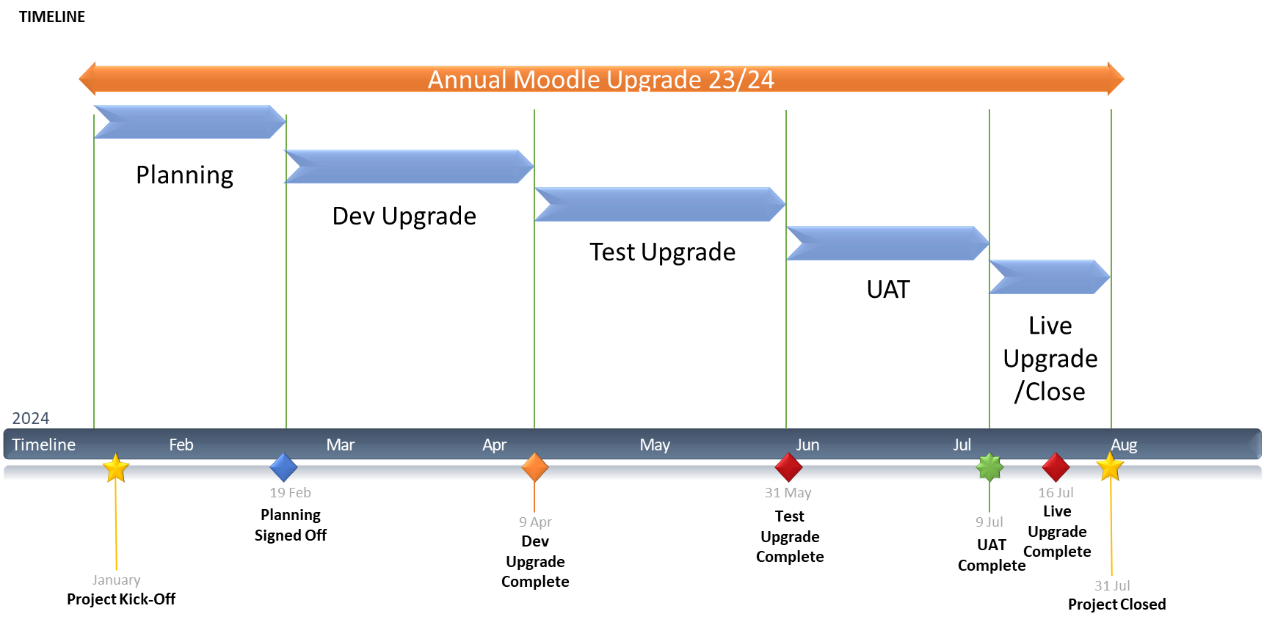
Moodle Summer Upgrade Project Timeline

Summer is normally a quiet time in the university when students are away for vacation, but it is the best time for IT departments to do the system upgrade and new feature testing and release.  In the summer of 2024, DLAM TEL Team took part in the Moodle Annual Upgrade project and led on the implementing […]

Diag| Memory: Current usage: 9 MB
Diag| Memory: Peak usage: 9 MB
css.php

Report this page

To report inappropriate content on this page, please use the form below. Upon receiving your report, we will be in touch as per the Take Down Policy of the service.

Please note that personal data collected through this form is used and stored for the purposes of processing this report and communication with you.

If you are unable to report a concern about content via this form please contact the Service Owner.

Please enter an email address you wish to be contacted on. Please describe the unacceptable content in sufficient detail to allow us to locate it, and why you consider it to be unacceptable.
By submitting this report, you accept that it is accurate and that fraudulent or nuisance complaints may result in action by the University.

  Cancel