Particularly with the Hayles reading, I found myself examining how the highlighted manners of reading affected my own comprehension and reading style between various modes. Especially with hyperreading, I found myself exhibiting the ‘f pattern’ of reading in real time with the article itself, forcing me to confront how deeply I was actually comprehending the material, subsequently returning and re-reading sections I had not paid attention to. Similarly, the practice of following nested trees of hyperlinks is something I do often, particularly within self-contained communities of short stories that draw upon one another to flesh out and create a consistent world. This practice is at once frustrating as it can lead to forgetting the original text, but can also provide entirely new modes of reading in the digital landscape, similarly to the blocks of text being revealed in Hayles’ example of The Patchwork Girl to simulate a fractured nature. Close reading, meanwhile, is something that never really seems to leave my conception of what it means to read a text, being constantly reinforced as the literary ‘gold standard’ by wider academia. It finds its place as central to the digital sphere too dues to its close synergies with machne reading. This confluence of both machine and close reading can elevate our literary analysis within the modern age to include pattern recognition and highlight trends that may otherwise be entirely missed, representing the fusion of human and digital perspectives that so characterises Digital humanities.
Category: Reflections on the field
The Digital Literary Sphere and The Death of The Author
This week’s readings put me in the mind of Roland Barthes’ “death of the author” concept, which argues that meaning does not originate in authorial intention and is instead found entirely through reader reception and interpretation. And where else could you possibly find more readerly intervention than the Internet? Murray’s account in particular extends Barthes’ implication for me through her discussion of the digital literary sphere, where authorship is increasingly mediated by social platforms (both reader review sites such as Goodreads and the development of algorithmic systems which tailor what you watch and read according to your so-called ‘preferences’). I confess that I count myself guilty of reading a book or watching a film largely for the satisfaction of either singing its praises or tearing it to shreds in online reviews – an exercise that might solely achieve me a like from one of my three Goodreads followers (and only then if it’s a book they’ve actually heard of before).
But it is in this way that Murray proves how the contemporary author functions less as a sovereign source of meaning than as a performative and marketable identity which is shaped by social media visibility. I like her discussion of what Jodi Dean refers to as “communicative capitalism”, because it implies that not only does the author lose their literary identity by maintaining a public, online persona but it also implicates the reader whose “participation” in offering criticism, reviews and interpretations often benefit big corporations such as Amazon. It allows readers to feel empowered by seeing themselves as the ultimate arbiter of meaning in a text, which leaves the author effectively “dead” to their own work and simultaneously benefits corporations who can extract value from the readers unpaid work without them even being aware of doing so.
The idea of authorship operating as an institutional construct rather than the natural origin of textual meaning also put me in the mind of the Hayles article, which similarly destabilises the author by shifting attention away from the writer and towards the way we read texts, arguing that textual meaning emerges through practices of close reading, hyper reading and machine reading. At the same time, these readings expose a tension between humanistic values of interpretation and subjectivity, as I understand them through Drucker, and the logic of digital platforms that increasingly govern literary circulation (where ‘worth’ is increasingly determined by metrics and popularity rather than critical interpretation). And this online popularity contest has, ironically, the ability to ‘go-offline’. If you walk into a real-life bookstore, you will see rows and rows dedicated to ‘Book-Tok’ favourites. And as a bookshop enthusiast myself, I can attest that as much as I enjoyed The Song of Achilles five years ago when I first saw it on a ‘Book-Tok’ shelf, it would be nice to switch things up a little. The real risk here is reducing both authorship and reading to quantifiable forms of engagement, as it raises the question of what becomes of meaning, value and critique when interpretation is subsumed by an economy driven by platforms.
Reflection on Literary Value within the Digital
After reading Hayles, Wright and Murray, it became clear that the way ‘literary value’ is policed, constructed, and categorised, along with the way we read and understand these texts are undergoing a period of dramatic change. The dissolution of the virtuous, literary ‘critic’, or policing ‘publisher’, who’s academic literary knowledge form the grounding for a valuation of texts, the power of ascribing a text’s ‘value’ seems to be shifting to the consumer. With the rapid rise of texts (across various media entities) available, and lower barriers to entry for ammeter authors, what makes an ‘author’ successful, or valued, is perhaps linked to both capitalist structures (which, perhaps, drive both publishers to value certain texts above others) and cultural pallets (which are now formed by the public, not ‘high-brow’ artists). It reminded me of the perceived ‘death’ of broadcast TV, which simulated this disintegration of the coherent, cultural palate which came hand in hand with the Netflixicafion of media diets. The consumer curates their digital diet, no longer policed by broadcasters. Is this a force for good?
Literary ‘lists’ and prizes are an attempt to separate the ‘professional’ from the ‘amateur’… which books are ‘good’, or worth reading, and those which aren’t. However, even so, with the rising density of published works, and unwavering power of conglomerates (google, amazon) these are, maybe, equally unsafe from changing consumer pallets and practices. Further points to think about (which I couldn’t include):
- Amazon/ Google recommendation systems shaping consumer tastes, by ‘recommending’ books based on algorithmic taste- does this ‘lock’ people into boxes, preventing cross-disciplinary interaction?
- How does Faucault’s ‘author function’ apply here? When does someone become an ‘author’ in the digital sphere?
- How might Hayles’ discussion of ‘hyperreading’ bear on the way we read texts? Does this trickle down to affect the ways texts are produced, or published (given the consumer impact on literary value)?
Introductory Aspects, Considerations, and Concerns of the Digital Humanities?
I understand Digital Humanities to be a field where individuals can better understand and analyse the humanities subjects (English, Art History etc.) through the lens of technology and data sets in order to revolutionise the academic field and institutions. It is a subject which does not necessarily aim to find the most ‘correct’ analysis but where discussion can be provoked through the different evaluations produced from data sets. When looking at data sets, it is important to acknowledge the legitimacy, accuracy, and whether the data is skewed as this should be taken into account when evaluating. It is a field that adapts to the evolving world and reimagines its intention and focus to take into account changing topical issues and to challenge the authorities that enforce inequality. With its growing popularity and necessity in the world, there are debates as to what is required to be a Digital Humanist (‘Big Tent’), for example, the debate around the necessity of coding comprehension.
Digi-Interpretation: A Luddite’s Immediate Reaction to Digital Humanities
I like the idea of public scholarship — a responsibility to share knowledge gained from being in a university institution with those who may not have as an immediate access as we do. I’m interested in how content, which may demand prior knowledge, can be democratised and made accessible to a wider community.
I also think digital humanities offers new opportunities to be creative in analysis and text interpretation. Especially when displaying research in unconventional ways for Literature studies. Mapping texts visually or using computational methods to create academic content besides an essay is very exciting to me. I’m thinking about how we normally model interpretation though standardised essay style… we are only allowed to have an analysis within this framework at university level. It seems liberating that different digital frameworks can create new ways of interpretation.
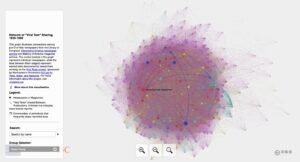
The question of legitimacy is something that strikes me about DH too. Our discussion about Substack, paywalls, peer reviews and social media lends itself to an age old debate about who decides what is intellectual or academic. I don’t think this is anything new. What is new, for me, is the democratising approach of DH. After exploring the Viral Texts DH Project I still find it is not totally accessible. The density of the data, and lack of immediate explanation to a user in this particular project is intimidating. Although aesthetically and visually stimulating, the graph is difficult to decipher without additional research.
A (briefer than normal) Introduction to Digital Humanities
As with many critical fields in the humanities, Digital Humanities really wants to define itself yet also hates being pinned down. Infact, it is a debate within the DH about whether or not the field should even have a strict definition at all. The positives of keeping it ill-defined keep it largely accessible and open, free from being pidgeon-holed into one specific field, allowing colloboration from a variety of actors. However, proponents of the view that it should have a closed definition argue on the same metric. They believe that once you have a definition, that is actually the point at which you can branch off of the initial concept, while still retaining a level of specificity that necessitates critical discussion.The closest I have gotten to understanding an ethos in Digital Humanities is the idea of “construction” rather than just “critique”. What is “construction” itself was controversial, with some people arguing that in order to be a “real” Digital Humanist you needed to know how to code. However because humanities student don’t enjoy learning anything difficult, the definition became much broader, utilising any method of digital construction or “meaning making” to take part. Part of this ethos also has an emphasis on accessibility, bridging the gap between academic and reader, utilising digital tools and the digital space to “democratise” information and knowledge. Interestingly it does (in my view) end up creating a clash between the nature of scholarship and the project itself, which I suppose is one of the very things Digital Humanities attempts to uncover.
It is also not fair to say “critique” does not hold an important place in DH. DH’s love critiquing, they love externally critiquing, internally critiquing, constantly self critiquing. Like most humanist fields they stay committed to being quite intersectional and deconstructionist in their approach, attempting to challenge hegemonies of thoughts that pervase themselves socially, but quite often academically aswell within digital fields. The critique can be showcased through the projects themselves, or it can be a much wider critique of any digital projects or data collection. All this is to help us better understand our purpose and role (moral or otherwise) on digital spaces, what exactly is at stake, and what contributions need to be made. Perhaps I’ve missed something, but there’s a lot of accessible web blogs who attempt to define the same (with a lot more construction, ethos, and critique than I).
My Reflections on Digital Humanities
I have always understood digital humanities to be an interdisciplinary field, one in which we witness an intersection between digital technologies and the broader field of humanities disciplines in an effort to explore human society and culture. What this point of intersection actually looks like to me, however, has always appeared somewhat vague. Indeed, my understanding of humanities disciplines as a standalone concept has remained fairly black and white, having largely taken place within the frameworks of textual analysis and interpretation (the result of being an English Literature student). As such, I had primarily associated digital humanities with the use of digital tools within this existing framework, often to study literary texts through databases, digitised archives or computational methods of analysis.
Only recently, through a developing engagement with critical theory, has my understanding of humanities begun to feel more interdisciplinary, extending toward other fields of study and expression – this, of course, includes the digital world. As such, what is already becoming apparent to me is how strongly the field of digital humanities is shaped by ethical concerns and political realities. From my initial engagement with Debates in the Digital Humanities, DH appears less like a fixed discipline, and more like a set of ongoing conversations about the way that knowledge is acquired, the way it is shared and the way it is valued. In this way, DH feels inherently attuned to the present moment, constantly redefining itself through responsiveness (particularly to social and political pressures).
This reframing has complicated my earlier, more technical understanding of the field. What has stood out the most to me through the readings is how DH repeatedly returns to questions of accessibility and public engagement, which consequently opens up tensions surrounding authority and legitimacy. An example of this can be public writings, such as blog posts, which exist alongside traditional peer-reviewed scholarship, which caught my attention due to it’s particular relevence to my own field of academic study. Thus, the field of DH foregrounds responsibility above all; decisions about data organisation, access and privacy reflect underlying assumptions about whose knowledge matters and how it should circulate, meaning that engaging with humanities digitally also involves engaging with it politically. This is what I now consider to be an intersection point.
At this early stage, my understanding of digital humanities remains provisional. However, I now understand DH as a field with two distinct sides; one that uses digital tools and computational methods to ask humanities questions, and another side which involves the humanistic critique of the tools, technologies and platforms that make such work possible.
Thinking About The Digital Humanities Field
Digital Humanities describes a distinct approach to the humanities field, routed in technology but also the principles of public scholarship. It is a malleable term encompassing a broad range of methods and practices, with voices in the field often keenly describing it more in terms of ‘doing’ than ‘thinking’ (as is the language more generally used in the more traditional humanities). Emphasis in the digital humanities is often the medium: from studying and critiquing the material of the digital humanities, using digital tools and applying computational methods to humanistic study. The importance of this work is in recognising data structuring is political and its central intellectual problem then becomes how we algorthimise or digitalise a world that is infinitely human – fluid, evolving and subjective.
Digital Humanities: An Overview
A precursory definition of Digital Humanities might be the utilisation of technology in order to better understand the humanities, particularly in a time when the digital world is rapidly becoming central to our daily lives, providing the ability to utilise a critical humanities background in analysing the digital world. Paraphrased from today’s seminar; ‘rigidity of computer and epistemological structures in contrast to humanities scholars wider understanding of culture, literature, language etc..’ The Digital Humanities also incorporates ideas around accessibility and responsibly of scholars and institutions to make their work available to the public, particularly publicly funded academic institutions. One end or goal of the field might be keeping the humanities current and promoting flexible types of thinking, particularly in the online world, when cultural or political issues are increasingly presented in bite-sized formats and as ‘black and white,’ often without nuance.
Digital Humanities is… – a short reflection
Digital Humanities is …
an innovative and creative field that combines knowledge of the humanities with emerging technologies. It examines the culture, stories, history, and art of communities to ask questions and generate ideas. As Matthew K. Gold puts it, DH has been developing over the years into a field of ‘socially oriented work’ (Gold, A DH That Matters). And we can track this development by engaging with the researcher’s comprehensive collections, Debates in Digital Humanities. From a field focused on establishing its own definition and finding its rightful place among more traditional academic scholarship; through loosening strict approaches of “The Big Tent”‘s “who’s in and who’s out”, by perceiving itself as “the expanded field” of relationships between its key concepts, and the possibilities they create; to stepping outside of the university walls by ‘engage[ing] the world outside academy’; to currently being oriented towards responding to pressing world issues and creating possibilities for inclusive futures.
An example of such a project could be Shakespeare and Company, which brings to the world a digitised (and therefore accessible) archive compiled by Sylvia Beach. These are library cards of (not only) famous writers and artists who held memberships at the Paris bookshop and lending library in the inter-war years. The public can, for example, browse the books that Gertrude Stein or Simone de Beauvoir read and engage with them themselves. It could also lead researchers engaging with it to create new, interesting projects that track influences on a particular author’s ideas in their publications. However, as we discussed in class, such a project also leads us to question whether such data should and can be made public. What about privacy? Wouldn’t James Joyce have wanted to keep his library card private?
That’s what interests me most in Digital Humanities. It is a way of creative reflecting on the current state of the world, in which our lives are becoming increasingly computerised and digitised. It is about two-way, collaborative approaches, in which communities and the public inform scholars’ work, and scholars foster critical thinking about emerging cultural and digital phenomena. But, most importantly for me, I see at the core of the DH, its commitment to asking critical questions regarding the world around us and the emerging technologies within it.
