Any views expressed within media held on this service are those of the contributors, should not be taken as approved or endorsed by the University, and do not necessarily reflect the views of the University in respect of any particular issue.

(How) to read or what to read… that is the question

The ‘Digital’ (as a vast overgeneralisation) is changing the literary sphere at every level: publishing processes, notions of authorship and authority, books as consumer objects, marketing infrastructures mediating author–reader relations. Murray’s account of an expanded ecology of paratexts, that today we can further expand to Substack newsletters, BookTok, reading logging apps, presents literary valuation as produced in a liminal zone. Reading itself is altered both practically and culturally, from how we engage with texts to how we choose what to read from this “endless list”. Questions that these authors are considering 10 to 20 years ago, expand and persist. In 2026, I find there to be an increasing scepticism around social media, and so now we see an age in which reading seems to reaffirm itself as a status symbol – becoming almost a sign of a successful ‘escape’ from the digital. The image of the ‘performative male’ with a paperback in a trouser pocket comes to mind, which I think illustrates nicely how the physical book has gained a sort of aura. It can be a bit of a contentious archetype on many levels but relevant here for its irony as a trope intrinsically associated with the media yet it seeming to claim rejection of. It draws parallels with our discussion about design decisions and Daisy’s example of the Fitzcarralo editions that to me exude a similar aesthetic of intellectualism. I could yap on about the Fitzcarralo book covers and the significance of Yves Klein Blue, but for the purpose of this post, it’s a design strategy that seems to represent the publisher trying to articulate their role as merit evaluator. In the context of Murray’s observation that the digital literary sphere erodes the traditional gatekeeper role of the publisher, Fitzcarralo perhaps is using colour as a beacon to grasp at this authority of cultural arbiter, a role that is more diversified in the digital literary sphere.

Hayles’ analysis of reading practices in the digital age anticipates anxieties of attention fragmentation that have only intensified the following 15 years. I found her article initially unsettling precisely because it feels prescient, but ultimately Hayles seems to offer a way of thinking through this without nostalgia or technophobia. Insisting that close, hyper and machine reading function best in relation and conjunction with each other another reframes the ‘problem’ of reading as one of transfer rather than decline. The issue of cognitive overload should make us more conscious of mobilising different types of reading deliberately. 

There seems a theme across Hayles, Murray, and Wright’s essays of how we assert our own agency as readers and scholars in this digital literary sphere. The optimistic takeaway from each is that we have the capacity to be more conscious in reading: both attending to the practice of how we read and how we choose what we read in a world where we will most certainly never be able to read everything. This autonomy is largely undermined though by the fallacy of consumer choice. Wright’s study of list culture describes how consumers are assigned the role of arbiter, but really this is heavily rhetorical, contextualised by the actual functioning of the bestseller-list’s own action in the book world as active marketer, not just consumer record – ‘the list’ in this way takes over this role of arbiter from readers without us even realising it. The reader might be able to gain this ‘meriting’ stance in other ways enabled by the digital sphere through virtual social engagement over texts. 
Texts mentioned: 
Hayles, N. Katherine. ‘How We Read: Close, Hyper, Machine’. ADE Bulletin, vol. 150, 2010, pp. 62–79.
Murray, Simone. ‘Charting the Digital Literary Sphere’. Contemporary Literature, vol. 56, no. 2, 2015, pp. 311–339.
Wright, David. ‘Literary Taste and List-Culture in a Time of “Endless Choice”’. From Codex to Hypertext: Reading at the Turn of the Twenty-First Century, edited by Anouk Lang, University of Massachusetts Press, 2012, pp. 108–23. 

E-valuating reading in the digital world

Thinking about reading in the world of digital…

There is no denying that the way we read has changed. Scholars and researchers (like Hayles) point to the changes in the physical and cognitive ways we read, drawing attention to different modalities of reading, such as hyperreading or, emerging now on a massive scale, machine reading. These are usually compared with the present-for-centuries method of close reading. As a result of these evolving practices, our attention shifts from deep focus to skimming, pecking, and falling down the rabbit hole of hyper….

However, cognitive changes are one thing; what is also being transformed is the way we perceive reading, how we choose to read, what we choose to read, but more importantly, what is the “cultural value” and value in general that we attribute to a text, reading as an activity, readers and writers as people, etc. In the essay ‘Charting the Digital Literary Sphere’, Simone Murray takes a closer look at the essential domain that materialised with the ubiquitous emergence of “cyber”  – the titular “digital literary sphere”. “Substack”, “Booktok”, “bookstagram”, “Goodreads”, the omnipresent Amazon.com… all the digital platforms, nooks and crannies of the Web that have already transformed and are still reconstructing the reading culture. What comes with this handiwork of the digital age has two sides. On the one hand, to use Murray’s phrasing, the digital literary sphere ‘erodes many of the traditional gatekeeper roles’, opening up discussions surrounding literature to amateurs and validating their taste. On the other hand, these developments ‘radically [undercut] the cultural-arbiter status of professional literary critics’ and in effect ‘”literature” […] becomes that which the digital literary sphere deems to be literature’. What, however, are the processes that are enmeshed in the digital redefinition of “literature”?

Crucially, we need to consider the cultural production of the contemporary digital literary sphere. David Wright draws attention to the ongoing ‘shift from word-of-mouth recommendation to algorithms recognised by software, in which […] the forms of “value” identified and exchanged by reviewers – are coded and automated’. As an example, the critic focuses on the “List Culture”, think: the trending books, “Top 100 books to read before you die”, book prizes, and the top 10 books on Amazon.com. And yes, I agree with Wright that “the list”, as well as (not mentioned by the author) bookstagram posts, Goodreads statictics, etc.,  [are] also a way of ‘negotiating the “endless” literary choice of the digital age’, because, it is true, the sheer volume of available books to read can be overwhelming. But! when looking at these developments, I cannot help but think about the processes of production, marketing, commodification, and consumption…

In the digital world, or the “digital literary sphere”, reading becomes inextricably tangled with the omnipresent standardised data – data about our reading, our tastes, “best of …” lists based on our ratings out of 5 stars, views and shares of posts, comments that unavoidably attract internet trolls, and so on. This all seems symptomatic of “knowing capitalism”.

“Knowing capitalism” is Nigel Thrift’s term (mentioned also in Wright’s article) that refers to an economic system in which data and information function as means of attributing value, specifically capital value. In such a societal structure, institutions and corporations use the collected data to generate profit for themselves but also to control human experience. In the digital world of reading, our tastes, reading activities, reviews, book culture in general, are being constantly observed, analysed and converted into massive amounts of data for the book industry conglomerates that then, as Wright puts it, ‘offer a means of organising and prioritising resources in the book industry such that they are “actively participating in the doings of the book world.”‘

Reading has thus entered, in Murray’s words, ‘a hazardous terrain of valorizing and consecrating authorities’. TO me it seems that reading is becoming kind of a dance between what seems anti-reductionist “sophisticated” reading practices of those interested in ” the content” of the book, how it is conveyed, questions and reflections it leads to; and, the commercial cover-based colourful world of 5 out of 5 best reads according to … I suppose, in a way, the value of reading is also changing, from the cultural, intellectual value of critical thinking to commercial, profit-oriented valuation.


Articles I mentioned:

Hayles, N. Katherine. ‘How We Read: Close, Hyper, Machine’. Modern Language Association, 2010, pp. 62–79.
Murray, Simone. “Charting the Digital Literary Sphere.” Contemporary Literature, vol. 56, no. 2, 2015, pp. 311–39. JSTOR, http://www.jstor.org/stable/24735010. Accessed 28 Jan. 2026.
Wright, David. ‘Literary Taste and List-Culture in a Time of ‘Endless Choice’’. From Codex to Hypertext: Reading at the Turn of the Twenty-First Century, edited by Anouk Lang, University of Massachusetts Press, 2012, p. pp 108-123. ProQuest Ebook Central, http://ebookcentral.proquest.com/lib/ed/detail.action?docID=4533124.


An array and flow of questions on the practice of reading in the digital

These readings were all really interesting in the way they consider and focus on the commercial and marketing aspect of the subjects of critical reading. Murray highlights the audience and author relationship that needs be fostered into the creation of novels and works in today’s overly consumerist western world. This makes me wonder the extent to which authors tied to publishing full length novels and books that end up physically printed and sold in bookstores, are Would this shift mean that traditional publishing houses and means will become more redundant? What can publishing houses do to move away from this road to pure commercial redundancy? (I liked the mention in class of the minimalist book cover with the text from the book written on the cover discussed in class as this specific marketing decision ties into the shift that commercial publishing practices are doing to cater to these changes) This discussion also made me consider how more ‘authentic’ pieces of writing have shifted to digital platforms such as substack, Goodreads reviews (including ‘para-text’), platforms that are ‘open-access’ and that allow for writings that look to generate peer-read opinions and discussions rather than commercially motivated writings. (what I mean by the term ‘authentic’ is that the writing might not have a commercial motivation behind it)

neuroscience cognitive aspect of reading, the connections we make. In particular, Hayes reading made me think of the scholarly concept of ‘chrononormativity’ how society is arranged in a way to direct us towards maximum productivity. I think this idea links quite well with the concept of ‘hyperreading’ as hyperlinks and endless streams of information brought by digital media in our reading practices of these include a sense of urgency in the process. And I agree with the article in the way it argues that we no longer read ‘deeply’ in the digital media landscape, but rather inside the endless array of information (whether it is info that contradicts or links with one another).


Digi-Interpretation: A Luddite’s Immediate Reaction to Digital Humanities

I like the idea of public scholarship — a responsibility to share knowledge gained from being in a university institution with those who may not have as an immediate access as we do. I’m interested in how content, which may demand prior knowledge, can be democratised and made accessible to a wider community.

I also think digital humanities offers new opportunities to be creative in analysis and text interpretation. Especially when displaying research in unconventional ways for Literature studies. Mapping texts visually or using computational methods to create academic content besides an essay is very exciting to me. I’m thinking about how we normally model interpretation though standardised essay style… we are only allowed to have an analysis within this framework at university level. It seems liberating that different digital frameworks can create new ways of interpretation.

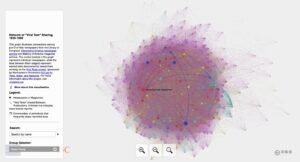
The question of legitimacy is something that strikes me about DH too. Our discussion about Substack, paywalls, peer reviews and social media lends itself to an age old debate about who decides what is intellectual or academic. I don’t think this is anything new. What is new, for me, is the democratising approach of DH. After exploring the Viral Texts DH Project I still find it is not totally accessible. The density of the data, and lack of immediate explanation to a user in this particular project is intimidating. Although aesthetically and visually stimulating, the graph is difficult to decipher without additional research.


css.php

Report this page

To report inappropriate content on this page, please use the form below. Upon receiving your report, we will be in touch as per the Take Down Policy of the service.

Please note that personal data collected through this form is used and stored for the purposes of processing this report and communication with you.

If you are unable to report a concern about content via this form please contact the Service Owner.

Please enter an email address you wish to be contacted on. Please describe the unacceptable content in sufficient detail to allow us to locate it, and why you consider it to be unacceptable.
By submitting this report, you accept that it is accurate and that fraudulent or nuisance complaints may result in action by the University.

  Cancel