Niamh McQuail
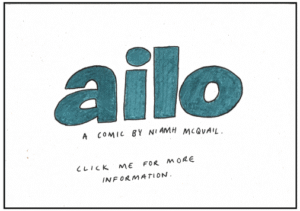
(click image to see the comic in full)
‘Falsehood flies, and truth comes limping after it; so that when men come to be undeceived, it is too late, the jest is over, and the tale has had its effect’
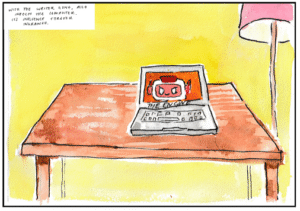
‘Ailo: A Comic’ is a creative exploration of the developing relationship between human everyday life and generative AI. It is a short comic strip, intended to be a quick and accessible way for people of all ages and literacies to engage with the ways in which AI systems are having an increasing influence on creativity and originality. The comic dramatises an outcome in which AI outputs become so great and so overwhelming that humans can no longer check for errors, leaving AI to operate alone.
This project was variously inspired by the writings of Jonathan Swift, whose quote regarding misinformation is the epigraph of this webpage. The epigraph highlights how misinformation is much easier and quicker to produce than it is to check, by which point the misinformation has already been disseminated. The rapid growth and popularity of Large Language Models (LLMs) to assist with writing, research, analysis, and problem-solving, poses real and current problems to human behaviours (Sun et al. 2024). Focusing specifically on LLMs, a specific application of generative AI in which responses are produced through interpolation, wherein answering a prompt, programmes fill in the ‘most likely option’ (Chiang 2023). There is, in this process, a great risk for mistakes or ‘hallucinations,’ as the generated information is the most likely option, not necessarily the most accurate. The term ‘hallucination,’ in regard to generative AI and LLMs, refers to this phenomenon where AI generates distorted information regardless of the intentions of the author (Sun et al. 2024). Nisrim Onyema states that in this way ‘AI complicates the fight against misinformation,’ as the line between human and machine error becomes more opaque; it ‘amplif[ies] the risks of false information being accepted and circulated’ (81).
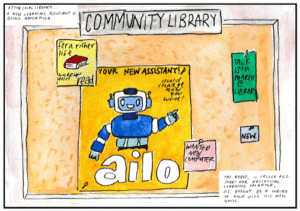
The comic takes place in two locations, in the local library, a public institution, and the home, a domestic space. These two sites were chosen to demonstrate how generated information is impacting both areas. Jessica Silbey and Woodrow Hartzog, in their article ‘How AI Destroys Institutions,’ explore how the mass production and circulation of misinformation threatens the legitimacy of academic scholarship and formal organisations (Hartzog and Silbey). The expertise and values on which institutions operate, the rule of law, free expression, and democracy are not upheld by LLM models. AI systems are opaque in their decision-making, homogenise content and devalue expertise and legitimacy of trusted information held in universities, public libraries, and research institutes (Hartzog and Silbey). As well as being a threat to the validity of academic scholarship, AI is becoming increasingly involved in the functioning of large educational and research institutions. AI can be used as a timesaving tool for educators, creating lesson plans, alleviating administrative tasks, and giving feedback to assignments (Elsayed 12). Although a degree of integration is inevitable, the comic emphasises this should not be at the expense of human critical or evaluative input. Hana Lee Goldin considers how it is the skills inherent to public institutions, of information literacy and critical thinking, that must be maintained in order to navigate ongoing engagement with AI (Goldin). Goldin encourages users to ‘think like a librarian’ to maintain a healthy skepticism that AI does not have the same expertise or contextual and emotional understanding as humans do.
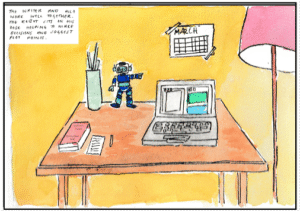
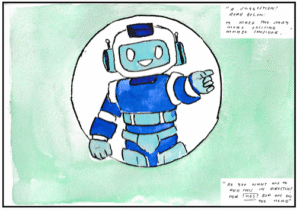
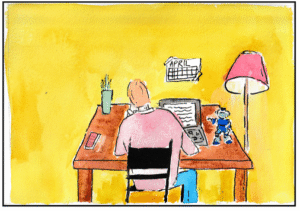
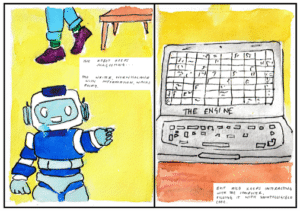
After seeing the advert, the writer acquires the Ailo robot, who sits on his desk at home and offers ‘creative’ inputs. Moving away from the institution, the main narrative of the comic takes place between the individual and the AI learning assistant. The same problems persist, threats to validity and devaluing of information, but the comic emphasises the importance of the individual’s original and imaginative ideas. Although LLMs give the impression of creative outputs, this should not replace authentic human thought.
Ailo: A Comic was created first by hand, painted with watercolour on paper, before being uploaded to the design software Figma. The explanatory panels were then handwritten, uploaded, and animated to create the ‘flip effect.’ The intention, as explained in the comic, was to allow dual engagement with the project as a straightforward comic strip and an informative resource. This aspect was noted by my peers as a useful and navigable way of moving from a simple to a more conceptual idea. Short captions have been included in-text to reference specific scholarly articles and a link back to the website page where full bibliography entries are included. There was a concern that the comic would not load fully from different devices; in order to fix this, the Figma account was upgraded to ‘professional’ in order to provide the best quality possible, and the illustrations from the comic are included below if all else fails.
Bibliography
Chiang, Ted. ‘ChatGPT Is a Blurry JPEG of the Web’. New Yorker, 9 Feb. 2023, https://www.newyorker.com/tech/annals-of-technology/chatgpt-is-a-blurry-jpeg-of-the-web.
Elsayad, Hassan. ‘The Impact of Hallucinated Information in Large Language Models on Student Learning Outcomes: A Critical Examination of Misinformation Risks in AI-Assisted Education’. Northern Reviews on Algorithmic Research, Theoretical Computation, and Complexity, vol. 9, no. 8, 2024, pp. 11–23.
Goldin, Hana Lee. ‘Why Everyone Needs to Think Like a Librarian Now’. Substack.com. Card Catalog, 9 Dec. 2025, https://cardcatalogforlife.substack.com/p/why-everyone-needs-to-think-like?utm_medium=email.
Hartzog, Woodrow, and Jessica M. Silbey. ‘How AI Destroys Institutions’. Social Science Research Network, 5 Dec. 2025. papers.ssrn.com, https://papers.ssrn.com/abstract=5870623.
Kanter, Dawn. ‘The Illusion of Knowledge: Interpreting Generative AI Hallucinations in the Study of Humanities and the Black Box of LLMs’. University of Reading Digital Humanities Hub, 16 Aug. 2024, https://research.reading.ac.uk/digitalhumanities/the-illusion-of-knowledge-interpreting-generative-ai-hallucinations-in-the-study-of-humanities-and-the-black-box-of-llms/.
Nisirim, Onyema. ‘Hallucinations in Artificial Intelligence and Human Misinformation: Librarians’ Perspectives on Implications for Scholarly Publication’. Folia Toruniensia, vol. 25, 2025, pp. 79–98, https://doi.org/10.12775/FT.2025.004.
Swift, Jonathan. ‘Issue 14’. The Examiner, 9 Nov. 1710, accessed via: https://www.ourcivilisation.com/smartboard/shop/swift/examiner/chap14.htm.
Weise, Karen, and Cade Metz. ‘When A.I. Chatbots Hallucinate’. The New York Times , 9 May 2023, https://www.nytimes.com/2023/05/01/business/ai-chatbots-hallucination.html.
Yujie, Sun, et al. ‘AI Hallucination: Towards a Comprehensive Classification of Distorted Information in Artificial Intelligence-Generated Content’. Humanities and Social Sciences Communications, vol. 11, no. 1, 2024, pp. 1–14, https://doi.org/10.1057/s41599-024-03811-x.
Cite this page:
McQuail, Niamh. 'Ailo: A Comic'. Cream of the Slop. version 1.0, Digital Humanities for Literary Studies 2025-26, University of Edinburgh, 10 Apr. 2026, https://blogs.ed.ac.uk/dh2025-26/.
