Regan Reiners
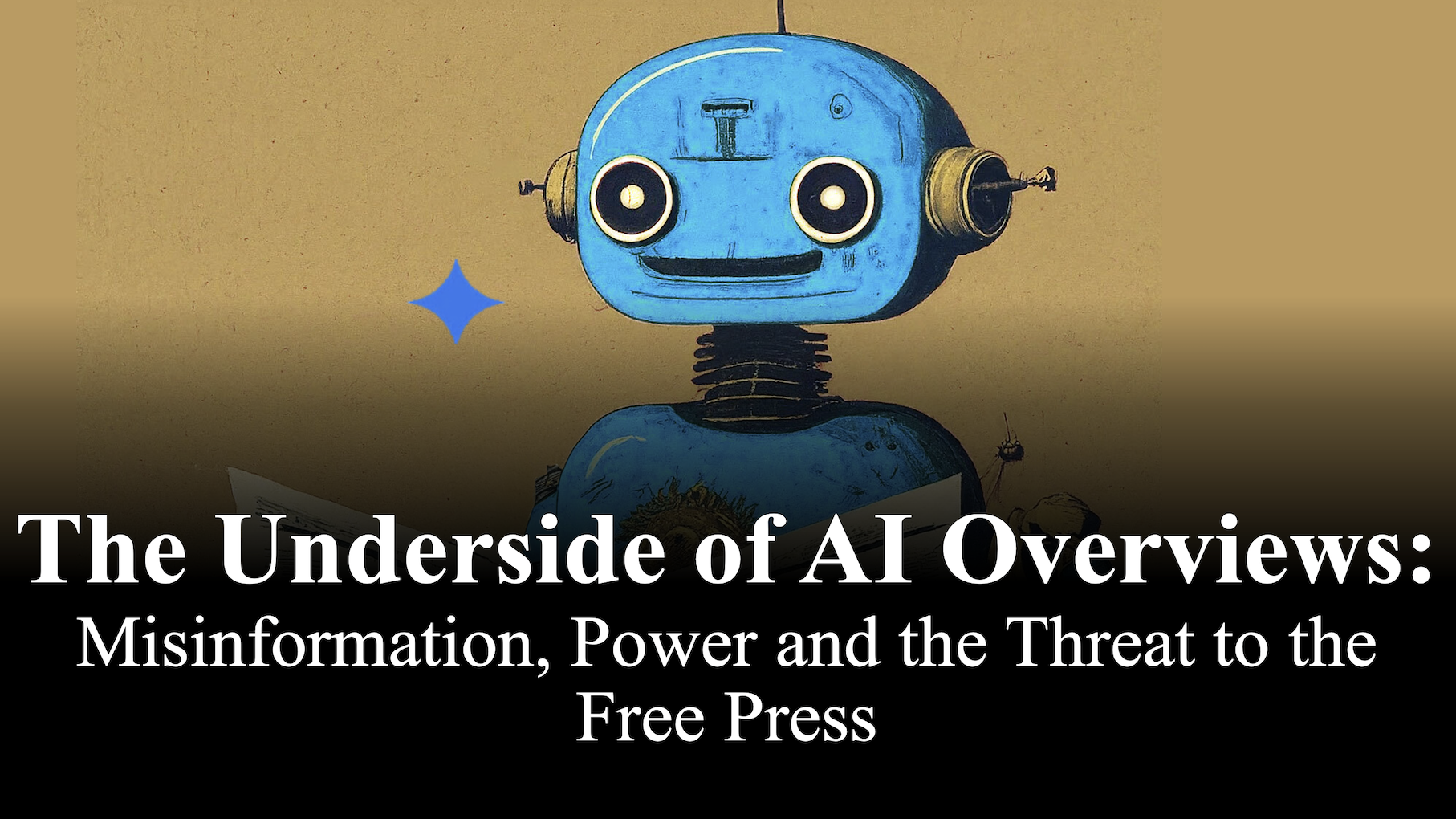
(click image to play)
‘Free access to information is a pillar that upholds the edifice of our societies, and for this reason, we are called to defend and guarantee it’
Transparency, accountability, and legitimacy form the foundations of the free press. In the world of AI Overviews, the ability to trust AI-assisted news as a source of ‘truth,’ and recognise who is accountable for its legitimacy comes into question. ‘The Underside of AI Overviews: Misinformation, Power and the Threat to the Free Press’ is a video essay that explores this question. Encouraging viewers to approach AI Overviews critically, the video uses a misinformation case study to demonstrate AI’s design flaws, and most importantly, why this matters for the future of the free press. In response to feedback, audio cuts and a slower tempo were applied in the editing stage to improve the structure of the argument. Visual cues and section headings were added to the video for clarity.
Google officially launched AI Overviews in May 2024, an extension of their Large Language Model (LLM) Google Gemini. In their most basic form, AI Overviews provide users with a ‘snapshot’ or ‘summary’ for search queries, accompanied by links to relevant webpages (Watson et al. 5). LLMs can be understood, to borrow Wharton professor Ethan Mollick’s words, as ‘incredibly sophisticated autocomplete systems’ (2024). When making a search query, the AI will break the query down into ‘tokens’ and generate language by predicting the next most likely word (or ‘token’) in a sentence (Mollick 2024). Trained on an extensive model of human language, Google Gemini distills large amounts of information into a rhetorically convincing, and often confidently incorrect, summary (BBC 7). Taking the highly sought-after top spot on the page, the scale and impact of AI’s misinformation seem to indicate a worrying trend: when human-made journalism is buried beneath AI’s homogenous slop, users are blocked from reliable news at the point of entry.
Since the dawn of the internet, the financial health of media organisations has largely depended upon visibility and website traffic (Levi 80). It started as a fair deal for publishers, albeit established ones: visibility on Google attracted higher click-through rates, print revenues translated into ad revenue, and attention turned into profit (Levi 81). While the new currency of ‘clicks’ encouraged attention-grabbing, divisive journalism, publishers remained largely in control of their content and reputational exposure (Levi 82). AI Overviews introduce a new threat entirely when visibility is the lifeblood of the publishing industry. With click-through rates reducing as high as 80% and reputational control bleeding through AI misinformation, publishers risk being gutted from the inside out (Watson et al. 4, BBC 2025).
Compromising the financial stability of publishers, however, raises wider concerns for the binding core throughout publishing ecologies: truth, transparency, and trust. In The Future of Press Freedom: Democracy, Law and the News in Changing Times, law professor Leli Levi highlights the impacts of this economic decline for the news industry, which include ‘compromised journalistic norms, a disaster for journalistic personnel and, with few exceptions, a practical abandonment of the press’ watchdog role’ (Levi 81). The issue Levi speaks to here is deeply human in nature: starving publishers at the source compromises journalism’s legitimacy at the point of construction.
If this decline continues, there seems to be a stalemate between Google and the publisher: the creation of Overviews, and their perceived legitimacy depends on the input of human-made journalism (Hartzog and Silbey 32). With their financial livelihood depending on it, publishers are beginning to implement AI from the back end of research to embedded public-facing summaries (Simon 2024). Bloomberg’s AI summary tool ‘Takeaways’, for example, has come under public scrutiny for producing ‘incorrect figures, incorrect attribution, and references to the wrong U.S presidential election,’ according to the New York Times (Robertson 2025). In response, Bloomberg editor John Micklethwait reminded readers that ‘an AI summary is only as good as the story it’s based on’ (2025). When the story it’s based on is sloppified by AI agents, however, the spread of misinformation and reputational erosion risks increasing exponentially.
AI scholar Kate Crawford speaks to this issue, explaining ‘AI systems degenerate when they are fed too much of their own outputs,’ gradually collapsing into ‘nonsense and noise’ (2025). This is where the major issue lies: where publishers face an uphill visibility battle, incorporating AI risks degrading news into a three-way exchange of inaccurate slop (Hartzog and Silbey 33). The AI-assisted article enters the LLM’s training data, is cited as a summary, and is then fed to the reader in an almost cannibalistic cycle (Nagappa et al. 2025). Compromising the creators of truth, accountability, and authority threatens the stability of ‘news’ itself as a reliable source of new information, critical human debate, or a space for opposition to popular discourse (Hartzog and Silbey 32). Legal scholars Hartzog and Silbey warn that ‘this has already devalued and undermined the expertise and legitimacy of trusted outlets and has polluted the public sphere’ (31). So, in a world where 45% of AI Overviews already contain at least one significant error, the regurgitating AI, on a scale larger than any publisher, will only continue to spread misinformation at the reader’s and publisher’s expense (BBC 2025).
The maintenance of human institutions, a trust in a free press, must not become secondary to economic and technological advancement. While referencing the digitisation of Google books, I think Robert Darnton makes a really important point here: ‘In the scramble to gain market share in cyberspace, something is getting lost: the public interest’ (2014). Approaching AI critically, recognising the stakes of LLM misinformation, is a step to prevent this loss (BBC 2025). This project hopes to raise awareness for the dangers of Large Language Models for news distribution; by their very design, LLMs will never be able to ensure legitimacy, challenge popular opinion, or produce new knowledge. The journalist, in this case, is irreplaceable.
Note: When searching for human journalism, adding ‘-AI’ to the end of the query is a great way to avoid AI Overviews, and increase the click-through rates for publishers!
Bibliography
Australian Associated Press. ‘You Won’t Believe What Degrading Practice the Pope Just Condemned.’ The Guardian, 9 Oct. 2025, https://www.theguardian.com/australia-news/2025/oct/10/you-wont-believe-what-degrading-practice-the-pope-just-condemned.
BBC, Ipsos. ‘Audience Use and Perceptions of AI Assistants for News.’ BBC x Ipsos. October 2025. https://www.bbc.co.uk/aboutthebbc/documents/audience-use-and-perceptions-of-ai-assistants-for-news.pdf.
Crawford, Kate. ‘Eating the Future: The Metabolic Logic of AI Slop.’ E-FLUX, September 2025. https://www.eflux.com/architecture/intensification/6782975/eating-the-future-the-metabolic-logic-of-ai-slop
Darnton, Robert. ‘A World Digital Library Is Coming True!’ New York Review of Books, vol. 61, no. 9, 22 May 2014. http://www.nybooks.com/articles/archives/2014/may/22/world-digital-library-coming-true.
Hartzog, Woodrow, and Jessica M. Silbey. ‘How AI Destroys Institutions.’ SSRN Scholarly Paper no. 5870623, Social Science Research Network, 5 Dec. 2025. papers.ssrn.com, https://papers.ssrn.com/abstract=5870623.
Levi, Lili. ‘Countering the Mosaic of Threats to Press Functions.’ The Future of Press Freedom: Democracy, Law, and the News in Changing Times. Edited by RonNell Andersen Jones and Sonja R. West, Cambridge University Press, 25 Jul. 2025, pp. 79–99. https://doi.org/10.1017/9781009515511.009.
Micklethwait, John. ‘How Journalism Will Adapt in the Age of AI.’ Bloomberg. 10 Jan. 2025, https://www.bloomberg.com/news/articles/2025-01-10/8-ways-ai-will-transform-journalism.
Mollick, Ethan. ‘Thinking like AI.’ One Useful Thing, Substack, 20 Oct. 2024, https://substack.com/session-attribution-frame.
Nagappa, Ashwin, et al. ‘AI Overviews Have Transformed Google Search. Here’s How They Work – and How to Opt Out.’ The Conversation, 12 Jun. 2025, https://doi.org/10.64628/AA.vhm9ya763.
Robertson, Katie. ‘Bloomberg Has a Rocky Start With A.I. Summaries.’ The New York Times, 29 Mar. 2025. https://www.nytimes.com/2025/03/29/business/media/bloomberg-ai-summaries.html.
Simon, Felix M. ‘Artificial Intelligence in the News: How AI Retools, Rationalizes, and Reshapes Journalism and the Public Arena.’ Columbia Journalism Review, https://www.cjr.org/tow_center_reports/artificial-intelligence-in-the-news.php/.
Watson, Abi, et al. ‘Publishers’ (in)Visibility Problem: Organic Traffic under Pressure.’ Enders Analysis, 13 Jul. 2025, https://www.endersanalysis.com/reports/publishers-invisibility-problem-organic-traffic-under-pressure.
Cite this page:
Reiners, Regan.'The Underside of AI Overviews: Misinformation, Power, and the Threat to the Free Press'. Cream of the Slop. version 1.0, Digital Humanities for Literary Studies 2025-26, University of Edinburgh, 10 Apr. 2026, https://blogs.ed.ac.uk/dh2025-26/.
