Any views expressed within media held on this service are those of the contributors, should not be taken as approved or endorsed by the University, and do not necessarily reflect the views of the University in respect of any particular issue.

You are reading my WordPress Post right now

The readings this week were a lot of fun. Murray’s Charting the Literary Sphere introduced ideas of the twittersphere, hypertext and distant reading. I was especially interested in the author’s concern over interdisciplinary competitiveness in the digital literary sphere – under that umbrella term was the clash of print culture studies versus digital media studies versus digital literature studies… but why is everyone fighting?

I keep coming back to Bourdieu’s formulation of fields which, for me, reads as quite an aggressive culture battleground where social actors are competing for different positions. The whole concept of cultural prestige and intellectual property links back to my original thoughts on public scholarship, which you can find in my first post.

Watch out though, hyperlinks are cognitively loaded. Hayles talks about the information consumption that interacts with how we read, and argues that there should be a disciplinary shift to a broader sense of reading strategies and interpretations. Hypertext reading does not support an enriched reading, as scholars thought it might.
Digi-Interpretation: A Luddite’s Immediate Reaction to Digital Humanities

I like the idea of public scholarship — a responsibility to share knowledge gained from being in a university institution with those who may not have as an immediate access as we do. I’m interested in how content, which may demand prior knowledge, can be democratised and made accessible to a wider community.

I also think digital humanities offers new opportunities to be creative in analysis and text interpretation. Especially when displaying research in unconventional ways for Literature studies. Mapping texts visually or using computational methods to create academic content besides an essay is very exciting to me. I’m thinking about how we normally model interpretation though standardised essay style… we are only allowed to have an analysis within this framework at university level. It seems liberating that different digital frameworks can create new ways of interpretation.

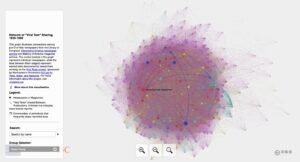
The question of legitimacy is something that strikes me about DH too. Our discussion about Substack, paywalls, peer reviews and social media lends itself to an age old debate about who decides what is intellectual or academic. I don’t think this is anything new. What is new, for me, is the democratising approach of DH. After exploring the Viral Texts DH Project I still find it is not totally accessible. The density of the data, and lack of immediate explanation to a user in this particular project is intimidating. Although aesthetically and visually stimulating, the graph is difficult to decipher without additional research.

css.php

Report this page

To report inappropriate content on this page, please use the form below. Upon receiving your report, we will be in touch as per the Take Down Policy of the service.

Please note that personal data collected through this form is used and stored for the purposes of processing this report and communication with you.

If you are unable to report a concern about content via this form please contact the Service Owner.

Please enter an email address you wish to be contacted on. Please describe the unacceptable content in sufficient detail to allow us to locate it, and why you consider it to be unacceptable.
By submitting this report, you accept that it is accurate and that fraudulent or nuisance complaints may result in action by the University.

  Cancel