
Any views expressed within media held on this service are those of the contributors, should not be taken as approved or endorsed by the University, and do not necessarily reflect the views of the University in respect of any particular issue.

Rannsachadh digiteach air a' Ghàidhlig ~ Goireasan digiteach airson nan Gàidheal

Author: lmellon

Opening the Well in 2025

We are nearing a month of the Opening the Well website being live, and the number of transcribers on the platform keeps increasing which is so excellent to see – thank you to everyone who is taking part and has told others about it.

Image Description: The photo features a plush toy, a Highland cow, sitting on a windowsill looking out an open window. Outside, there are green leafy trees and a multi-story grey building with a modern architectural design. Although not directly stated in the photograph, the image is being taken out of a attic room of 29 George Square, looking out to the Main Library of the University of Edinburgh in George Square.

Image Description: The photo features a plush Highland Cow toy, sitting on a windowsill looking out an open window. Outside, there are green leafy trees and a multi-story grey building with a modern architectural design. Although not directly stated in the photograph, the image is being taken out of a attic room of 29 George Square, looking out to the Main Library of the University of Edinburgh in George Square.

There are also many folk interested in gaining transcriptions of Gaelic materials for a variety of reasons, research purposes, to family ties or artistic inspiration. We’re finding some of the connected projects and events you mention fascinating.

With new requests comes new permission checks, so here’s what Seumas – the Copyright & Permissions Administrator on the project – has been up to this December.

More tracks enter the Well

First up, was some harvest customs recorded on Jura. In 1953, Calum Maclean visited with Janet Shaw to learn about the traditions surrounding the last sheaf of a harvest and the festivities that would follow. You can listen to the track here.

Then, an item from South Uist got added to the list. We’re sticking with Calum Maclean as the fieldworker but it’s a later one for him – 1960 and with contributor Donald MacIntyre. He speaks about the knowledge and experience of the island midwife. Fifty years into her profession and she had the experience of being called upon by two families in labour at the same time. You can listen to Donald’s description of this here.

We were off to Harris next where Cait Dix was recorded by Ian Paterson in 1970. Cait has tonnes of tracks on Tobar an Dualchais and was a fantastic tradition bearer. On this particular tape, she talks about a girl taken by the fairies whilst out keeping an eye on cattle. She bakes scones for them, but has to work out how the amount of flour will ever diminish enough for her to go home. Listen here.

It was quite a heavy Calum Maclean couple of weeks in general, as the next two from Mull come from him. Both are back to the early years of the Archive coming from 1953. The first track is information based and talks about a piper playing a tune to warn a MacDonald that Campbells were coming. We link it here. The other tells the story of Murchadh Geàrr, who lost his lands and returned with men from the Earl of Antrim to take back the castle. It’s available here.

Overwhelmingly though, we’re sticking with a Barra theme for requests, similar to the launch tracks discussed in the last blog post. It was an excuse for Seumas to spend more time on the island.
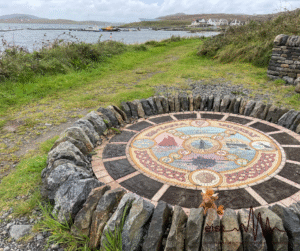
Image Description: A circular stone mosaic set into the ground and surrounded by upright stone slabs. The mosaic is detailed with colorful, intricate patterns and symbols. It is designed to be a compass that features motifs of the island. On the side closest to the camera sits a stuffed animal toy. Around it is a grassy area with some rocks, leading towards a body of water in the background.

Image Description: A circular stone mosaic set into the ground and surrounded by upright stone slabs. The mosaic is detailed with colorful, intricate patterns and symbols. It is designed to be a compass that features motifs of the island. On the side closest to the camera sits a stuffed animal toy. Around it is a grassy area with some rocks, leading towards a body of water in the background.

The next track is a group of folk, illustrating just how many people might need to be contacted for each track to be included in the Well. Hugh MacNeil, Mary Morrison and Annie MacNeil were recorded by Mary MacDonald and Emily Lyle in 1974. The conversation surrounds death omens. Listen here.

As we head into Castlebay, we have two tracks from contributor Neil Mackinnon. In the first track, Neil discusses a time he got lost in mist here.
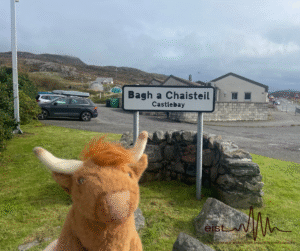
Image Description: A stuffed toy Highland Cow facing a road sign. The sign reads ‘Bàgh a Chaisteil, Castlebay,’ with a stone wall and a grassy area nearby. In the background, there is a modern car, some buildings, and rocky hills under a cloudy sky.

Image Description: A stuffed toy Highland Cow facing a road sign. The sign reads ‘Bàgh a Chaisteil, Castlebay,’ with a stone wall and a grassy area nearby. In the background, there is a modern car, some buildings, and rocky hills under a cloudy sky.

The second track from Neil discusses the SS Politician and stories of taking whisky from the ship wreckage off of Eriskay. This shipwreck is the reason that the pub there is named The Politician and the event inspired Compton Mackenzie to write Whisky Galore.

Seumas was able to visit Compton Mackenzie’s grave on his travels, seeing as the author was buried on Barra.
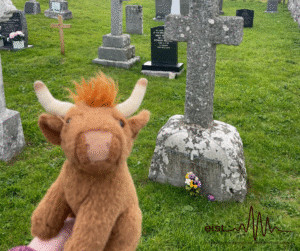
Image Description: The photo depicts a graveyard with several headstones and green grass. In the foreground of the photo, a plush toy resembling a brown cow or highland cattle with light-coloured horns and a tuft of orange hair is stuck up. The nearest gravestone, with a bunch of white, purple and yellow flowers infront of it reads ‘Compton Mackenzie 1883-1972’.

Image Description: The photo depicts a graveyard with several headstones and green grass. In the foreground of the photo, a plush toy resembling a brown cow or highland cattle with light-coloured horns and a tuft of orange hair is stuck up. The nearest gravestone, with a bunch of white, purple and yellow flowers laid infront of it reads ‘Compton Mackenzie 1883-1972’.

And with Seumas already in the Eoligarry area…
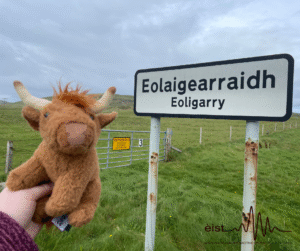
Image Description: A plush Highland cow is being held up in front of a countryside scene with green grassy fields and a cloudy sky. In the background, there is a white and black road sign that says ‘Eolaigearraidh’ with ‘Eoligarry’ written underneath, indicating the place name in Gaelic and its English equivalent. There is also a yellow sign on a metal gate further back, and a real Highland cow with horns can be seen standing in the grass behind the sign, blending in with the environment.

Image Description: A plush Highland cow is being held up in front of a countryside scene with green grassy fields and a cloudy sky. In the background, there is a white and black road sign that says ‘Eolaigearraidh’ with ‘Eoligarry’ written underneath, indicating the place name in Gaelic and its English equivalent. There is also a yellow sign on a metal gate further back, and a real Highland cow with horns can be seen standing in the grass behind the sign, blending in with the environment.

… another track becomes applicable. This one is from Rachel Mackinnon who speaks of a cauldron that was borrowed by the fairies’ multiple times. When they didn’t return it, the woman had to go to the fairy knoll to request it back. Find out how the story turns out here.

Heading in the opposite direction (island wise), we had a couple of Nan (Annie) Mackinnon tracks available in the launch, and unsurprisingly – as a firm favourite amongst the Archive/website users – she is back again already.

So, it’s a wee trip onto Vatersay whilst she speaks to James Ross about MacLean of Duart’s daughter and the black arts.
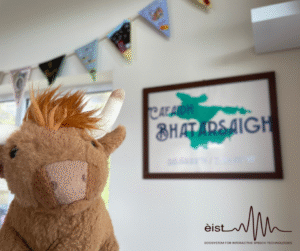
Image Description: A brown fluffy toy animal, possibly a Highland cow, with white horns. The toy is placed in the foreground on the left side. In the background on the right, is a blue and green framed picture reading ‘Cafaidh Bhatarsaigh’ and shows a map outline with co-ordinates in silver lettering.

Image Description: A brown fluffy toy animal, a Highland cow, with white horns is placed in the foreground on the left side. In the background on the right, is a blue and green framed picture reading ‘Cafaidh Bhatarsaigh’ and shows a map outline with co-ordinates in silver lettering.

Listen to the track here.

So now you’re up to date on the tracks that we’ve been able to clear, usage wise, in the transcription project… and what better way to celebrate this fact on Barra than at Café Kisimul.
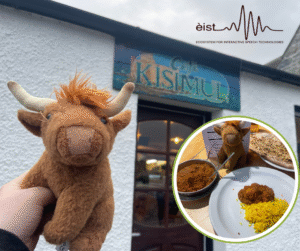
Image Description: The main photo features a small, stuffed plush toy of a Highland Cow with horns infront of a white building that has a colourful sign that says ‘Café Kisimul’. There is a second, smaller circular image in the bottom right-hand corner of an Indian meal with naan bread, curry and yellow rice on a table. It is taken inside the location of the main photo. There is a plate with a serving of rice and curry, a dish of curry with a spoon, and a large piece of naan on another plate. A plush toy resembling a brown Highland cow with horns is sitting near the food with a menu behind them.

Image Description: The main photo features a small, stuffed plush toy of a Highland Cow with horns infront of a white building that has a colourful sign that says ‘Café Kisimul’. There is a second, smaller circular image in the bottom right-hand corner of an Indian meal with naan bread, curry and yellow rice on a table. It is taken inside the location of the main photo. There is a plate with a serving of rice and curry, a dish of curry with a spoon, and a large piece of naan on another plate. A plush toy resembling a brown Highland cow with horns is sitting near the food with a menu behind them.

Seumas will be back in the New Year with more updates regarding permissions. We hope you have a lovely festive break in the meantime (and maybe even spend some of that time transcribing).

Nollaig Chridheil agus Bliadhna Mhath Ùr (no Bliadhna Mhath Ùr, mas fheàrr leat sin!).

Merry Christmas and a Happy New Year.

References

Cleachdaidhean aig àm an fhoghair ann an Diùra., Janet Shaw, Calum Maclean, SA1953.126.9, School of Scottish Studies Archives, University of Edinburgh.

Iomradh air an eòlas a bh’ aig bean-ghlùine., Donald MacIntyre, Calum Maclean, SA1960.031.B3, School of Scottish Studies Archives, University of Edinburgh.

Iomradh air diofar uairean a fhuair daoine manadh bàis., Hugh MacNeil; Mary Morrison & Annie MacNeil, Mary MacDonald & Emily Lyle, SA1974.92.A4a-c, School of Scottish Studies Archives, University of Edinburgh.

Mar a fhuair Colla Ciotach rabhadh., Archibald MacLean, Calum Maclean, SA1953.105.B9, School of Scottish Studies Archives, University of Edinburgh.

Murchadh Geàrr agus Oighreachd Loch Buidhe., Donald Morrison, Calum Maclean, SA1953.100.6, School of Scottish Studies Archives, University of Edinburgh.

Na sìthichean agus an coire., Rachael Mackinnon, Mary MacDonald & Emily Lyle, SA1974.090.B5, School of Scottish Studies Archives, University of Edinburgh.

Nighean a bha a’ fuine ann an sìthean ‘s mar a fhuair i às., Catherine Dix, Ian Paterson, SA1970.295.B3, School of Scottish Studies Archives, University of Edinburgh.

Nighean MhicIllEathain Dhubhaird agus a’ bhuisneachd., Annie (Nan) Mackinnon, James Ross, SA1960.128.B20, School of Scottish Studies Archives, University of Edinburgh.

The am fiosraiche ag innse mu uair a chaidh e air chall sa c…., Neil MacKinnon, Mary MacDonald & Emily Lyle, SA1974.90.B1; SA1974.90.B2, School of Scottish Studies Archives, University of Edinburgh.
Copyright and Permissions for Opening the Well

Launch

With ÈIST launching Opening the Well / Fosgladh an Tobair on the 2nd of December, we felt it was important to “introduce” you to the ‘Copyright and Permissions Administrator’ on the project.

So, everyone say hello to Seumas.

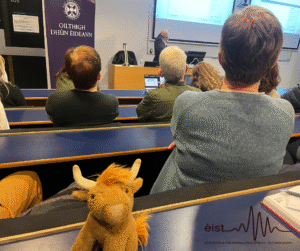
Image Description: Photograph of a lecture hall. Several people are sitting in tiered seats facing the front, where a person is giving a presentation at the podium. There is a blue banner at the front with text and a logo, reading ‘University of Edinburgh’ in both English and Gaelic. A plush toy cow with light brown fur and white horns is visible on the desk in the foreground facing the camera.

Image Description: Photograph of a lecture hall. Several people are sitting in tiered seats facing the front, where a person is giving a presentation at the podium. There is a blue banner at the front with text and a logo, reading ‘University of Edinburgh’ in both English and Gaelic. A plush toy cow with light brown fur and white horns is visible on the desk in the foreground facing the camera.

They are pictured here in attendance of the Opening the Well launch. This was at the 20th annual memorial lecture for Angus Matheson, held at the University of Glasgow.

Seumas has been in post since mid-August and has been working in the background to gain permissions for recordings to be included in this crowdsourcing initiative.

Currently, Opening the Well is focusing on the spoken word. Transcripts for Gaelic tales and information-based extracts (e.g., interviews) are the priority. This makes over 9000 tracks on the Tobar an Dualchais website applicable – with even more content that has already been transcribed.

All recordings have the possibility of including multiple fieldworkers and/or contributors, so there is always a chance that several people will need to contacted for only a couple of minutes of content. As a result, Seumas has their work cut out for them.

A lot of the recordings uploaded for launch were randomly selected based on getting permissions in time. That said, we also looked into what materials have experienced high traffic/usage recently, knowing that it would be useful for the community to have these transcripts available to them as soon as possible.

There is a mixture of materials from the School of Scottish Studies Archives, (University of Edinburgh), as well as from the Canna Archive (National Trust for Scotland). Amongst the varied Collections, we aimed for different locations and a mix of genders.

Here’s a more in-depth look at some of the tracks that were uploaded in time for the launch:

Tracks to Transcribe

A couple come from the mainland of Scotland – a bit from Argyll and some from Inverness-shire. Then, we also had the odd track from folks that came from Mull, Tiree, Islay, Harris and St Kilda.

Seumas noticed that this round, we managed to get a bunch from the Uists and from Barra – which was an excuse to set out for some permissions work on these islands.

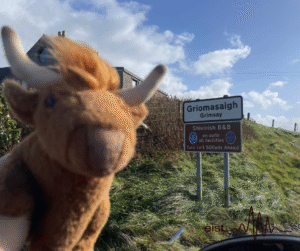
First up on the tour was Grimsay in North Uist…

Image Description: A brown soft toy Highland Cow with white- and cream-coloured horns in the foreground, positioned in front of a road sign. The sign reads ‘Griomasaigh / Grimsay’ and has a second, brown road sign below it. The colour indicates that this additional information is aimed at tourists. There is some grass and a building with a blue sky and clouds in the background.

Image Description: A brown soft toy Highland Cow with white- and cream-coloured horns in the foreground, positioned in front of a road sign. The sign reads ‘Griomasaigh / Grimsay’ and has a second, brown road sign below it. The colour indicates that this additional information is aimed at tourists. There is some grass and a building with a blue sky and clouds in the background.

… where we located two tracks recorded by fieldworker Donald Archie MacDonald.

On the first, the contributor is Peter Morrison who was a local crofter and fisherman. Perhaps unsurprisingly then, the theme of the tale he provides revolves around a fisherman. You can listen to his track here. The second is from contributor Donald MacLean, and deals with a historical tradition on the island about a murderer on North Uist. Again, feel free to check it out here.

From there, Seumas started making his way down through South Uist. The first stop amongst the launch tracks was for a couple of items from Gerinish.

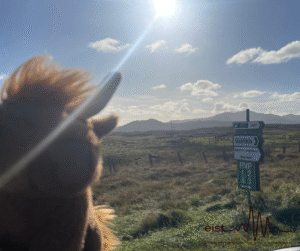
Image Description: A rural landscape scene with a plush toy Highland cow very close to the camera in the foreground. In the background, there are grassy fields, hills and a partly cloudy sky with the sun shining down. There’s a white road sign in front of a fence post that reads ‘Geirinis’ with a variety of other signs attached – some are white and some are green.

Image Description: A rural landscape scene with a plush toy Highland cow very close to the camera in the foreground. In the background, there are grassy fields, hills and a partly cloudy sky with the sun shining down. There’s a white road sign in front of a fence post that reads ‘Geirinis’ with a variety of other signs attached – some are white and some are green.

Specifically West – where we were looking for contributor, Michael MacIntyre. Michael was born on the East Coast of the island but settled in West Gerinish working as a shepherd. As Michael had a few tracks that went to the launch, we provide a link to his profile here. You can press the ‘tracks by this person’ button to access all of them.

And then we continued down south to Frobost.

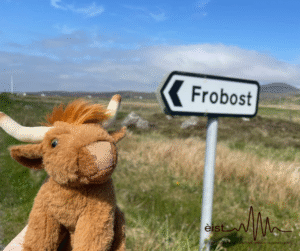
Image Description: A brown plush toy with horns, resembling a Highland Cow, is being held up in front of a road sign. The sign, featuring a black arrow pointing to the right, says ‘Frobost’. The background shows grassy fields and a partly cloudy blue sky.

Image Description: A brown plush toy with horns, resembling a Highland Cow, is being held up in front of a road sign. The sign, featuring a black arrow pointing to the right, says ‘Frobost’. The background shows grassy fields and a partly cloudy blue sky.

A fan of ghostly apparitions? Listen to Patrick MacPhee discuss a sighting of one in the Frobost area here.

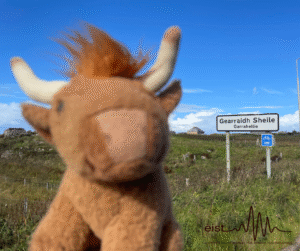
Image Description: A plush toy highland cow with brown fur and light horns is in the foreground of the photo, blocking part of the view. In the background, there is a white road sign that says ‘Gearraidh Sheile / Garrahellie’ and a blue cycling route sign below the main one. The setting is a grassy, rural area with a bright blue sky.

Image Description: A plush toy highland cow with brown fur and light horns is in the foreground of the photo, blocking part of the view. In the background, there is a white road sign that says ‘Gearraidh Sheile / Garrahellie’ and a blue cycling route sign below the main one. The setting is a grassy, rural area with a bright blue sky.

It’s Garryhellie next, where a couple of tracks from fieldworker Calum Maclean feature. He recorded Donald MacInnes in 1953 and animals are a running theme amongst his deposits. You can pick your fancy between information on why a hen might be cursed here, why a corn field might grow fast here or how a mother still cared for her children after she passed here.

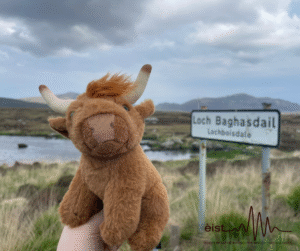
Onwards, to Lochboisdale, in 1965, where Alan Bruford recorded a ghost story from Barra with contributor Archie Munro. Listen here.

Image Description: A small plush Highland cow toy is held up by a hand outdoors, with a scenic background of a grassy landscape, water and rolling hills. In the background, there is a road sign that says ‘Loch Baghasadail / Lochboisdale’.

Image Description: A small plush Highland cow toy is held up by a hand outdoors, with a scenic background of a grassy landscape, water and rolling hills. In the background, there is a road sign that says ‘Loch Baghasadail / Lochboisdale’.

And with Barra on our minds, it was time for Seumas to get the ferry over there.

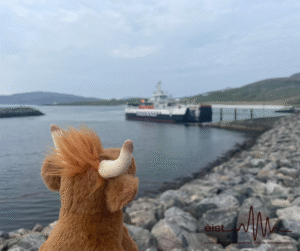
Image Description: A plush toy with brown fur and white horns, resembling a Highland Cow, is positioned on a rocky shoreline in the foreground. The toy is facing away from the camera, looking out towards a large body of water where a Calmac ferry is visible in the distance. There are hills in the background across the water. Although it is not stated in the photograph, the picture is of the ferry port on Eriskay.

Image Description: A plush toy with brown fur and white horns, resembling a Highland Cow, is positioned on a rocky shoreline in the foreground. The toy is facing away from the camera, looking out towards a large body of water where a Calmac ferry is visible in the distance. There are hills in the background across the water. Although it is not stated in the photograph, the picture is of the ferry port on Eriskay.

As mentioned, a couple of items from Barra feature amongst the tracks you can find on Opening the Well right now.

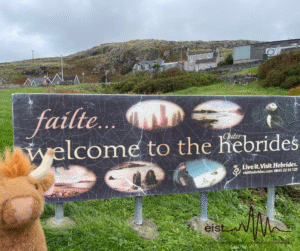
Image Description: A plush Highland cow is in front of a large outdoor sign on green grass. The sign reads ‘failte… welcome to the outer hebrides’ with scenic pictures of the area around the text, such as beaches, standing stones and a puffin. The sign also includes the text ‘Live it. Visit Hebrides’ with a website and phone number available. Those familiar with Barra will recognise this as the sign visitors are greeted by as they get off the ferry in Castlebay.

Image Description: A plush Highland cow is in front of a large outdoor sign on green grass. The sign reads ‘failte… welcome to the outer hebrides’ with scenic pictures of the area around the text, such as beaches, standing stones and a puffin. The sign also includes the text ‘Live it. Visit Hebrides’ with a website and phone number available. Those familiar with Barra will recognise this as the sign visitors are greeted by as they get off the ferry in Castlebay.

So once back on dry land, Seumas was looking into securing permissions for Annie MacNeil who was recorded in 1974 by Mary MacDonald and Emily Lyle. She speaks about death omens here.

However, it would have been more apt earlier, to say that a lot of tracks secured are actually from Vatersay.

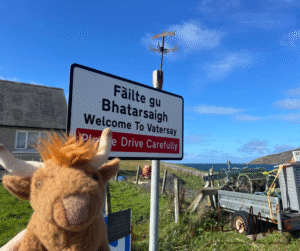
Image Description: Stuffed highland cow toy close to a road sign. The sign is bilingual, in both Gaelic and English and reads ‘Welcome to Vatersay. Please drive carefully.’ In the background, there’s a blue sky, a house, a metal trailer with some fishing equipment on it, and a weather vane.

Image Description: Stuffed highland cow toy close to a road sign. The sign is bilingual, in both Gaelic and English and reads ‘Welcome to Vatersay. Please drive carefully.’ In the background, there’s a blue sky, a house, a metal trailer with some fishing equipment on it, and a weather vane.

For example, Nan Mackinnon talking about piping here, Kate Gillies talking about Pabbay here or three more tracks from Nan Mackinnon. This time recorded by James Ross, that deal with the origin of fairies (here); the story of the song ‘Mo Chailin Donn Òg’ (here) or information on the song ‘Bealach nan Gall’ here.

Which allows us to round off nicely with some female voices and even more variety regarding topics discussed.

We hope you join us for more insights into our permissions work here soon, as well as a chance to signpost towards and celebrate the people behind the Collections.

Everyone at ÈIST, Seumas included, was delighted to see so many folks at the launch event and to see the number of sign-ups to transcribe materials climbing every day. Thanks to some fantastic individuals, many of the items listed here are already in the process of being transcribed – and we’ll keep you updated on those results as well.

Seumas provides some more useful general information below, and will be back soon as more tracks enter the Well.

Frequently Asked Questions

What does ÈIST stand for?

ÈIST stands for Ecosystem for Interactive Speech Technologies, but also means ‘listen’ in Gaelic.

What is Opening the Well?

Opening the Well, (or Fosgladh an Tobair in Gaelic) is a crowdsourcing platform where volunteers are transcribing Gaelic language recordings.

When will Opening the Well launch?

The initiative launched officially on December 2nd 2025. You can now locate a ‘request transcript’ button on applicable tracks of the Tobar an Dualchais website and/or sign up to be a volunteer transcriber here.

Who can transcribe material?

We would be excited for anyone with the Gaelic language to check out the website and sign up as a transcriber. The team are actively hoping for a range of dialects and community knowledge. A variety of experience levels have been assigned to each track available. This is with a mixture of language skills and audio quality in mind. A wide range of recording lengths also appear amongst applicable tracks – some can be 20 seconds and some 20 minutes long – so we wouldn’t always be asking for tonnes of people’s time amongst our smaller extracts. Guidance is available to all who sign up.

Where are the sources that appear on Opening the Well coming from?

You can check out everything on the Tobar an Dualchais website. At present, the majority of sources come from Collections housed at the School of Scottish Studies Archives (SSSA) and material from the National Trust for Scotland (NTS) within the Canna House Collection.

Will the project only include material on the Tobar an Dualchais website or can other recordings be transcribed?

Opening the Well is connected to the Tobar an Dualchais website. Only applicable tracks that feature there will appear for transcription (and this is after full permissions have been sought to do so). But the ÈIST team do have plans for expansion. Keep an eye out for upcoming news!

Who can I speak to about the project?

In the first instance, you would be welcome to email eist@ed.ac.uk. The team here can direct your query to the most relevant individual for a reply.

Does the ÈIST project have an actual Copyright & Permissions Administrator in post?

Yes. In August 2025, this position was taken up by Lily Mellon, who is also the main photographer behind Seumas photos. Lily completed her Undergraduate and Master’s by Research in Scottish Ethnology (Celtic and Scottish Studies department at Edinburgh). After graduating, she spent time working in several roles at the National Galleries of Scotland and at Edinburgh City Council amongst their museums and monuments team. This included a variety of their galleries and museums in central Edinburgh as well as conducting tours of the Walter Scott Monument. Since February 2023, Lily has been working as an Archive & Library Assistant at the School of Scottish Studies Archives – a role she is able to continue part time alongside the Copyright and Permissions position for ÈIST.

Isn’t the highland cow a bit of a stereotype?

Yes! We hoped you’d notice and enjoy that silliness. Providing Seumas as the face of updates to our permissions journey means that we get to put out a decent amount of content and updates without the team being on camera constantly. Choosing to have Seamus feature is also a little nod to a cliché that the community will recognise (and hopefully feel ‘in on’ the subversion joke). Stereotypes and little jokes aside though, we take the permissions process incredibly seriously and have a robust and detailed workflow that is implemented for every track that enters the Well. We would be delighted to provide more information regarding this process to anyone interested.

Does Seumas speak Gaelic?

Seumas is not a native Gaelic speaker but has enjoyed taking some beginner classes and tries to do their Duolingo every day.

Where does Seumas come from?

Seumas started their life in the tourist information shop in Portree on Skye.

Does Seumas have a favourite place that he has visited for permissions?

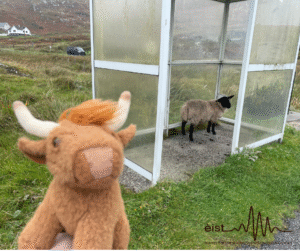
Seumas couldn’t pick a favourite, every trip and event amongst this community has been delightful to be a part of. There have been some wonderful moments throughout, so please enjoy, as just one example, when Seumas found a sheep waiting for a bus on Barra. Seumas would have hidden from the wind on that day too!

Image Description: The photograph contains a brown, plush toy animal with white horns in the foreground being held towards the camera. In the background, there is a real sheep with a black face and legs, standing on a gravel terrain inside of a bus stop shelter. Grassy terrain is all around, with a road and white house at the bottom of a hill in the background.

Image Description: The photograph contains a brown, plush toy animal with white horns in the foreground being held towards the camera. In the background, there is a real sheep with a black face and legs, standing on a gravel terrain inside of a bus stop shelter. Grassy terrain is all around, with a road and white house at the bottom of a hill in the background.

References

An t-amadan agus an rìgh., Michael MacIntyre, Donald Archie MacDonald, SA1966.085.A1, School of Scottish Studies Archives, University of Edinburgh.
An t-iasgair a thachair ris an Donas., Peter Morrison, Donald Archie MacDonald, SA1975.027.A4, School of Scottish Studies Archives, University of Edinburgh.
Bealach nan Gall, Annie (Nan) MacKinnon, James Ross, SA1960.117.B13, School of Scottish Studies Archives, University of Edinburgh.
Coirce a dh’fhàs cho àrd tron oidhche ‘s gun do chòmhdaich e…, Donald MacInnes, Calum Maclean, SA1953.038.A4, School of Scottish Studies Archives, University of Edinburgh.
Fear a chunnaic riochd duine faisg air Fròbost., Patrick MacPhee, Donald Archie MacDonald, SA1964.085.A5, School of Scottish Studies Archives, University of Edinburgh.
Mac banntraich a’ pòsadh nighean rìgh., Michael MacIntyre, Donald Archie MacDonald, SA1964.064.B2, School of Scottish Studies Archives, University of Edinburgh.
Mac bantraich a’ pòsadh nighean aig fear beairteach., Michael MacIntyre, Donald Archie MacDonald, SA1964.064.A-B1, School of Scottish Studies Archives, University of Edinburgh.
Mac na banntraich., Michael MacIntyre, Donald Archie MacDonald, SA1970.195.A+B1, School of Scottish Studies Archives, University of Edinburgh.
Manaidhean-bàis., Annie MacNeil, Mary MacDonald & Emily Lyle, SA1974.101.B3a-B4b, School of Scottish Studies Archives, University of Edinburgh.

Mar a tha a’ chearc air a mallachadh, Donald MacInnes, Calum Maclean, SA1953.038.A3, School of Scottish Studies Archives, University of Edinburgh.

Mar a thàinig na sìthichean., Annie (Nan) MacKinnon, James Ross, SA1960.119.A12, School of Scottish Studies Archives, University of Edinburgh.

Pìobaireachd agus mnathan-tuireim., Annie (Nan) MacKinnon, Alan Bruford & Donald Archie MacDonald & Mary MacDonald, SA1976.186.B3, School of Scottish Studies Archives, University of Edinburgh.

‘S e eachdraidh a tha seo mu mhurtair a bha ann an Uibhist a…, Donald MacLean, Donald Archie MacDonald, SA1965.079.A1 , School of Scottish Studies Archives, University of Edinburgh.

Sgeulachd à Barraigh mu bhòcan., Archie Munro, Alan Bruford, SA1965.116.B3, School of Scottish Studies Archives, University of Edinburgh.

Sgeulachd an òrain ‘Mo Chailin Donn Òg’., Annie (Nan) MacKinnon, James Ross, SA1960.117.B15, School of Scottish Studies Archives, University of Edinburgh.

Sgeulachd bheag a tha ag innse mar a fhuair Cumhal – fear dh…, Michael MacIntyre, Donald Archie MacDonald, SA1964.065.A2, School of Scottish Studies Archives, University of Edinburgh.

Taibhse boireannaich a’ nochdadh ri càraid ann am Pabaigh., Kate Gilles, Donald Archie MacDonald, SA1965.7.B3, School of Scottish Studies Archives, University of Edinburgh.

Thill màthair a bha marbh gus cùram a thoirt dhan teaghlach…, Donald MacInnes, Calum Maclean, SA1953.038.A13, School of Scottish Studies Archives, University of Edinburgh.

Powered by WordPress & Theme by Anders Norén

css.php

Report this page

To report inappropriate content on this page, please use the form below. Upon receiving your report, we will be in touch as per the Take Down Policy of the service.

Please note that personal data collected through this form is used and stored for the purposes of processing this report and communication with you.

If you are unable to report a concern about content via this form please contact the Service Owner.

Please enter an email address you wish to be contacted on. Please describe the unacceptable content in sufficient detail to allow us to locate it, and why you consider it to be unacceptable.
By submitting this report, you accept that it is accurate and that fraudulent or nuisance complaints may result in action by the University.

  Cancel