Any views expressed within media held on this service are those of the contributors, should not be taken as approved or endorsed by the University, and do not necessarily reflect the views of the University in respect of any particular issue.

Blog Posts

Reflection on Literary Value within the Digital

After reading Hayles, Wright and Murray, it became clear that the way ‘literary value’ is policed, constructed, and categorised, along with the way we read and understand these texts are undergoing a period of dramatic change. The dissolution of the virtuous, literary ‘critic’, or policing ‘publisher’, who’s academic literary knowledge form the grounding for a valuation of texts, the power of ascribing a text’s ‘value’ seems to be shifting to the consumer. With the rapid rise of texts (across various media entities) available, and lower barriers to entry for ammeter authors, what makes an ‘author’ successful, or valued, is perhaps linked to both capitalist structures (which, perhaps, drive both publishers to value certain texts above others) and cultural pallets (which are now formed by the public, not ‘high-brow’ artists). It reminded me of the perceived ‘death’ of broadcast TV, which simulated this disintegration of the coherent, cultural palate which came hand in hand with the Netflixicafion of media diets. The consumer curates their digital diet, no longer policed by broadcasters. Is this a force for good?

Literary ‘lists’ and prizes are an attempt to separate the ‘professional’ from the ‘amateur’… which books are ‘good’, or worth reading, and those which aren’t. However, even so, with the rising density of published works, and unwavering power of conglomerates (google, amazon) these are, maybe, equally unsafe from changing consumer pallets and practices. Further points to think about (which I couldn’t include):

  • Amazon/ Google recommendation systems shaping consumer tastes, by ‘recommending’ books based on algorithmic taste- does this ‘lock’ people into boxes, preventing cross-disciplinary interaction?
  • How does Faucault’s ‘author function’ apply here? When does someone become an ‘author’ in the digital sphere?
  • How might Hayles’ discussion of  ‘hyperreading’ bear on the way we read texts? Does this trickle down to affect the ways texts are produced, or published (given the consumer impact on literary value)?
The Cognitive Load is Too Big I Canny Think

I found the liminal space between digital communities and contemporary literary culture that Simone Murray identifies a really productive and generative place for discussion; lots of members of the class brought in examples from other areas of study or from other areas of culture which identified other actors in the relationship between these two phenomena. It also seems to me that quite a lot of the articles we’ve read so far are grounded in more ‘real’-feeling, current social or political issues and come from quite an advocatory perspective, proposing more workable and concrete changes in DH working practices or policy, rather than the more intangible conclusions I often come away from after reading conventional literary criticism. Matthew K. Gold and Lauren F. Klein identify increasingly prevalent intentions of those working in the field to ‘[connect] their work with social justice imperatives’ in their introduction to DDH 2023.

Katherine Hayles’ article in particular also made me think about modalities, in particular audio ‘reading’ (audiobooks, podcasts) and how this might affect comprehension and retention of information. I consume quite a lot of information via this medium, and haven’t really thought much about the specificities of how I engage with it compared to sight reading (whether print or digital). It definitely allows more engagement with different texts in a lot of ways (infomaxxing while I’m walking or doing the washing up), but I’m never sure how this affects my retention of content. I suspect that this maybe echoes the distinction Hayles makes between short-term working memory and long-term memory? Like hyperreading, I wonder if listening engages short-term memory more than the deeper comprehension associated with typical print reading, hopefully I can do a bit of reading around this in the future!

The word ‘disintermediation’ came up in Murray’s article too, and I found it to be an interesting way of expanding the ways we think about literary and digital ecosystems. Her matrix neatly details the ways in which the role of traditional literary middle-people (publishers) have been impacted amidst writers’ ability to communicate to readers. I think that discussing the processes which are now engaged in these discourses (other media which elevates authors to the status of celebrity and literary communities which grow on social media platforms, for example) allows us to investigate how the functionality of these processes might impact readership and how texts are received, as well as the interests of the people and organisations developing and maintaining digital platforms. As a funny side note, this expansive consideration of literary ecosystems also made me think about the internet trends of ‘performative reading’, and how pre-existing cultural ideas around certain texts or writers can be used signal intelligence or a particular worldview. Hopefully walking around 50GS with my printed out Debates in the Digital Humanities makes me look very high brow, or low brow, or no brows – I don’t know!


An Overview of the Key Debates in the ‘Expanding Field’ of the Digital Humanities

Having limited knowledge on the Digital Humanities as a discipline, this week’s reading traced the key debates on the expanding field of the digital humanities, and the major forces it faces within this development. Gold and Klein’s writing in ‘moment to moment’ traced how the field must recalibrate to the ‘uncertainty brought by ruptures’ which exceed ‘any prior reference points’. In a rapidly changing field, which outpaces the rate of traditional academic literary development, which is largely collaborative in nature, the issues surrounding the digital humanities (the lack of specificity within the discipline ‘the big tent’, the lack of involvement from marginalised groups etc) have become more pronounced. The ‘public’ nature of these projects, and collaborative peer-to-peer publishing is particularly unique academically, but allows for this rapid, accountable development.

Moving DH from the academic field to the wider world, by ‘enabling communication across communities and networks’, by creating platforms that amplify the voices of those most in need of being heard’, realised in ‘mapping events  in the wake of Hurricanes Irma and Maria’, and aiding aid efforts in Puerto Rico, the humanitarian potential of the digital humanities can be realised. Special issues in the ‘American Quaterly, the Black Scholar’ etc, mark this expansion and innovation within the field. The ‘Moment to Moment’ introduction trace the ‘fusing go the personal and the historical’, detailing a ‘past characterised by unequal access and the pains of slavery’ which continue to affect academic institutions. Digital Humanities, seems to be a technological attempt to bring attention to these fissures, beyond the capabilities of traditional academia (without the restrictions of a singular field of study, encapsulating a broad variety of disciplines).

The changing attitudes towards DH from the first edition (2012) to the 2019 edition was equally interesting. In the 2019 introduction, the original over-arching optimism, while still there, was less prominent, and instead focused discussions on the major issues facing DH. Gold and Klein describe the field as remaining ‘very much Anglocentric’, expressing a desire to ‘ensure that the field can match the vitality and breadth of those who place themselves in it’. Looking at the digital in projects in class showed a snippet of this breadth, across disciplines, regions etc. Comparing the digitised Blake archive to the Geographical name-mapping website showed the ‘wide range of methods and practices’, as well as purposes, the field can capture. ‘Visualisations of large image sets, 3D modelling of historical artefacts’ encourage a re-interpretation of existing data sets, and the creation of new ones.

Introductory Aspects, Considerations, and Concerns of the Digital Humanities?

I understand Digital Humanities to be a field where individuals can better understand and analyse the humanities subjects (English, Art History etc.) through the lens of technology and data sets in order to revolutionise the academic field and institutions. It is a subject which does not necessarily aim to find the most ‘correct’ analysis but where discussion can be provoked through the different evaluations produced from data sets. When looking at data sets, it is important to acknowledge the legitimacy, accuracy, and whether the data is skewed as this should be taken into account when evaluating. It is a field that adapts to the evolving world and reimagines its intention and focus to take into account changing topical issues and to challenge the authorities that enforce inequality. With its growing popularity and necessity in the world, there are debates as to what is required to be a Digital Humanist (‘Big Tent’), for example, the debate around the necessity of coding comprehension.

Digi-Interpretation: A Luddite’s Immediate Reaction to Digital Humanities

I like the idea of public scholarship — a responsibility to share knowledge gained from being in a university institution with those who may not have as an immediate access as we do. I’m interested in how content, which may demand prior knowledge, can be democratised and made accessible to a wider community.

I also think digital humanities offers new opportunities to be creative in analysis and text interpretation. Especially when displaying research in unconventional ways for Literature studies. Mapping texts visually or using computational methods to create academic content besides an essay is very exciting to me. I’m thinking about how we normally model interpretation though standardised essay style… we are only allowed to have an analysis within this framework at university level. It seems liberating that different digital frameworks can create new ways of interpretation.

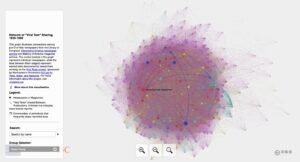
The question of legitimacy is something that strikes me about DH too. Our discussion about Substack, paywalls, peer reviews and social media lends itself to an age old debate about who decides what is intellectual or academic. I don’t think this is anything new. What is new, for me, is the democratising approach of DH. After exploring the Viral Texts DH Project I still find it is not totally accessible. The density of the data, and lack of immediate explanation to a user in this particular project is intimidating. Although aesthetically and visually stimulating, the graph is difficult to decipher without additional research.

A (briefer than normal) Introduction to Digital Humanities

As with many critical fields in the humanities, Digital Humanities really wants to define itself yet also hates being pinned down. Infact, it is a debate within the DH about whether or not the field should even have a strict definition at all. The positives of keeping it ill-defined keep it largely accessible and open, free from being pidgeon-holed into one specific field, allowing colloboration from a variety of actors. However, proponents of the view that it should have a closed definition argue on the same metric. They believe that once you have a definition, that is actually the point at which you can branch off of the initial concept, while still retaining a level of specificity that necessitates critical discussion.The closest I have gotten to understanding an ethos in Digital Humanities is the idea of “construction” rather than just “critique”. What is “construction” itself was controversial, with some people arguing that in order to be a “real” Digital Humanist you needed to know how to code. However because humanities student don’t enjoy learning anything difficult, the definition became much broader, utilising any method of digital construction or “meaning making” to take part. Part of this ethos also has an emphasis on accessibility, bridging the gap between academic and reader, utilising digital tools and the digital space to “democratise” information and knowledge. Interestingly it does (in my view) end up creating a clash between the nature of scholarship and the project itself, which I suppose is one of the very things Digital Humanities attempts to uncover.

It is also not fair to say “critique” does not hold an important place in DH. DH’s love critiquing, they love externally critiquing, internally critiquing, constantly self critiquing. Like most humanist fields they stay committed to being quite intersectional and deconstructionist in their approach, attempting to challenge hegemonies of thoughts that pervase themselves socially, but quite often academically aswell within digital fields. The critique can be showcased through the projects themselves, or it can be a much wider critique of any digital projects or data collection. All this is to help us better understand our purpose and role (moral or otherwise) on digital spaces, what exactly is at stake, and what contributions need to be made. Perhaps I’ve missed something, but there’s a lot of accessible web blogs who attempt to define the same (with a lot more construction, ethos, and critique than I).

My Reflections on Digital Humanities

I have always understood digital humanities to be an interdisciplinary field, one in which we witness an intersection between digital technologies and the broader field of humanities disciplines in an effort to explore human society and culture. What this point of intersection actually looks like to me, however, has always appeared somewhat vague. Indeed, my understanding of humanities disciplines as a standalone concept has remained fairly black and white, having largely taken place within the frameworks of textual analysis and interpretation (the result of being an English Literature student). As such, I had primarily associated digital humanities with the use of digital tools within this existing framework, often to study literary texts through databases, digitised archives or computational methods of analysis.

Only recently, through a developing engagement with critical theory, has my understanding of humanities begun to feel more interdisciplinary, extending toward other fields of study and expression – this, of course, includes the digital world. As such, what is already becoming apparent to me is how strongly the field of digital humanities is shaped by ethical concerns and political realities. From my initial engagement with Debates in the Digital Humanities, DH appears less like a fixed discipline, and more like a set of ongoing conversations about the way that knowledge is acquired, the way it is shared and the way it is valued. In this way, DH feels inherently attuned to the present moment, constantly redefining itself through responsiveness (particularly to social and political pressures).

This reframing has complicated my earlier, more technical understanding of the field. What has stood out the most to me through the readings is how DH repeatedly returns to questions of accessibility and public engagement, which consequently opens up tensions surrounding authority and legitimacy. An example of this can be public writings, such as blog posts, which exist alongside traditional peer-reviewed scholarship, which caught my attention due to it’s particular relevence to my own field of academic study. Thus, the field of DH foregrounds responsibility above all; decisions about data organisation, access and privacy reflect underlying assumptions about whose knowledge matters and how it should circulate, meaning that engaging with humanities digitally also involves engaging with it politically. This is what I now consider to be an intersection point.

At this early stage, my understanding of digital humanities remains provisional. However, I now understand DH as a field with two distinct sides; one that uses digital tools and computational methods to ask humanities questions, and another side which involves the humanistic critique of the tools, technologies and platforms that make such work possible.

Thinking About The Digital Humanities Field

Digital Humanities describes a distinct approach to the humanities field, routed in technology but also the principles of public scholarship. It is a malleable term encompassing a broad range of methods and practices, with voices in the field often keenly describing it more in terms of ‘doing’ than ‘thinking’ (as is the language more generally used in the more traditional humanities). Emphasis in the digital humanities is often the medium: from studying and critiquing the material of the digital humanities, using digital tools and applying computational methods to humanistic study.  The importance of this work is in recognising data structuring is political and its central intellectual problem then becomes how we algorthimise or digitalise a world that is infinitely human – fluid, evolving and subjective.

Digital Humanities: An Overview

A precursory definition of Digital Humanities might be the utilisation of technology in order to better understand the humanities, particularly in a time when the digital world is rapidly becoming central to our daily lives, providing the ability to utilise a critical humanities background in analysing the digital world. Paraphrased from today’s seminar; ‘rigidity of computer and epistemological structures in contrast to humanities scholars wider understanding of culture, literature, language etc..’ The Digital Humanities also incorporates ideas around accessibility and responsibly of scholars and institutions to make their work available to the public, particularly publicly funded academic institutions. One end or goal of the field might be keeping the humanities current and promoting flexible types of thinking, particularly in the online world, when cultural or political issues are increasingly presented in bite-sized formats and as ‘black and white,’ often without nuance.

Digital Humanities is… – a short reflection

Digital Humanities is …

an innovative and creative field that combines knowledge of the humanities with emerging technologies. It examines the culture, stories, history, and art of communities to ask questions and generate ideas. As Matthew K. Gold puts it, DH has been developing over the years into a field of ‘socially oriented work’ (Gold, A DH That Matters). And we can track this development by engaging with the researcher’s comprehensive collections, Debates in Digital Humanities. From a field focused on establishing its own definition and finding its rightful place among more traditional academic scholarship; through loosening strict approaches of “The Big Tent”‘s “who’s in and who’s out”, by perceiving itself as “the expanded field” of relationships between its key concepts, and the possibilities they create; to stepping outside of the university walls by ‘engage[ing] the world outside academy’; to currently being oriented towards responding to pressing world issues and creating possibilities for inclusive futures.

An example of such a project could be Shakespeare and Company, which brings to the world a digitised (and therefore accessible) archive compiled by Sylvia Beach. These are library cards of (not only) famous writers and artists who held memberships at the Paris bookshop and lending library in the inter-war years. The public can, for example, browse the books that Gertrude Stein or Simone de Beauvoir read and engage with them themselves. It could also lead researchers engaging with it to create new, interesting projects that track influences on a particular author’s ideas in their publications. However, as we discussed in class, such a project also leads us to question whether such data should and can be made public. What about privacy? Wouldn’t James Joyce have wanted to keep his library card private?

That’s what interests me most in Digital Humanities. It is a way of creative reflecting on the current state of the world, in which our lives are becoming increasingly computerised and digitised. It is about two-way, collaborative approaches, in which communities and the public inform scholars’ work, and scholars foster critical thinking about emerging cultural and digital phenomena. But, most importantly for me, I see at the core of the DH, its commitment to asking critical questions regarding the world around us and the emerging technologies within it.

css.php

Report this page

To report inappropriate content on this page, please use the form below. Upon receiving your report, we will be in touch as per the Take Down Policy of the service.

Please note that personal data collected through this form is used and stored for the purposes of processing this report and communication with you.

If you are unable to report a concern about content via this form please contact the Service Owner.

Please enter an email address you wish to be contacted on. Please describe the unacceptable content in sufficient detail to allow us to locate it, and why you consider it to be unacceptable.
By submitting this report, you accept that it is accurate and that fraudulent or nuisance complaints may result in action by the University.

  Cancel