


In this post, Dr Allison Cullinane outlines how the School of Biological Sciences utilises the Skills for Success Framework to capture student reflections on their skills. Dr Cullinane demonstrates that the Framework has been a useful tool to make the skills already embedded in the School’s courses more explicit to students, but also how by introducing the Framework to the students early on, it also becomes a tool in their development as well.Dr Alison Cullinane is the Portfolio Director at the School of Biological Sciences. This post is part of the Skills for Success Framework series.
In the School of Biological Sciences (SBS), we use the Skills for Success Framework (SFSF) to structure and capture students’ skills reflections. Our courses are driven by skills-based curricula to equip students with data analysis and science process skills, and they also offer multiple opportunities to develop transferable skills for students’ future profession. The SFSF has provided a useful template to surface and make visible the skills already embedded within our courses. The SFSF captures these effectively because the framework focuses on broadly applicable and transferable skills that support student development.
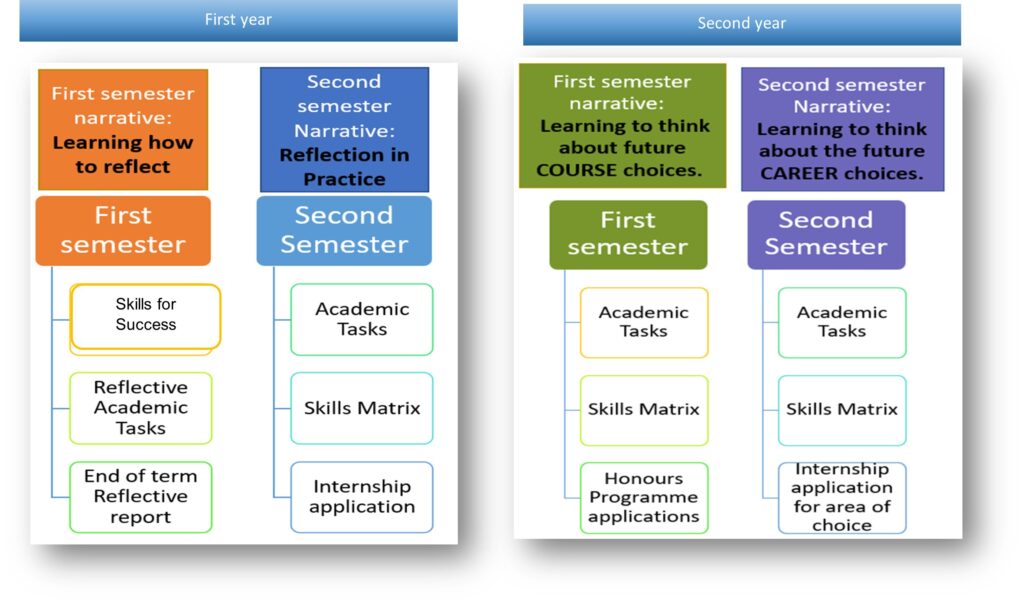
For example, in our pre-honours courses, students engage with a reflective portfolio which is designed to support academic, personal, and professional skills reflection while at university (Cullinane 2024). The portfolio is assessed as a substantial component of each course, and students treat it as a professional document for assessment. Figure 1 shows the portfolio curriculum that is attached to first and second year of our undergraduate course. The portfolio curriculum already had an existing skills matrix which was an expanded version of the SFSF and so it was a perfect introduction to the skills in the school for new first year students.
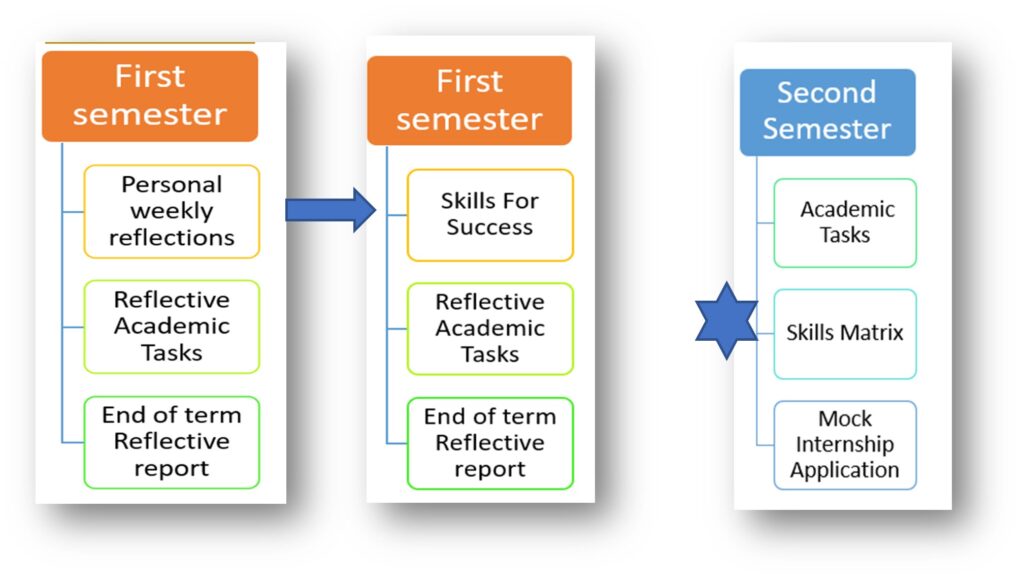
When initially developing the portfolios, I looked to the University’s Graduate Attributes as a framework to guide the focus of reflections. However, these proved challenging to incorporate into a portfolio where I wanted the students to reflect each week. They seemed more suited to end-of-degree reflection rather than capturing learning as it happens. Instead, I designed ‘Personal Weekly Reflections’ to map to themes in two compulsory first-year courses, but over time these themes shifted as the courses evolved and the links in the ‘Personal Weekly Reflections’ were less obvious and less effective. So, when the SFSF was introduced, I felt it worked well to make explicit the skills on our courses. The SFSF also mapped well to the existing skills matrix that the students meet in their second semester portfolio, which has some more disciplinary nuance. The SFSF provides the ideal template to bring into focus what we already do, providing an opportunity to sharpen and capture the skills that students naturally develop on our courses.
We have embedded reference to the SFSF so that students see how the portfolio aligns with what they encounter in our courses as well as with the university wide agendas. The SFSF is introduced in welcome lectures, and when students open their portfolio, it is one of the first elements they encounter. We did not have to change the course objectives or add anything to our content that was not already there, but the Framework provided a template for us to surface the language of skills for the students. This demonstrates how easily it was for us to embed the SFSF throughout our courses, rather than the Framework feeling like an isolated add‑on.
SFSF examples in the portfolio
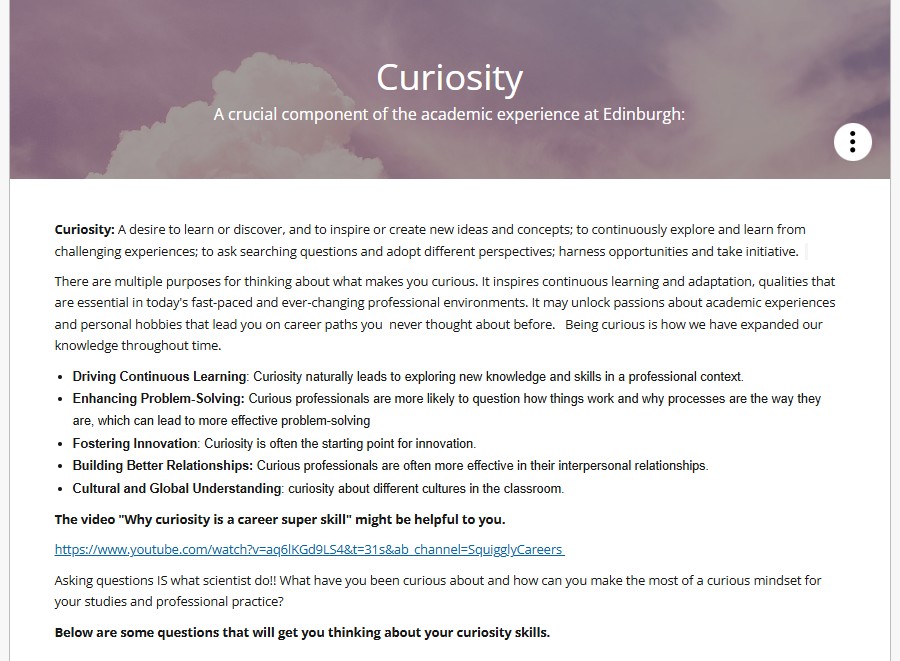
While we did not have to change any course material or any learning objectives, we did need to include information and questions on the SFSF in the reflective portfolio and, as shown in Figure 3, the sections include:
- information about each skill,
- why the skill is important for future study and careers, and
- where possible, a blog, video, or article that evidences its relevance to the job market.
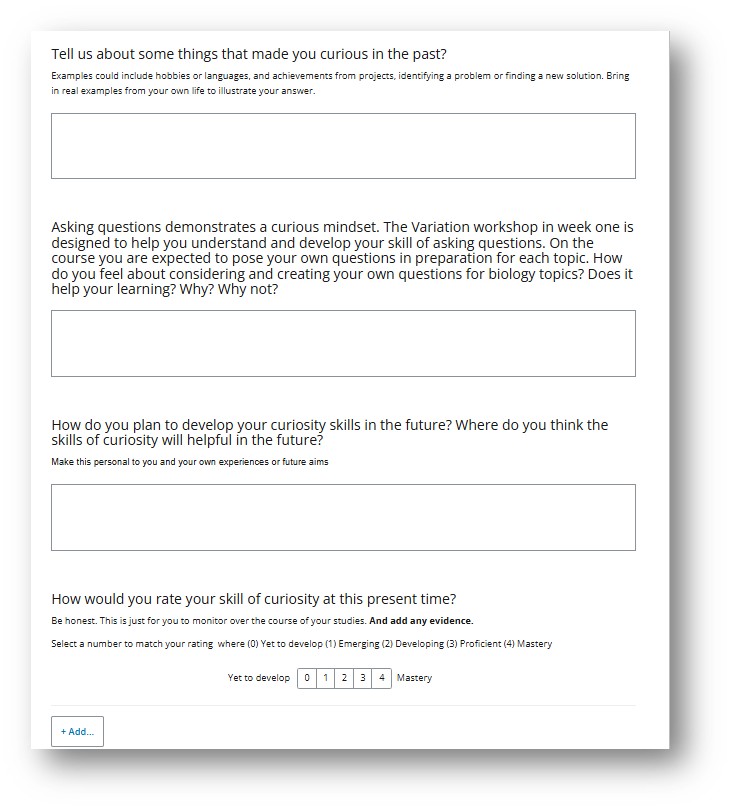
The reflective questions designed (see figure 4) for the ten skills follow a past–present–future structure:
- Past: Where have they used this skill before? (to help recognise they bring skills with them to university)
- Present: Where are they are using the skill now on the course, or in other areas of their life? (to recognise skills currently being taught and developed)
- Future: Initiate that what they learn and do now will have implication for the future, and to link current learning to future goals.
While the portfolio allows students to capture the skills they are developing, completing it also cultivates skills such as reflection, critical thinking, and communication. The Reflective Portfolio prompts higher-order questions (Chen et al. 2009; Bloom 1956) such as:
- What could I have done differently?
- How did this experience challenge my assumptions?
- What did I learn about myself or others?
This kind of questioning is fundamental to critical thinking, and students find the Skills for Success Framework valuable for their skills reflection and development:
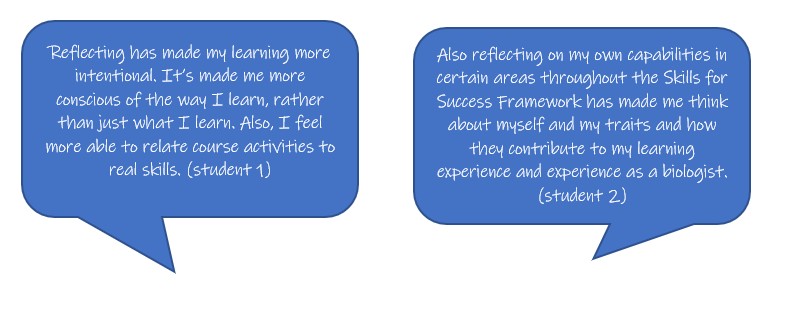
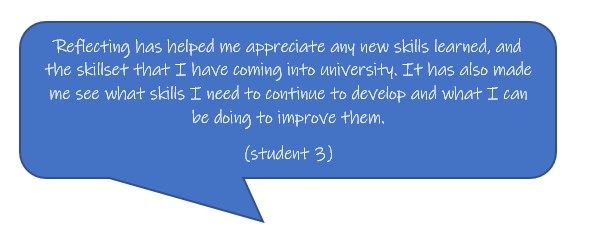
To conclude, the key take away from our experience with the SFSF is that we did not need to add or change our course content, but rather the SFSF acted as a lens to sharpen what we are already doing and make it visible to students. I am confident that every course organiser across the university will be able to surface these SFSF skills very easily while also including their disciplinary nuances in their course learning objectives and activities.
Acknowledgements
Thanks to Prof Heather McQueen for her support and advice with the development of SFSF portfolio questions.
References
- Bloom, B.S. (1956) Taxonomy of Educational Objectives, Handbook: The Cognitive Domain. David McKay, New York.
- Butt, (2025) Making reflective portfolios in Biological Sciences matter, Teaching matters, September 2025 https://blogs.ed.ac.uk/teaching-matters/making-reflective-portfolios-in-biological-sciences-matter/
- Chen, N.-S., Wei, C.-W., Wu, K.-T., & Uden, L. (2009). Effects of high-level prompts and peer assessment on online learners’ reflection levels. *Computers & Education*, *52*(2), 283–291. https://doi.org/10.1016/j.compedu.2008.08.007
- Cullinane, A. (2024) Embedding a reflective portfolio for student development in science courses: Challenges, suggestions, and solutions, Teaching Matters: March 2025 https://blogs.ed.ac.uk/teaching-matters/embedding-a-reflective-portfolio-for-student-development-in-science-courses-challenges-suggestions-and-solutions/
 Dr. Allison Cullinane
Dr Alison Cullinane is the Portfolio Director at the School of Biological Sciences since 2022. In this role, she had creative control to design reflective portfolios for first- and second-year programmes, which are undertaken by over 750 student each semester. She is also currently expanding her role in the school to Deputy Director of Students.