
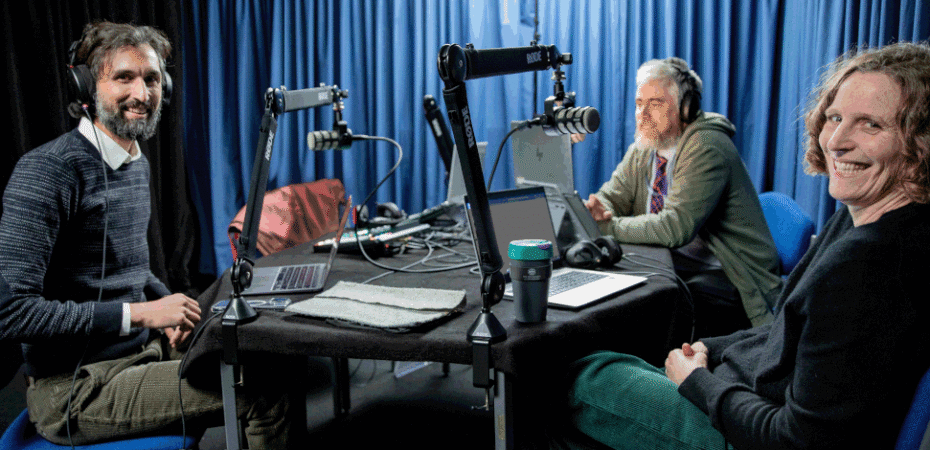
In this post, Juan José (JJ) Miranda shares what managing the Holyrood podcast studio at Paterson’s Land has revealed about how colleagues use audio to support student learning. Drawing on his experience supporting colleagues from programmes including the MSc in Social Justice and Community Action and the MSc in Digital Education, JJ reflects on what a dedicated recording space makes possible, and what it reveals about how colleagues teach. JJ is Learning Technologist at Moray House School of Education and Sport. This post is part of the Podcasting in Learning and Teaching series.
I manage a small podcast studio. That may not be the most glamorous part of my job description, but it’s become one of the more interesting ones. The studio sits in a hidden corner of Paterson’s Land, on Holyrood Campus Lower Ground 2, and if you’ve never been, yes, it is a bit of a maze to get to. But colleagues keep finding it, and watching how they use it has shifted how I think about my role as a learning technologist.
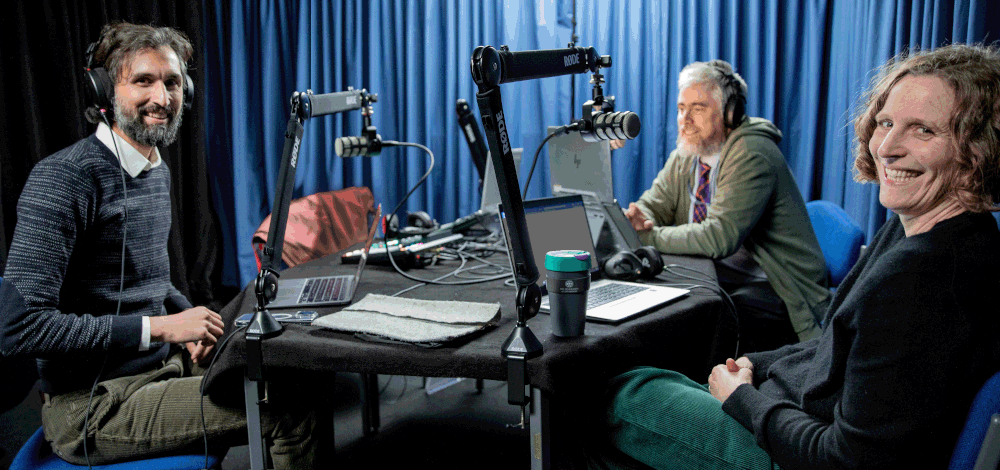
I enjoy seeing that the colleagues who are getting the most out of the studio were not waiting for it to exist before they started making audio recordings, although plenty of colleagues have found their way to audio through the studio itself. Dr Callum McGregor and Dr Andie Reynolds, who teach on the fully online MSc in Social Justice and Community Action, had been recording dialogue-based sessions huddled around a laptop in an office before they ever set foot in the studio. The space itself (a round-table setup with RODE microphones, a mixer and acoustic curtain treatment) is designed for recording.
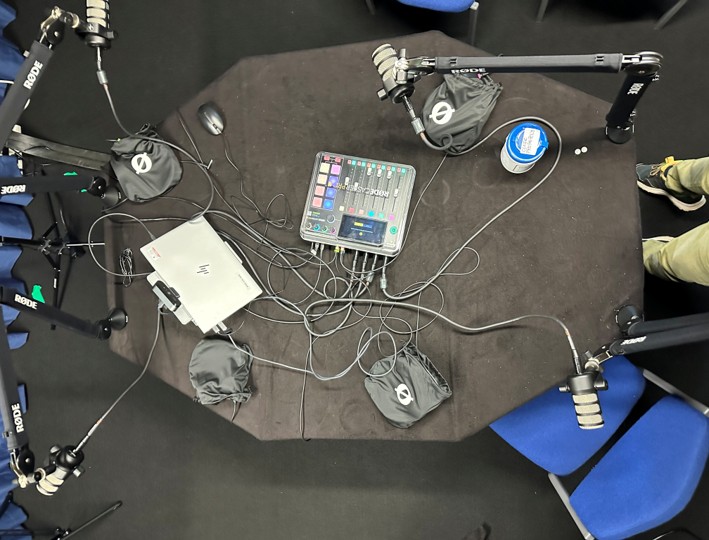
The studio helped, but it didn’t create the practice. If anything, it removed friction. I like to think that we’re helping something that already works well become more sustainable and a bit easier to repeat.
Accessibility and audio quality
Accessibility ended-up being more central to the process than I was expecting. Good audio quality means much more accurate captions, clearer comprehension for students for whom English is not their first language, and a more equitable experience for those who may find some accents challenging. Students with Schedules of Adjustments depend on this more than most. We all know bad audio when we hear it. At that point, it stops being a quality issue and becomes an access issue.
Audio delivery also seems to open up different kinds of access. Students on online programmes are often working professionals with families, fitting their studies around demanding lives. Listening while commuting, cooking, or walking is a different rhythm of engagement – not necessarily a lesser one. This is especially important when designing for a global cohort studying mostly asynchronously.
What voice does that other formats do not
There’s something specific about voice that is hard to replicate elsewhere. Dr Michael Gallagher, who teaches on the online MSc in Digital Education, spoke about how removing video strips away some of the performativity that comes with being on camera. What is left is often more direct and, in some cases, more honest. He also made a point I’ve thought about since: students can tell when something is scripted. The advice for someone going into the studio is to prepare differently rather than more: a solid outline with enough structure to stay on track, but loose enough to follow the conversation where it goes. Too much structure and it becomes brittle.
When the format does pedagogical work
Podcasting works best, I’ve found, when the format is doing some of the pedagogical work itself. On courses like ‘Learning for Democracy’ and ‘Theories and Politics of Social Justice’, Callum McGregor, Andie Reynolds and Claire Bynner use dialogue to model the very processes they’re asking students to engage with. The conversation enacts what the course is about. Andie noted that students often pick-up threads from those conversations in asynchronous discussions in ways that don’t tend to follow a conventional lecture. One student nominated the course for a EUSA Teaching Award, writing that Callum and Andie,”varied from lectures to include some podcast-style dialogues, which have been fantastic.” Another student said that they wished other lecturers would use podcasts in their teaching.
I should also be honest about what is not simple. Colleagues have raised the workload question directly, and it’s a fair one. Two colleagues producing and delivering what is counted as one lecture is difficult to justify in workload terms, whatever the pedagogical case. That tension hasn’t been resolved; it just means you need a clear rationale going in.
Looking ahead
Michael also described using audio beyond individual teaching sessions, including informal recordings that help students understand how a programme fits together. He found that removing video made students less hesitant to engage with him in his capacity as (formerly) Programme Director of the MSc in Digital Education. This approach broadened my sense of what podcasting in education might actually include, inviting possibilities for more informal learning and teaching moments beyond course content.
I’m hoping to develop a follow-up blog post with colleagues from the MSc in Social Justice and Community Action, who have been thinking carefully about specific techniques within this approach. There’s more to say about the craft of it, and I’d rather say it with the people experimenting with it. For now, if you’re curious about the studio, the booking process is straightforward.
The harder and more useful question is: what you want dialogue to do in your teaching that your current approach doesn’t?
 Juan José Miranda
Juan José (JJ) Miranda is a Learning Technologist at the University of Edinburgh, working across the Centre for Open Learning and Moray House School of Education and Sport, where he supports staff to design accessible, student‑centred courses and assessments. His work focuses on translating ambitious pedagogical ideas into workable digital realities across disciplines.