
In this post, Cynthia Naydani, Professor Susan Jarvis, Dr Jill MacKay, and Dr Sarah M Brown, from the Royal (Dick) School of Veterinary Studies, discuss how the Skills for Success Framework has helped them highlight the skills they have already embedded within their two ‘sister’ MSc programmes of Applied Animal Behaviour and Animal Welfare and International Animal Welfare Ethics and Law. This post is part of the Skills for Success Framework series.
In the Royal (Dick) School of Veterinary Studies (R(D)SVS), our Strategic Plan 2025-2030 describes four principles:
- Leadership and advocacy for social impact
- Engaging and training the next generation
- Putting people and communities first
- Pioneering research, translation and entrepreneurship
These key principles have been informing how the animal welfare programmes at the R(D)SVS engage with the Skills for Success Framework.
Applied Animal Behaviour and Animal Welfare and International Animal Welfare Ethics and Law are a set of ‘sister’ MSc programmes at the Royal (Dick) School of Veterinary Studies. We have talked before about the ‘wicked’ problem of animal welfare on the Teaching Matters blog and how our programmes focus on providing passionate and ambitious people with the skills needed to improve the lives of animals all over the world.
The Skills for Success Framework has been supporting our curriculum review, particularly with how it has helped us think about the academic experience of a student at the University of Edinburgh and what we can offer society in this important field. We are also focusing specifically on data and digital literacy, recognising the changes in the animal welfare sector, problem solving as a specific aim of our programmes, and how the Skills for Success Framework can be applied across the different modalities of our on-campus programme and our distance learning part time programme.
The Academic Experience at the University of Edinburgh
The Skills for Success Framework embeds curiosity, collaboration, critical thinking, and problem solving as key elements of what a student can expect to experience in an Edinburgh degree programme. One of our strengths of our MSc programmes is our position within the R(D)SVS, which includes the Roslin Institute, the Dick Vet Animal Hospitals, and the Edinburgh Empathy Place. We can follow the story of fundamental research from translation into production and clinical settings and then directly to societal impacts and policy.
Curiosity, Critical Thinking and Collaboration
A recent example can be seen within the internal Seafood Symposium, which aims to connect researchers and educators across the school who are active, or simply interested in, One Health and welfare in aquaculture settings. MSc students attended and helpfully contributed to discussions along with department heads and department heads.
To engage the next generation in animal welfare, we aim to foster curiosity and make spaces like this symposium welcome and opening to students, which also helps to build their networks. Our students were more than capable of engaging with the critical thinking exercises throughout the day, listening to the expert talks, and integrating that new information with their understanding of animal welfare to challenge current thinking. We were extremely proud.
Problem Solving
Problem Solving is core to animal welfare programmes, not least because the challenges inherent in animal welfare dilemmas are complex and multifactorial. While there are many high-level problems we aim to equip our students to go and solve when they graduate, we also focus on supporting our students to develop their problem solving skills and robustness in smaller, more concrete activities.
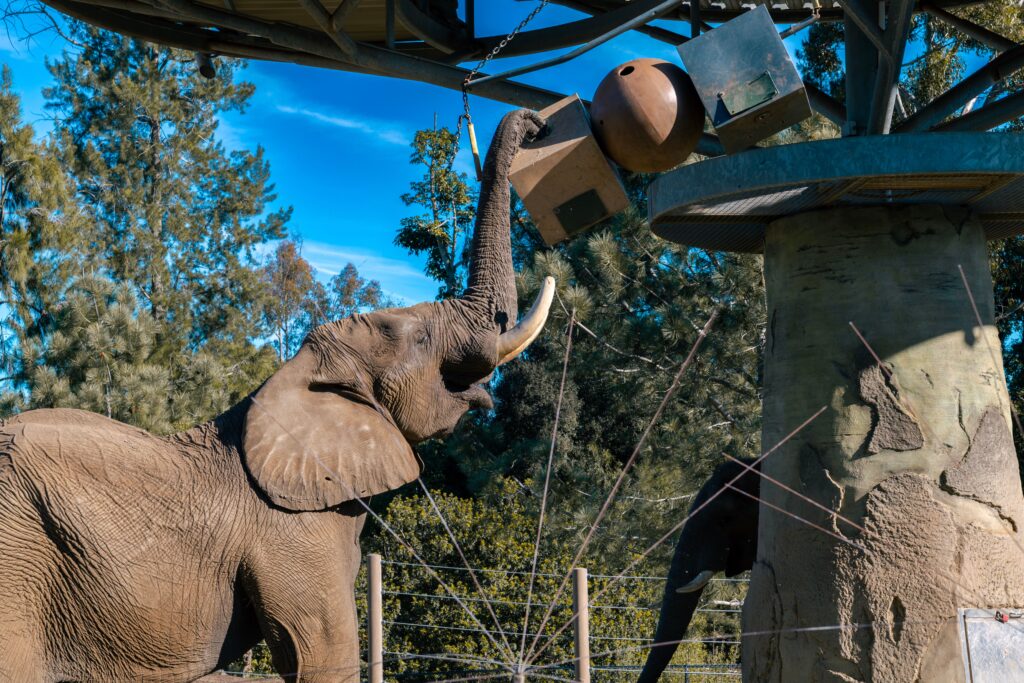
Applied Animal Behaviour Science runs an exercise in partnership with Five Sisters Zoo and BITE Ltd where our students work in groups to design, build, and implement an enrichment resource for an animal enclosure. We won’t say that working out in the cold in Scottish winters is part of how we drill our students in adversity, but these types of physical and practical tasks tie in with the Skills for Success reflective framework.
The students partake in this design activity through the following stages in reflective problem solving:
- Orientation
- Our students review what they know of the animal’s behavioural needs and environment
- Define the task (the who, what, where and how?)
- Students break down the requirement for enrichment
- Clarify the current position
- What tools do students have available to them?
- Evaluate alternative solutions
- Students evaluate the potential options
- Decide on an action plan
- Students decide to test various approaches
- Take action
- Implementing the enrichment
- Evaluate action
- Record the behaviours of the animals to explore whether welfare has improved
Data and Digital Literacy
Both our programmes are grounded in data literacy, with a core tenet of animal welfare policy being ‘what we can measure we can manage’. We are reviewing our teaching materials to better support open scholarship and research, which reflects our ethical positions on making science accessible and reproducible.
In International Animal Welfare Ethics and Law, we teach the statistical programming language R. We support our distance learning students to adapt to this new tool as many of them have never coded before. While we have used open textbooks for years to teach R, with our data literacy approach, we ‘lifted the veil’ on the behind the scenes work in our Research Methods and Data Analysis course by providing a companion textbook that shows how every chart and statistical test used in the lectures was generated. This allows students to recreate their teaching materials.
With the RMDA Companion textbook, we are able to provide extra resources to students at relatively little extra cost to ourselves. We need to generate these teaching examples anyway, so having them contained in a repository is simply organising our materials in a way that helps scaffold student learners in their journey to becoming independent coders.
Iterations not Revolutions
Ultimately, working within the Skills for Success Framework as we review our programmes has not resulted in a full curriculum revolution. Our programmes still have the core aim of producing a better world for animals. We have, however, found Skills for Success a helpful way of assessing what we already deliver, what we do well, and where we can improve our offerings – sometimes in small incremental ways. We’re excited about what’s to come in our programmes over the next decades!
Cynthia Naydani
Cynthia is a Lecturer in One Health and Animal Welfare and co-Programme Director for MSc in Applied Animal Behaviour and Animal Welfare. Her research interests focus on Human Behaviour Change science as a tool for the translation of scientific evidence into real-world practice.
Susan Jarvis
Susan is Professor of Animal Welfare Science and Education and Co-Programme Director for the MSc Applied Animal Behaviour and Animal Welfare. Her focus has been on welfare assessment of farmed pigs and salmon, and the role of animal welfare within sustainable food systems.
Jill Mackay
Jill is a Senior Lecturer in Veterinary Science Education and Programme Director (Pre Dissertation) for International Animal Welfare Ethics and Law. She is fanatic about research methodologies, and loves exploring how scientific questions can be explored in a range of ways.
Sarah M Brown
Sarah is a lecturer in Animal Behaviour and Welfare and Programme Director (Dissertation) for International Animal Welfare, Ethics and Law. She is also part of the Equine Science programme team and maintains a research footprint within the Roslin Institute. She is particularly passionate about equine behaviour and welfare, with a research focus on Positive Animal Welfare in a number of species.