
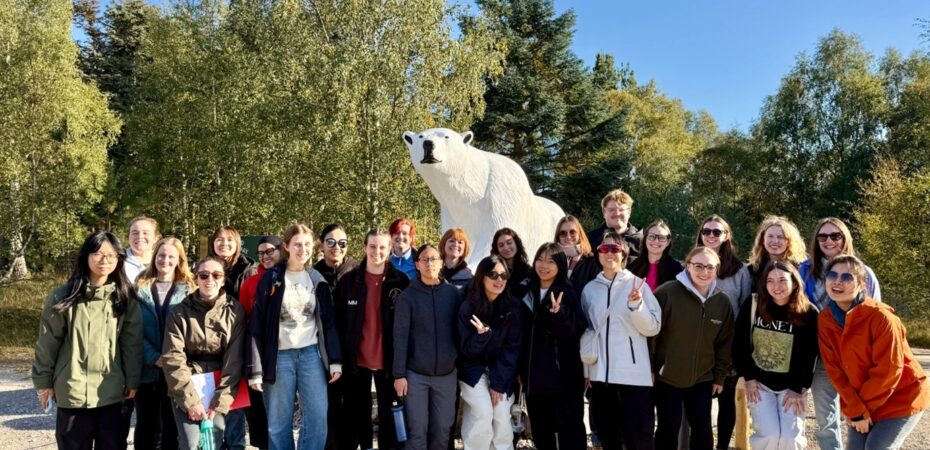
In this extra post, Cynthia Naydani, Professor Susan Jarvis, Dr Jill MacKay, and Dr Sarah M Brown, from the Royal (Dick) School of Veterinary Studies, draw a comparison between the discipline of Animal Welfare Science and the notion of ‘wicked problems’. They highlight two, innovative and long-standing MSc programmes as integral learning opportunities for the animal welfare community.
The UK may be a nation of animal lovers, but many people are unaware of the University of Edinburgh’s long history with animal welfare. The Royal (Dick) School of Veterinary Studies celebrated its bicentenary in 2023, celebrating 200 years of caring for and educating the world on animals. But the scientific study of animal wellbeing and welfare is relatively new, only formalised as an academic discipline in the 1960s following high profile publications such as the UK’s Brambell Report on the welfare of farmed animals[1].
The on-campus Applied Animal Behaviour and Welfare MSc started in 1990 and was the world’s first postgraduate programme to study animal welfare. The online MSc International Animal Welfare Ethics and Law began in 2012, and offers part-time distance learning opportunities for improving the lives of animals.
In 2025, both programmes received new Programme Directors: Cynthia Naydani took on the role of Director for Applied Animal Behaviour and Welfare, alongside former Programme Director Professor Susan Jarvis; and Drs Jill MacKay and Sarah Brown took the role of Programme Directors for International Animal Welfare Ethics and Law.
As we come to the end of our first academic year in the role, we wanted to reflect on what makes these programmes so enjoyable to teach, the amazing diversity and passion of our students, and what we see in the future for these historical yet innovative programmes.
What’s so wicked about welfare?
Animal welfare is built on a fundamental principle that animals are sentient beings who can think and feel, and animal welfare science has spent a great deal of effort providing evidence for this principle over and over. And yet, animal welfare challenges persist. We often tell students that animal welfare is a Wicked problem, and to make a difference in the lives of animals, our graduates need to be able to take action around complex, multifaceted, real-world problems.
Rittel and Webber[2] defined WICKED problems as having:
- No definitive formulation
- No stopping rule
- Only ‘better’ or ‘worse’ solutions
- No immediate solution
- ‘One-shot’ opportunities to solve
- Limited solutions and attempts
- Unique characteristics
- Symptomatic characteristics of other problems
- Multiple explanations for discrepancies
- Moral obligations on the attempted answers
Animal welfare operates across these problems, much like Rittel and Webber’s chosen example of ‘public welfare’.
However, as we start to recognise the intensity of the Wicked problems that face animal welfare, we see that it is not always as simple as demonstrating the conclusive evidence that animals can suffer. Instead, we often need to understand the cultural importance of, and societal expectations on, the role of animals in society in order to make any improvements for their welfare. We have started to see our students’ interests evolve as well, as they begin to explore interdisciplinary challenges. Across the 30 years of Applied Animal Behaviour and Welfare dissertation projects, we now see students choosing to explore topics like consumer choice in farm animal mutilations, why pet owners are attracted to extreme morphologies in pedigree cats, and how social media affects perceptions of wild animal welfare.

Who studies welfare?
One of the great benefits of having a set of sister programmes working across two modalities – the on-campus programme and the part-time distance-learning programme – is that we can build a huge, international community of animal welfare practitioners.
Each student brings their unique perspective and experience to their programme, and, as lecturers, we always that we learn as much from the discussions as the students do. Animal welfare challenges always have multiple explanations and symptoms of wider cultural issues, and there is no simple answer that will work globally – they are truly wicked problems.
Students from both programmes have gone on to work in a huge range of industries, from policy making, charities, pharmaceutical companies, and zoos.
One of the great benefits of International Animal Welfare Ethics and Law programme is that it can be done part-time alongside employment so we have had students based in the US from multinational corporations such as McDonalds engaging with professional development alongside local dog shelter volunteers based in China. It really demonstrates how the University of Edinburgh alumni have a network of colleagues who are passionate and care for animals in their own day-to-day practice.
The future of animal welfare at the University of Edinburgh
We feel as though we are joining a long line of Programme Directors who have been custodians of this animal welfare community. The discipline of Animal Welfare Science is having to face new challenges with our growing world, such as socio-economic impacts on animal welfare, the integration of artificial intelligence into systems, and increasing recognition of animal sentience. Our R(D)SVS 2025-2030 strategy champions science-based decision-making as well as empathy, courage and compassion. Our animal welfare programmes and need people who are passionate, skilled, and ambitious to make a difference to the lives of all the animals on the planet.
You can read student testimonials from International Animal Welfare Ethics and Law here, and Applied Animal Behaviour and Welfare here.
References
[1] Broom, D.M. (2011) ‘A History of Animal Welfare Science’, Acta Biotheoretica, 59(2), pp. 121–137. Available at: https://doi.org/10.1007/s10441-011-9123-3.
[2] Rittel, H.W.J. and Webber, M.M. (1973) ‘Dilemmas in a General Theory of Planning’, Policy Sciences, 4, pp. 155–169. Available at: https://doi.org/https://doi.org/10.1007%2Fbf01405730.
Cynthia Naydani
Cynthia is a Lecturer in One Health and Animal Welfare and co-Programme Director for MSc in Applied Animal Behaviour and Animal Welfare. Her research interests focus on Human Behaviour Change science as a tool for the translation of scientific evidence into real-world practice.
Susan Jarvis
Susan is Professor of Animal Welfare Science and Education and Co-Programme Director for the MSc Applied Animal Behaviour and Animal Welfare. Her focus has been on welfare assessment of farmed pigs and salmon, and the role of animal welfare within sustainable food systems.
Jill Mackay
Jill is a Senior Lecturer in Veterinary Science Education and Programme Director (Pre Dissertation) for International Animal Welfare Ethics and Law. She is fanatic about research methodologies, and loves exploring how scientific questions can be explored in a range of ways.
Sarah M Brown
Sarah is a lecturer in Animal Behaviour and Welfare and Programme Director (Dissertation) for International Animal Welfare, Ethics and Law. She is also part of the Equine Science programme team and maintains a research footprint within the Roslin Institute. She is particularly passionate about equine behaviour and welfare, with a research focus on Positive Animal Welfare in a number of species.