
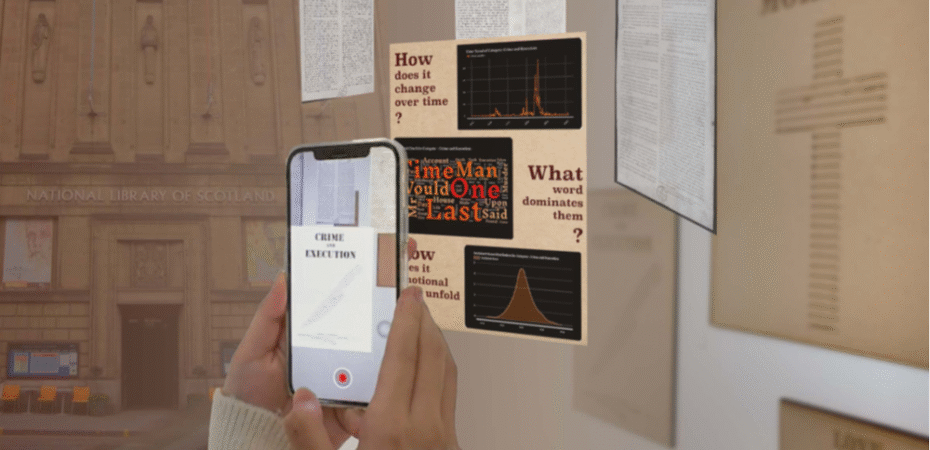

In this post, Sarah Dunn discusses her experience of working across three Schools, with Tara Capel, Dorsey Kaufmann and Theodore Koterwas, with the aim of learning from each other to redesign two Design courses in the School of Informatics. This post is part of the Student Partnership Agreement 2025 series.
As a long time member of the University of Edinburgh, I have the unique position of experiencing the Design Courses taught at the university as a student, a tutor/ teaching assistant and now as a researcher into teaching methods, thanks to Student Partnership Agreement (SPA) funding. Last year, I undertook ‘The Human Factor’ course in the School of Informatics as a PhD student. During a meeting with the new course organiser, Dr Tara Capel, I learned that she was in the process of redesigning the course curriculum, to give students a more hands-on, practical and immersive experience in the field of human-centered design via the application of novel, experiential and practical approaches.
What began as a series of discussions at the coffee machine, soon became a project proposal, and finally the undertaking of this project which ended up expanding far further than we could have imagined due to the generous input of Theodore Koterwas from Edinburgh College of Art (ECA), and Dorsey Kaufman from the Edinburgh Futures Institute (EFI).
Together, the unique backgrounds, diverse teaching methods and combined experiences of these teaching staff spanning three Schools within the University provided new insights. They also helped inform and validate the proposed redesign of ‘The Human Factor’ and ‘The Human Computer Interaction’ courses in the School of Informatics. Additionally, and perhaps even more importantly, this project opened a dialogue between the schools as to how they each addressed the common issues associated with design, in order to allow for learning from each other.
Why is teaching practical work such as design so difficult?
In order to understand what aspects of design courses students struggle to understand, we combined interviews with course tutors, my own personal reflections and student feedback from a variety of Design Courses taught at the University of Edinburgh.
Key aspects students struggle with include:
- Relating theory to the practice of design, both in relation to their own work, or in industry or professional applications.
- Differing student backgrounds and levels of experience, in particular, quantitative versus qualitative thinking styles:
“I think this is hard for a lot of people coming from a data science background… as they’re in this realm of subjectivity and it might be somewhat uncomfortable for them” – D. Kaufmann
- Group projects, especially group dynamics and project management:
“One year before I was basically a therapist for a group that couldn’t get along” – T. Koterwas
- Fixation on marks and exams, and subsequent fear of experimenting:
“I think the minute that you get assessment involved, students get very anxious justifiably they’re like I have to make this perfect… that can actually work against the learning process and them trying things out” – D. Kaufmann
- Reluctance to experiment and get their hands dirty for fear of doing something wrong:
“I find that there’s a lot of rigidity around not wanting to get that wrong… they don’t like trying” – D. Kaufmann
Techniques to aid teaching of design
1. Teach the non-linear, bespoke and imperfect design process
- Incorporate real world examples, especially examples from lecturers own work, emphasising design decisions, the design process and creative journey; not just the final result.
- Break down the process of design into steps:
“It walks them through and breaks down the actual design process of, here’s my data, and then here’s a series of decisions I can make” – D. Kaufmann
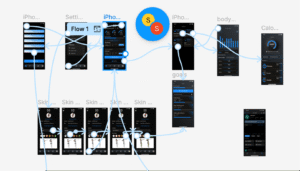
- Teach rapid prototyping and demonstrate a variety of tools to aid this so students can find the right ones for them:
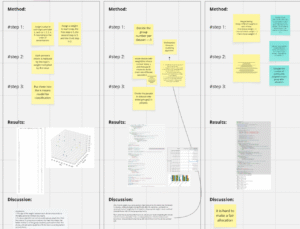
- Incorporate activities and interaction into lectures. Bare in mind students may be resistant to contributing to these so consider anonymous methods:
- Use of metaphors, analogies and thinking exercises when conceptualising a project:
“Pretend this is sort of a murder mystery. What’s the twist? How are you going to make this different, make people think differently or surprise people? One is a twist. The twist of contrast is another one… I used that quite a lot” – T. Koterwas
- Introduce the use of frameworks and templates but emphasise the limitations of these and the need for creative thinking:
- Iron triangle, Double Diamond, BASIC Framework.
2. Demonstrate and situate Design in the real world
- Introduce this from the very beginning:
“They produce a portfolio right away. So we start out the course with that…” D. Kaufmann
- Bring in guest lecturers from diverse fields of design (industry, companies, galleries etc).
- Organise field trips, for example to the Edinburgh University galleries, to allow students to experience design as users and start to conceptualise what they will be working on in their projects. Include involvement and insights from gallery curators, exhibition organisers, artists etc.
3. Help students overcome paralysis or perfectionism
- Lower the stakes for students. Use low value, constant assessment (e.g. weekly written reflections, contributions to tutorials or student quizzes that count for a small percentage of the course mark).
- Set practical exercises in class time, for example, improvised, hands-on activities with available materials which encourage students to get their hands dirty:
“Something that I really like doing when they’re stuck is to get them to just pick random materials and construct something out of this… it’s just basically about applying limitations and from that comes creativity…” Koterwas
4. Consider the course in context of overall programme (e.g. UG or MSc)
- Carefully consider when to introduce theoretical content and why, being sure to relate it to practice from the start:
“You have to be really intentional about when you’re introducing certain concepts to For example, with the Representing Data course, we want to have them understand what the process of designing is first so they can try some things out on their own…” – D. Kaufmann
- Consider the background knowledge of students. Where possible, get all students on same page without boring or demotivating some.
- Consider pre-requisite courses or prior knowledge required.
5. Use a variety of assessment techniques
- Written reports, reflective reports.
- Student showcases and projects: conduct walk-throughs in which students to present final outputs in their own words and answer questions.
- Ensure transparency and clarity from the outset as to how the course will be assessed. Consider sharing course assignment brief forms from the DRPS, marking schemes and even the marking rubrics and frameworks.

Applying our work to ‘The Human Factor’ course
The original aim of this project was to learn how best to redesign the assessment of ‘The Human Factor’ course. Some changes, validated by this initiative, are already being implemented in Semester 2 this year (2025 – 2026), and even bigger changes are being proposed for next year (2026 – 2027).
These include:
- Reformatting lectures from two, one-hour teaching slots to one, two-hour lecture and workshop each week allowing for more practical and interactive experiences.
- Refinement of the coursework, including slightly narrowing the scope of the design brief, and additional student guidance.
- Additional content focused on the application of design practices in both lecture content and tutorial based activity.
- Combining ‘The Human Factor’ and ‘Human Computer Interaction (HCI)’ courses (both 10 credits) into one, 20-credit course to allow students to explore design concepts in a more thorough way and ensure greater consistency of prior knowledge (at present, only some students take HCI in semester 1 leading to repetition of content).
- Incorporating more guest lectures from industry or professional designers working outwith academia.
- The use of real-world datasets with engagement from external collaborators who act as clients for the students, in order to mimic the real world design process.
- Obtaining ethical approval for students to obtain feedback from more than just those in their student groups (for example, friends, the general public etc).
I will be TAing on ‘The Human Factor’ course this year, and Dr Capel will be teaching it, so it will be interesting to see how these changes impact the student experience…
 Sarah Dunn
Sarah Dunn is a PhD student on the Precision Medicine Doctoral Training Program, based in the School of Informatics and the Usher Institute. Her research explores the application of novel data visualization techniques to communicate medical data to patients in an understandable way. Sarah recently developed a strong interest in learning and teaching methods due to her experiences as a student, tutor, marker and teaching assistant at The University of Edinburgh. She is passionate about improving the student experience, through exploring new teaching methods in practical, applied subjects such as programming and design.
 Tara Capel
Dr Tara Capel is a Lecturer in Design Informatics at the University of Edinburgh with an interest in how technology can support people’s wellbeing and empowerment. Her research explores new areas of technology design through a combination of participatory and feminist research, collaborative design (co-design), design probes and making practices. Tara is currently the course organiser of ‘The Human Factor’ course, and lecturer on the ‘Human Computer Interaction’ course, both taught by The School of Informatics.
 Dorsey Kaufmann
Dorsey Kaufmann is a data visualisation designer, artist, and researcher who creates interactive data interfaces and participatory art installations. As a member of the University of Edinburgh’s School of Informatics, Design Informatics and the Edinburgh Futures Institute, Dorsey lectures in data visualisation and design. In 20203, Dorsey received the Information is Beautiful Gold Award as the creator of Ripple Effect, an interactive installation that visualizes local water quality data through data sonification, light, and water vibrations.
 Theodore Koterwas
Theodore Koterwas is an artist, designer and musician seeking to draw critical attention to aspects of daily experience that go unnoticed but profoundly impact on how we understand each other, technology and the environment. Examples of his recent work can be found here: https://theodorekoterwas.com/ Ted recently became course organiser of the Data Science for Design at the Edinburgh College of Art, and has taught on a variety of courses in the school of Design Informatics.


Thanks for your post, and all the best for THF for next semester and the new HCI in 2026/27.
I think the changes sound great, though I would say that 2 hour slots can be slightly trickier timetabling-wise (greater chance of clashes). That said, I’m very willing to support them if good and thoughtful use is made of the slot, as you are doing.