


In this post, Juan José Miranda and Annie Kelly bring together their learning technology and administrative perspectives behind the Challenge Course ‘Understanding Understanding Decolonisation in a Globalised World’. It describes how they adapted familiar tools and processes, from using ABC course design principles in new and collaborative ways for an interdisciplinary cohort, to rethinking possibilities for engagement across multiple Schools. They show how these innovations turned an ambitious interdisciplinary idea into a coherent, timetabled course with university‑wide enrolments. Juan José is a Learning Technologist working across the Centre for Open Learning and Moray House School of Education and Sport (MHSES) and Annie is Academic Services Coordinator (Learning and Teaching) at MHSES. This post is part of the ‘Creating a Challenge Course’ series.
Juan José Miranda: A Learning Technology perspective
I joined the project as a Learning Technologist. My role often involves sitting at the points of friction where pedagogical ideas meet the realities of institutional systems (for example, deciding which tools we can use to deliver an idea and how it will actually appear in Learn). My task was to help turn the ambitious vision for ‘Understanding Decolonisation in a Globalised World’ into a course structure that staff could deliver and students could navigate. This was a process of working closely with a Community of Practice (CoP) made up of academic staff, professional services colleagues, and student partners from across different Schools and Colleges. I acted as a bridge between their disciplinary expertise and the digital learning environment.
To support this, we adapted course design methodology into a collaborative Miro board. ABC is a practical way of building courses that uses different ‘learning types’ (as outlined by Laurillard) to visually map the student journey. By starting with the intended learning outcomes and the mix of activities we wanted, we could check whether the design matched the course’s goals. Miro made this process more flexible for our multidisciplinary group, and the board became a living document that colleagues could update asynchronously, which was essential for a project involving so many contributors and areas of expertise. Thinking about what Learning Technology tools we used for designing the course also helped us think more deliberately about accessibility and hybrid participation from the outset.
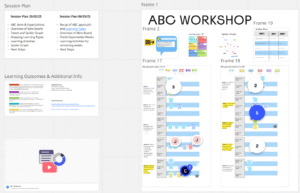
Given the complexity of the subject matter, it was challenging for some colleagues to do sprint-style design exercises, such as defining the purpose of a theme in the course in one sentence. We treated this discomfort as an integral part of the learning process. Overall, we realised that working with a subject from multi-disciplinary perspectives could risk oversimplifying the nuances or the weight of the themes. In this case, however, adapting the Learning Technology processes and tools allowed this to come together coherently and innovatively.
Annie Kelly: The administrative perspective
As the Academic Services Co-ordinator (Learning and Teaching), I support the MHSES Board of Studies, and ensured that the course information on CCAM and DRPS was accurate. I was delighted to move beyond the approval process and join the course’s co-developers to experience how the course content was created. This provided insight into what might be required for the administrative delivery of the course, and to follow through, I became the course administrator as well.
One of the key features of the course is that the student cohort comes from a wide range of disciplines. It is what makes the course so appealing and also provides a few administrative ‘challenges’. Our focus tends to be on the school’s programmes, and it was important to differentiate the needs of this course.
Timetabling requirements are gathered a year in advance, which means we have to make decisions even as the course was being designed. As part of the co-development, we discussed how to find venues for students based on several campuses. We also identified the optimum days and times for lectures to avoid clashes across colleges and schools.
Unlike other courses at MHSES, students were enrolled by their own schools – so my role was managing the quota and liaising with the advisers and administrators from those other schools and campuses. We welcomed a range of auditing students, including some working on a special project. This involved setting up a workshop for them, giving them complex permissions on Learn, ensuring they had access to materials and navigating the logistical needs of staff and students.
As a course administrator, standard support for courses in the School means that I deal with queries from students and staff, set up attendance registers, create assignment submission boxes and support the teaching and assessment processes on Euclid and Learn. I collate and upload assignment and course results and, when these are presented at the Board of Examiners, I prepare the reports and attend the meetings. I publish the ratified results and answer queries from students and their schools. However, for this cohort it is especially important to ensure that school specific guidance is clear for students and staff who are accustomed to their own school’s policies and processes.
Working for this course so closely at different stages has been eye-opening, and I enjoyed engaging with the content itself. I genuinely learned to think differently about the topic and was impressed with the structure of the course and the detailed planning – especially the interactive elements, such as the scavenger hunt and the virtual tour of Old College. Above all, it was great to work collaboratively with the course organiser, the co-developers, tutors and students, to make an ambitious, creative and interdisciplinary course possible.
Conclusion
Together, our reflections highlight the often invisible work required to support the development and delivery of courses at the university. The additional complexity for a cross-institutional course meant we adapted our approaches to overcome the constraints of existing processes through inclusive collaboration.
 Juan José Miranda
Juan José (JJ) Miranda is a Learning Technologist at the University of Edinburgh, working across the Centre for Open Learning and Moray House School of Education and Sport, where he supports staff to design accessible, student‑centred courses and assessments. His work focuses on translating ambitious pedagogical ideas into workable digital realities across disciplines.
 Annie Kelly
Annie Kelly is Academic Services Coordinator (Learning and Teaching) at MHSES and has previously worked for the School of Literatures, Languages and Cultures at University of Edinburgh. Her academic degrees are in literature, magazine journalism and creative writing.