
by Kenneth G C Reid, Emeritus Professor of Scots Law, University of Edinburgh
How much business is there in the Inner House of the Court of Session? This can be looked at in more than one way. The official Civil Justice Statistics tend to measure activity by the number of cases initiated or disposed of. This blog, being interested in court decisions as a source of law, has looked at a different measure: the number of decisions thought to be of sufficient significance to be uploaded as numbered judgments to the website of the Scottish Courts and Tribunals Service.[1] Judged by this measure, there has been a steep decline in Inner House business over the last 10 years. In calendar year 2016, 97 numbered judgments were issued by the Inner House. The corresponding figure for 2025 was 32. The Civil Justice Statistics show a similar if less vertiginous pattern of decline.[2]
Why the decline? Cost is certainly a factor. For not only are the days of free judges long since gone but in the last decade fees for litigation in the Court of Session have increased sharply so that, whereas in 2015 the charge made for a hearing before a three-person bench was £234 per party per half-hour, itself no small sum, by 2026 this had more than doubled to £641.[3] By contrast the cost for a day before three judges in the Sheriff Appeal Court is a bargain-basement £727.[4] But the greatest single cause of the decline in Inner House business is not cost but the shift in case-load from the Court of Session to the sheriff court which was brought about by the Courts Reform (Scotland) Act 2014. This has affected the Inner House in two different but related ways.
First, by raising the financial threshold for actions begun in the Outer House of the Court of Session, the 2014 Act reduced the number of Outer House cases and hence the number of decisions which might potentially be reclaimed to the Inner House. By virtue of s 39 of the 2014 Act, the sheriff court has exclusive jurisdiction where the aggregate total of the orders sought is £100,000 or less. This, admittedly, is a lower figure than the £150,000 which appeared in the Courts Reform Bill as first introduced to the Scottish Parliament,[5] but it is a huge step up from the previous threshold of £5,000. The idea was to prevent straightforward, low-value cases, typically those concerned with personal injury, from taking up the time of the senior judiciary.[6] Figure 1, which gives the total of numbered judgments issued by the Outer House and the Inner House for each of the last 10 years, shows the extent of the decline in Court of Session business.
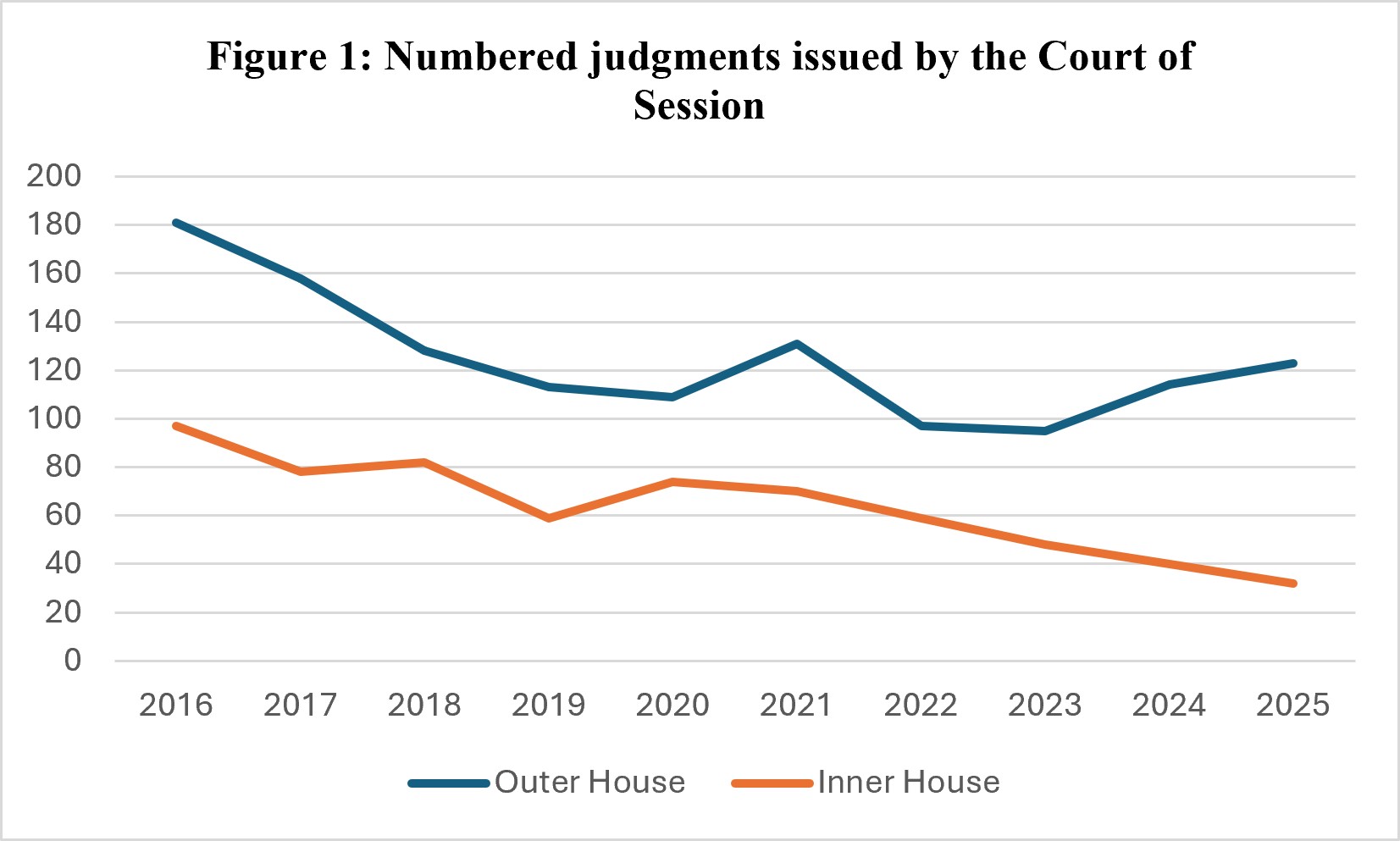
The falling-off of judgments in 2022 and 2023 in both the Outer and Inner House is likely to have been in part a delayed reaction to the Covid emergency of 2020-22 which affected levels of litigation in all of the Scottish courts.[7] Since then there has been a slight recovery in Outer House business, and this seems likely to continue as inflation begins to erode the £100,000 threshold. But while the number of Outer House judgments has begun to rise, those in the Inner House have, so far at least,[8] continued their apparently inexorable fall. Which brings me to the second, and more important, consequence of the 2014 Act which will occupy the rest of this blog entry.
Prior to the Act, there were three main categories of Inner House business, namely (i) appeals (reclaiming motions) from the Outer House, (ii) appeals from the sheriff court, and (iii) a miscellaneous category which can be termed, rather loosely, as statutory appeals (planning appeals, valuation appeals, appeals from the Information Commissioner, appeals from the Scottish Legal Complaints Commission and other regulatory bodies for the professions, and so on). Of those, the second category, sheriff court appeals, contributed around one-third of Inner House business.[9] Today sheriff court appeals have largely disappeared from the Inner House. Under the pre-2014 Act system, appeals from a decision of the sheriff lay both to the sheriff principal and also, if desired, directly to the Inner House. A decision of the sheriff principal could itself be appealed to the Inner House, and around a third of sheriff court appeals to reach the Inner House were appeals from sheriffs principal.[10] Leave was not required for either type of appeal. In consequence, the Inner House was an important appellate forum for decisions of the sheriff court. In financial year 2014-15, the last full year in which the pre-2014 Act system was in operation, there were 40 numbered appellate judgments issued by sheriffs principal and 25 issued by the Inner House in respect of appeals from the sheriff court, of which 9 were appeals from decisions of a sheriff principal.
All of this changed with the 2014 Act. Direct appeals to the Inner House were abolished except where expressly provided for by other legislation.[11] Instead, appeals were to be made to a new appellate court, the Sheriff Appeal Court.[12] As before, no leave to appeal was needed. In theory, a decision of the Sheriff Appeal Court could itself be appealed to the Inner House,[13] but leave to appeal was required and, as we will see, is not often granted. The result, as figure 2 shows, is that appeals from the sheriff court have almost disappeared from the Inner House.
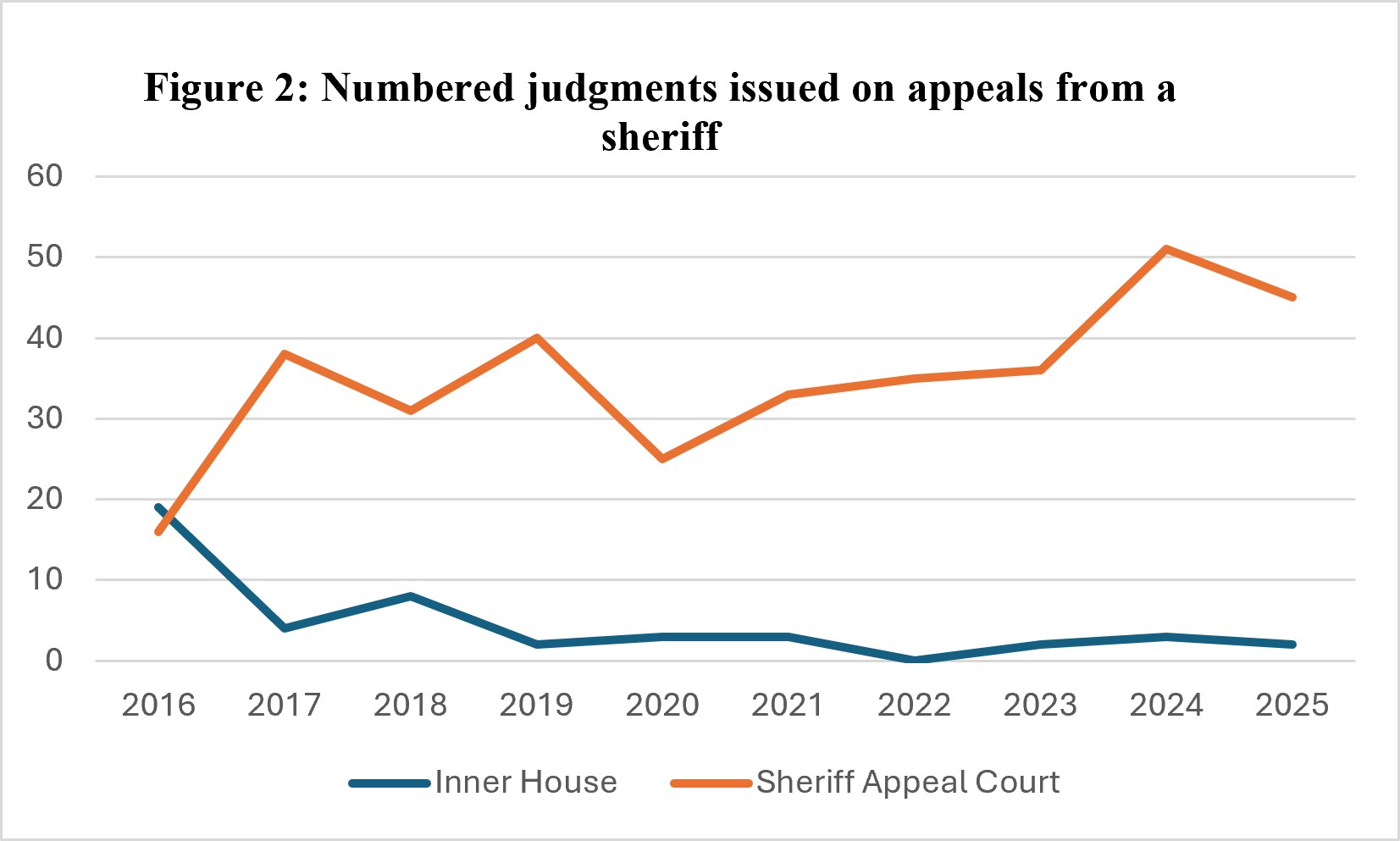
The Sheriff Appeal Court started hearing civil appeals at the beginning of 2016 and in that year, there were still more sheriff court appeals in the Inner House – all legacy appeals – than in the Sheriff Appeal Court. The position was however speedily reversed. As early as 2017 there were 38 numbered judgments issued by the Sheriff Appeal Court in civil matters as compared with a mere 4 judgments in sheriff court appeals heard by the Inner House. The latest figures, for calendar year 2025, are 45 and 2 respectively. So with the coming into force of the 2014 Act, the Inner House has lost almost all appeals coming from the sheriff court, and hence a third of its overall business.
This, of course, was no accident. The relevant provisions of the 2014 Act were intended to address problems identified by the Scottish Civil Court Review, which had reported in 2009. As the report noted:[14]
There is an open appeal, with no requirement of leave, from the sheriff or the sheriff principal to the Court of Session. This right of appeal brings before the Court of Session numerous appeals of no legal significance or material value, the burden of which adds to the inefficiency of the court. In effect, the court has no control over its workload.
These themes were taken up again by the Policy Memorandum which accompanied the introduction of the Courts Reform Bill to the Scottish Parliament. Civil appeals from the sheriff court ‘do not merit the attention of Inner House judges except in very exceptional cases’; to confine them largely to the new Sheriff Appeal Court ‘will free up Inner House judges to deal with more complex matters’.[15]
The basic argument is certainly hard to fault. No one looking through the sheriff court appeals that, prior to the 2014 Act, were routinely sent to the Inner House can doubt that, for the most part, they did not merit the attention of the senior judiciary. And yet, and yet. It is no simple matter to draw the line in the right place – to spare the Inner House the merely routine while continuing to ensure that it receives the cases of real legal significance and difficulty. Was this delicate balance achieved – and achieved first time – by the 2014 Act? Is it really the case, as the Policy Memorandum urged, that sheriff court appeals are today always ‘heard at an appropriate level in the court structure – the right cases in the right courts’?[16] Or, rather, has the 2014 Act freed up the judges of the Inner House more than was really intended or than is desirable for the future development of Scots law? These important questions will be explored in part 2 of this blog entry.
[1] <https://scotcourts.gov.uk/>.
[2] See Civil Justice Statistics in Scotland 2022-23 <https://www.gov.scot/collections/civil-justice-statistics/> table S9, showing a decline in Inner House appeals disposed of from the sheriff court or other courts or tribunals from 174 in 2013/14 to 90 in 2022-23. These are the latest figures available: publication of the annual statistics is currently ‘paused’.
[3] Court of Session etc Fees Order 2015, SSI 2015/261, sch 1; Court of Session etc Fees Order 2026, SSI 2026/80, sch 1.
[4] Sheriff Appeal Court Fees Order 2026, SSI 2026/79, sch 1.
[5] Courts Reform (Scotland) Bill (as introduced on 6 February 2014) s 39(1)(b)(ii).
[6] For this and other reasons for the change, see Courts Reform (Scotland) Bill: Policy Memorandum (2014) paras 79-90.
[7] Civil Justice Statistics in Scotland 2022-23 p 4.
[8] It is possible that numbers will rise to some extent in 2026 – in the first five months of the year, 26 judgments were issued by the Inner House – and a degree of fluctuation is to be expected from year to year.
[9] Courts Reform (Scotland) Bill: Policy Memorandum para 120.
[10] Courts Reform (Scotland) Bill: Policy Memorandum para 120.
[11] Courts Reform (Scotland) Act 2014 s 110(5). Appeals to the Inner House under other legislation are rare. An example is UV v Locality Reporter Manager of the Scottish Children’s Reporter Administration [2025] CSIH 19, 2025 SLT 946 (stated case under s 163 of the Children’s Hearings (Scotland) Act 2011).
[12] Courts Reform (Scotland) Act 2014 s 110.
[13] Courts Reform (Scotland) Act 2014 s 113.
[14] Report of the Scottish Civil Courts Review (2009) vol 1, v. The quotation comes from the introduction by the Lord Justice-Clerk, Lord Gill, who led the review.
[15] Courts Reform (Scotland) Bill: Policy Memorandum para 133.
[16] Courts Reform (Scotland) Bill: Policy Memorandum para 35.
(Stephencdickson, CC BY-SA 4.0
(Stephencdickson, CC BY-SA 4.0