Any views expressed within media held on this service are those of the contributors, should not be taken as approved or endorsed by the University, and do not necessarily reflect the views of the University in respect of any particular issue.
Part Two: The Chilean fideicomiso and trusts in Latin America
By León Carmona Fontaine, Assistant Professor of Private Law at the Pontificia Universidad Católica de Chile.
In a previous entry published on this blog, I showed that there are compelling reasons to think that the fideicomiso provided for in the Chilean Civil Code of 1855 was influenced by English legal ideas. This second entry examines how the Chilean fideicomiso went on to play an important role in the introduction of trust instruments in Latin America, even though it never evolved into a fully fledged trust instrument capable of widespread use within Chile.
This entry argues that this development happened in two stages: First the Chilean fideicomiso was taken up by the Panamanian jurist Ricardo J. Alfaro, who relied on it when drafting the first trust legislation in Latin America in 1925. Subsequently, during the 20th century the Panamanian trust served as a model for trust legislation in several other jurisdictions in the region including Puerto Rico, Mexico, El Salvador, Venezuela, and Colombia.
Part One: English influences in the Chilean Fideicomiso
By León Carmona Fontaine, Assistant Professor of Private Law at the Pontificia Universidad Católica de Chile.
Latin American and most European jurisdictions are commonly regarded as civil law jurisdictions. Yet one notable difference between the two is that trust instruments were introduced in Latin America much earlier than in Europe. Panama (1925), Mexico (1926), El Salvador (1926), and Puerto Rico (1928) were pioneers of this development, followed by Venezuela (1956) and Colombia (1971), whereas Argentina (1995) and Uruguay (2003) adopted such instruments at a later stage. By contrast, with the exception of Liechtenstein (1926), European civil law jurisdictions introduced trust instruments considerably later, and primarily due to the influence of the Hague Trusts Convention. Romania (2011), the Czech Republic (2014), and Hungary (2014) are examples of this much later development.
One explanation for this divergence between Europe and Latin America lies in the stronger influence of the United States in Latin America. However, there is also another factor that has received far less attention so far: the influence that English law may have exercised on the fideicomiso as regulated in the Chilean Civil Code of 1855, and the role that the Chilean fideicomiso played in the introduction of trust instruments in other jurisdictions of Latin America. As this entry and a forthcoming one argue, there are several reasons to believe that the fideicomiso provided for in the Chilean Civil Code was influenced by English legal ideas and later functioned as an important bridge for the introduction of trust instruments in Latin America.
by Elspeth Reid, Emeritus Professor of Scottish Private Law
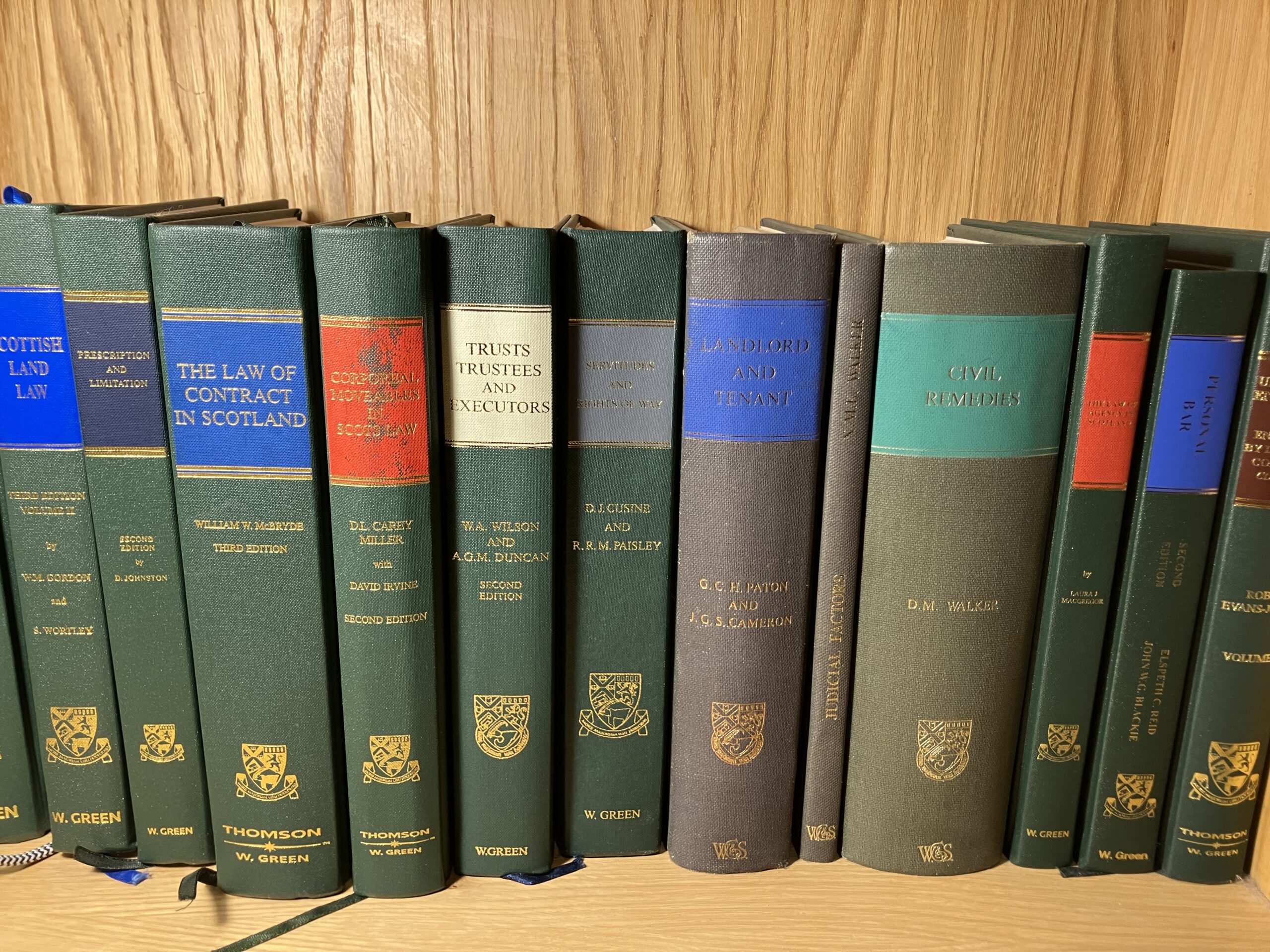
The publication of the second edition of Personal Bar has come nearly twenty years after the first, which these days is a long time in the world of academic writing. The transformed environment for the second edition has given me cause to reflect on the enterprise of writing a Scottish Universities Law Institute (SULI) text, or any “big” legal treatise for that matter. How has treatise writing altered, or how should it be modified, in response to the huge changes we have seen in the 21st century? I cannot pretend that I have answers to the questions raised here, but the following suggest themselves as concerns that might now usefully be considered in the wider legal community.
T B Smith’s vision for the SULI series when it was established in 1960 was much influenced by the Louisiana State Law Institute, as a model of what a smaller jurisdiction could do for itself. Scotland, like Louisiana, was a smallish jurisdiction which valued its distinctive identity, where publishing was expensive and challenging, and there were few publishing outlets available for texts specifically about that jurisdiction. The Louisiana State Law Institute was dedicated to “public service”, and that seemed to be part of Smith’s vision too. The Louisiana State Law Institute had broader ambitions of law reform, which in Scotland were hived off elsewhere, but its key mission, which SULI was to share, was carrying out “scholarly research and scientific legal work”, producing treatises which were directed at supporting the profession as much as the academic community. In 1961 Smith predicted that “Within ten years we may hope to see the main divisions of Scots law restated in up to twenty comprehensive treatises.”[1] SULI did not quite reach that ambitious target, but it has done a wonderful job with an impressive list of titles over the last 65 years, and also in energising academic writing in Scotland more generally, all the while observing T B Smith’s motto for the series, more majorum, usu hodierno – according to the custom of our ancestors, according to today’s practice. But “today’s practice” has changed hugely since the 1960s. To what extent does this mean that SULI texts or similar legal treatises should change too?
Compare how it felt to speak your first words in a foreign language with how it feels now after years of practice. Once we can do things as a matter of habit, they start to become automatic for us. Deliberately framing something in a different perspective – what the Russian literary theorist Shklovsky said about the role of art in his concept of ‘defamiliarization’ (‘ostranenie’)[2] – challenges that automatic response. Defamiliarization is also possible in legal research. It enables us to take a new look at our own jurisdiction and how we work within it.[3] Studying and researching only in our home jurisdiction makes everything we do there feel natural to us – even inevitable. All that changes once we see it from the outside.
Breaking through this habituation and seeing familiar things with new eyes can be facilitated by a research stay abroad. In 2024 the author of this blog entry undertook a six-month research stay at the University of Edinburgh. This entry deals with the differences in the research and teaching between Edinburgh and Basel, as well as the new perspectives the author gained from her time abroad. She experienced an ‘ostranenie’ that challenged her automatic assumptions of how the law had to be.
by Professor Reinhard Zimmermann, Emeritus (Director) of the Max Planck Institute for Comparative and International Private Law, Hamburg
“Mr. Booker, however, would review such a book as Lady Carbury’s ‘Criminal Queens’ without bestowing much trouble on the reading. He could do it almost without cutting the book, so that its value for purposes of after sale might not be injured”: Anthony Trollope, ‘The Way We Live Now’, Chapter 1.
(i) Modern academic life is characterized by an apparently unstoppable trend towards specialization. At the same time, we are faced with a proliferation of legal literature. It becomes more and more difficult to follow developments in areas not directly relevant to one’s own field of research. (ii) Contrary to the natural sciences and economics, law is a field of research where the writing of books constitutes a long-established and essential means of producing knowledge. In a number of countries (Germany and Italy among them) a scholar has to write two books in order to qualify for an academic career. In other countries (England and Scotland, for example) an aspiring academic usually has to write a PhD thesis which, in a revised version, is often subsequently published as a book. (iii) With so much writing going on, nobody can read all new law books, even those in a limited field such as contract law, or constitutional law.