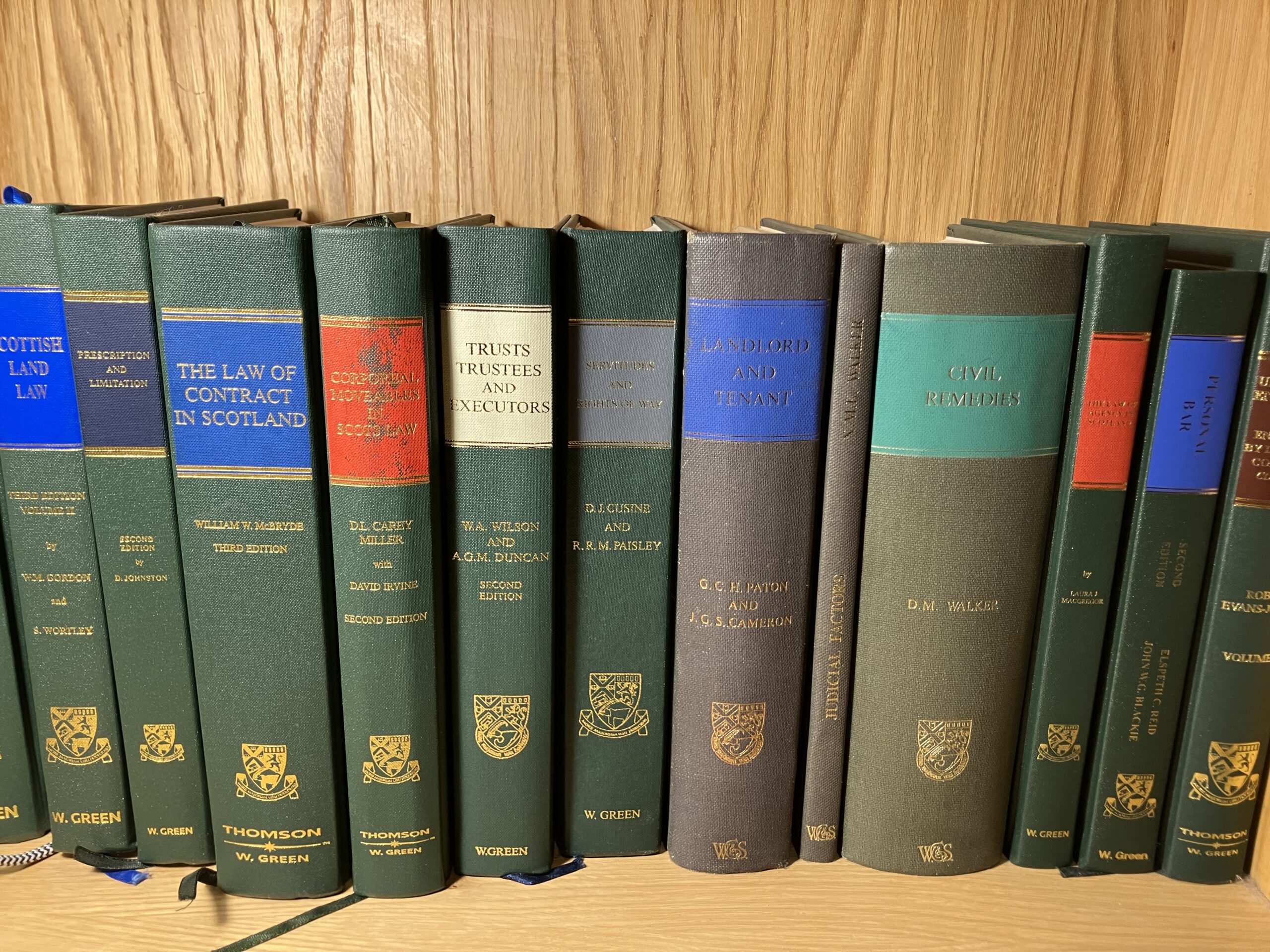
by Elspeth Reid, Emeritus Professor of Scottish Private Law
The publication of the second edition of Personal Bar has come nearly twenty years after the first, which these days is a long time in the world of academic writing. The transformed environment for the second edition has given me cause to reflect on the enterprise of writing a Scottish Universities Law Institute (SULI) text, or any “big” legal treatise for that matter. How has treatise writing altered, or how should it be modified, in response to the huge changes we have seen in the 21st century? I cannot pretend that I have answers to the questions raised here, but the following suggest themselves as concerns that might now usefully be considered in the wider legal community.
T B Smith’s vision for the SULI series when it was established in 1960 was much influenced by the Louisiana State Law Institute, as a model of what a smaller jurisdiction could do for itself. Scotland, like Louisiana, was a smallish jurisdiction which valued its distinctive identity, where publishing was expensive and challenging, and there were few publishing outlets available for texts specifically about that jurisdiction. The Louisiana State Law Institute was dedicated to “public service”, and that seemed to be part of Smith’s vision too. The Louisiana State Law Institute had broader ambitions of law reform, which in Scotland were hived off elsewhere, but its key mission, which SULI was to share, was carrying out “scholarly research and scientific legal work”, producing treatises which were directed at supporting the profession as much as the academic community. In 1961 Smith predicted that “Within ten years we may hope to see the main divisions of Scots law restated in up to twenty comprehensive treatises.”[1] SULI did not quite reach that ambitious target, but it has done a wonderful job with an impressive list of titles over the last 65 years, and also in energising academic writing in Scotland more generally, all the while observing T B Smith’s motto for the series, more majorum, usu hodierno – according to the custom of our ancestors, according to today’s practice. But “today’s practice” has changed hugely since the 1960s. To what extent does this mean that SULI texts or similar legal treatises should change too?
Change in focus?
First of all, should the radically different research environment mean a change in focus for the content of SULI texts and their equivalent? When John Blackie and I embarked on the research for the first edition of Personal Bar, Scots Law Times was available in electronic form, initially on a borrowed CD rom, as I recall. Scots Law Times eventually became available on Westlaw, but at that time the pre-20th-century Session Cases were not included there, far less older sources including Morison’s Dictionary. To find the pre-20th-century authority, the Faculty Digest and old-fashioned serendipity gave a reasonable steer, but essentially it was necessary to take each volume of Session Cases down off the shelves and go painstakingly through the indexes. It was a completely different world, in which unearthing the case law and logging the relevant cases was an invaluable service for treatise authors to perform. “Big books”, SULI texts included, typically devoted much of their space to cataloguing case law, often narrating the facts at length. Rankine on Personal Bar, published in 1921, was perhaps an extreme example of this.
The research environment has now changed dramatically. For the second edition of Personal Bar we were able to flick effortlessly through Westlaw and other databases to check out new authorities, as well as picking up some older material that our earlier researches missed, and Westlaw links us instantly to commentary on recent developments and the relevant passages in journals and Thomson Reuter publications. Many 19th-century treatises are also now fully searchable, not just for those who have access to the Making of the Modern Law but even on Google Books etc. In many ways, therefore, the business of primary research has become much more straightforward – logistically at any rate, although increased accessibility does present its own challenges. But now that Westlaw and other search engines can do much of the work in identifying and navigating primary and secondary sources, does that change our expectations of legal treatises? Should this signal a shift in approach?
Traditionally we have thought of SULI texts as providing an authoritative statement of the current law – of immediate practical relevance, but also fully grounded in the primary sources and the academic literature. They might perhaps suggest future directions for the law, but authors were directed that they should refrain from elaborating in great detail on the reforms that the author would wish to see. The question is whether ease of access to authority now means that coverage of the sources, until now a central feature, might usefully be scaled back. In that connection we should remember that the majority of readers these days are likely to be reading the text online rather than in print format. Should less space be devoted to exploring the sources therefore, and should it be left to Westlaw and the hypertext links in the text to share the work that the author did previously?
No doubt well-populated footnotes are not entirely redundant. At any rate, authors should still be expected to flag the important cases and sift out for the reader the material of particular significance, particularly in areas such as delict where there is an abundant case law. But if identification of the relevant sources has, in a sense, become a lower-order skill these days, should other elements perhaps move up to greater prominence? The evaluation of competing arguments has of course been important for SULI texts hitherto, but should SULI texts shift to become more polemical in their content?
Change to format?
A related question is whether there should be changes in format to meet the needs of a community that is much more likely to be reading the text online rather than between the traditional stiff green covers, and, come to that, a community that reads more or less everything online or not at all.
A number of noticeable changes were made to the format in the second edition of Personal Bar. These were required by Sweet and Maxwell, rather than being suggested by the authors – the text as originally presented had followed the format of the first edition and previous SULI texts. However, as I understand, those changes were driven not so much by pedagogic reasons but by the need to standardise format across the Thomson Reuter estate – West and Sweet and Maxwell publications alike. It is not entirely clear that what we have now, or, for that matter, the format we had in the first edition, is the most helpful possible for our online readership. Subject to what our publishers might in future require, we might usefully consider in more detail what works most effectively for that medium. When readers are scrolling rather than turning individual pages, how do we ensure that we capture and retain their attention most effectively? Does this mean shorter sections, clearer labelling in terms of headings and sub-headings and so on, or a more radical restructuring?
AI?
We are all aware of the looming shadow of AI, although it is unclear as yet what this will become capable of. At the moment it is impotent in regard to older, more obscure, sources, which it is unable to scrape. It has also shown itself to be not entirely reliable when it comes to retrieving and selecting the authority that is available to it, sometimes confecting non-existent authority instead, or so it would appear. Moreover, it can do little currently by way of sophisticated analysis of legal argument. There is therefore no immediate threat to what SULI texts can offer, but that could change very rapidly. And, of course, SULI texts themselves will become a source for AI. Thomson Reuter is already developing its inhouse AI “legal solution”, CoCounsel Legal, drawing on the content of Westlaw and Practical Law, and inevitably SULI material is going to seep out further. Should we accept this drift as inevitable, and if so, are there ways to shape our content to promote its optimal use alongside AI?
Practical issues: open access?
There are also some practical issues to be considered when looking to the future of “big books”. One of those is the progress being made by open access publications, although this is not the current model for SULI. A number of the mainstream legal publishers are offering open access publication, not necessarily as their prime mode of publication for the time being, but very much one of the options, for example, Edward Elgar, Taylor Francis, De Gruyter Brill, and more locally the Edinburgh Legal Education Trust. Self-publication was once regarded as the last refuge of the desperate, but at a recent webinar for aspiring authors, Bloomsbury (which now includes Hart) was adopting a very different tack, promoting open access much more positively, as a means of making scholarship accessible and “democratising” knowledge. It certainly has the potential to reach a much wider readership even than SULI books achieve currently, although admittedly without Westlaw’s very useful hyperlinks and associated content.
Typically, publishers will demand a “Book Processing Charge” from open access authors. Bloomsbury, for example, asks for £13,500 for a book of 180k-250k words. De Gruyter Brill starts at €7000. At the moment, open access is therefore likely to shunt the cost of publication from the readers and the readers’ institutions, to the authors and the sources which the authors or their community can muster. But there may be other alternatives. The Edinburgh Legal Education Trust does not charge the authors but instead funds publication through the revenue from professional seminars. De Gruyter Brill says that in order to extend open access, it is working with academic libraries and research funders to develop new funding models which will not involve cost to the authors themselves.[2]
Innovative thinking may therefore be required, but an initiative along these lines may not be so far removed from the model that T B Smith set up for SULI, which received substantial “financial encouragement” from the Carnegie Trust and was initially underwritten by subscriptions from the Scottish legal community.[3] And, of course, the actual costs of producing a book these days are relatively speaking a lot less than they were in the days of T B Smith, when all content came from printing presses that were still working on hot metal typesetting. If SULI is continuing to aspire to a “public service” role, as mentioned earlier, are there interesting possibilities here?
Practical issues: the SULI authors of the future?
Finally, the most fundamental point of all is who will be the SULI authors of the future? John Blackie and I are both retired from full-time teaching and will hopefully remain research active for a while, but not indefinitely, so who is going to be prepared to take on the writing of books like these? Academics have their research agenda very much dictated by the REF, and this may force difficult choices on writing projects on a SULI scale. I am out of touch with how the next REF is going to work, but last time around, I understand that at best books counted for double an article or chapter. It is easy to see why younger scholars in particular, anxious about career progression, will set a target of writing a portfolio of articles rather than taking the risk of concentrating on a single lengthy monograph. I understand also that in some instances academic writers at the beginning of their careers can be positively discouraged from embarking upon projects of this nature. Can SULI counter this by itself providing incentives, perhaps setting up a scheme, in partnership with others, for funding periods of research leave? This is an important concern for the future health of the series.
These are all questions for which I have no immediate answer, but which may be important to consider if SULI is to continue to live up to the high standards which T B Smith set for it 65 years ago.
[1] T B Smith, British Justice: The Scottish Contribution (Hamlyn lectures) (1961), 227.
[2] See: https://www.degruyterbrill.com/publishing/for-authors/book-authors/open-access/transformation-packages
[3] TB Smith (n 1) 227.