
Welcome to the May – July Learning & Teaching Enhancement Theme: Skills for Success Framework, co-edited by Lorna Devlin (Senior Design Lead, Skills for Success).
Welcome to this Teaching Matters Blog series exploring how the Skills for Success Framework is embedded and uncovered across the University of Edinburgh.
An evolution of Graduate Attributes, the skills and mindsets built into the university’s education planning for students, the Skills for Success Framework builds on the broad value of a University of Edinburgh education in the current social climate. While Graduate Attributes was future focused and aspirational, the language of the Skills for Success Framework is embodied in the past, present, and future. It validates existing skills and builds skills confidence on programmes of study. From June 2026, new courses and programmes, and those undergoing review, will embed the Skills for Success Framework using updated unified paperwork with all core courses transitioning over the next few years as part of the Learning & Teaching Strategy 2030.
Uncovering the iceberg
With current employers valuing skills and attitude over knowledge, which they are confident they can teach ‘on the job’ (HR Magazine 2022),students need an increased awareness of the skills they are developing and confidence in articulating these for their future (CBI 2019). A body of data and evidence generated from graduate outcome research highlights the disconnect between higher education and employability around skills transfer (Advance HE 2018).When asked about specific skills many students can give an example from their sports team or volunteering. What is frustrating for lecturers is that skills are often present in the classroom, but students do not always recognise their presence (Oron-Semper &Blasco, 2018). It is the much laboured iceberg metaphor – the skills may be there, but the students cannot see them.

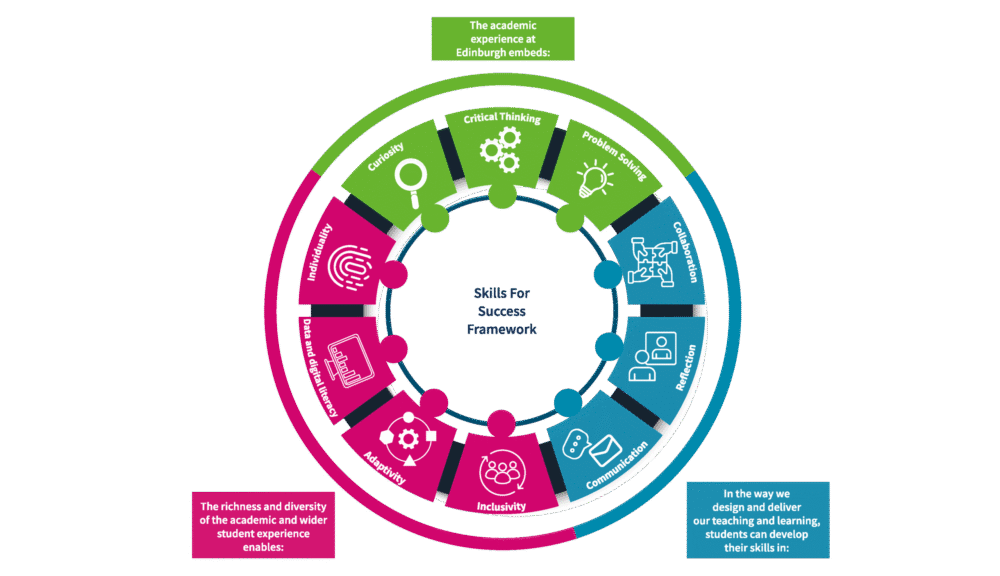
The ten Skills for Success have been identified through research into both higher education and the employment sector. All taught students will have the opportunity to develop and demonstrate these ten skills on their programmes. A coherent development arc that is designed with academics, employers, careers, student development, learning technology, and students also suggests a ‘psychological contract’ more like a professional workplace (WONKHE 26).
The Skills are in three overlapping groups and full descriptions of each Skill can be found on the public website and on the Skills for Success Framework Sharepoint for staff.
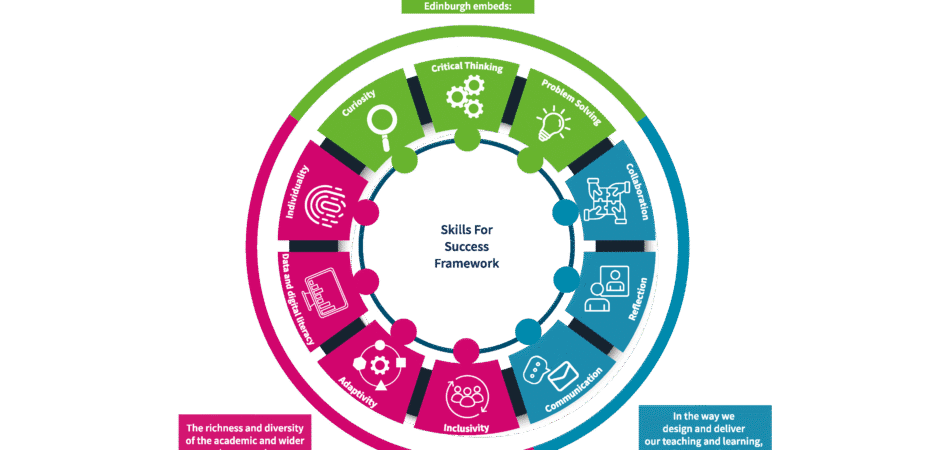
The academic experience at Edinburgh embeds core academic skills of Critical Thinking, Curiosity, and Problem Solving. In the way we design and deliver our teaching and learning, students can develop their skills in: Collaboration and Communication. The richness and diversity of the academic and wider student experience enables students to develop Inclusivity, Adaptivity, Data and Digital Literacy, and Individuality.
The Skills for Success Framework has been developed taking into account SCQF level descriptors and accrediting bodies. The language is deliberately general – it applies to all subject areas and is recognisable to both employers and students. The ten skills are not mutually exclusive – one cannot effectively problem solve for example without also reflecting.
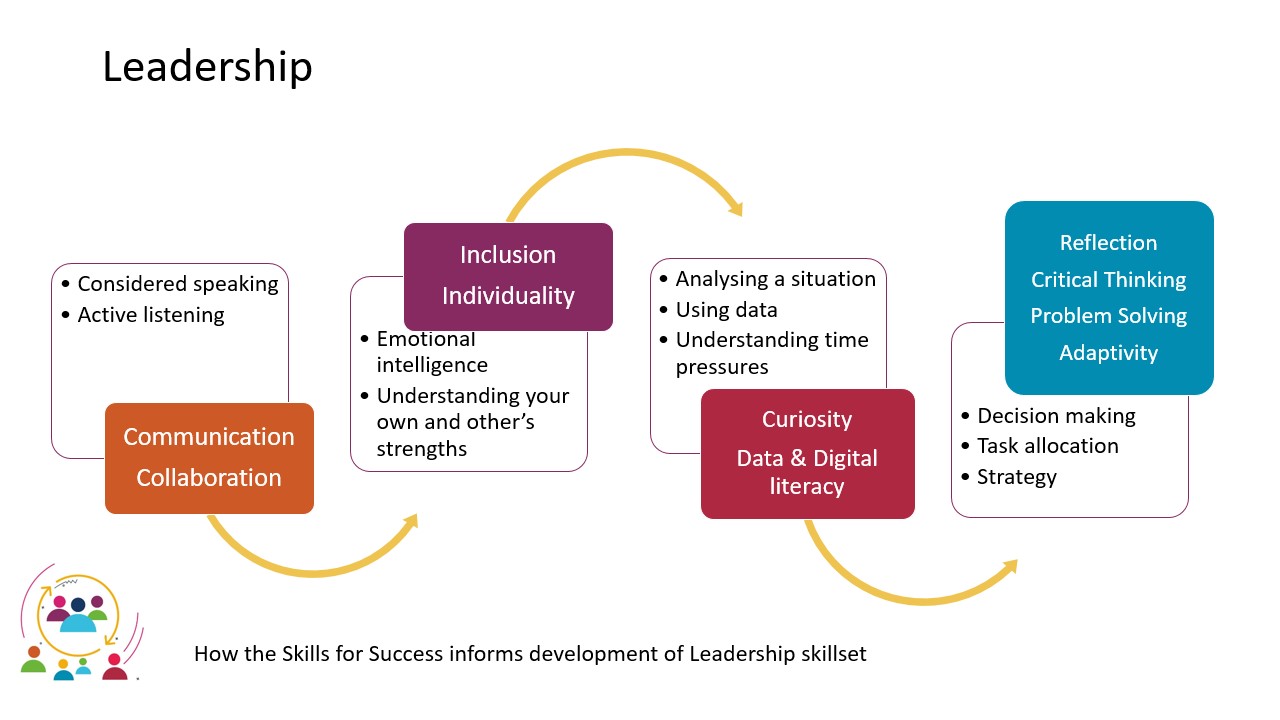
The skills also work together as skillsets, such as Leadership, which is a set of skills that is temporal and situational. Leadership requires active listening and considered responses (communication and collaboration), working with emotional intelligence (individuality), and understanding the strengths of others (inclusion). This allows for the analysis of a situation (curiosity and data), decision making (critical thinking), and the ability to take action (problem solving).
Upcoming in this series…
How do you begin to help the students notice the skills your carefully planned lesson develops? How do you (back to the iceberg) lower the waterline or give your students goggles? And how can we help students to develop the critical reflection skills necessary to notice their own capabilities and use these to their advantage? This series rumbles with these questions.
This series is an opportunity for us all to don goggles and see what is already there beneath the surface and explore how we can develop our students’ confidence in their skills. Over the coming weeks, come with us to explore how to transition your course to the Skills for Success Framework with an Architecture case study; adapt your courses or professional service provision to prepare students for a dynamic world of work in your discipline with the postgraduate Ambassadors Scheme; discover how to spot the skills that many of us have normalised in the work that we do but are yet still being cultivated in our students; and, learn how to build skills towards mastery among others. The Skills For Success Framework is already hidden within fundamental elements of academia: sharing concepts in class with peers, presenting work, answering questions, and researching and sharing ideas as a group for a project. Within all of these recurring academic moments, there are skills that make up part of the Skills For Success Framework. This series will demonstrate how to embed them and also show us that the skills are often already there within our courses.
Within this series, we will learn about innovative ways that individual skills can be developed. Skills for Success provides an opportunity to make the most out of the education we provide and allow students to to gain much more from surfacing an already present curriculum.
 Lorna Devlin

Lorna Devlin is the Senior Design Lead for the Skills for Success Framework. An ex-secondary school Headteacher, Lorna has a keen interest in supporting our students higher education through both their pastoral care (she was a Design Lead on the new model of Student Support) and their classroom experiences. Lorna is passionate about active engaged learning as a space for developing skills, sense of belonging and social responsibility.