
In this extra post (Part 1 of 2), Andrei Ghira, Eduardt Nica, and Aurora Constantin, from the School of Informatics, and Gennaro Imperatore, from Computer and Information Sciences (University of Strathclyde), discuss two MSc projects aimed at embedding accessibility into the curriculum. These projects address the pedagogical challenge of teaching accessibility as a fundamental principle of education, moving beyond a ‘tick-box’ approach to foster critical awareness and prepare graduates to engage meaningfully with diversity and inclusion. Part 2 builds on the foundations outlined in Part 1, and focuses on what students and educators have learned when accessibility became the starting point for real-world projects.
Accessibility is increasingly recognised as a fundamental dimension of technology design and digital education, highlighting the importance of designing inclusively from the outset (Burgstahler, 2013). Within higher education, teaching accessibility is not only about meeting legal or regulatory requirements, but about equipping students with the skills and critical awareness needed to design technologies that are inclusive, equitable, and responsive to diverse user needs (Lewthwaite, 2024). Despite this growing recognition, accessibility remains underrepresented in many computing curricula. As a result, many students graduate without the practical experience required to design accessible digital systems (Lewthwaite 2024; Weeden 2023).
Inclusive design as a driver of innovation
In response, educators are exploring ways to integrate accessibility more deeply into project-based learning. Rather than treating accessibility as an afterthought or a final-stage checklist, an emerging pedagogical approach positions inclusive design as a driver of innovation. When students are encouraged to design for diverse users from the outset, accessibility becomes a core design principle shaping architecture, interaction design, and evaluation.
Two MSc Artificial Intelligence dissertation projects provide a useful illustration of this approach. Both began with accessibility as the starting point for design and resulted in mobile applications aimed at addressing real-world barriers experienced by users with disabilities. One focused on improving navigation in urban environments for wheelchair users, while the other explored how museum visits could be made more inclusive through personalised digital support. Together, these projects show how postgraduate assessment can move beyond simple prototypes towards systems with meaningful social impact.
Accessibility as a learning challenge
Embedding accessibility within computing education presents several interconnected challenges. At an educational level, students must move beyond theoretical awareness and engage with accessibility as a practical design problem. This requires learning to consider diverse abilities early in the development process rather than attempting to retrofit accessibility features later.
From a technical perspective, accessibility projects demand systems that resemble real-world applications rather than isolated components. Students must consider how data structures, user interfaces, and system architecture support inclusive interaction. They must also address ethical issues when working with accessibility-related data, including questions of privacy, safety, and representation.
Evaluation presents another important challenge. Understanding whether a system is genuinely accessible requires more than implementing features. Students must learn how to design meaningful evaluation methods, measure usability and task effectiveness, and interpret feedback from real users. Ultimately, the aim is to support students in developing technologies that have genuine social impact beyond the university environment.
NaviWheel: supporting accessible urban navigation
NaviWheel is an Android mobile application designed to help wheelchair users navigate urban environments safely and independently (see Figure 1). While popular navigation tools like Google Maps offer general directions, they often lack reliable accessibility information and rarely address the specific needs of wheelchair users.
NaviWheel fills this gap through a community-driven approach. The app provides a city map showing accessible locations, each containing details such as ramps, elevators, and accessible toilets. Users can also contribute by adding new locations and leaving reviews with photos, descriptions, and ratings.
The system includes safety features, such as an emergency button that sends the user’s GPS coordinates to a trusted contact via SMS. AI-generated summaries also condense multiple reviews into short explanations that can be delivered through text-to-speech, helping reduce cognitive load and support visually impaired users.
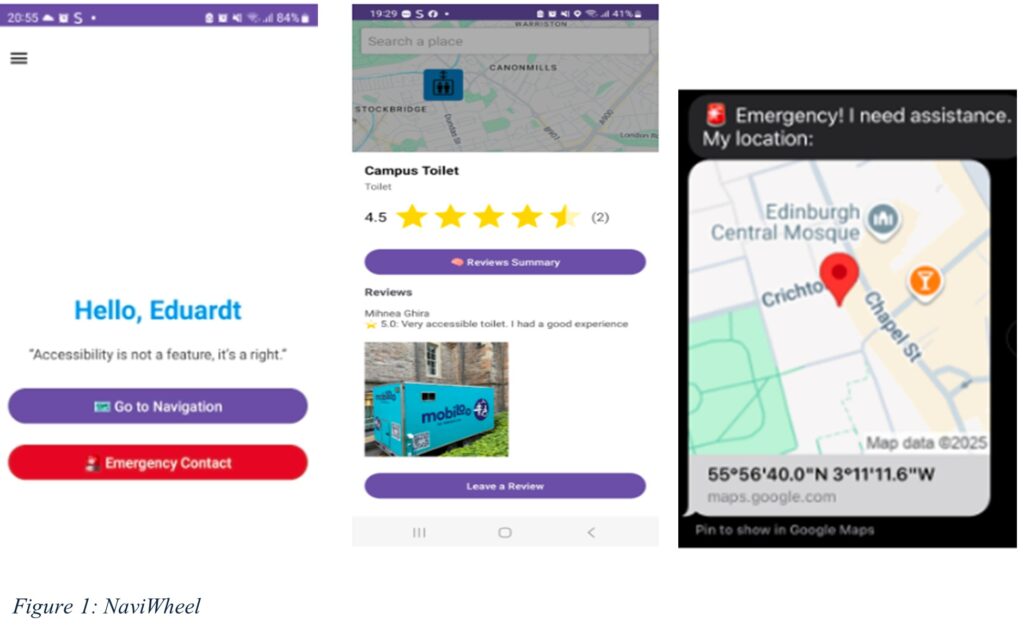
Evaluation with wheelchair users and accessibility experts showed promising results. Participants reported high usability and highlighted the clarity of the map interface, the usefulness of community-generated data, and the reassurance provided by the emergency feature.
AURA: making museums more inclusive
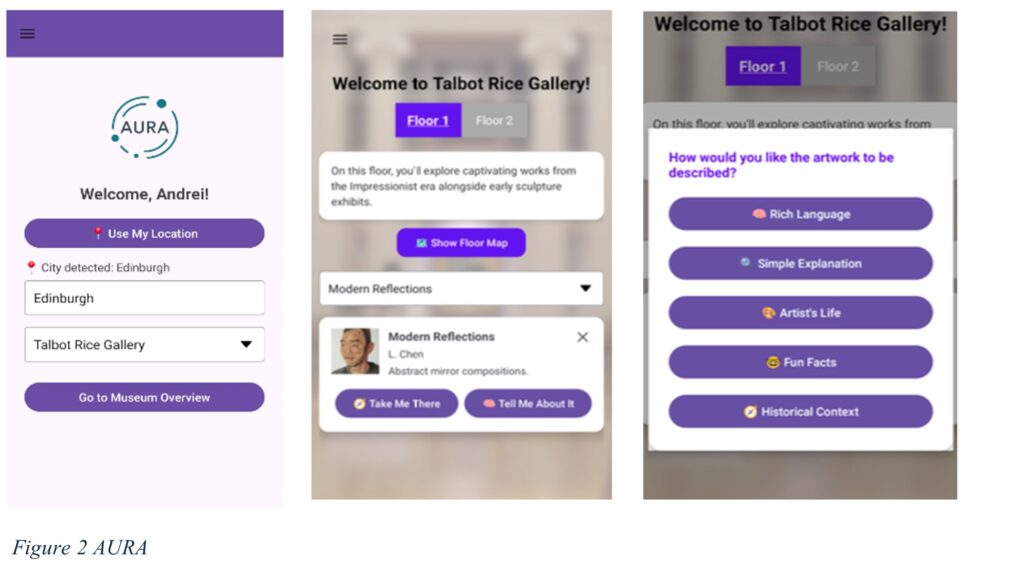
The second project explored accessibility in museum visits through AURA (Accessible User-centric Responsive Application), a prototype designed to make museum environments more inclusive for visitors with disabilities (see Figure 2).
Accessibility tools in cultural heritage spaces are often static, text-heavy, or poorly integrated into the visitor experience. AURA addresses this by embedding accessibility throughout the system design.
The application supports the full museum journey. During onboarding, users specify accessibility preferences such as mobility requirements or preferred content formats. They can then select a museum and navigate it using a floor-aware interface.
Two main features support the in-gallery experience. The ‘Take Me There’ function provides navigation routes that include mobility-friendly alternatives, while the ‘Tell Me About It’ feature generates AI-powered explanations of artworks tailored to the user’s interests and preferred complexity level. These explanations are designed for readability and can also be delivered through text-to-speech.
Evaluation with wheelchair users and accessibility experts showed positive engagement. Participants particularly valued the personalised explanations and accessible navigation, while also suggesting improvements to readability and interface discoverability.
Evaluating accessibility in practice
Both projects incorporated structured evaluation with wheelchair users and accessibility experts. Participants completed task-based testing and provided feedback through interviews and usability assessments.
NaviWheel achieved particularly strong usability results, with an average System Usability Scale (SUS) – a widely used questionnaire for assessing perceived usability – score of 87.8, indicating excellent usability. Participants highlighted the clarity of the map interface, the usefulness of AI-generated summaries, and the reassurance provided by the emergency button.
AURA also demonstrated positive usability outcomes, achieving an average SUS score of 78.4. Participants generally described the application as accessible and engaging, although some improvements were suggested, particularly around readability and the discoverability of certain features.
Embedding accessibility in computing education means treating it as a core design principle rather than an afterthought. When introduced from the start, it encourages students to engage more deeply with real user needs, ethics, and system complexity. In this context, principles such as accessibility-by-design, user-centred and participatory approaches, and integrating accessibility across the whole system shape how students approach both problem definition and solution development. Through hands-on projects and user involvement, accessibility becomes an integral part of how systems are designed rather than something added later. This approach also has relevance beyond computing, as similar principles can be applied in other disciplines, such as design, education, and the social sciences, to support more inclusive and user-centred practices. This sets the stage for the lessons explored in Part 2.
References
Burgstahler, S.E. and Cory, R.C. eds., 2010. Universal design in higher education: From principles to practice. Harvard Education Press.
Lewthwaite, S., Coverdale, A. and Butler-Rees, A., 2020. Teaching accessibility in computer science and related disciplines: a systematic literature review and narrative synthesis protocol. Social Science Protocols, 3, pp.1-11.
Weeden, E., 2023. A model of an accessibility curriculum in higher education. Frontiers in Computer Science, 5, p.1139350.
 Andrei Ghira
Andrei Ghira is a recent MSc graduate from the School of Informatics, University of Edinburgh. They are currently working as a Software Engineer and are interested in building technology to solve accessibility problems.
 Eduardt Nica
Eduardt Nica is a recent MSc graduate from the School of Informatics, University of Edinburgh. They are currently working as a Software Engineer and are interested in building technology to solve accessibility problems.
 Aurora Constantin
Aurora Constantin is a Lecturer at the University of Edinburgh’s School of Informatics and a Senior Fellow of the Higher Education Academy. She leads the School’s teaching support staff training programme and co-organises the Computer Science Education Group and the Accessibility and Inclusivity Working Group. Her research spans Human-Computer Interaction (including Child-Computer Interaction), applied AI, Educational Technology, assistive technologies and Participatory Design.
 Gennaro Imperatore
Gennaro Imperatore is a Teaching Associate at the University of Strathclyde, with a particular interest in accessibility. He is an HCI and mobile development expert. His work focuses on developing inclusive and accessible solutions with real-world impact to assist those with disabilities.