In this extra post, Dr Sayed Mahdi Mosawi shares his experiences of incorporating documentary films in his course, ‘Unfolding Afghanistan in a Globalised World’ as a way to decolonise the curriculum with the Alwaleed Centre’s Project and Communications Officer, Mouna Chatt. Their conversation is based on a research project Dr Mosawi conducted to develop a practical approach to decolonising the curriculum within his course and to examine the impact of using visual tools, particularly documentaries, on students’ learning. Mahdi is an Alwaleed Fellow in Contemporary Muslim Societies in a Globalised World at the Alwaleed Centre, the University of Edinburgh.
Mouna Chatt (MC): Hi Mahdi! Thank you so much for meeting with me. Can you tell me more about the aims of your research project on using documentary films in the classroom?
Mahdi Mosawi (MM): The specific research objective I had for this project was understanding how students, who attend my course, Unfolding Afghanistan in a Globalised World, experience documentaries about forced migration and displacement. I was interested in how these documentaries shape students’ understanding of fundamental concepts in forced migration, such as what is meant by “refugee,” “asylum seeker,” and “internally displaced person.” Engaging with these foundational categories is crucial, as they can be understood as “threshold concepts” in the field, that is, concepts that are often difficult, transformative, or counter-intuitive and therefore require innovative pedagogical approaches (Nicola-Richmond et al., 2018, p. 102).
MC: What documentaries did you include in your class?
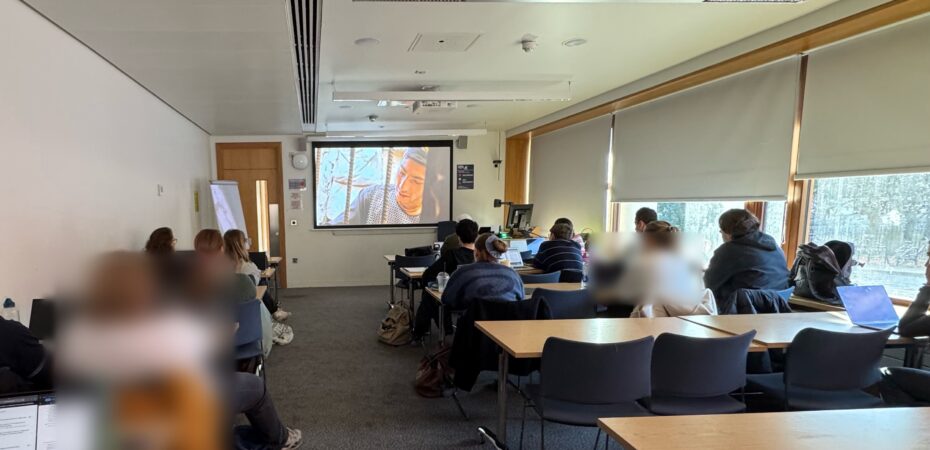
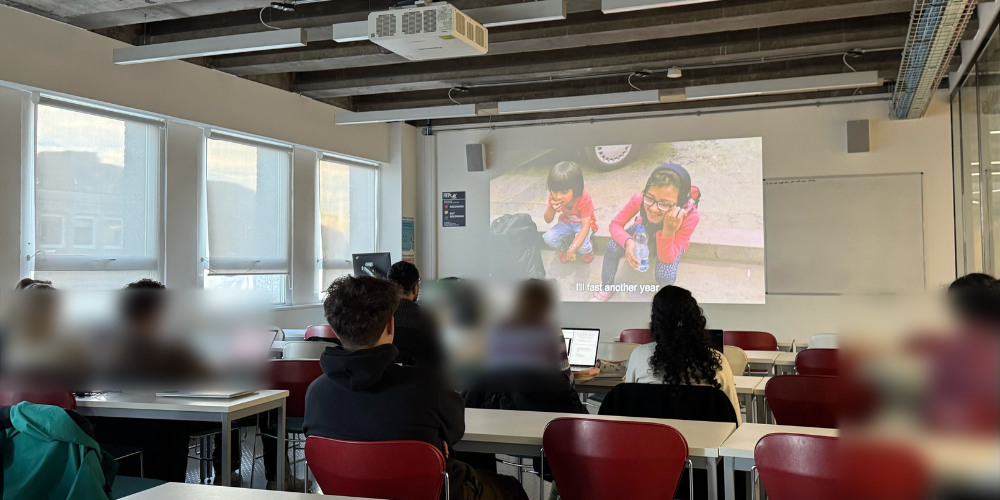
MM: I screened two documentaries that could be categorised as types of participatory and observational documentaries. The first documentary, Three Songs for Benazir, focuses on a couple – a man, Shaista, and a woman, Benazir – who live in a displacement camp in Kabul, Afghanistan. Released in 2019 and filmed over several years, the short documentary portrays their everyday lives in a conflict-affected setting, highlighting experiences of poverty, insecurity, and inequality. It provides a grounded setting for exploring gender relations, and I incorporated it into a seminar addressing constructions of gender and masculinity in relation to conflict and displacement in Afghanistan.
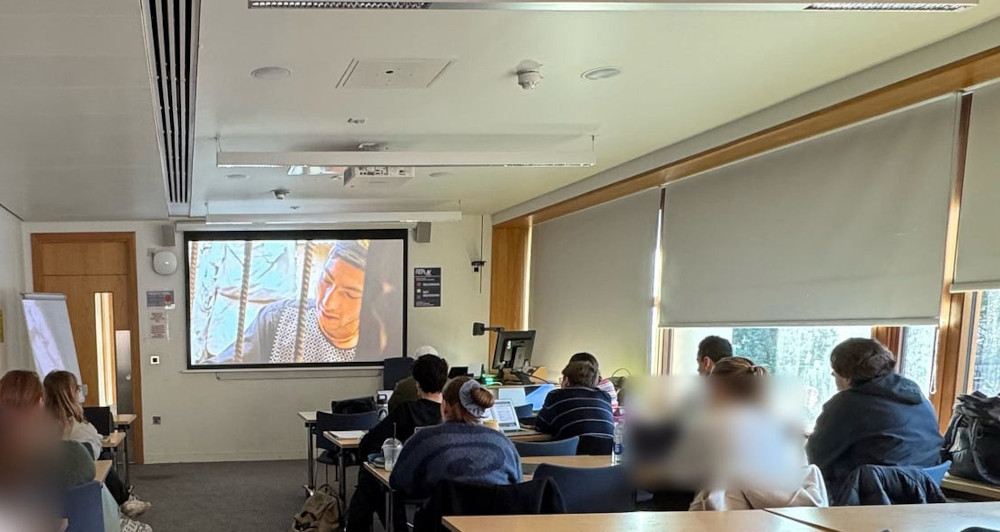
The second documentary, Midnight Traveller, also released in 2019, is a self-recorded feature-length film documenting a refugee family’s journey from Afghanistan to Europe. Forced to flee the country, the family undertakes an irregular migration route across several borders, including Iran, Turkey, Bulgaria, and Serbia.
MC: Why did you decide to use documentaries in your classroom?
MM: I decided to use documentaries to move beyond abstract concepts and theoretical frameworks and provide students with situated, lived examples. The course readings cover key debates and analytical approaches in (forced) migration, and these are unpacked further in lectures. However, I felt that students also needed engagement with lived realities in order to grasp how these concepts operate in practice. This is particularly important given the racialised and right-wing rhetoric about migrants that students encounter outside the classroom. While most students do not have experiential access to displacement contexts, nor are they in a position to undertake field-based research with displaced communities within the constraints of an academic semester, these documentaries offer alternative perspectives by foregrounding displaced people’s own narratives.
MC: How have your students responded to the documentaries?
MM: To understand the impact of these documentaries, I conducted some in-depth semi structured interviews with students who kindly volunteered to share their experiences and reflections after watching these documentaries in class as well as some group discussions and observations that I organised in the classroom.
Generally speaking, all the students I interviewed, and also those who participated in the group discussion, confirmed the very meaningful impact of these documentaries. They found these documentaries engaging and impactful, especially in terms of increasing their critical understanding of the intended key concepts like who is a refugee, who is an asylum seeker, and who is an internally displaced person.
MC: Do you have advice about how to incorporate documentary film into teaching material for other people who teach at higher education institutions?
MM: One key challenge in efforts to decolonise the curriculum lies in moving from principle to practice. I would encourage colleagues to think beyond textual diversification, which has been a central focus of this debate, and instead consider diversifying modes of knowledge production. Integrating documentary film and other visual sources that highlight marginalised voices can be particularly valuable in this regard. More specifically, documentaries should be embedded purposefully and in a structured manner within the curriculum, aligned with learning objectives rather than treated as merely supplementary material. When used in this way, they can deepen students’ critical engagement and support more reflexive and decolonial understandings of key concepts.
MC: Thank you so much for your time and answers, Mahdi!
This blog post was first posted on The Alwaleed Centre’s Substack Page on 27 March 2026. Read the original piece on the website.
References
Nicola-Richmond, K., Pépin, G., Larkin, H., & Taylor, C. (2018). Threshold concepts in higher education: A synthesis of the literature relating to measurement of threshold crossing. Higher Education Research & Development, 37(1), 101–114. https://doi.org/10.1080/07294360.2017.1339181
Mirzaei, E., & Mirzaei, G. (2022). Three songs for benazir M. Films; Netflix. https://www.imdb.com/title/tt14608922/
Fazili, H. (2020). Midnight traveller E. Mahdavian & S. Kim; Oscilloscope Laboratories (US Distributor). https://www.imdb.com/title/tt8923500/companycredits/
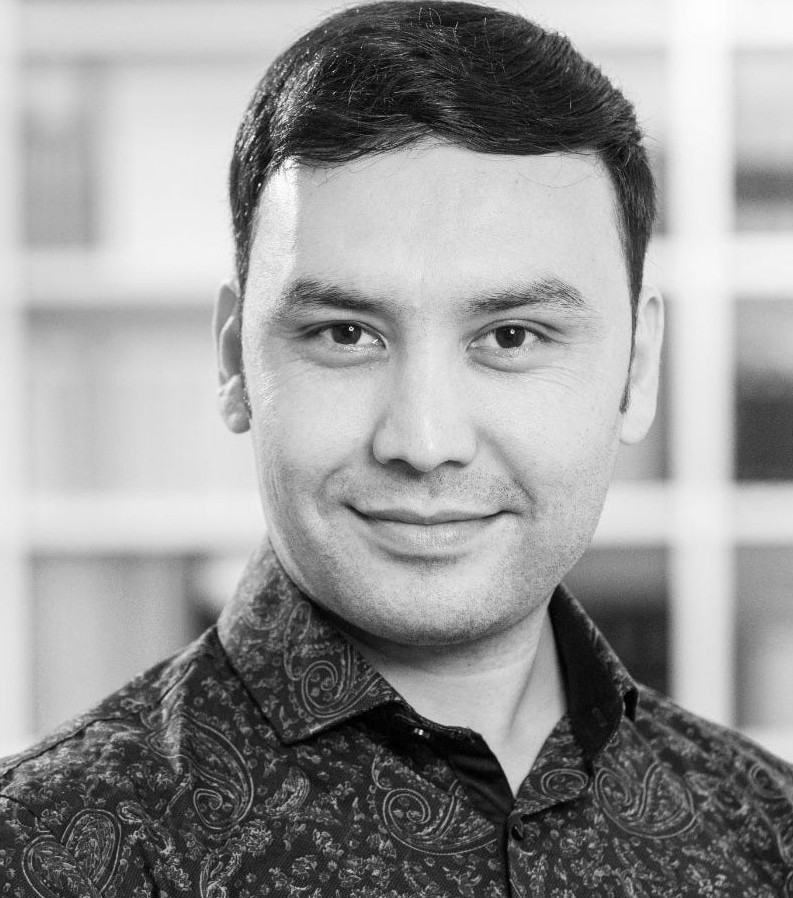 Sayed Mahdi Mosawi
Dr Sayed Mahdi Mosawi is an Alwaleed Fellow at the Alwaleed Centre for the Study of Islam in the Contemporary World at the University of Edinburgh, with research interests in forced migration, refugees, diasporic Muslim communities, and gender and masculinity. Learn more about Dr Mosawi’s work.