
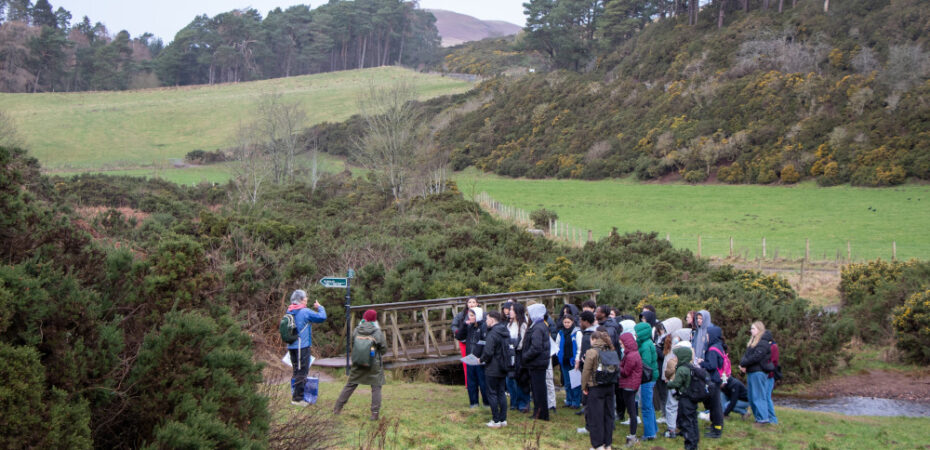
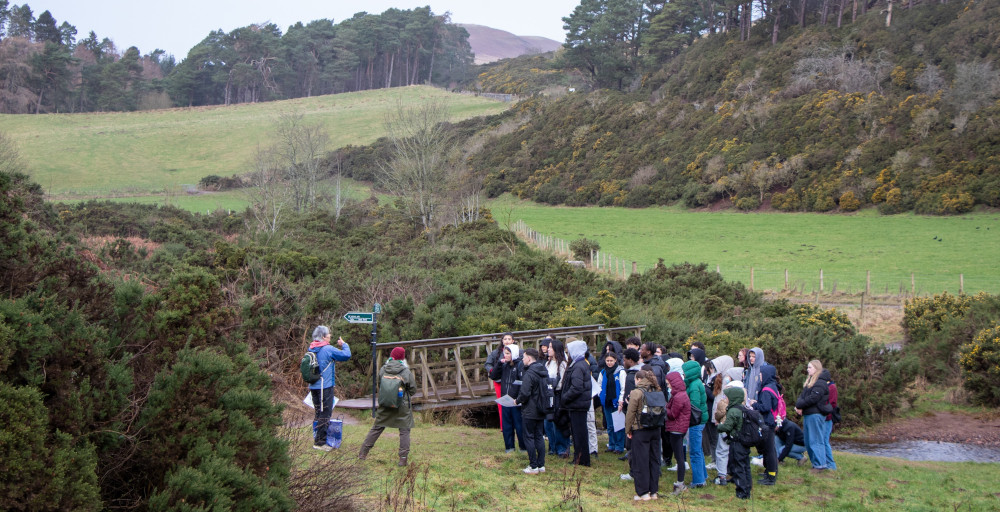
In this extra post, Jennifer Yule describes how she experimented with taking the International Marketing class from the Business School into the field (quite literally!), partnering with the School’s Student Development Team the University’s Forest & Peatland programme to explore how Scotland’s biodiversity, land use and the University’s carbon footprint are being managed. Jennifer is a Senior Lecturer in Marketing at the University of Edinburgh Business School.
The Business School course on International Marketing explores themes relating to culture, sustainability and place branding, but what happens when students experience these ideas directly in the landscape itself rather than the lecture theatre? Our destination was Rullion Green woodland in the Pentlands, part of the University’s wider initiative to restore forests and peatlands while supporting research, teaching and climate goals. For students studying International Marketing, the visit offered an opportunity to see how the rural Scottish landscape is embedded in narratives of Scotland as a brand.
Preparing students to see landscapes differently
Before the trip, students completed a pre-field trip worksheet designed to encourage intentional reflection. Rather than arriving as passive visitors, they were asked to think critically about their expectations of the Scottish countryside. For many students, especially those studying far from home, it also highlighted how perceptions of Scotland are often formed through media, tourism marketing and national branding. It was also a great opportunity to experience Scotland outside of the city environment.
Linking field experience to international marketing theory
The field trip was embedded directly into the course assessment. After the visit, students completed a reflective essay linking their experience to core themes from the International Marketing course. These included cultural frameworks, consumer behaviour shifts, sustainable tourism and destination branding. Students were encouraged to reflect on their experience of the landscape and analyse how Scotland might position itself to international visitors interested in nature-based tourism or responsible travel. Many were struck by how restoration initiatives such as woodland planting and peatland recovery contribute to a broader narrative about Scotland’s environmental stewardship. They were also surprised to learn about the poor condition of Scotland’s biodiversity and the University’s efforts to in-set (rather than off-set) the impact of their international travel carbon footprint (see Edwards et al., 2026 for details about in-setting).
The reflective format allowed students to combine personal observation with theoretical insight. Rather than simply describing the trip, they were challenged to combine what they had learned on the trip with classroom topics such as how sustainability initiatives influence destination image and how global consumers increasingly seek authentic, nature-based experiences and what that means for biodiversity.
A new collaboration for the Business School
The visit also represented an important teaching innovation. The Forest & Peatland programme regularly hosts field trips from disciplines more traditionally aligned with land management, such as ecology and environmental science. However, this was the first time a Business School course, specifically International Marketing, had taken part. While the Business School offers several courses focused explicitly on sustainability, this collaboration illustrates how sustainability themes can also be embedded meaningfully within courses that are not primarily designed around sustainability.
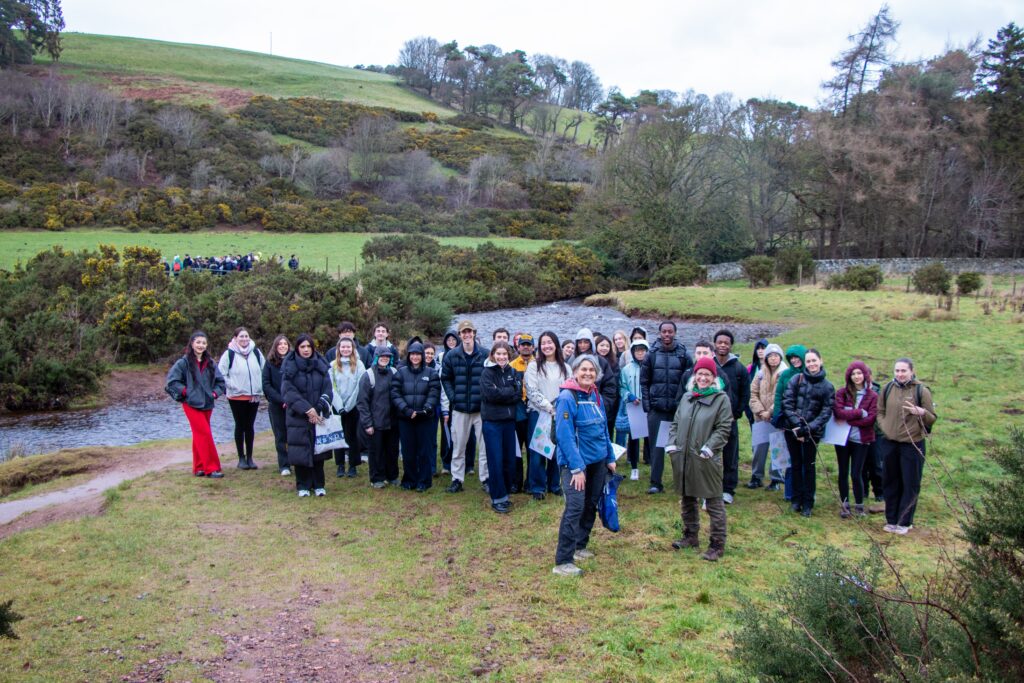
The scale of the visit was notable too. The sustainability team hosted their largest group to date: 82 students and four staff members. Organising a visit of this size required close collaboration between the Business School and the Forest & Peatland team, as well as careful planning to ensure students had meaningful engagement with the site.
What students discovered
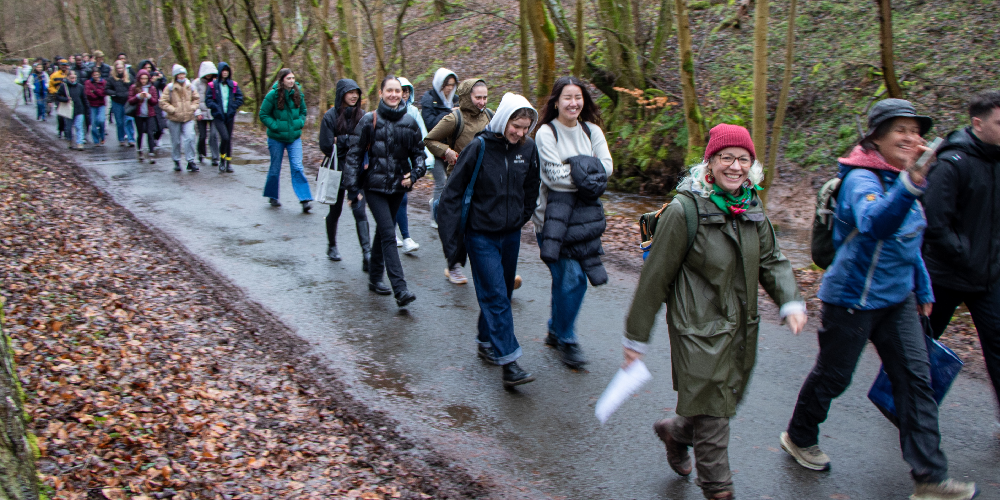
One of the most rewarding aspects of the trip was observing how quickly students began connecting their field observations with course concepts, which didn’t seem obvious prior to arriving on site. Conversations during the visit ranged from discussions of landscape restoration to broader questions about branding and tourism. Students reflected on how Scotland’s landscapes contribute to its global reputation, how sustainability initiatives and land management practices shape visitor expectations, and started considering how destinations might communicate environmental responsibility to international audiences.
Lessons for experiential learning in marketing education
This collaboration reinforced the value of experiential learning for business education.
A few practical insights emerged:
- Prepare students before the trip. Structured reflection activities help students engage critically with what they see rather than simply observing the environment.
- Link the experience to assessment. Reflective assignments encourage students to connect field observations with academic theory.
- Collaborate across disciplines. Sustainability initiatives within the university offers a meaningful real-world teaching resource. Student Development and Student Services colleagues can help students build peer connections and understand the value of the experience from an employability perspective as well as providing crucial logistical support during the trip itself.
- Use place as a teaching tool. Landscapes themselves can act as case studies for a range of subjects and topic areas
Looking ahead
As sustainability becomes increasingly central to global marketing strategy, it is important that business students engage with these issues beyond the classroom. Initiatives such as the Forest & Peatland programme provide valuable opportunities to bridge academic learning with real-world practice. By stepping outside the lecture theatre and into the landscape itself, students were able to see how theory, policy and practice intersect in ways that textbooks alone cannot fully capture. Student feedback gathered after the trip was overwhelmingly positive. As one student wrote:
It was a pleasant change from a classroom setting and was more impactful as being on site required full engagement and active learning.
- For further information about the forest and peatland site and the education and research opportunities, please visit our webpage.
- If you are interested in the Forest and Peatland Programme sites for learning, teaching and research, please contact the Academic Manager for further details.
References
Edwards Y, Gorman D, Higgins P and Reay D (2026) Sustainable universities and the transition to net zero: lessons on insetting from the University of Edinburgh. Frontiers Education (Vol. 11, p. 1746640). doi: 10.3389/feduc.2026.1746640
Read more on Placements and Fieldwork and Place-Based Education on Teaching Matters.
 Jennifer Yule
Dr Jennifer Yule is a Senior Lecturer in Marketing at the University of Edinburgh Business School. Her research focuses on consumer behaviour and decision-making, particularly in the context of health and well-being. Jennifer also teaches International Marketing to UG and PG students.