


In this extra post, Daisy Bao and Rosemary Banister showcase how essay-based assessments can be effectively approached by a student in a meta-cognitive process. They also discuss why AI tools may be unhelpful and time-consuming for certain aspects of producing high-quality academic writing. This post may be valuable for teaching staff in identifying possible gaps in assessment support, and for students in easing the pressure associated with essay assignments and developing the habitus of essay writing with minimum efforts, thereby potentially reducing reliance on AI tools. The idea of this practice-sharing piece emerged from an informal conversation co-reflecting on the excellent academic performance that Rosemary demonstrated in a course for which Daisy served as a tutor during the 2025-26 academic year. The reflections below are credited to Rosemary’s narrative.
In their generative AI use guidelines, the University of Edinburgh recognises the value of generative AI, particularly for idea formulation and defining concepts. However, during my studies I have found that AI is no replacement for reading literature and producing your own ideas. I hope to set out here the skills and methods I have developed to efficiently produce high quality essays, without the use of generative AI.
Starting with the basics
As obvious as it might sound, I think lectures are the perfect place to start for essay writing. I like to use course lectures to get a grasp on the important concepts but also to begin to develop some analysis. Lecture content provides an outline of the concepts far better than a generative AI chatbot can; discussing academic discourse, and often key pieces of literature, that would usually be overlooked by a general ‘AI overview’. Moreover, lectures can be the first port of call for essay analysis, with lecturers usually touching on the key viewpoints and criticisms of the subject.
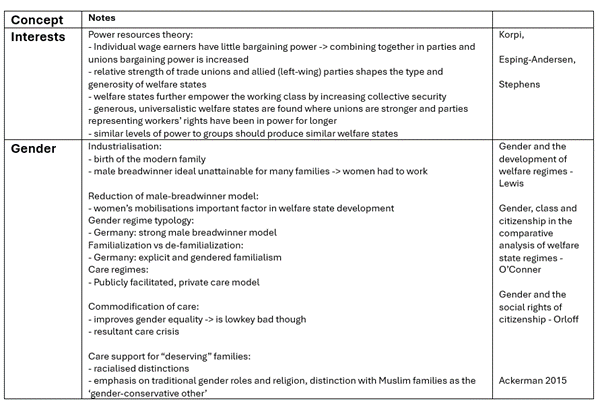
By spending a short amount of time looking at the themes, concepts, literature, and criticisms provided in course lectures, you can begin to develop an outline or line of argument for an essay (see a real example in Fig 1 below). For example, in my Comparative Social Policy class the lecturer introduced analytical lenses such as institutions and gender. These lenses offered an initial starting point to analyse further content: by taking note associated with these lenses and identifying my primary interests before doing the course and extended readings, I could begin to capture ideas for analysing the subject even before making an essay plan.
Reading analytically
As students, we are told time and time again to ‘read critically’, but I’m not sure many of us really know why this matters. In my experience, reading critically is what makes the difference between a mediocre and a great essay – and it’s a skill that AI struggles with. An AI chatbot may produce a small amount of critical analysis, but to get analysis that is highly relevant to a specific topic, in depth enough, or synthesises multiple viewpoints is unlikely. To successfully get this level of analysis you have to repeatedly prompt the AI and at that point you’re better off just doing the analysis yourself!
This is why I see the importance of closely reading academic literature, and have developed some skills to help make sense of the pages of text:
- Start with the relevant essential course readings: course readings are so important as lecturers are experts in their field; they know the relevant and high-quality literature as well as (and, most likely, better than) any AI does.
- Use the themes and concepts from the lectures to narrow down the focus: by already having an idea of the relevant concepts, it makes it easier to identify them within the literature and begin to build a plan for an essay. For example, if a lecture has talked about the role of gender, this signals that this is an important theme within the gender lens. This, in turn, makes it much easier to spot where gendered patterns appear within the literature. You can then link these between different readings and produce an essay structure that makes note of these similarities and differences, leading to a more argument-driven and informative discussion.
- Look out for frameworks and models: readings can provide helpful frameworks of analysis that can be applied to structure an essay. These frameworks are often more specific and applied than the basic structures usually produced by AI. Looking out for frameworks could involve asking questions like:
-
- Does the research classify results into specific groups or categories?
- Does a theory use a multi-step process?
- Does the author split up the findings into certain characteristics?
Using these distinctions can inform an essay structure, particularly in developing sub-themes. Then I can split up writing in a way that allows for coherent and detailed comparison and analysis based on findings from different papers.
-
- Read in depth: often the best analysis emerges from small things an author says outwith their overall argument; these nuances won’t be picked up by an AI summary yet can make a huge difference to the quality (and mark) of an essay.
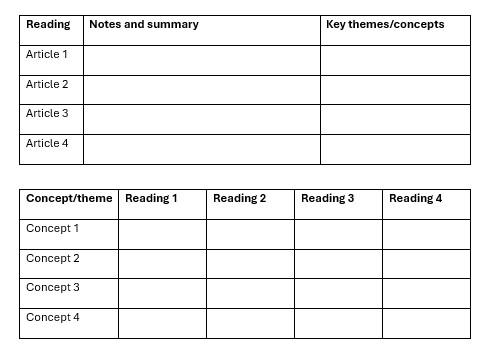
Controversially, I would also recommend working intensely over a short period of time for this stage of essay writing. I find reading multiple articles back-to-back over a few days makes it is easier to recognise where articles link to one another. However, this will obviously depend on individual working and writing styles. Alternatively, it can be super helpful to use a table to keep track of ideas from one reading to another. Grouping notes by either theme or by reading (see examples in Fig 1 and Fig 2) can help prevent notes becoming a jumble of unrelated points, and provide some structure to build a plan from.
Conclusion
We must recognise that generative AI can be a powerful tool which we could utilise, but there are many things AI cannot do. There is real value in human intelligence, particularly for critically and analytically engaging with academic literature. Generative AI may be a quick short-cut to passable work. But, by capitalising on the expertise of university teaching staff, it is possible, and at times easier, to produce high quality work without the use of generative AI.
 Rosemary Banister
Rosemary Banister is a 2nd year Social Policy and Sociology undergraduate student at the University of Edinburgh. She often focuses on the role of gender in political institutions and debate.
 Daisy Bao
Daisy Bao is a PhD researcher in Higher Education at the University of Edinburgh, exploring student partnerships and how equity, diversity, and inclusion can shape fairer universities. Before starting her PhD, she worked as a higher education researcher at the Municipal Teacher Professional Education Centre and served on the committee for the municipal supervisor training scheme. She’s passionate about building learning environments where students and staff can thrive together.