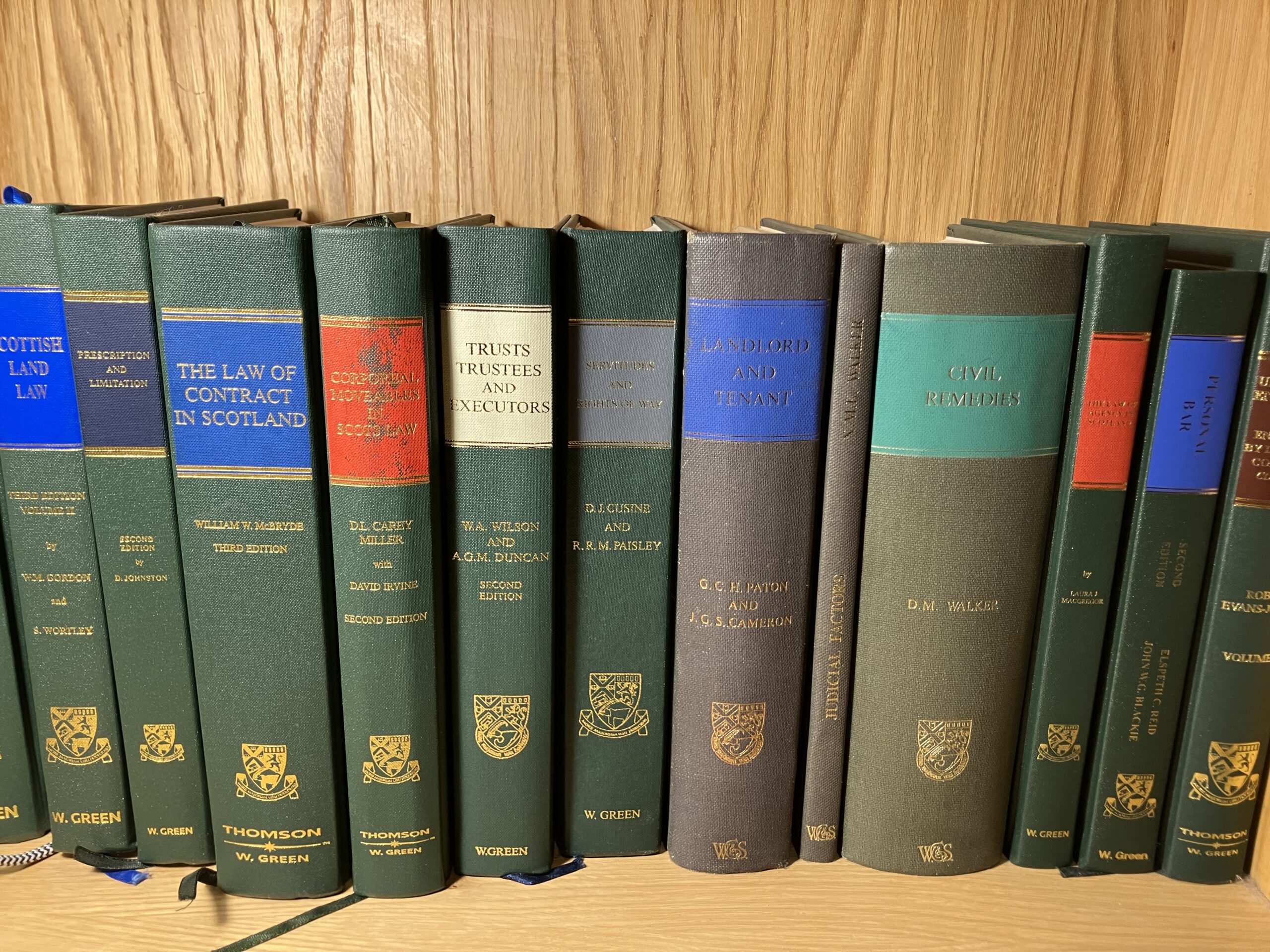
by Elspeth Reid, Emeritus Professor of Scottish Private Law
The publication of the second edition of Personal Bar has come nearly twenty years after the first, which these days is a long time in the world of academic writing. The transformed environment for the second edition has given me cause to reflect on the enterprise of writing a Scottish Universities Law Institute (SULI) text, or any “big” legal treatise for that matter. How has treatise writing altered, or how should it be modified, in response to the huge changes we have seen in the 21st century? I cannot pretend that I have answers to the questions raised here, but the following suggest themselves as concerns that might now usefully be considered in the wider legal community.
T B Smith’s vision for the SULI series when it was established in 1960 was much influenced by the Louisiana State Law Institute, as a model of what a smaller jurisdiction could do for itself. Scotland, like Louisiana, was a smallish jurisdiction which valued its distinctive identity, where publishing was expensive and challenging, and there were few publishing outlets available for texts specifically about that jurisdiction. The Louisiana State Law Institute was dedicated to “public service”, and that seemed to be part of Smith’s vision too. The Louisiana State Law Institute had broader ambitions of law reform, which in Scotland were hived off elsewhere, but its key mission, which SULI was to share, was carrying out “scholarly research and scientific legal work”, producing treatises which were directed at supporting the profession as much as the academic community. In 1961 Smith predicted that “Within ten years we may hope to see the main divisions of Scots law restated in up to twenty comprehensive treatises.”[1] SULI did not quite reach that ambitious target, but it has done a wonderful job with an impressive list of titles over the last 65 years, and also in energising academic writing in Scotland more generally, all the while observing T B Smith’s motto for the series, more majorum, usu hodierno – according to the custom of our ancestors, according to today’s practice. But “today’s practice” has changed hugely since the 1960s. To what extent does this mean that SULI texts or similar legal treatises should change too?
Leave a Comment