

Walking Traces Collection: Using Simple Traces to Understand Community Flow
Summary
Art is not the privilege of artists. This toolkit uses a single sheet of paper to transform the daily space into a scene for observing movement traces, recording footprints, dust, the rhythm of footsteps, walking directions, etc. Learners can obtain a small community flow keyframe in just 20 minutes and understand how their own community is used. This toolkit can operate completely independently of the designer: with clear goals, simple steps and explicit reflection.
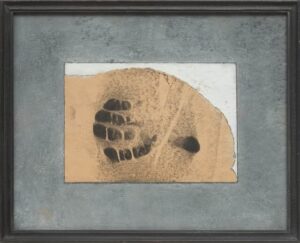
This toolkit is inspired by two contemporary artworks: Richard Lang’s “A Line Drawn by Walking” (1967), which tells us that walking is both a method and a work, and that movement leaves meaning. Geta Brătescu’s “The Worker’s Hand” (1974) reveals the visible imprints left by daily movements and exposes the hidden structures behind them. Therefore, by combining the above two works for understanding, in this toolkit, footprints, sounds and dust in the community become clues to understanding the structure behind daily life.
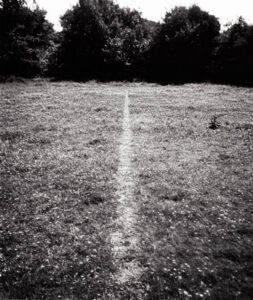
Richard Long, A Line Made by Walking, 1967
Learning Objective
- Identify different types of traces in a community space.
- Understand how traces reflect usage patterns (direction, density, rhythm).
- Create their own small community flow record.
Brief Teaching Principles
a. Openness: The resources involved and the teaching process are all open and shared, hoping that learners can recreate the content from them, making the teaching significance more diverse and adaptable.
b. Universality: The teaching content does not require learners to have any prior knowledge or drawing skills. It only needs to be posted, collected and recorded. No need to master too many professional skills;
c. Convenience: The operation process of this toolkit is relatively simple. You only need to observe the traces left after the time changes and express your own opinions. There is no right or wrong.
Required materials
- Four A4 sheets of white paper
- A roll of tape
- A pen
- A sticky note
- A camera (optional)
Teaching Process
Why Observe Traces?
Traces are evidence of movement. Different traces reflect different users, times and purposes.
- Footprint depth → how recent the movement was
- Dust/Wear and tear → Long-term usage frequency
- Shoe patterns → Characteristics of different groups of people
- The rhythm of footsteps → hurried/slow
- Movement direction → Function of space
- The number of traces → whether it is a community hotspot
These tiny observations can help us understand the “invisible structure” of the community.
Action Guide: Four Steps to Collect Footprints (20 minutes)
Follow the Steps:
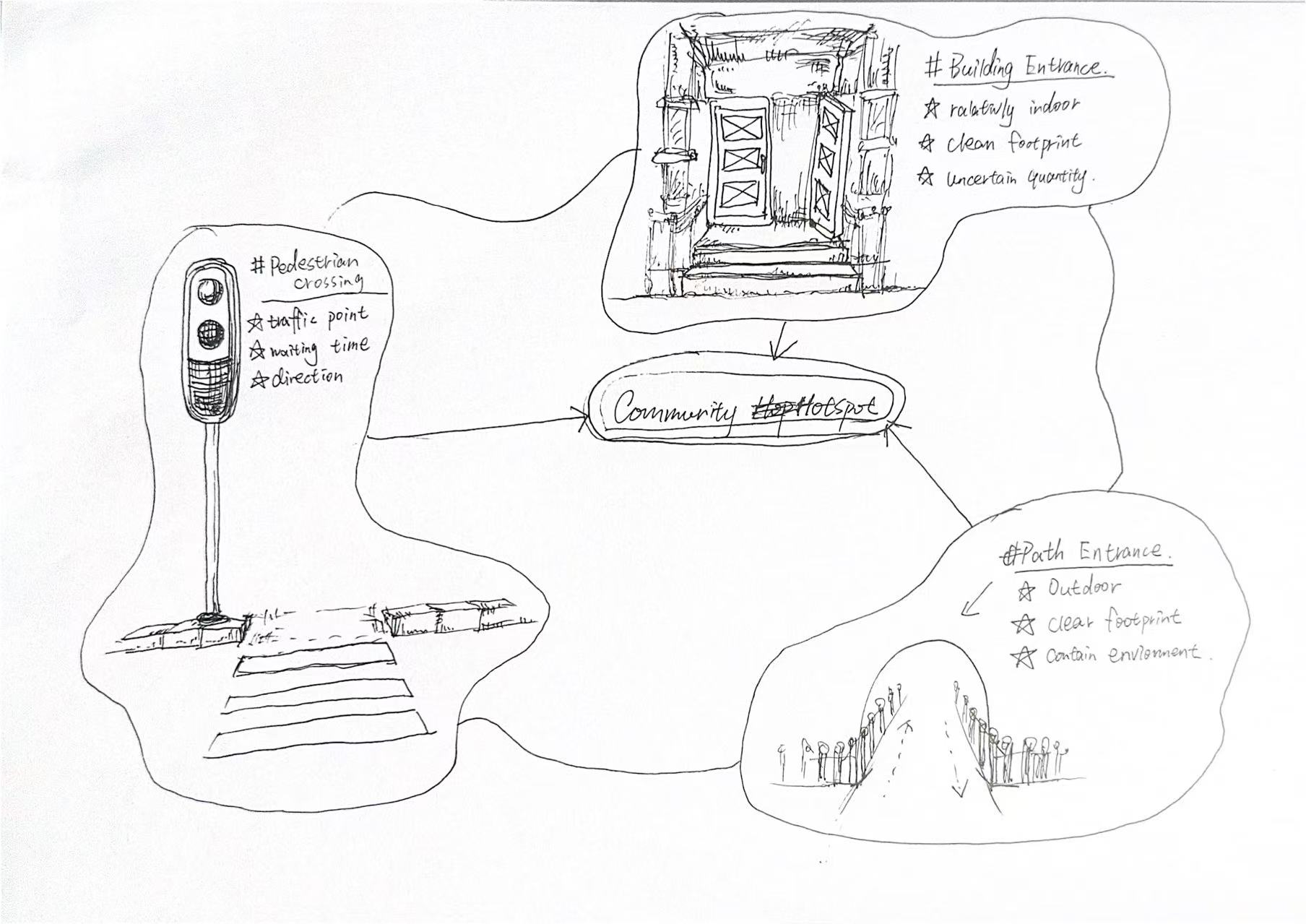
- 1. Observation Setup (1 minute)
Choose a public spot where people naturally pass (corridor, building entrance, traffic cross). Ensure safety.
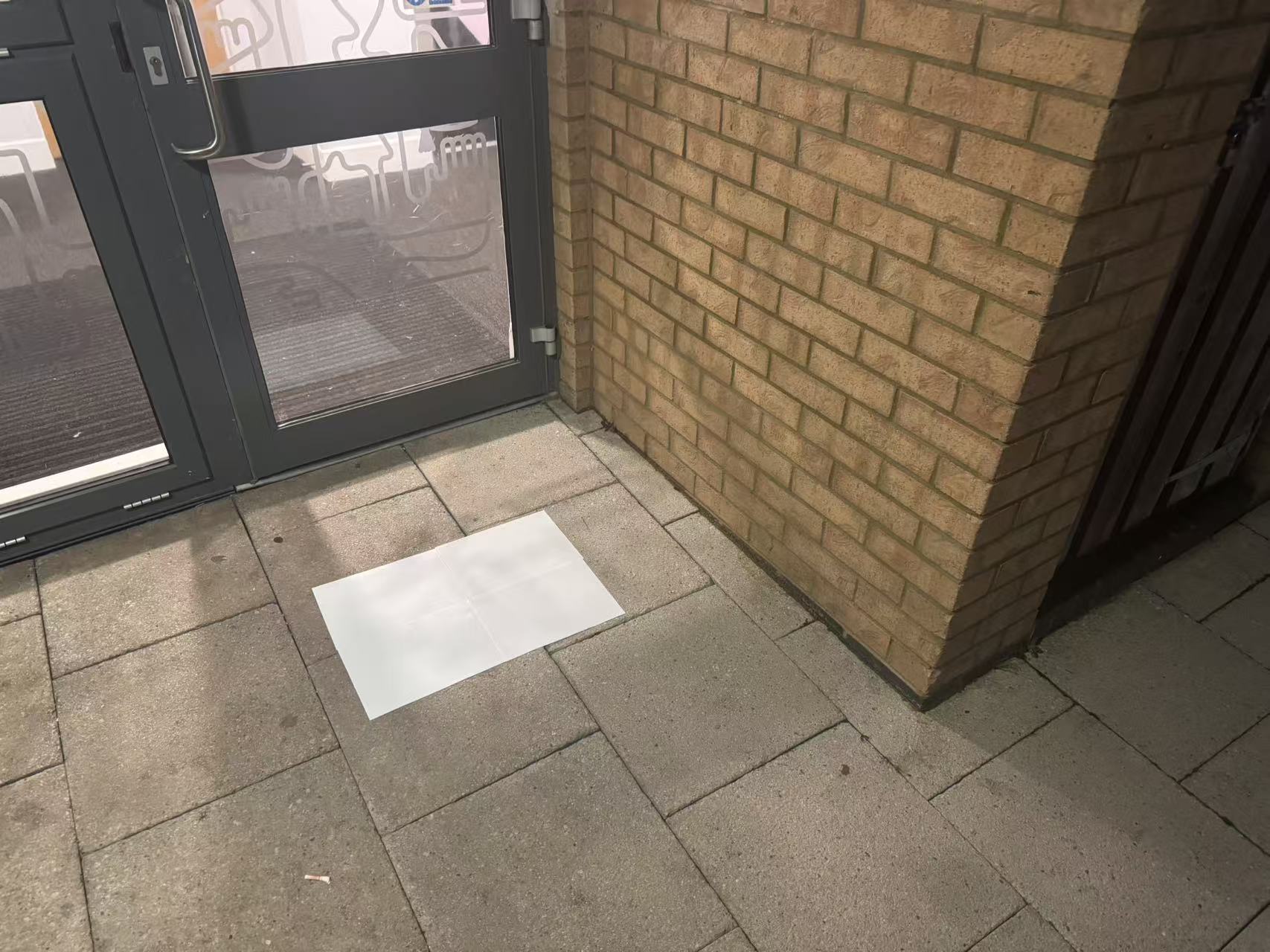
- 2. Lay out the paper (1 minute)
Tape the four sheets on the ground—this becomes your trace sensor.
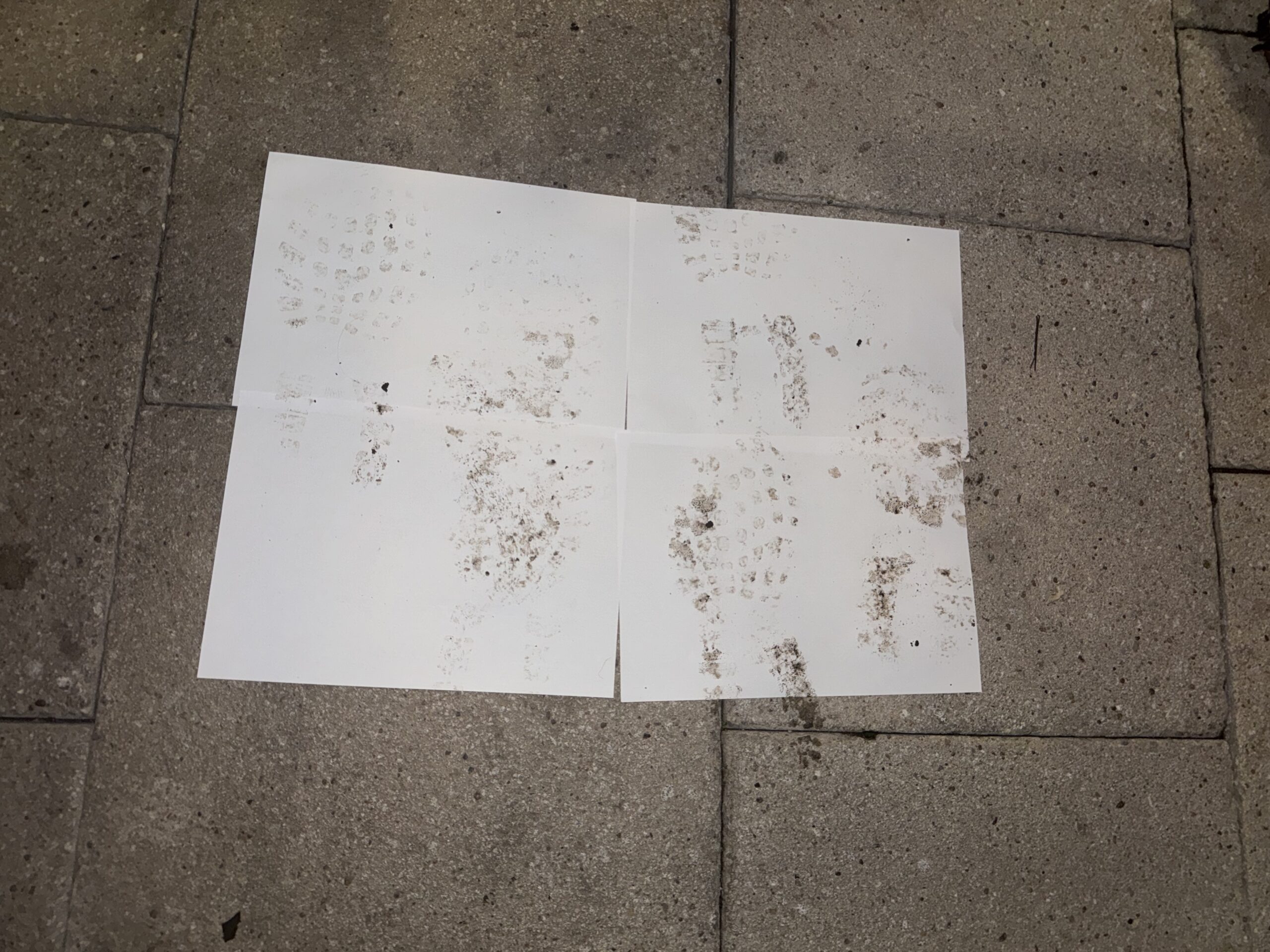
- 3. Wait for footprints (15 minutes)
For the next 15 minutes, please quietly observe three types of information:
- Visible traces – footprints, dust, ground tear
- Sound rhythm – the speed of footsteps and the sound of conversations
- Direction of Action – Where do people come and go
If there are no footprints: Observe the traces on the ground, or instead record the sound and the direction of movement.
Guiding question: How did these traces indicate that this space was being used at this moment?
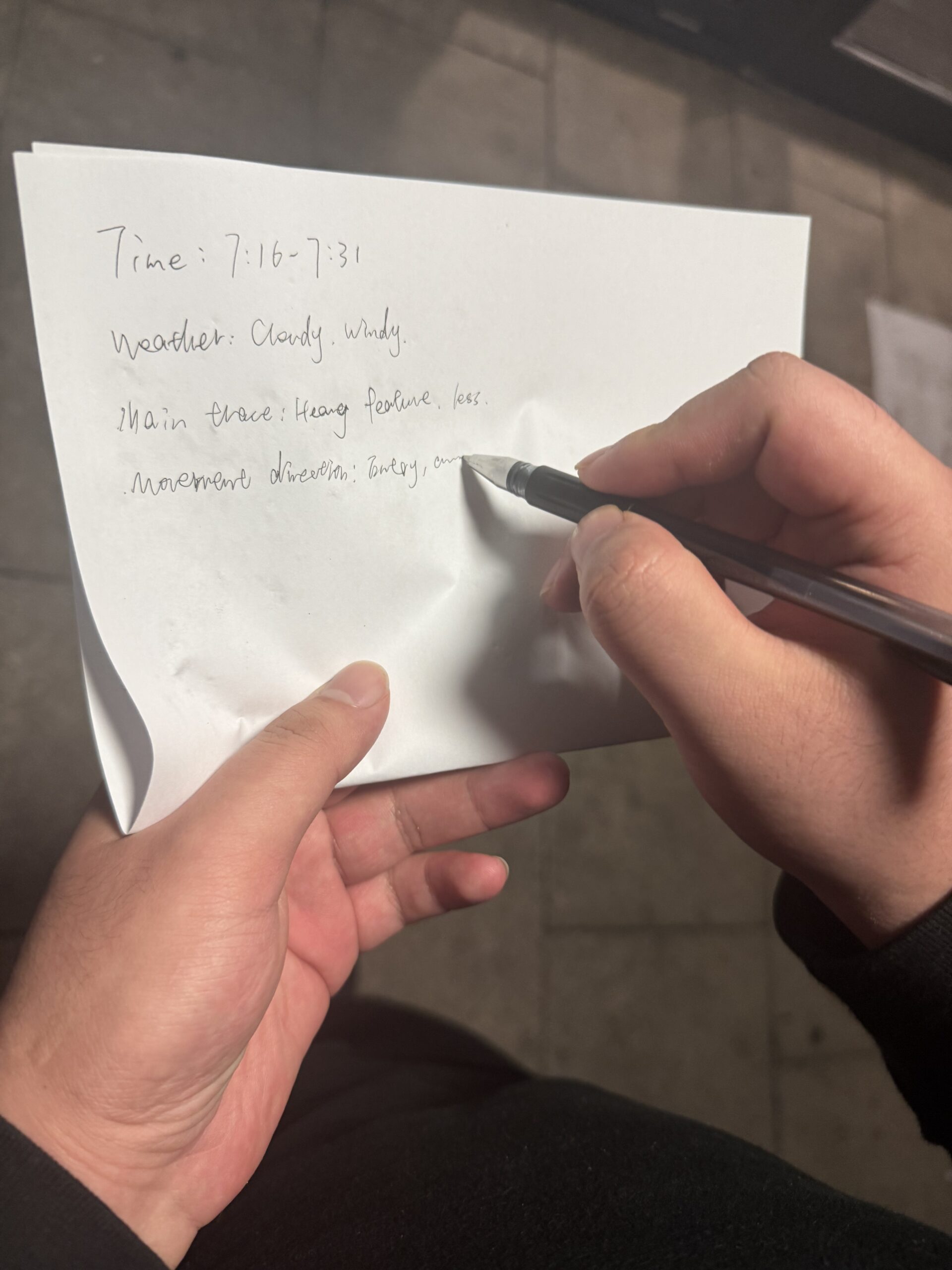
- 4. Quick notes (1minutes)
In sticky note, simply write a few sentences:
– Time: What time is it now?
– Weather: Sunny? Rainy day?
– Main traces observed: How many footprints are there? Let’s roughly count.
– Movement direction: Which way to go? Is it going east or west?
– One surprising detail
Just a few key words will do. It would be even better if photos or video could be taken(optional).
- 5. Reflection and Analysis (2 minutes, optional)
Please think about it. Just these three simple questions:
- What pattern of movement did I observe?
- What did these traces reveal about the people using this space?
- What new way of seeing my community did I gain?
Example: What I Saw During Testing
During testing, I found that although few footprints appeared on the paper, the sound rhythm (such as, fast footsteps before class, slow ones after) revealed the time pattern of the space. Dust marks near the edges showed long-term use. This taught me that *not all traces are visible*—movement can also be heard and inferred.
Congratulations!
In just 20 minutes, simple traces allow us to see our community differently. Observation becomes a form of participation, and movement becomes a form of drawing.
Walking Traces Collection: Using Simple Traces to Understand Community Flow © 2025 by Tianshun Zhao is licensed under CC BY-NC-SA 4.0
(https://www.flickr.com/photos/9197427@N06/15133367485)
(https://paisajetransversal.org/2010/02/el-revolucionario-y-fabuloso-metodo/)
(https://d7hftxdivxxvm.cloudfront.net/?height=518&quality=80&resize_to=fit&src=https%3A%2F%2Fd32dm0rphc51dk.cloudfront.net%2Fm6pFB-qEWY5cNjD0rtrqRQ%2Flarge.jpg&width=640)
(https://blogs.ed.ac.uk/opentoolkits/wp-content/uploads/sites/8719/2025/11/5471dfc5ed32a30ae4516f704402bd84.jpg)
(https://blogs.ed.ac.uk/opentoolkits/wp-content/uploads/sites/8719/2025/11/3ebacbabfa496e6ba383fadd22e47f44.jpg)
(https://blogs.ed.ac.uk/opentoolkits/wp-content/uploads/sites/8719/2025/11/c6c2661f36ac154f71ea4965be108234-scaled.jpg)
(https://blogs.ed.ac.uk/opentoolkits/wp-content/uploads/sites/8719/2025/11/35c5734995e26fbfc5c1a27b92b47604-scaled.jpg)