
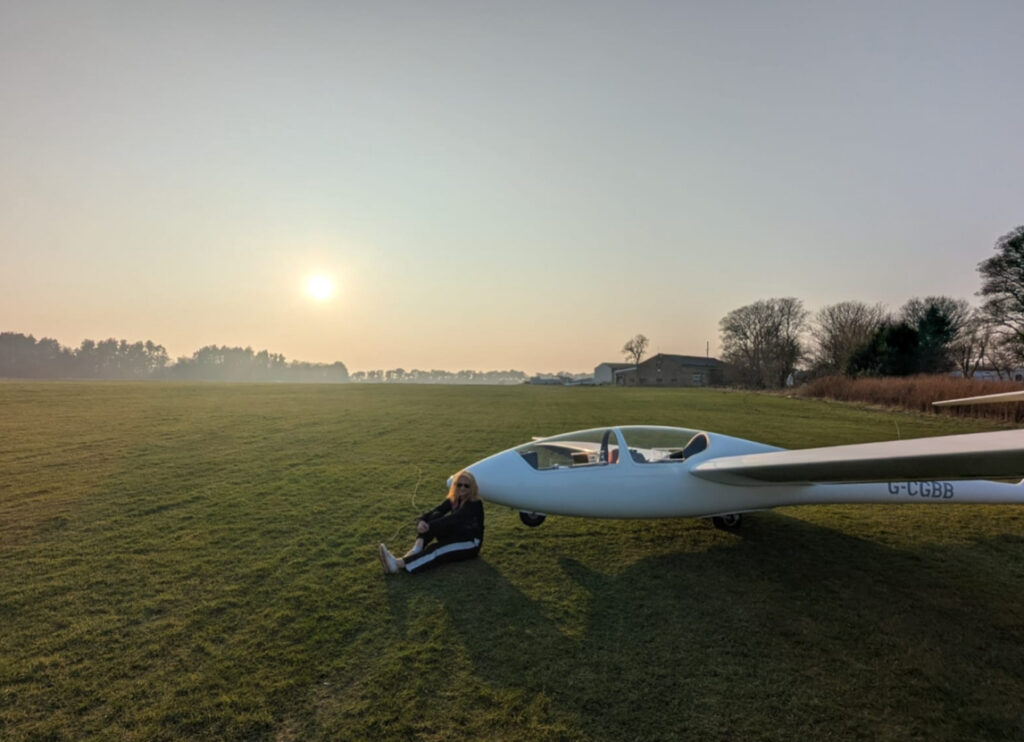
Allison is part of the Edinburgh University Gliding Club. She shares her experience with flying planes without engines as part of her university experience, and explains the physics of the plane designs.
How did you get into gliding?
I started my gliding journey by joining the Edinburgh University Gliding Club (EUGC) in my first year. I did not have any prior experience in flying before my trial flight, I started my training from scratch.
EUGC runs its flying operations at the Scottish Gliding Centre (Portmoak Airfield). The university owns its own aircraft and offers the flying rates at 30p per minute and £13.83 for a winch launch.
I scheduled my trial flight as soon as I entered the University. After my first flight, I was completely hooked onto the sport. I travel to the airfield almost every weekend during semester times.
How does the glider get up?
The glider gets up by a winch launch or aerotow. A winch launch employs a powerful engine to reel in a cable attached to a glider. The wings of a glider is designed so that when the glider gains airspeed, the wings’ shape causes lower pressure above and high pressure below the wings. In simple terms, as air flows round the wings, lift is created. Another method of launching is called an aerotow. This method uses a powered plane and skilled pilots to tow the plane up in the air.
How does the glider stay airborne?
The glider actually naturally flies in a shallow descent. As the pilot tilts the nose of the glider slightly downwards, gravity pulls it slightly downwards and forward, the glider gains airspeed and the lift is created. In a nutshell, a glider stays airborne by converting altitude into forward motion, a battle between gravitational potential energy and kinetic energy.
How does the glider gain height without any engine or fuel?
A glider gains altitude without any engine or fuel by finding rising air. The three main sources of rising air are thermals, ridge lift and Lee waves. Thermals are columns of hot air rising from the ground on a hot and sunny day. A glider can soar on a ridge when the wind is blowing in the right direction and creates a push of rising air. Lee waves, the coolest method in my opinion, are atmospheric standing waves of air formed when air is oscillating up and down.
As you probably know by now, gliding is more than just the controls but also the physics involved!
How does gliding shape your university experience?
As an international student from Hong Kong, being an active member of the gliding club really helps me integrate into Scottish society. There are a lot of local pilots at the airfield and international students from the university club. The mix of people creates a diverse experience for me to learn how to fly. I am very grateful for the local pilots for being patient with me when I was learning to understand the Scottish accent back when I first joined the club. Through this sport, I acquired a lot of meaningful friendships.
For more information about the University gliding club, visit : Edinburgh University Gliding Club