In Three Rival Versions of Moral Enquiry, MacIntyre writes that any answer to the question what are universities for? should begin with this:
They are, when they are true to their own vocation, institutions within which questions of the form ‘What are x’s for?’ and ‘What peculiar goods do y’s serve?’ are formulated and answered in the best rationally defensible way. That is to say, when it is demanded of a university community that it justify itself by specifying what its peculiar and essential function is, that function which, were it not to exist, no other institution could discharge, the response of that community ought to be that universities are places where conceptions of and standards of rational justification are elaborated, put to work in the detailed practices of enquiry, and themselves rationally evaluated, so that only from the university can the wider society learn how to conduct its own debates, practical or theoretical, in a rationally defensible way. (page 222, italics mine)
Echoing one of the key ideas discussed in his The Idea of an Educated Public, MacIntyre here presents universities as institutions responsible for clarifying and testing standards of rational justification, and thereby contributing to the formation of a wider educated public capable of reasoned debate. In this sense, the university’s distinctive role is not merely the production of knowledge, but the cultivation and evaluation of the standards by which knowledge-claims themselves are judged.
Put simply: universities exist so that the arguments arising within society can be examined according to the best available standards of reason, and so that those standards can inform debate in the wider public.
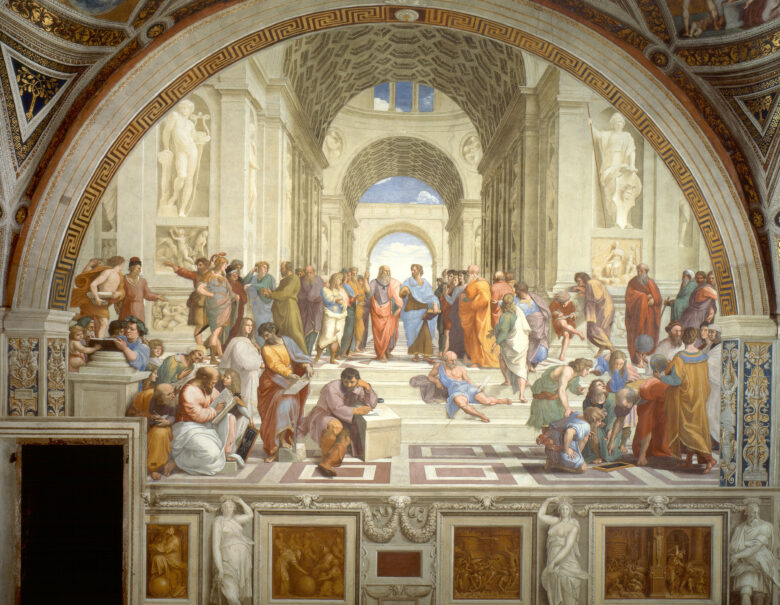
(Raphael: The School of Athens (1509-1511))