In the preface (p. xi) to Dependent Rational Animals: Why Human Beings Need the Virtues (1999), Alasdair MacIntyre refers to a prayer by Thomas Aquinas ‘in which he asks God to grant that he may happily share with those in need what he has, while humbly asking for what he needs from those who have’. (It is worth noting that attribution of specific prayers to Aquinas is not always textually secure.)
MacIntyre remarks that this struck him as highlighting the vulnerability and dependence inherent in human life, along with the virtue of acknowledged dependence (including humility and the willingness both to give and to receive). These themes stand in contrast to the self-sufficient megalopsychos of Aristotle’s Nicomachean Ethics. For MacIntyre, Aristotle underestimates radical dependence (disability, vulnerability, asymmetrical need). He goes on to suggest that Aquinas’ account of the virtues not only supplements but also corrects Aristotle’s.
While MacIntyre does not name the prayer or provide a reference, it can plausibly be identified as the Prayer to Obtain All Virtues (also known as A Prayer to Acquire the Virtues or Petition for the Virtues).
The text invokes a wide range of virtues, including the so-called seven virtues: Faith, Hope, Charity, Prudence, Fortitude, Temperance, and Justice. The first three are the theological virtues, ordered directly to God. The latter four, the cardinal virtues, are traditionally understood as moral (or human) virtues, capable of development through habituation. However, in Aquinas’ account, even the cardinal virtues – in their perfected form – require grace.
The prayer begins with the theological virtues:
O God, all powerful, Who knowest all things, Who hadst neither beginning nor end, Who dost give, preserve, and reward all virtues; deign to make me steadfast on the solid foundation of faith, to protect me with the impregnable shield of hope, and to adorn me with the wedding garment of charity.
It then turns to the cardinal virtues:
Give me justice, to submit to Thee; prudence, to avoid the snares of the enemy; temperance, to keep the just medium; fortitude, to bear adversities with patience.
This is then followed by the section that includes the line MacIntyre references and that explicitly introduces the idea of the good:
Grant me to impart willingly to others whatever I possess that is good, and to ask humbly of others that I may partake of the good of which I am destitute; to confess truly my faults; to bear with equanimity the pains and evils which I suffer. Grant that I may never envy the good of my neighbor, and that I may always return thanks for Thy graces.
Further references to the good include ‘to end good actions by a happy death’ and ‘deign to direct my soul to a good life’.
This prayer presents a view in which the human agent is not self-sufficient: the virtues that are necessary for a good life are given by God. Moreover, the virtuous person is never independent but is at every point both giver and recipient of the good. On this account, failure to acknowledge dependence is not a strength but a moral error.
References
Alasdair MacIntyre. 1999. Dependent Rational Animals: Why Human Beings Need the Virtues. Chicago and La Salle, Illinois: Open Court.
Tracy Tucciarone. (no date) Becoming Virtuous: St. Thomas Aquinas’s Prayer to Obtain Virtues. [Online] Available at: https://www.fisheaters.com/becomingvirtuous-aquinasprayer.html (Accessed: 3 April 2026).
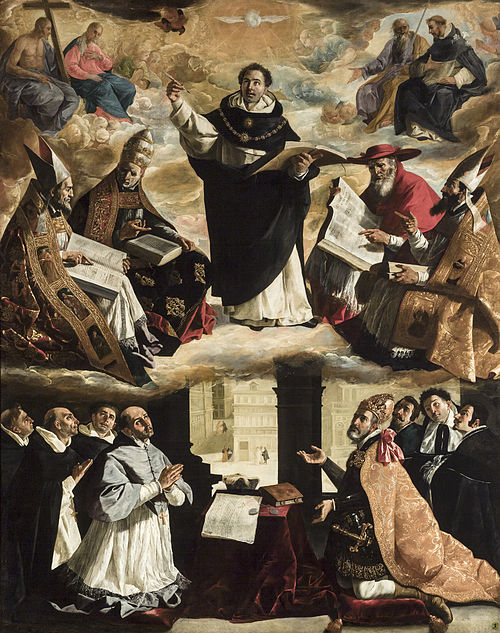
(Francisco de Zurbarán: The Apotheosis of St. Thomas of Aquinas (1631))