While watching the 2026 World Snooker Championship, I was surprised by how often the word character was used. Commentators repeatedly praised one player or another for showing (good) character in maintaining their form and composure during particularly challenging and stressful situations.
The etymology of the word, as outlined in etymonline, is revealing:

The English word character ultimately derives then from the Ancient Greek noun kharakter (an engraved mark, imprint, or distinctive stamp). This comes from the verb kharassein (to engrave, scratch, or sharpen), which is formed from kharax (pointed stake or sharpened post) The root kharax is of uncertain origin but is most likely Pre-Greek.
Over time, the meaning broadened:
- Literally: a physical mark made by engraving or stamping
- Figuratively: a distinctive quality, trait, or imprint on the soul
In English (borrowed via Latin character and Old French caractere), the word entered in the mid-14th century with senses like symbol, mark, or distinctive feature.
The modern sense (= the sum of qualities that define a person or thing and distinguish it from another) dates specifically to the 1640s. A related sense of ‘moral qualities assigned to a person by repute’ appears slightly later (early 18th century).
Why is this of interest to me now? Because character plays a central role in ethical systems focused on virtue. I am thinking particularly of the moral philosophies of Aristotle, Aquinas, and – of course – MacIntyre. All three recognise that our moral life does not usually consist of dramatic, one-off moral dilemmas (such as Philippa Foot’s trolley problem). Rather, we enter every situation as moral agents who already have a personal history and an established character. When that character is well formed, it enables us to act in accordance with the virtues we have developed over time.
In the snooker matches, players demonstrating good character are those who remain able to act in accordance with the virtues – or excellences – that they have cultivated over many years. Even under intense pressure, they continue to play as they have been trained to play: with composure, focus, resilience, and discipline. In other words, they can be relied upon to peform as their established character dictates.
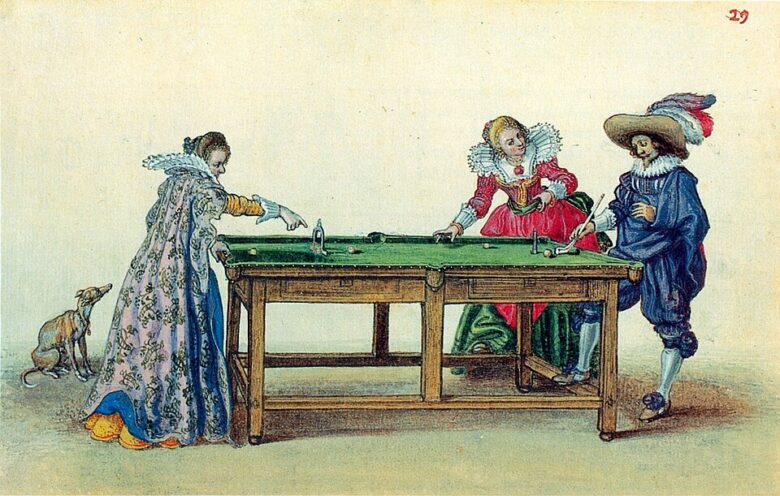
(Adriaen Pietersz van de Venne: A Game of Billiards)