The Scottish university system differed markedly from the English one. It prioritised broad general education and a strong philosophical foundation:
- Four-year MA curriculum (usually entered at age 15–16), combining broad study across philosophy, languages, and science with sustained philosophical integration.
- Specialised or professional study was generally postponed until after this broad foundational education.
Entrance and Access (Early Nineteenth Century)
- No Entrance Exams: Scottish universities operated with relatively open access and without formal matriculation examinations.
- Social Mix: Comparatively socially open for the period. Because costs were relatively low and barriers to entry less rigid than in England, students from a wider range of social and financial backgrounds studied together.
The Curriculum
Davie describes the curriculum as a tripartite structure (p. 14) combining:
- a language–literature course
- a philosophy–ethics course
- a mathematics–physics (natural philosophy) course
First Principles
Even non-philosophical subjects placed strong emphasis on first principles, the philosophical and metaphysical grounds of disciplines, and the historical development of knowledge.
Pedagogy and Assessment
- Daily Routine: Teaching consisted of daily lectures combined with daily ‘examination hours’ or ‘meetings in committee’.
- Oral Examination Culture: During these sessions, students were questioned publicly on their understanding of lectures and expected to respond orally to conceptual and interpretive issues. Students might be called on at random and examined interactively before their peers. The emphasis was less on rote detail than on grasping central ideas, intellectual judgment, and the broader relation of subjects to human concerns and ordinary life.
- Continuous Assessment: These oral sessions were not usually numerically graded, but they formed the primary basis on which professors judged students.
- Bridge to Debate: The examination hours also connected formal teaching to the wider culture of student debating societies and public intellectual discussion.
Graduation vs. Certificates
- The Limited Importance of Formal Graduation: In the early nineteenth century, relatively few students proceeded to the final MA graduation examinations, partly because the degree was expensive and often unnecessary for professional life.
- Professors’ Certificates: Many students instead relied on certificates of attendance and merit awarded by professors, based substantially on performance during the oral examination hours.
- Graduation Examinations: For those who did graduate formally, assessment commonly took the form of oral examination and public defence before a panel of professors rather than written examinations.
English Contrast
The English university system differed in several important respects:
- University entry typically occurred later, around age 18.
- Wealthier students spent longer in elite public schools such as Eton College or Harrow School preparing in Latin and Greek before university.
- Although there was no centralised entrance examination system, Oxford and Cambridge colleges functioned as selective gatekeepers through high fees, religious restrictions, and classical entry requirements.
- Education centred more narrowly on classical study and elite formation, with less emphasis on a shared philosophical grounding across fields.
Universities (Scotland) Act 1889 and the Associated Commission
Davie argues that the reforms associated with the 1889 Act significantly altered the older Scottish system:
- Standardised Entrance: Compulsory written matriculation examinations raised entrance standards and increased the average age of entry to around 18.
- Increasing Examination Culture: Scottish schools became increasingly oriented toward written entrance examinations and more specialised preparation.
- Parallel Degree Streams: Universities developed parallel Ordinary and Honours degree routes, encouraging greater specialisation.
- Bureaucratisation: The system shifted away from oral assessment, classroom disputation, and professors’ certificates toward formal written examinations and more standardised assessment procedures.
- Anglicisation: These reforms accelerated the movement of Scottish universities toward English institutional models and educational assumptions.
Davie’s Conclusion
Davie presents these developments as a major weakening of the older Scottish tradition of the “democratic intellect”: a culture of broad, philosophically informed general education sustained through oral teaching, public discussion, and attention to first principles.
He also suggests that this generalist tradition was understood by many contemporaries in moral as well as intellectual terms. Education, in the words of James David Forbes, was not simply the accumulation of facts, but ‘the cultivation of the habit of selfreliance, of accurate analysis, of calm decision’ (p. 198). Such qualities, Forbes argued, were more likely to be developed through general than specialist education.
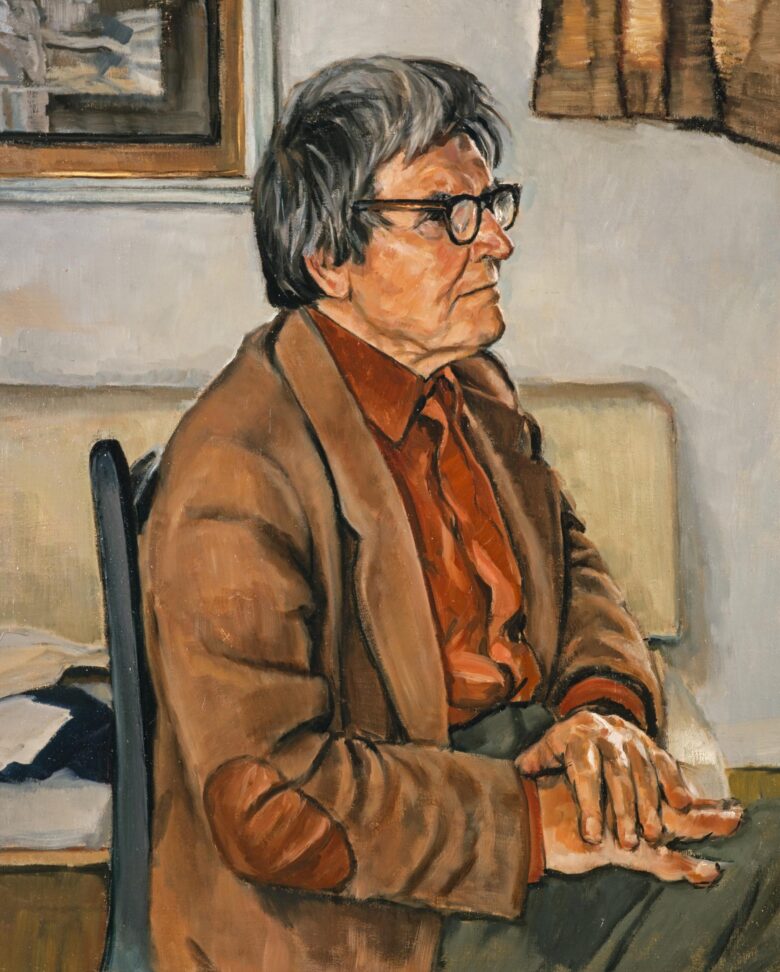
(Michael Knowles (born 1958), George Elder Davie, 1912 - 2007. Philosopher, writer and historian, about 1990. Oil on canvas. Presented by Dr George Elder Davie 1998. © The Artist. Photography by Antonia Reeve. National Galleries of Scotland. https://www.nationalgalleries.org/art-and-artists/52221 )