In After Virtue, MacIntyre distinguishes between the internal and external goods of a practice. Internal goods are intrinsic to a specific practice: they can only be achieved by participating in it according to its standards (for example, among the goods of chess are the development of a certain tactical awareness and a particular strategic imagination). External goods, by contrast, are only contingently attached to practices and include such rewards as money, status, and power.
MacIntyre illustrates this distinction through the example of portrait painting. Here, the internal goods include both the production of excellent portraits and what he calls ‘the good of a certain kind of life’ (p. 190), in this case, that of a painter. Practices then are not only productive activities; they can shape the character and form of life of those who participate in them.
A practice has three defining features:
- it enables the achievement of internal goods,
- it is governed by standards of excellence specific to that activity,
- it requires submission to those standards, often under the guidance of more experienced practitioners.
The virtues are the qualities that enable individuals to achieve these internal goods. MacIntyre identifies justice, courage, and truthfulness as necessary to all practices. Notably, the exercise of these virtues may hinder the pursuit of external goods, given the pressures and incentives of modern social life.
This framework clarifies why cheating is not a minor procedural violation but a fundamental corruption of practice. As MacIntyre puts it, a willingness to cheat ‘so far bars us from achieving the standards of excellence or the goods internal to the practice that it renders the practice pointless except as a device for achieving external goods’ (p. 191). The activity is hollowed out from within.
It is often said that the cheater only harms themselves. That is only partially true, of course. In the short term, cheating can secure external rewards. In the university, plagiarism once served this function; now, the uncritical use of generative AI may do the same. But understood in MacIntyre’s terms, the deeper problem is clear: the practice itself becomes meaningless for the individual. One may still acquire credentials or recognition, but the internal goods – intellectual formation, disciplined inquiry, the development of judgement – are lost.
The cost is therefore not only academic but ethical. The practice actually matters or should matter. The virtues required for participation in practices are also those required for a flourishing life. To bypass the practice is not simply to take a shortcut; it is to forgo the formation that the practice makes possible.
What, then, can the university do? It is only one element within a wider social order that prizes external goods, and it is required to distribute both internal and external goods. For many students, it remains primarily a route to employment, and so to external rewards. The difficulty does not originate within the university alone, and it would be misplaced to treat it as the primary source of the problem.
MacIntyre instead points to the importance of local, practice-based communities oriented towards internal goods and the virtues. The question, then, is whether universities can still sustain something of this orientation: not by denying the role of external goods, but by more clearly articulating and prioritising the internal goods of the disciplines they teach, and the forms of intellectual and ethical formation that participation in them makes possible.
Alasdair MacIntyre (2004) After Virtue. 2nd edition. London: Duckworth
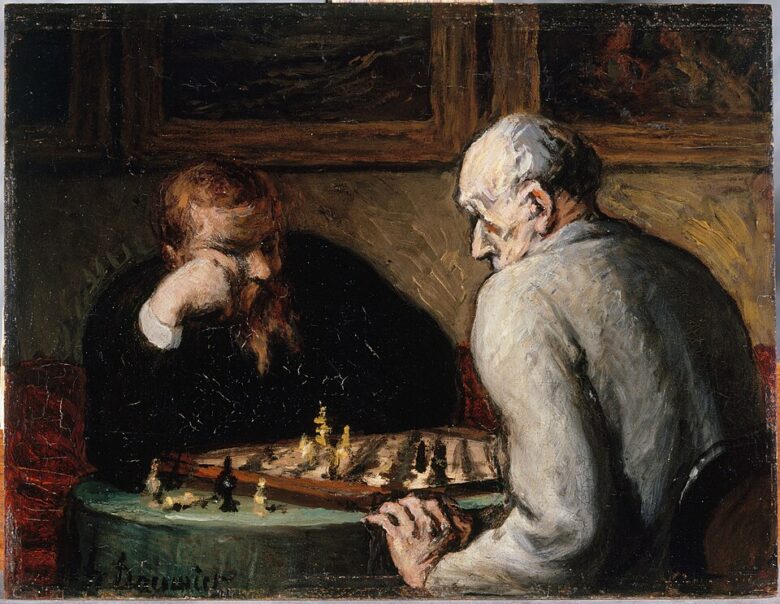
(Honoré Daumier: The Chess Players)