During the exhibition, I was positioned at the “customs” checkpoint of our installation, where the interaction between participants and the system first began.
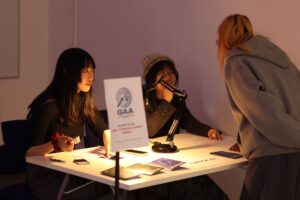
There were two of us managing this stage. My partner was responsible for communicating with visitors and stamping their passports, guiding them into the experience. My role was more observational and responsive. I monitored the colour of each participant’s passport and adjusted the type of “air” they would receive accordingly, which directly influenced their breathing experience in the next stage.
This role required constant attention rather than direct instruction. Instead of guiding participants verbally, I had to interpret small visual cues and translate them into system responses. This created a subtle layer of control that was mostly invisible to the participants.

What became interesting during this process was how differently people behaved when entering the space. Some participants tried to speak or ask questions, while others remained silent and simply followed the situation. Without clear instructions, people began to rely on their own assumptions, which shaped how they experienced the installation.
This made me realise that interaction does not always need to be explicitly guided. By reducing instructions, the system created space for uncertainty, where participants became more aware of their own actions and decisions. My role, although simple on the surface, was part of maintaining this balance between structure and ambiguity.