Any views expressed within media held on this service are those of the contributors, should not be taken as approved or endorsed by the University, and do not necessarily reflect the views of the University in respect of any particular issue.

Mid-Project Contribution and Reflection

At the mid-point of the project, I was mainly responsible for developing the user flow of the installation. I mapped out how visitors would enter the space, receive a passport, be classified, and then move into different breathing environments. The overall structure of the journey is now clear, but I realised that some transitions between stages still need to be smoother and more convincing.

I also took part in the early discussions about the main idea of the project. We talked about how air, breathing, and environmental differences could become the core theme, and how to turn these abstract ideas into something people can physically feel. During this process, I helped clarify the purpose of the passport system, making sure it represents structural inequality rather than judging individual behaviour.

Through this stage, I learned that building a clear experiential flow is not only about arranging steps, but also about making sure each moment supports the concept. Although the flow is not fully final yet, the main direction is clear, and we will continue refining it through testing and discussion.
Inspiration about first submission feedback

After reading the feedback, I realized that our concept is actually strong, but our technical work does not yet fully support it. As the person responsible for coding, I started to think more carefully about how the technology can truly express our idea, instead of just creating visual effects. For example, the particle system and noise texture should not only look interesting, but should represent invisible pollution and the slow damage happening to the body before people are aware of it. I was especially inspired by the idea of “destroyed rights” and the political meaning of the passport. Through code, we can create unfair systems, such as random assignment, to reflect the arbitrariness of birth and privilege. I also began to question whether we really need to release real gas or control people’s breathing, or if we can use sound and visuals to simulate these experiences in a safer and more meaningful way. This feedback helped me understand that technology is not just a tool, but a language. From now on, I want to focus on building a clearer experience structure and make sure every technical decision supports our core message.

Personal Contribution to the First Submission

In this project, I was mainly responsible for the research related to the target participant group. I took part in discussions about the overall theme at the early stage, especially how air, breathing, and environmental difference could become the core idea of our project. During these discussions, I helped connect the topic of air pollution to people’s daily experiences and body feelings, so that the theme would not stay abstract but relate to real life.

For the research part, I focused on analysing the participant group. I helped design and structure the interview questions, making sure they could guide participants to talk about their personal experiences, daily routines, and body sensations. I also worked on defining the selection criteria, deciding who would be suitable for our research and why. I explained why people who have experienced relocation are important for our topic, because they have lived in different environmental conditions and can compare changes in air quality and atmosphere.

In addition, I analysed how different backgrounds—such as country of origin, climate, and length of stay in Edinburgh—may influence how people feel about the air and their physical condition. I tried to understand how environmental changes can slowly affect breathing, comfort, and energy levels, even when people are not fully aware of it. I also helped link these research findings to the theme of air pollution and environmental inequality, so that the participant analysis could support the concept and direction of the final installation.

Through this work, I contributed to building a clearer connection between research and design, making sure that our project is based on real experiences rather than only theoretical ideas.


Making Invisible Pollution Visible: Particle Falls – Andrea Polli

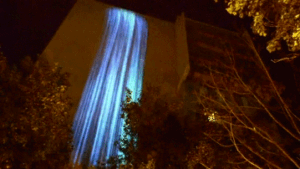
One project that I find particularly compelling is Particle Falls by media artist Andrea Polli. Installed on the façade of a public building, the work uses real-time air quality sensors to detect particulate pollution (PM2.5 and PM10) and translates this data into dynamic LED light patterns visible at night.

What interests me most about this installation is how it makes something normally invisible part of everyday visual experience. Air pollution usually exists as numbers in reports or as abstract warnings in the news. It is rarely something we can directly see. By turning particulate data into shifting intensities of light, Particle Falls brings environmental conditions into the shared space of the city.

Rather than presenting raw statistics, the work operates through translation. Higher pollution levels result in denser and more intense light “falls” across the building surface. In this way, scientific measurement becomes atmospheric and spatial. I find this shift important, because it reduces the gap between environmental monitoring systems and public awareness. The building itself becomes a kind of interface.

At the same time, the project makes me question the relationship between aesthetics and crisis. Does visualising pollution increase awareness in a meaningful way, or does it risk softening the severity of the issue through beautiful light effects? By embedding air quality data into the night-time cityscape, the installation reframes pollution as something present and continuous rather than distant or abstract.

For me, Particle Falls demonstrates how design can mediate between scientific systems and public understanding. It suggests that environmental data does not have to remain confined to expert discourse, but can become part of shared urban experience—something we encounter, notice, and reflect on together.

Reference
Polli, A. (2010). Particle Falls.
Science History Institute.
https://www.sciencehistory.org/sensing-change-particle-falls/


Deep thinking of TouchDesigner Node about particles

I followed the flowchart and connected nodes like Audio Device In CHOP, Analyze CHOP, Math CHOP — volume and spectrum data came through fine.
But at first I just linked the volume value directly to particle size and speed — the result was really stiff. Particles either stayed still or suddenly jumped, nothing like the “sound mountain” I had in mind.
Then it hit me: driving all particles with a single value flattens everything.
So I switched back to a Python script inside Geometry COMP, looping through each particle per frame, using Noise TOP to give each point its own base height, then scaling the whole thing with volume.
Now the movement feels natural — when the sound gets loud, the whole “mountain” rises, but each particle keeps its own little wobble.
One thing that really stuck with me:
Sound is a trigger, but it shouldn’t be the only boss. Visualization isn’t about translating sound into an image — it’s about giving sound something that’s already alive, and letting it move along.

Case Study on Air Pollution Visualization Device – Thijs Biersteker

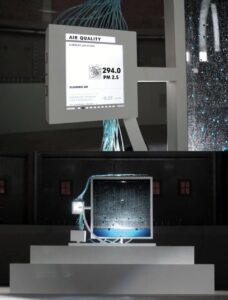
The GASP art installation, which focuses on air pollution, is an outstanding interdisciplinary design work that combines visual expressiveness, scientific support, and social value. It does not convey environmental protection concepts through cold science explanations or radical appeals. Instead, it transforms the intangible air pollution into a visual experience that is visible, tangible, and empathetic, allowing viewers to directly confront the hazards of air pollution from their own experiences. This not only achieves the uniqueness of artistic expression but also effectively disseminates social issues. It is an excellent example of how art design can empower the resolution of real problems.
From the perspective of the work itself, its ingenuity and impact lie in three core aspects: Firstly, it translates abstract data into concrete forms, using the dynamic changes in the number of oil droplets to correspond to the real-time PM2.5 concentration monitored by sensors, turning the obscure environmental monitoring data into visual symbols that the audience can intuitively perceive, breaking the barrier between professional data and the general public in terms of understanding; Secondly, it evokes emotional resonance by using the cost of reality to trigger empathy. It does not simply list the hazards of PM2.5, but ties it to specific health issues such as lifespan loss, stroke, and heart disease, and even quantifies the lethality of pollution through comparisons with the number of deaths from the novel coronavirus, making viewers shift from an indifferent “not concerning me” state to a concern for their own health. This emotional impact based on reality is far more persuasive than simple textual explanations; Thirdly, it strengthens action awareness through contrast, juxtaposing polluted air with clean air, and visualizing the harm of “every polluted breath”, making the work no longer just an information output but a strongly guiding call to action, naturally prompting viewers to think and discuss air pollution issues, achieving a value upgrade from “expression” to “connection” in the artistic work. Overall, the GASP installation not only successfully achieves the core goal of “turning intangible pollution into tangible” but also shows me the power of design ,  design can not only be works that pursue visual beauty, but also can carry real issues, connect the public and society, and promote thinking and action. This also sets an important direction for my subsequent design practice: to make design rooted in reality, with both beauty, warmth, and practical significance.


css.php

Report this page

To report inappropriate content on this page, please use the form below. Upon receiving your report, we will be in touch as per the Take Down Policy of the service.

Please note that personal data collected through this form is used and stored for the purposes of processing this report and communication with you.

If you are unable to report a concern about content via this form please contact the Service Owner.

Please enter an email address you wish to be contacted on. Please describe the unacceptable content in sufficient detail to allow us to locate it, and why you consider it to be unacceptable.
By submitting this report, you accept that it is accurate and that fraudulent or nuisance complaints may result in action by the University.

  Cancel