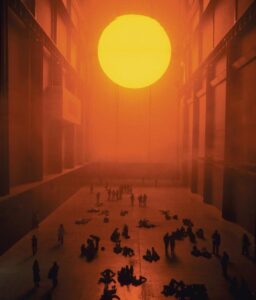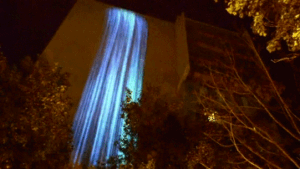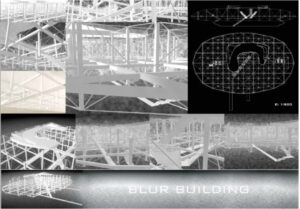
Unlike traditional architecture, which depends on form and structure, Blur Building by Diller Scofidio + Renfro replaces solidity with atmosphere. Built for the Swiss Expo on Lake Neuchâtel, the structure exists as a cloud of artificial fog, continuously forming and dissolving in response to environmental conditions.
From a distance, the building appears as a vague mass. As visitors enter, visibility rapidly collapses. Edges disappear, depth becomes uncertain, and spatial orientation is no longer reliable. Movement through the space depends on partial and constantly shifting information.
This instability forces a change in how the body navigates. Vision, typically the dominant sense in spatial understanding, becomes insufficient. Instead, perception is distributed across multiple sensory inputs: humidity on the skin, resistance in the air, sound of water pressure, and the presence of nearby bodies.
Proximity becomes the only reliable indicator of space. Objects and people emerge suddenly at close range, often without clear boundaries. This creates a continuous state of anticipation, where each step is exploratory rather than confirmatory.
Sound plays a subtle but important role. Mechanical noise, wind, and distant movement replace visual clarity as orientation cues. These elements do not provide precise information, but they contribute to a shifting sense of location.
Another key aspect is the absence of fixed form. The building does not maintain a stable outline; its shape depends on wind, temperature, and water pressure. As a result, the architecture feels less like an object and more like a condition—something experienced moment by moment rather than observed as a whole.
What makes this work particularly compelling is how it redistributes attention. Without clear visual structure, awareness shifts toward micro-level sensations: slight changes in temperature, density, and sound. The body becomes more active in constructing meaning from incomplete information.
For design practice, this project suggests that clarity is not always necessary for engagement. By removing stability and predictability, it is possible to create experiences that require active participation. Instead of presenting a fixed environment, the design can invite people to continuously negotiate their relationship with space.
In relation to my own work, this reinforces the idea that interaction can emerge through uncertainty. Rather than guiding users toward a clear interpretation, the experience can remain open, allowing meaning to form through movement, hesitation, and sensory adjustment.
Reference work:
Blur Building (2002), Diller Scofidio + Renfro, Lake Neuchâtel