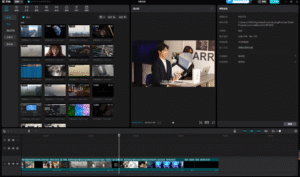
Before editing this video, I understood “circulation” mainly as a spatial problem—
where visitors enter, how they move, and how they are guided through an installation.
But during the editing process, I began to realise something else:
Circulation does not only exist in space.
It also exists in time.
And editing, in this sense, becomes a way of redesigning the experience.
Translating Space into Time
The video documents the full journey of our installation:
From receiving a passport, to watching the introduction film, passing through customs, entering the interactive installation, and finally arriving at the feedback area.
In the physical space, this unfolds as a continuous sequence of actions.
In video form, however, it must be compressed, reorganised, and narrated differently.
This raised an important question for me:
If the audience no longer walks through the experience, but watches it—does the experience still exist?
While editing, I constantly adjusted the rhythm:
- What needs to be shown first?
- What must remain?
- What should be emphasised?
At some point, I realised that I was no longer documenting the journey—
I was reconstructing it.
From Concept to Sensation: Passport, Smell, and Body
When I reached the core installation section, I paused repeatedly to reflect:
Is the idea actually being communicated?
The mechanism of the installation is relatively simple:
- Each visitor receives a passport representing a country
- Each country corresponds to a different level of air pollution
- The gas they smell is determined by this identity
- Meanwhile, their breathing is recorded and visualised in real time
But the project is not really about this system itself.
It is about the question behind it:
If air quality is unequal, can breathing still be considered equal?
During editing, I deliberately broke the logic into short, direct sentences:
- “The gas you smell is determined by your passport”
- “Different countries, different pollution levels”
- “Your breathing is being recorded”
These statements are simple, but they create a gradual shift—
from understanding information to sensing it physically.
Because ultimately, the work does not happen inside the installation.
It happens inside the body of the viewer.
Making the Invisible Perceptible
One of the fundamental challenges of air pollution is that it is difficult to perceive directly.
We may see smog, but not PM2.5.
We may smell something, but cannot measure its risk.
We breathe constantly, yet rarely question the quality of air.
In the installation, we used smell, devices, and data
to make air perceptible.
But in video editing, I faced a similar challenge:
How can someone “feel” air through a screen?
Instead of simulating air, I chose to emphasise difference:
- Different passports
- Different smells
- Different breathing patterns
As these differences accumulate,
they begin to form a realisation:
Air is not a neutral background.
It is a condition that is unevenly distributed.
From Experience Design to System Awareness
Through editing, I also began to see the project differently.
It is not only about pollution itself.
It points toward a larger system:
- Why are some regions exposed to higher levels of pollution?
- How are air quality and inequality connected?
- Why does something as basic as breathing become unevenly distributed?
These questions are implicit in the installation,
but in the video, I wanted them to surface more clearly.
That is why I chose to end with a direct statement:
Breathing is not equally shared.
It is not a conclusion.
It is an opening.
Editing as Re-Design
This process changed how I think about editing.
A video is not just documentation. It is an extension of the work.
In space, the audience moves through the installation.
In video, the audience moves through time.
Editing becomes the bridge between the two.
It translates, but it also reshapes.
Conclusion
When I placed the final subtitle on the timeline,
I realised something quite simple:
We cannot bring everyone into the installation.
But we can make more people aware of what it reveals.
Breathing has never been entirely free.
It is shaped by environment, infrastructure,
and the uneven conditions of the world we live in.
Design may not immediately solve these problems.
But it can make them visible, perceptible, and discussable.
And sometimes,
that is where change begins.