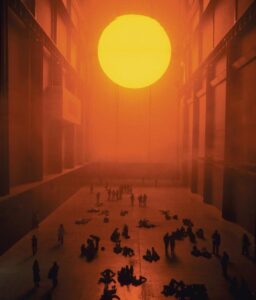
It is often assumed that perception is a direct response to what we see. This assumption is subtly challenged in The Weather Project by Olafur Eliasson, installed at Tate Modern.
At a formal level, the work is minimal: a glowing semicircle, reflected by a mirrored ceiling, completes the illusion of a full sun. Mist fills the space, diffusing light and flattening contrast. However, the work does not end at what is seen. Its impact emerges gradually through how people begin to behave within it.
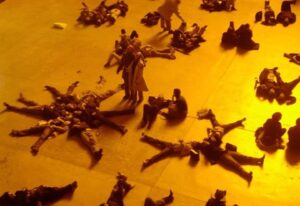
Over time, visitors slow down, lie on the floor, and gather in groups. Many look upward, not only at the artificial sun but also at their own reflections above. Without any explicit instruction, the installation reorganises behaviour. The space becomes less about observing an artwork and more about inhabiting a shared condition.
What is particularly interesting is that there is no direct interaction system—no sensors, no feedback loop in the conventional sense. Instead, the environment itself operates as a soft form of interaction. Light, scale, and atmosphere guide attention and movement without making this guidance visible.
The mirrored ceiling plays a crucial role. It introduces a secondary layer of awareness: people see themselves as part of the environment they are experiencing. This creates a subtle feedback loop between body and space, where observation shifts toward self-observation. The participant is no longer just looking, but also being seen within the same visual field.
The strength of the work lies in its restraint. Rather than overwhelming the audience with complex media, it relies on a limited set of elements to produce a gradual shift in awareness. This experience unfolds over time, making subtle behavioral changes become obvious.
For my own project, this reference suggests that interaction does not always need to be explicit or reactive. Instead of designing clear instructions or outcomes, it is possible to construct conditions that influence how people move, pause, and attend to their surroundings. In this sense, interaction can exist in atmosphere rather than interface.
Reference work:
The Weather Project (2003), Olafur Eliasson, Tate Modern