From Three-Tier Structure to Power as a System
In previous curatorial research, I framed the exhibition around the question of how mythical animals operate as a system of power across three levels: family, state, and cosmic cognition. At the state level, represented by Ai Weiwei, myth was situated within historical and political narratives. Drawing from Roland Barthes’s proposition that “myth is not a story, but a system of communication”, myth can be understood as a mechanism through which meaning and ideology are produced across different scales.
link: week6| Mythical Animals and Power Structures
As discussed in the previous week, the decision to move away from Ai Weiwei was based on both practical constraints and a shift toward focusing on the core characteristics of artworks rather than their authorship. Building on this, the project now reconsiders how these characteristics—scale, material force, and symbolic transformation—can be rearticulated through other practices.
link: week7| From research to situated feasible exhibition structure
Reframing the Case: Why Raeyen Song
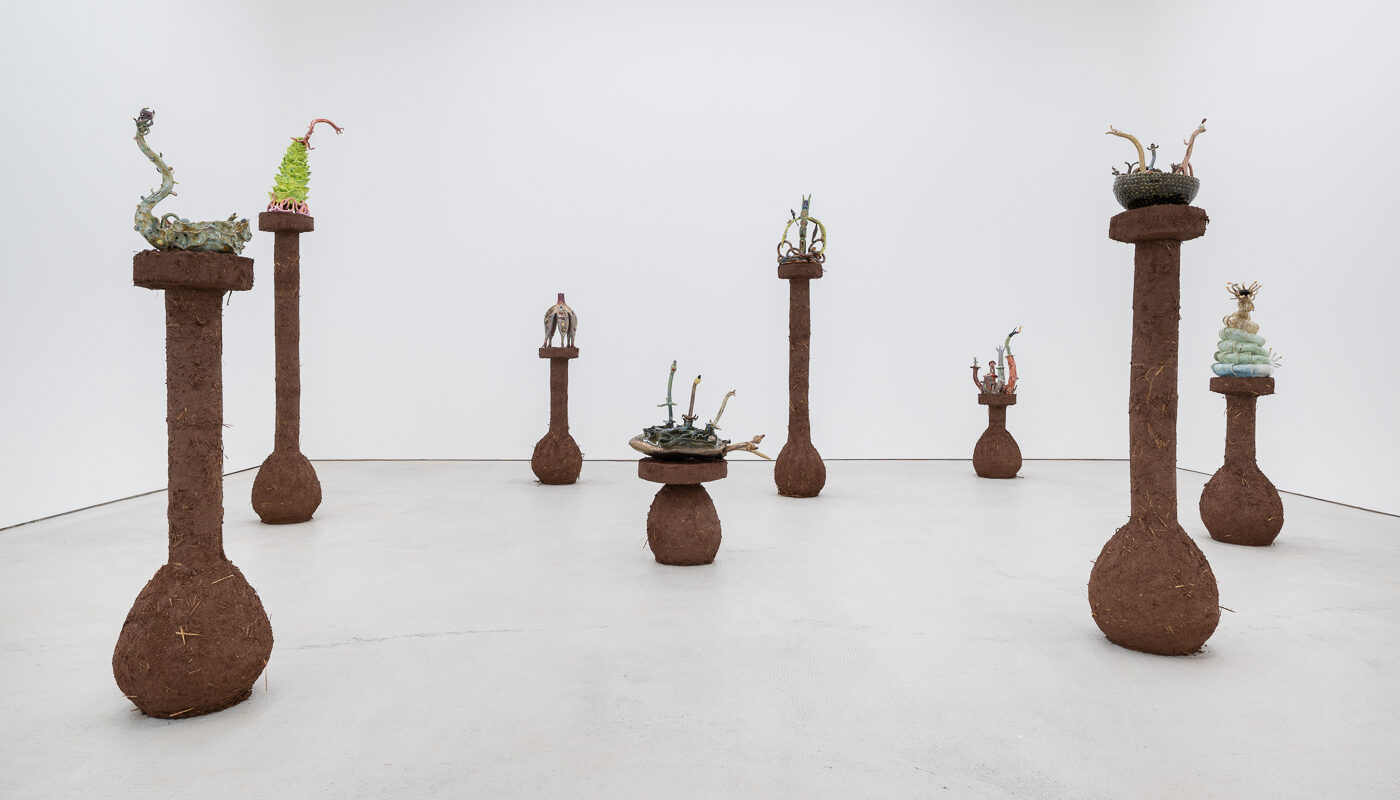
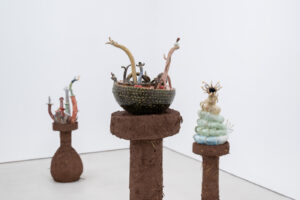
In this context, the work of Raeyen Song offers a critical alternative. Song is a contemporary artist whose practice engages with ecological processes and material transformation, often working with microorganisms, organic matter, and ceramics to construct speculative cosmologies. In his installation, microorganisms in a pond are reimagined as ”gods“, while ceramic forms evoke Daoist “golden bodies”. This shift from monumental representation to micro-scale processes repositions myth as something generated through interaction rather than fixed within historical narratives.
link: https://rae-yen-song.com/projects/☁☁☁☁songxian☁☁☁☁/
From Centralised Power to Distributed Agency
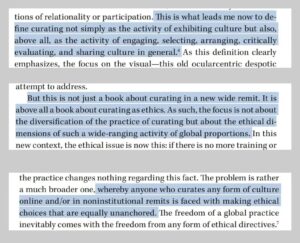
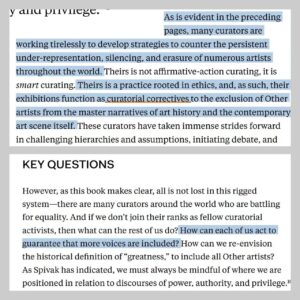
Accordingly, the notion of power is also redefined. Rather than a centralised or monumental structure, power can be understood as relational and distributed. This aligns with Jean-Paul’s argument that curating operates as an ethical practice shaping relations and responsibilities, as well as Maura Reilly’s emphasis on curatorial agency as a means of redistributing visibility and voice. From this perspective, power emerges through processes of selection, arrangement, and interaction rather than being imposed from above.
The relationships between microorganisms, soil, and ceramic material form an evolving ecosystem in which meaning is continuously produced. In this sense, myth is no longer a fixed symbolic form but an ongoing generative system. The transition from Ai Weiwei to Raeyen Song, therefore, does not weaken the political dimension of the exhibition but deepens its understanding of power as something embedded in processes of growth, interdependence, and transformation across human and non-human networks.
Therefore, through this process, I arrive at the title of the exhibition: When Animals Speak the Language of Power.
Bibliography
Raey Yeen Song. ••••song~xian••••. 2025. https://rae-yen-song.com/projects/☁☁☁☁songxian☁☁☁☁/
Jean-Paul Martinon. Curating as Ethics. Minneapolis: University of Minnesota Press, 2020.
Maura Reilly. Curatorial Activism: Towards an Ethics of Curating. London: Thames & Hudson, 2018.