

Pocket Archive: Creating an Exhibition for Everyday Archaeology
Summary
Pocket Archive is a 20-minute open toolkit that transforms everyday belongings into an archaeological micro-museum of the self. By emptying items from pockets—or any personal container such as a bag, coat, or wallet—learners explore how objects silently record habits, emotions, memories, routines, and identity.
This toolkit is designed for both individual and collaborative use. It is accessible to participants without an art background and inclusive of different lifestyle practices and clothing choices.
Concept
Our pockets are the miniature museum of our daily life.
The objects we carry are not random. They are unconscious traces of time, behavior, and identity.
In Pocket Archive, participants are both archaeologists and curators:
excavating the objects they carry, arranging them as an exhibition, and discovering the hidden connection between body, habits, and everyday rituals.
Objectives
Re-examine everyday belongings as “witnesses of time.”
Turn ordinary items into exhibition texts.
Explore the symbiotic narrative between the body and objects.
Materials
Use any everyday container you carry:
✔ pockets
✔ bag / backpack
✔ coat
✔ wallet
✔ OR a “minimal object mode” (phone + one small item)
Other materials:
Paper & pen
Phone/camera
Flat surface (table)
Now, let’s get started.
Steps
Step 1: Excavation (2 minutes)
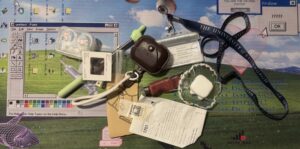
Empty your pocket, bag, or coat.
Place all items on the table.
Ask: Where did each object come from? Why is it here today?
Step 2: Categorisation (3 minutes)
Sort your items into groups of your choice:
Function (e.g., tools / identity / comfort)
Emotion (e.g., stress / protection / pleasure)
Frequency (daily / accidental / forgotten)
If you only have 1–2 items:
Use “Minimal Pocket Mode.” Focus on small details: weight, texture, memory, and emotional feeling.
Step 3: Exhibition Layout (6 minutes)
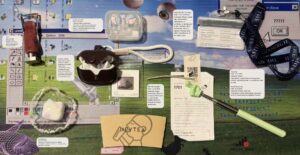
Arrange your items like a miniature exhibition.
Write a simple label for each item (write only 1–2 lines):
- Date
- Function or event linked to it
- Emotional note (if any)
Template example:
Object name (e.g., “Contact Lens Case”)
Date: 11.11.2025
Function: Helps me see clearly during long days on campus.
Emotional Note: A subtle reminder to stay alert and awake.
Take one overall “exhibition photo.”
Step 4: Interpretation (6 minutes)
Think about the guiding questions:
What category is most common in your carrying habits?
Which items seem important, and which are accidental?
What differences appear between items from different containers (pocket vs. bag)?
Which item feels like it represents today? Why?
Stage 5: Find one’s best representative symbol (1 minutes)
Select the item that best represents your current state, mood, or identity.
Place it in the center of your layout like the “keystone” of your miniature museum.
Step 6: Upload to Pocket Archive Cloud (Padlet)
To build a shared public archive, participants are invited to upload:
Their exhibition photos
Their representative object
Their short labels or reflections
Instructions:
- Click the Padlet link (https://padlet.com/s2853883/pocket-archive-public-museum-4kv33v8texpsgzao).
- Press “+ Add Post.”
- Upload your exhibition image.
- Add: Title (e.g., Today’s Archive), 1-2 sentence reflection
- Browse other people’s archives & leave comments.
This transforms Pocket Archive into a collective digital museum
Extended Gameplay
Exchange your pocket photo archive with a friend and write curator statements for each other’s exhibitions.
Try Backpack Archive, Coat Archaeology, Desk Drawer Archive, or Soles Geography.
Create a Pocket Archive Zine using collages or photography.
Create a weekly “micro-museum map” that highlights your habits.
Optional Section—Accessibility Notes
For participants with no carried items:
Use digital pockets (phone screenshot, app layout)
Use emotional pockets (draw symbolic items)
Use soc
Reflection
Which item best represents you today?
Does your pocket resemble something? A workshop, a temple, or a trash can? And how does it relate to personal preferences and occupation?
Can you recall a certain moment of your body through an object?
How does the body shape what we carry (left/right, dominant hand, weight)?
How might the archive change in the future, such as tomorrow, next month, or next year?
Theoretical Foundations
Pocket Archive uses several main ideas from material culture studies, everyday archaeology, phenomenology, and narrative identity. These views help explain why the small items we carry—keys, receipts, badges, stones, or a worn USB stick—are more than just practical tools. They help build memory, behavior, and identity.
- Material Culture (Miller, 2010)
Daniel Miller argues that everyday objects are not passive; they actively participate in shaping who we are. We define ourselves through what we choose to keep, use, carry, and discard. For Pocket Archive, items found in a pocket or bag are not random. They act as physical things that build and show identity. A keychain from home, a used transit card, or a broken earphone quietly records relationships, routines, and personal values.
2. Archaeology of the Everyday (Buchli & Lucas, 2001)
Buchli and Lucas propose that contemporary life can be studied archaeologically. The ordinary things around us are “artifacts of now,” capable of revealing the hidden structures of daily habits.
Pocket Archive uses this exact method: emptying, sorting, and arranging personal items becomes a form of miniature archaeological excavation. This excavation uncovers behavior patterns, cultural habits, and unconscious choices.
3. Phenomenology of Perception (Merleau-Ponty, 2012)
Merleau-Ponty emphasizes “embodied perception,” the perception that we experience the world through our bodies, habits, and sensory memory.
Pocket items are meaningful due to their nature and how the body interacts with them. These sensory traces form part of how we remember, navigate, and inhabit everyday life.
4. Body–Object Relations (Turkle, 2007)
Sherry Turkle’s work on “evocative objects” highlights how certain objects act as extensions of the body and containers of memory.
Pocket Archive as intimate companions, holding emotions, histories, and behavioral imprints. A charm, an inhaler, a USB stick, or a note from someone important can serve as an external memory device.
5. Narrative Identity (Ricoeur, 1994)
Paul Ricoeur argues that individuals construct identity by assembling experiences into stories. Pocket Archive uses this idea. Each object becomes a narrative anchor. By arranging and showing these items, people tell small stories of their routines, values, and sense of self.
Reference:
- Buchli, V., Lucas, G., Cox, M., & Taylor & Francis. (2001). Archaeologies of the contemporary past. Routledge. https://www.taylorfrancis.com/start-session?idp=https%3A%2F%2Fidp.ed.ac.uk%2Fshibboleth&redirectUri=https%3A%2F%2Fwww.taylorfrancis.com%2Fbooks%2F9780203185100
- Merleau-Ponty, M., & Landes, D. A. (2012). Phenomenology of Perception (1st ed.). Routledge. https://doi.org/10.4324/9780203720714
- Miller, D. (2010). Stuff. Polity Press. https://login.eux.idm.oclc.org/login?url=http://search.ebscohost.com/login.aspx?direct=true&scope=site&db=nlebk&db=nlabk&AN=571938&authtype=ip,shib&custid=s3013074
- Ricœur, P. (1992). Oneself as another. University of Chicago Press.
- Turkle, S. (2011). Evocative Objects: Things We Think With (Sherry Turkle, Ed.; 1st ed.). The MIT Press.
Pocket Archive: creating an exhibition for everyday archaeology © 2025 by Qifei Jiang is licensed under CC BY 4.0

(https://www.publicdomainpictures.net/en/view-image.php?image=560609&picture=paper-background-for-scrapbook)