
Mapping your career path: From self-evaluations to acting now!
Summary
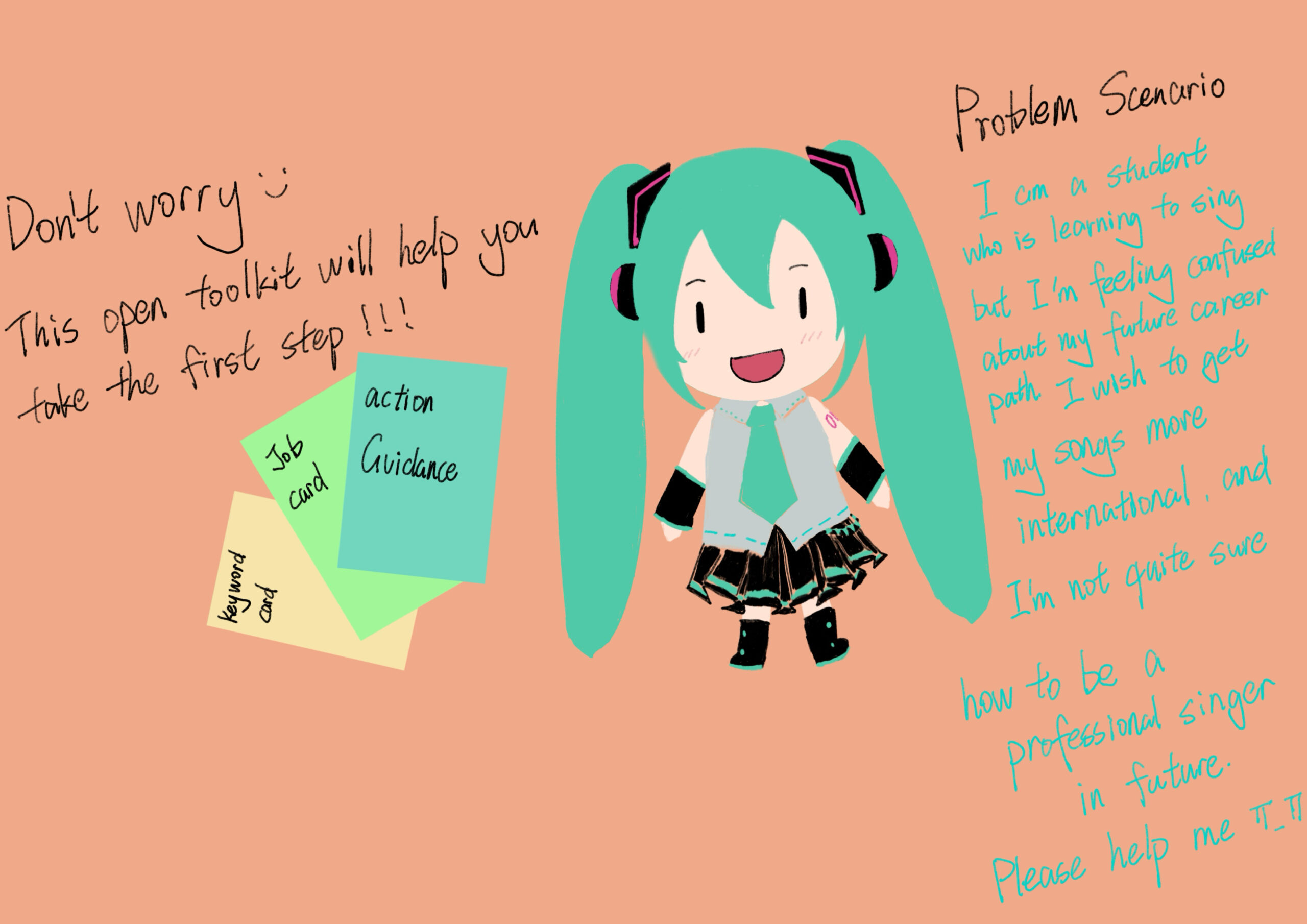
This open toolkit is designed to assist learners in reflecting on their experiences and self-evaluations. Following collaboration with other learners, learners will select keywords from a set of cards that best represent their personal characteristics. These keywords will then be categorised and prioritised to distinguish core values from secondary values. Based on the top three core value cards chosen, learners will match these to relevant career directions and develop an action plan for the future.
Aim: To assist learners in identifying and categorising their own career values, and to develop an action plan for the following career path.
Why create this open toolkit?
In contemporary society, the arts labour market faces a continuous downward trend. Examples include oversupply of job seekers, the dominance of project-based work, income inequality, and the unpredictability of career prospects (Bielby & Bielby, 1994; Menger, 1999; Throsby, 1992, 2012, cited in Lingo & Tepper, 2013). This has revealed the struggles faced by arts workers on career pathways. Based on this, cultural labour itself has progressively become a core concern in academia. Fundamentally, working practices, talent development systems, and the widespread use of unpaid internships have resulted in job opportunities in the cultural and creative industries becoming the exclusive domain of privileged groups (Brook et al., 2018; Dubois, 2015; Eikhof & Warhurst, 2013; McRobbie, 2016, cited in Belfiore, 2021). Consequently, accessing the arts as a career and effectively mapping your professional prospects has always been a core challenge for arts workers. Moreover, artists require a clear sense of personal direction to address uncertainty, failure, and changing possibilities, such as understanding their motivations, strengths, and which enterprises or projects best support their career path (Gruber, 1988; Zwaan, ter Bogt, & Raaijmakers, 2010, cited in Lingo & Tepper, 2013).
Announcement: All materials provided in this Open Toolkit can be printed and added independently.
The career pathways and suggestions offered in this Open Toolkit are based on learners’ self-descriptions and value choices. They are intended as suggested paths for exploration and reflection, not the result.
Target Learners: learners with an interest in or who are confused about the arts field; learners wishing to work in the arts field; arts workers; and learners seeking to quickly clarify their personal value and identify career directions in a short time.
Time: around 20 minutes
Participant limit: Must be two or more participants.
Materials: A4 paper, a pen, and you need to print the keyword cards, job cards, and action guidance cards provided in this open toolkit yourself.
Step by step:)
Step 1: Evaluating myself (5 mins)
Answer the following three questions:
1) In the arts field, what work/ aspects do I most want/enjoy?
2) In the arts field, what work or aspects do I not want/hate?
3) Select one of the following questions to answer:
a) If you have past internship experience (in any field, including project collaborations), what do I think I did well in? What am I most skilled at? (This may be based on self-evaluation or feedback from others)
b) If you have no internship experience (in any field, including project collaborations), what do I believe I could do well in? What am I most skilled at? (This may be based on self-evaluation or feedback from others)
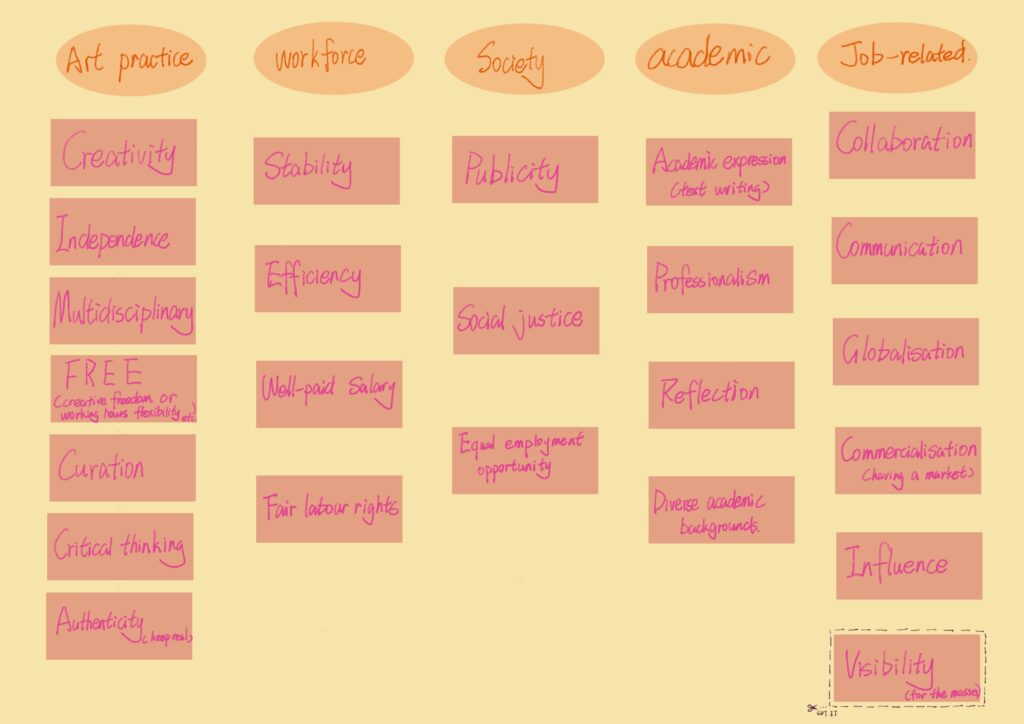

Step 2: Selecting My Keyword Cards (5 mins)
Lay out the keyword cards provided in this open toolkit in the order shown in the image.
1) Based on my answers to the three questions, each learner selects three cards that best represent my keywords, offering appropriate explanations for their choices.
2) I select three suitable keyword cards.
*Cards can be repeated; learners can add blank cards to cover any keywords not included.
Step 3: Rank (2 mins)
Rank the keyword cards I got in order, from the keyword I consider most important to the least important ones.
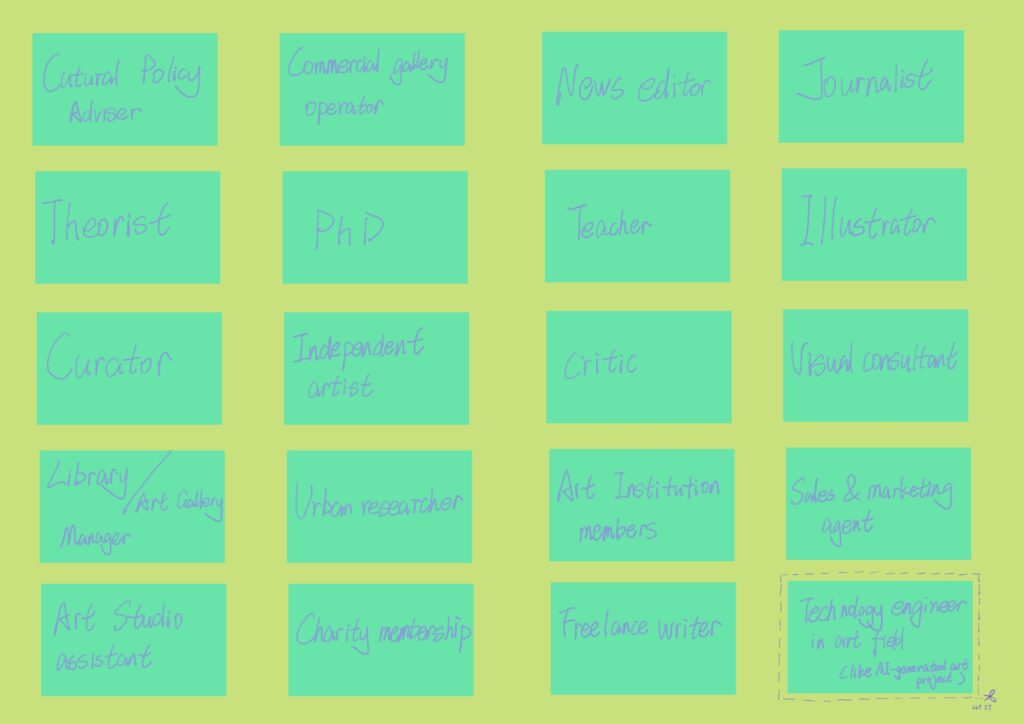

Step 4: Pick up your job cards (5 mins)
Lay out the job cards provided in this open toolkit
Take the top three core keyword cards you listed and match them to the corresponding job cards (you may discuss with other learners)
*If unsure how to match them, consider the following guidance:
Example 1: Critics, fellow artists, and the public give the label of ‘authenticity’ to those artists who reject economic motivation and maintain independence (Lloyd, 2010; Røyseng et al., 2007, cited in Lingo & Tepper, 2013). Thus, the keyword cards for authenticity, critical thinking, and influence could correspond to critics, independent artists, and writers.
Example 2: UNESCO (1980, cited in Lingo & Tepper, 2013) adopted a proposal on the status of artists, encouraging member states to recognise ‘the vital role of the arts in the life and development of individuals and societies’ and to ‘protect, defend and support artists and their creative freedom.’ Consequently, the keyword cards for influence, multidisciplinarity and globalisation could relate to UNESCO-like jobs such as cultural policy advisor, freelance writer and journalist.
*Learners can add jobs not listed on the cards. Learners can choose one to three job cards.

Step 5: Take Action! (3 mins)
Lay out the action guidance cards provided in this open toolkit. Take out an A4 sheet and a pen.
Using these action guidance cards as guidance, reflect on how to develop your next steps into an actionable plan.
On the A4 sheet, write: By using [keyword cards] as my core focus, I will further [select an appropriate action guidance card].
*The above sentence structure is for example purposes only and may be edited as needed.
*Learners can add any actions not covered by the cards
*This open toolkit would provide three open-access websites offering action guidance for arts-based careers as recommendations:
Axis is an artist-led charity dedicated to providing contemporary visual artists with resources, networking opportunities, and exposure. Examples include facilitating engagement with artist and curator communities (Axis, n.d.).
This website facilitates collaborative events and activities designed to open various artistic practices to new viewers. Additionally, it serves as a platform for regular gatherings where arts workers can exchange ideas and reflections (Artstogetherleeds.co.uk., 2025).
This platform builds pathways and career opportunities for freelance artists and creative professionals, including micro-enterprises with up to nine employees. Examples include specific training, development, and funding opportunities (Artstogetherleeds.co.uk., 2025).
(All images in this open toolkit are created by me and are available for download and adding.)
Reference
Artstogetherleeds.co.uk. (2025). Arts Together. [online] Available at: https://artstogetherleeds.co.uk/.
Artstogetherleeds.co.uk. (2025). Networks – Creative Careers – Arts Together. [online] Available at: https://creativecareers.artstogetherleeds.co.uk/networks/ [Accessed 17 Nov. 2025].
Axis. (n.d.). Promoting, supporting, and collaborating with over 10000 artists. [online] Available at: https://axisweb.org/.
Belfiore, E. (2021). Who cares? At what price? The hidden costs of socially engaged arts labour and the moral failure of cultural policy. European Journal of Cultural Studies, [online] 25(1), pp. 61–78. Available at: https://journals.sagepub.com/doi/full/10.1177/1367549420982863. [Accessed 1 Dec. 2025].
Lingo, E.L. and Tepper, S.J. (2013). Looking Back, Looking Forward: Arts-Based Careers and Creative Work. Work and Occupations, [online] 40(4), pp.337–363. Available at: https://journals.sagepub.com/doi/10.1177/0730888413505229. [Accessed 1 Dec. 2025].
Mapping your career path: From self-evaluations to acting now! © 2025 by Chenchen Feng is licensed under CC BY-NC 4.0