
Covering and Revealing of Color: Finding Calmness in Art Practice
Summary
This toolkit will guide learners to use the properties of oil pastels to relieve low-level anxiety through the artistic methods of drawing, covering and scratching. Turn anxiety into images and rewrite them. Allow learners to relax and calm down, and be able to look at problems more rationally.
Introduction📖
In today’s fast-paced life, people are more or less under pressure from many aspects, which leads to the generation of low-level anxiety. This toolkit will help you relieve low-level anxiety in the moment through an artistic healing method. Rediscover your inner peace by engaging in the practice of art.
Do you ever feel anxious because of small things?
Do you find yourself bothered by this kind of low-level anxiety?
This toolkit will help you calm down, reduce your anxiety, and re-examine the issues that make you anxious in 20 minutes through art practice. It is recommended to complete this independently.
⚠️⚠️⚠️
Note: This toolkit is only for low-level anxiety and cannot be used for disease treatment. (Anxiety UK defines low-level anxiety as short lived, proportionate to stressor, manageable, temporary, no/negligible impact on day-to-day life, mild worry, normal emotion.)
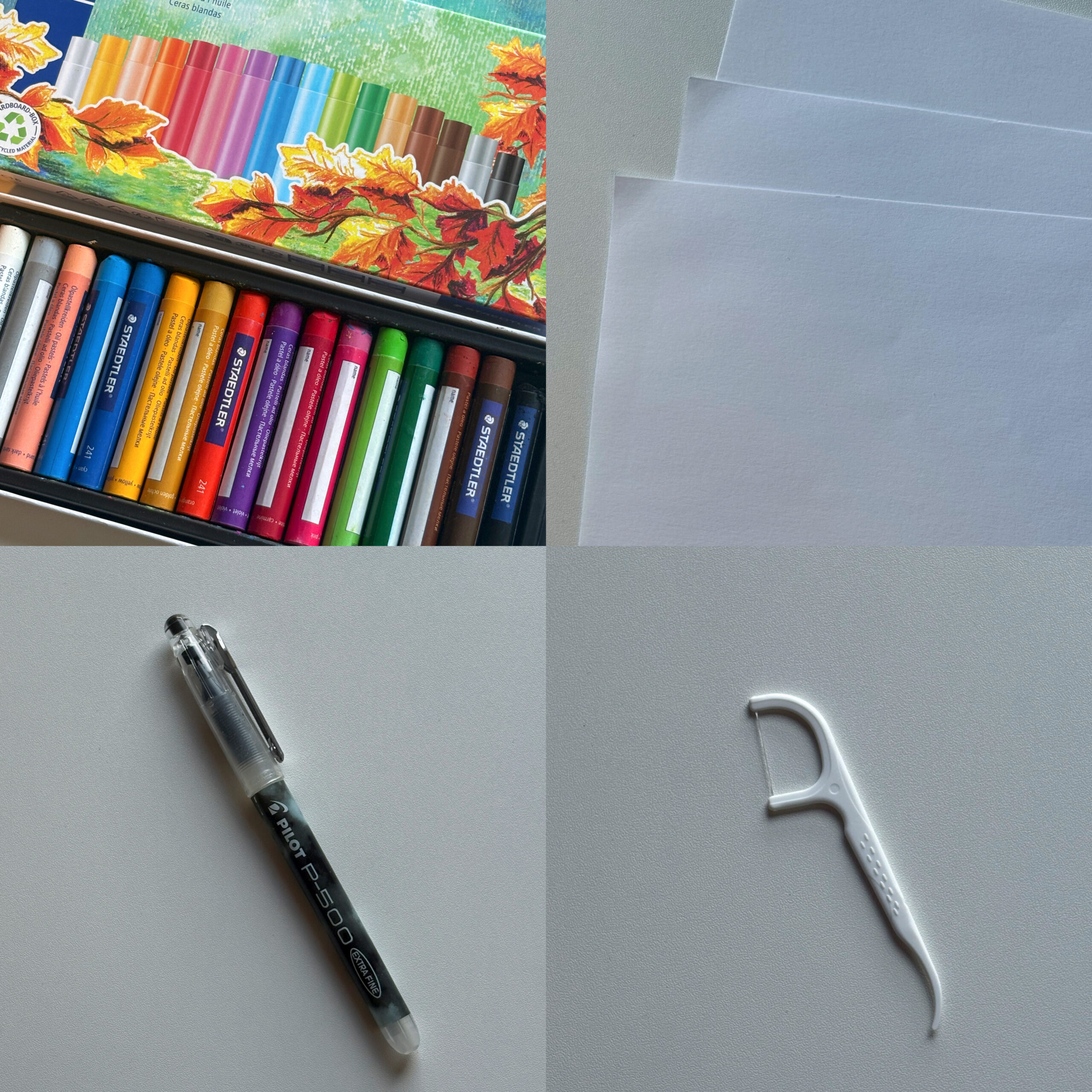
Materials required🎨
-
a gel pen
-
a blank piece of paper (quarter of A4 size)
-
some colored oil pastels
-
a black oil pastel
-
a floss pick (or toothpick)
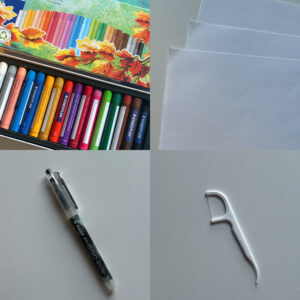
Materials required © 2025 by Ruohan Hao is licensed under CC BY-NC-SA 4.0


Let’s get started!💡
Step 1 (2 minutes)
-
Take a deep breath…
-
Inhale deeply through your nose and count silently for 4 seconds.
-
Hold your breath and count silently for 7 seconds.
-
Exhale slowly through your mouth and count silently for 8 seconds.
You can repeat the above breathing method 3 to 5 times to calm yourself down and relax.
Now you can think about what makes you anxious.
Step 2 (3 minutes)
-
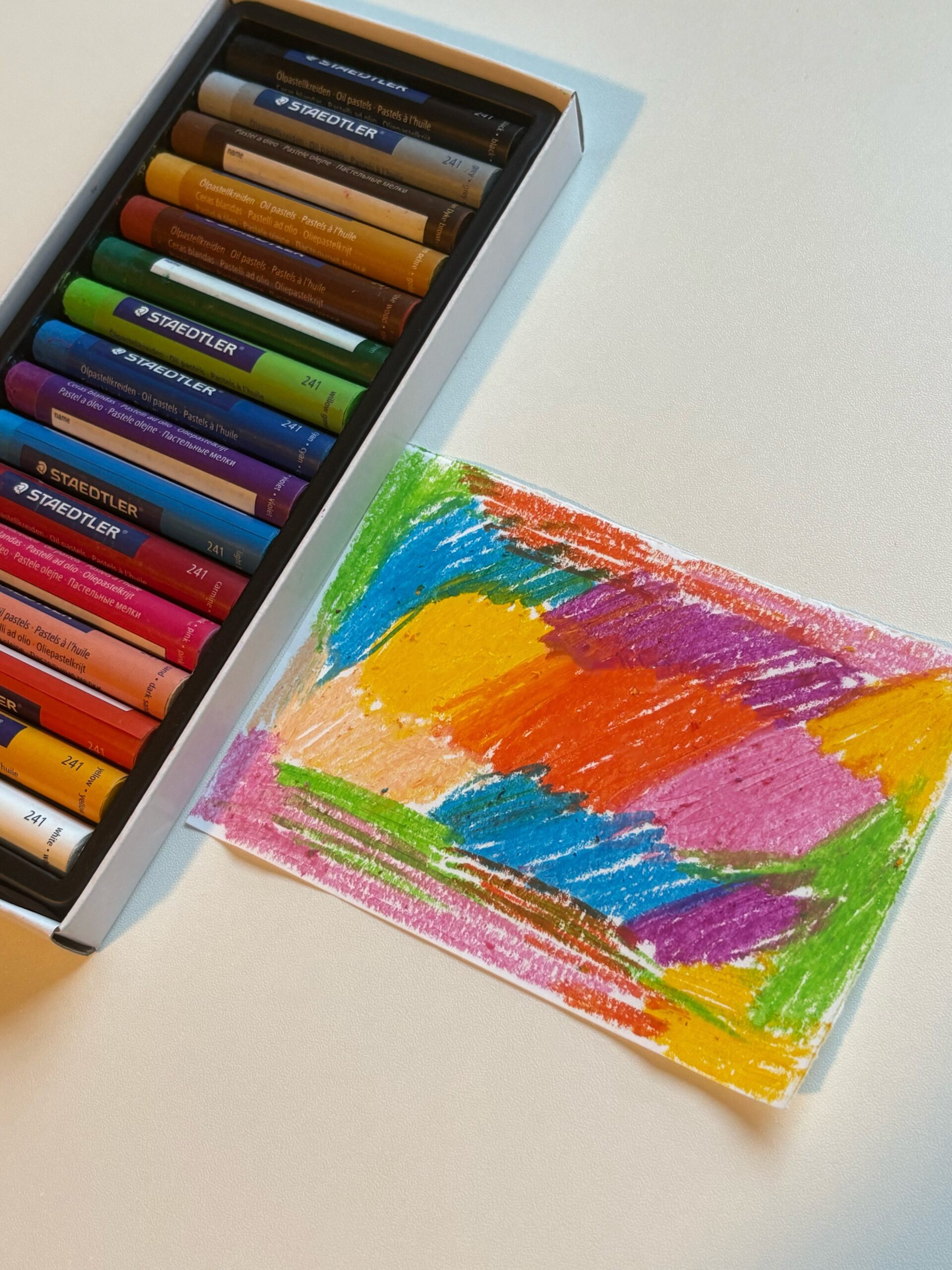
Choose a few colors from colored oil pastels that you think can represent this emotion (no less than 2 colors), and try to transform the thing that makes you anxious into an image in your mind.
-
Paint them on the paper, create freely, it can be in any shape, don’t worry about the composition, but it should cover the entire paper.
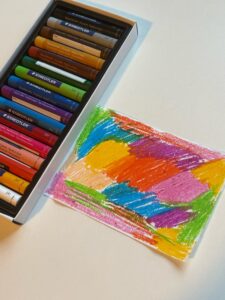
Step 2 example © 2025 by Ruohan Hao is licensed under CC BY-NC-SA 4.0
Step 3 (3 minutes)
-
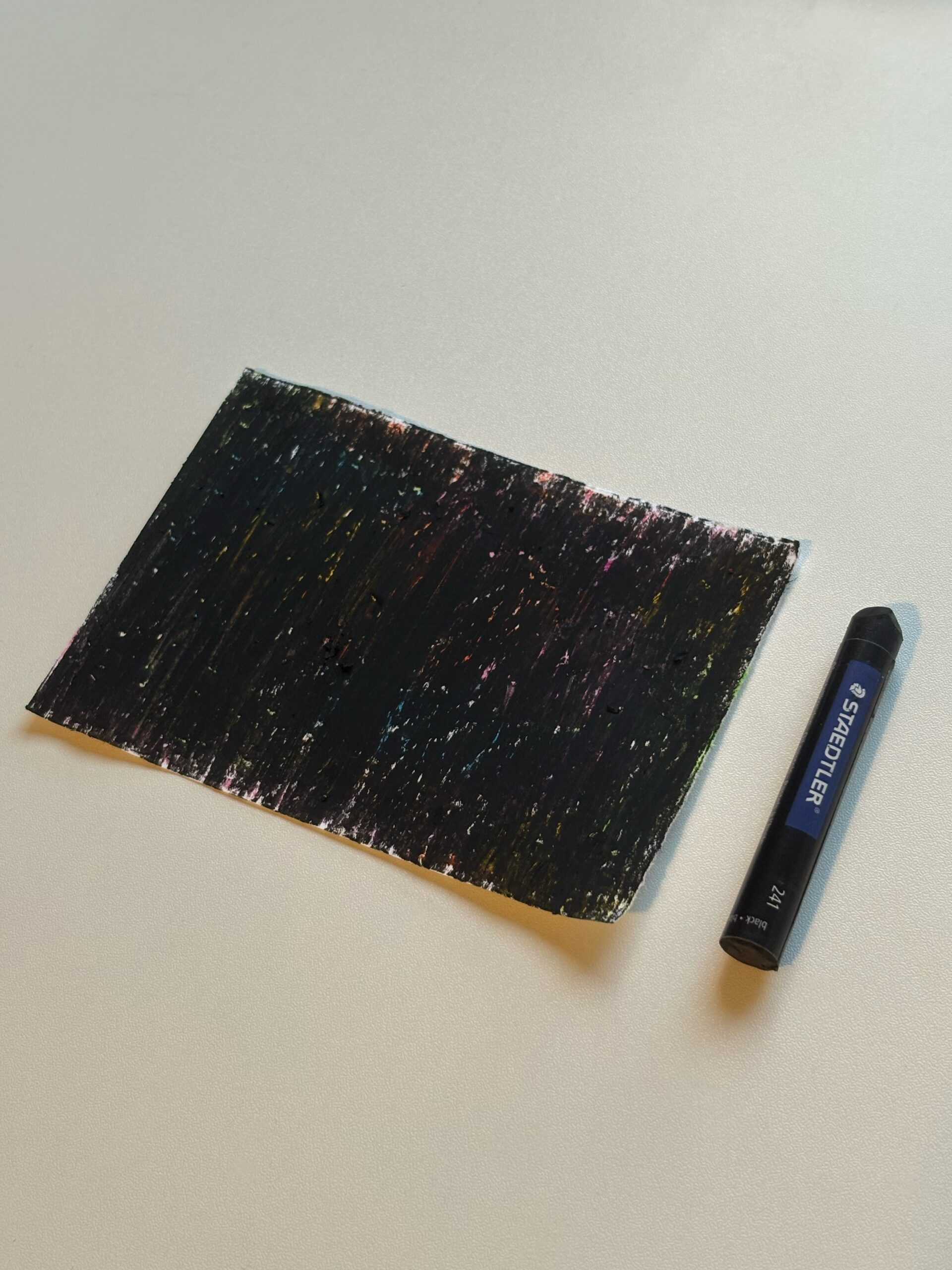
Use a black oil pastel to paint the entire paper, lightly covering all the marks you just made.
-
During this process you can release as much as you want and feel the precipitation of this emotion.
💡💡💡
Note: This step may stain the table. You can choose to place a tablecloth or larger paper under the work, but this is not necessary.
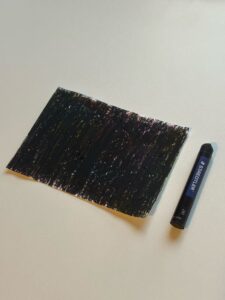
Step 3 example © 2025 by Ruohan Hao is licensed under CC BY-NC-SA 4.0
Step 4 (5 minutes)
-
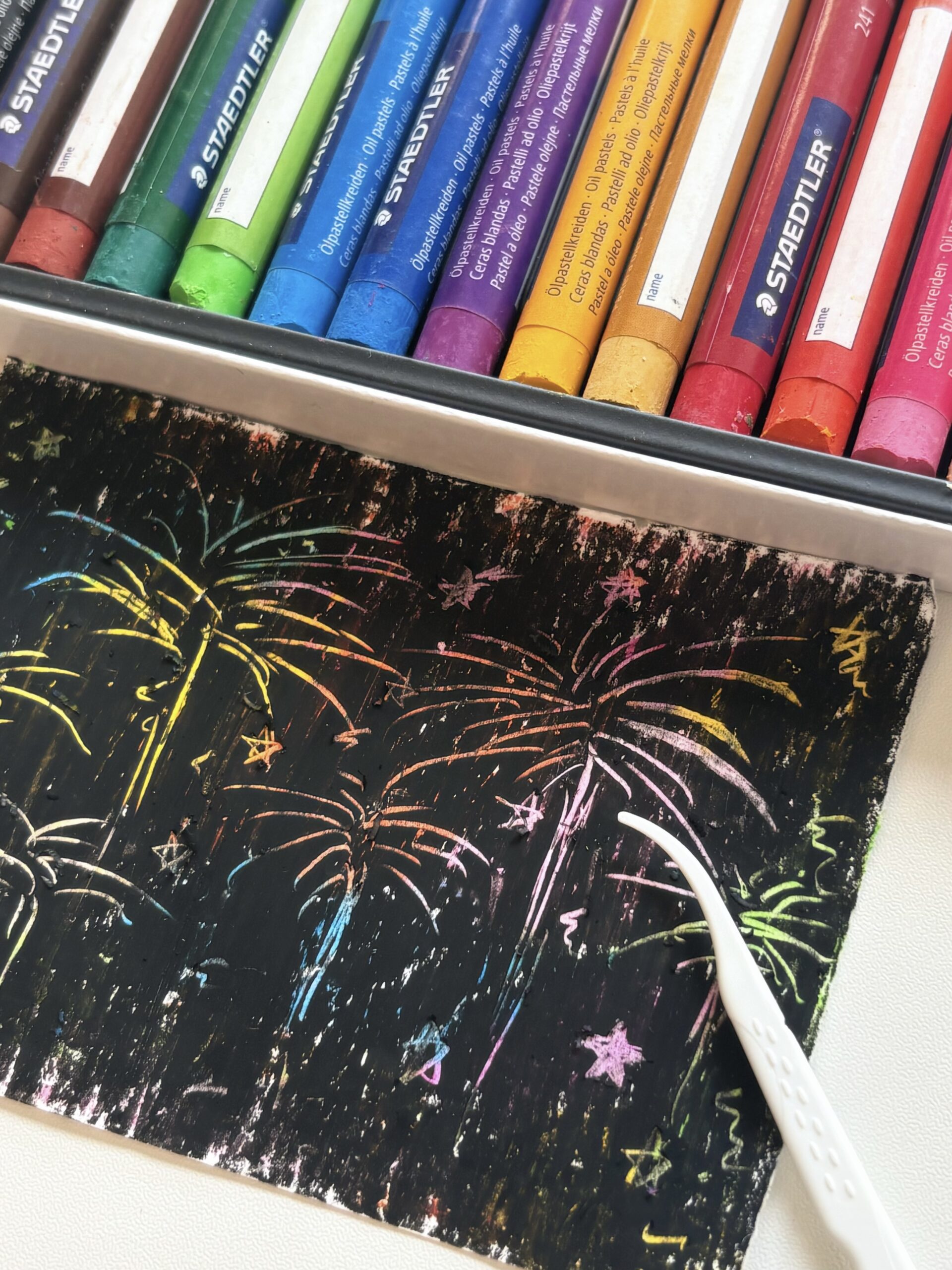
Use a floss pick to scratch out the desired lines or pattern on the piece.
-
At the same time, observe the resurfacing of the underlying colors and experience a variety of colors and images full of surprises.
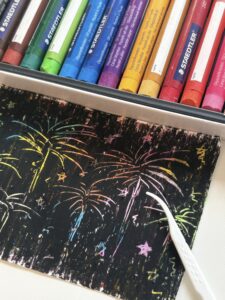
Step 4 example © 2025 by Ruohan Hao is licensed under CC BY-NC-SA 4.0
Step 5 (3 minutes)
-
Observe the final work and think about how the whole process makes you feel.
Reflective Questions💭
-
During the creative process just now, was there a moment when you felt even a little more relaxed?
-
Do you think the colors, shapes, or lines you used in your work were expressing something?
-
Did this creation help you realize that you might be stronger than you thought?
-
Have you found a new perspective on the thing that was making you feel anxious?
Finally, you can keep the final artwork, and you can place it anywhere as a symbol of your victory over anxiety.
Bibliography
Anxiety UK. “About Anxiety.” Anxiety UK, 2024. https://www.anxietyuk.org.uk/get-help/about-anxiety-and-anxiety-disorders/.
Gilad, Efrat, Ran Gilad-Bachrach, Daniel McDuff, and Mary Czerwinski. “Scribbling Intervention for Depression, Anxiety and Stress.” Microsoft Research, May 6, 2017. https://www.microsoft.com/en-us/research/publication/scribbling-intervention-depression-anxiety-stress/.
Kaimal, Girija, Kendra Ray, and Juan Muniz. “Reduction of Cortisol Levels and Participants’ Responses Following Art Making.” Art Therapy 33, no. 2 (May 23, 2016): 74–80. https://doi.org/10.1080/07421656.2016.1166832.
Lee, Alyssa Wan-Chei, Rahim Hirani, Jonathan Ogulnick, Raj K Tiwari, and Mill Etienne. “Emerging Therapies for Neurological Disorders: A Clinical Review of MANAGED (Music, Art, Nature-Based, Animal-Assisted, Game, Essential Oil, Dance) Care.” NeuroSci 6, no. 2 (June 4, 2025): 51–51. https://doi.org/10.3390/neurosci6020051.
Priasmoro, Dian Pitaloka, Yuni Asri, and Rifzul Maulina. “Exploring 4-7-8 Breathing for Stress Relief and Improved Quality of Life in Chronic and Degenerative Diseases: A Scoping Review.” Proceeding of the International Conference of Inovation Science Technology Education Children and Health 5, no. 1 (June 30, 2025): 209–17. https://doi.org/10.62951/icistech.v5i1.190.
Surana, Komal, and Paramita Datta. “Canvas of Calm: A Pilot Study on Art‐Based Interventions for Academic Stress Management in Higher Education.” Counselling and Psychotherapy Research 25, no. 1 (February 18, 2025). https://doi.org/10.1002/capr.12904.
Covering and Revealing of Color: Finding Calmness in Art Practice © 2025 by Ruohan Hao is licensed under CC BY-NC-SA 4.0
(Covering and Revealing of Color: Finding Calmness in Art Practice © 2025 by Ruohan Hao is licensed under CC BY-NC-SA 4.0)