Any views expressed within media held on this service are those of the contributors, should not be taken as approved or endorsed by the University, and do not necessarily reflect the views of the University in respect of any particular issue.

Collaborating in Digital Education for Educational Sustainability in Ghana

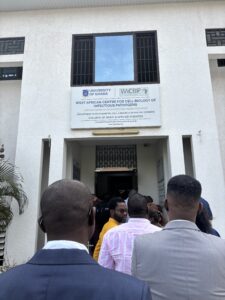
In April, CEID Research Group member Michael Gallagher travelled with his peers at the Centre for Research in Digital Education (CRDE) Alice Dias Lopes and Pete Evans to Accra, Ghana for the Mastercard Foundation African Scholars Programme Summer School which lasted the better part of a week. The events in this busy week spoke to the growing relationships between the attending universities (primarily the University of Ghana, the University of Edinburgh, and the University of Witswatersrand) around the role that digital technology has played and will continue to play in educational development in Ghana and throughout the African continent.  

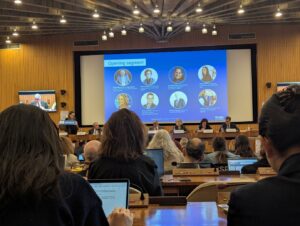
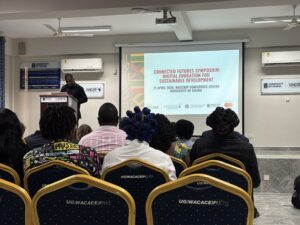
During this week, there was a one-day symposium at the University of Ghana emphasising the role that digital education plays in educational sustainability titled Connected Futures: Digital Education for Sustainable Development. Our own MSc in Digital Education student and current Visiting Scholar at the Centre for Research in Digital Education (and former Director General of the Ghana Education Service (GES) at the Ministry of Education) Dr Eric Nkansah gave the opening keynote on the role that digital education must play in realising sustainability on the African continent.  

The relationship with the Ministry of Education in Ghana, the University of Ghana, and the University of Edinburgh is an important in many different, mutually beneficial ways. Ghana has been and remains a leading light in Pan-Africanism, a movement towards the solidarity of all African nations and diaspora groups, the defense of local autonomy, and the overall decolonisation of Africa (Nugha, 2021). Ghana has not shied away from finding educational models that support their significant intellectual and cultural traditions (and in turn, Pan-Africanism).  
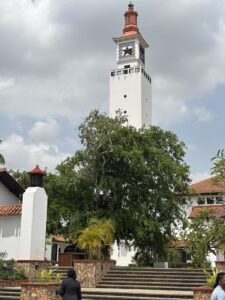
At GES and at the Centre for National Distance Learning and Open Schooling (CENDLOS) at the MoE, they have crafted confident and decidedly Ghanaian approaches to the use of digital technology in education, rather than merely bending to the tropes of seeing digital technology merely as instruments of standardisation and homogenisation, and subsequently to import them wholesale. Ghana doesn’t do this. It has invested in its digital infrastructure, an investment that shows no signs of abating (and which Dr Nkansah is looking to explore in research on innovative educational financing models). The MoE has created and distributed its own educational technology (iBox and iCampus are two examples), and its own open university frameworks. It is using this activity not only for maintaining the diverse knowledge traditions present in Ghana but potentially using them to inform further ‘open futures’ (Adeyeye and Mason, 2020) unbound by the discursive closure of much digital education development.  

Our collaborations at CEID and CRDE with the MoE of Ghana and the University of Ghana are mutually beneficial ones as we learn from these Ghanaian experiences and the candour of our colleagues, see how individual countries can confidently navigate these decidedly uneven digital terrains, and chart a more open future for themselves.  

If interested in learning more, consider the following: 

1.       Adeyeye, B. A., & Mason, J. (2020). Opening futures for Nigerian Education-integrating educational technologies with indigenous knowledge and practices. Open Praxis, 12(1), 27-37. https://search.informit.org/doi/10.3316/informit.219235558450433  

2.       Gallagher, M., Evans, P., & Sarpong-Duah, J. (2024). Radiating out rather than scaling up: Horizontalism and digital educational governance in Ghana. International Journal of Educational Development, 111, 103168. https://doi.org/10.1016/j.ijedudev.2024.103168  

3.       Royston, R. (2025). Pan-African Futurism: Ghana and the Paradox of Technology for Development. University of California Press. https://www.ucpress.edu/books/pan-african-futurism/paper  

4.       Nugha, T. P. (2021). Nkrumah’s pan-Africanism: a proposal for African integration. International Journal of New Economics and Social Sciences IJONESS, 14(2), 197-210. 
CEID Featured Alumni: Niamh Ní Iceadha

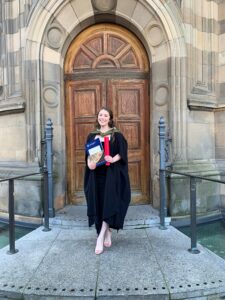
Niamh Ní Iceadha, CEID Class of 2023
Nationality: Irish
Current Position:
Education Coordinator, Global Action Plan Ireland.
Project Manager, Ballymun is Brilliant Project

My current position is a very varied one, which is one of the reasons I love it.  I started with Global Action Plan, an environmental education charity based in Dublin, exactly one month after I finished my Masters in Edinburgh.

I began as an education  officer, mainly focused on running environmentally focused workshops in schools and for community groups and businesses.

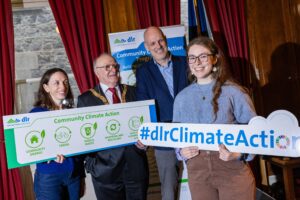
For the past two years I have also been the project manager for Ballymun is Brilliant, a creative climate arts project that aims to engage the community of Ballymun ( a disadvantaged inner city community in Dublin) in issues of climate change through using creative approaches. This has been my dream project, as art is my main passion outside of work.

I am the type of person who enjoys lots of different types of tasks,  which also made this role perfect for me,  as it involved not only project management,  but also event planning, arts liaison, hiring, community work, admin, project evaluation, social media and running arts workshops.  I have also had the opportunity to create 3  community murals. It’s lucky that I like to be busy!

CEID was an absolutely wonderful experience for me. Not only were the staff helpful, supportive, and actually interested in engaging with their students, feeling part of the CEID community was so unique and something that was constantly envied by my friends in other courses. I am lucky to have made lifelong friends and have visited and been visited by them multiple times in the past couple of years.

CEID supported me academically and socially and also provided good career development options, from our amazing class trip to London, to hosting panels, presenting at international conferences and, most importantly for me, the opportunity to complete a placement-based dissertation. I worked with the amazing team at Scotdec to complete my Master’s thesis. Seeing the inner workings of a small charity was valuable to me, as it reflects the experience of my current role.  I found the range of assignment options including debates, presentations, and posters, alongside traditional essays, were good preparation for the practical presentations I would create in my future career.

It was also great to have the opportunity to work on group projects with people who were as interested and passionate about the topics we covered as I was. I discovered that I loved to lead these projects, and am therefore excited to be starting a new job next month, as Project Lead of the Creative Places Project with Southside Partnership DLR. This is my dream role, focused on bringing the arts to communities who have little access to them.

I was extremely lucky when it came to finding a job after my Masters (I submitted my Master’s thesis, one hour later I had my second job interview for my current role and 10 minutes after that I got the phone call saying I had got the job!). It can be difficult to balance working on a thesis while searching for jobs,  but I am glad I took the time to do some job research during my thesis summer, as it meant I had a job straight after I finished the course. I found my post on a job mailing list and would recommend signing up to one.

The main challenge of working in the non-profit sector are the low pay options. Unfortunately, the most meaningful work is usually the lowest paid. My advice to students looking to start a career in the non-profit sector is to have a strong CV both academically and with extracurriculars.

My biggest piece of advice is to enjoy your time as a CEID student. My Master’s in Edinburgh was one of the most magical periods of my life and if I could redo it tomorrow I would.

For more alumni posts

CEID Alumni Contribute to UNESCO’s Global Education Monitoring Report

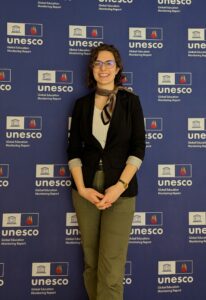
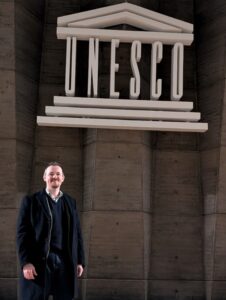
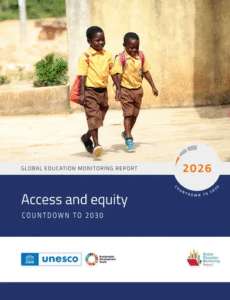
With UNESCO’s 2026 version of its flagship Global Education Monitoring (GEM) Report launched this week, we took a moment to connect with CEID Alumni Michael Cairney and Emily Goldstein who have been contributing behind the scenes. As the inaugural Moray House-GEM Report interns Michael and Emily are near the completion of their six month internships with the GEM Report. We asked them each five questions about their experience at the GEM Report, UNESCO, and in Paris!

What have been your overall responsibilities or activities with the GEM Report?

EG: As an intern, I have been fully integrated into the GEM team, carrying out the same research and advocacy activities as staff members. The team has put a lot of trust in us to independently deliver rigorous inputs while also providing support and mentorship where needed.

MC: I’ve been mostly working with the Profiles Enhancing Education Reviews (PEER) which is a massive database containing profiles on every single country, which underpins the findings of the report. It’s a marvellous research resource and updating it is a mammoth undertaking. Working on the profiles involves a lot of research and communication with local experts.

How have you contributed to the 2026 GEM Report?

EG: One of the most exciting projects I’ve contributed to the 2026 GEM Report was drafting a country case study evaluating contextual factors that affected education completion. I have also interviewed students, parents, and activists all over the world to provide stories that emphasize the human impact of education policies. The majority of my time has been spent developing PEER profiles, documenting equity measures in education finance systems and verifying data used for analysis.

MC: I’ve written profiles, contributed some paragraphs for the report and DJed for the Christmas party. I’ve also spent a lot of time puzzling out anomalies on spreadsheets.

What has been the most illuminating or surprising part of your work at the GEM Report?

EG: The UNESCO name goes a long way in opening doors. Whether interviewing a mother of a student with disabilities for a research profile or networking with experts in the development field, it’s amazing how many people are willing to share their time and perspectives with you when you’re working with UNESCO. Being part of the organization has also provided access to a plethora of events and learning materials.


MC: I had no idea it would be so close to the centre of Paris! A view of the Eiffel tower from the window! The building itself is a mid-century modern classic. It was also great to be given so much responsibility early on.


What are the other benefits you’d enjoyed as part of your internship experience?

EG: It’s been an immense learning opportunity to peek behind the scenes and see the real processes of data analysis and reporting at an international institution that we studied in CEID. Statistics and country comparisons take on a whole different meaning when you see how they are made, and there’s no better way to learn than jumping into the fray.

MC: Being at UNESCO is a great way to see how these international systems operate. I attended a Global Citizenship Education awards ceremony and learned vastly more from a few chats than I could from looking at the website. There’s nothing like human connection.

Anything else you’d like to add?

EG: I would be remiss if I didn’t mention another outstanding benefit which is access to all of the delectable pastries of Paris.

MC: Big thanks to the Korean delegation for the cookery lesson!


css.php

Report this page

To report inappropriate content on this page, please use the form below. Upon receiving your report, we will be in touch as per the Take Down Policy of the service.

Please note that personal data collected through this form is used and stored for the purposes of processing this report and communication with you.

If you are unable to report a concern about content via this form please contact the Service Owner.

Please enter an email address you wish to be contacted on. Please describe the unacceptable content in sufficient detail to allow us to locate it, and why you consider it to be unacceptable.
By submitting this report, you accept that it is accurate and that fraudulent or nuisance complaints may result in action by the University.

  Cancel